Morning Report: Existing home sales disappoint, but internals are better

Vital Statistics:


Last Change
S&P futures 2999 -8.5
Oil (WTI) 56.94 0.14
10 year government bond yield 2.05%
30 year fixed rate mortgage 4.06%


Stocks are lower this morning as earnings continue to come in. Bonds and MBS are flat.


Today is a big day for earnings, with numbers coming out for Ford, Boeing, Caterpillar, Facebook, and Tesla.


House prices rose 0.1% in May, according to the FHFA House Price Index. They were up 5% on a YOY basis. Home price appreciation has been decelerating across the board, but it is most pronounced in the Pacific and Mountain regions.


FHFA regional


Mortgage Applications fell by 2% last week as purchases and refis fell by the same amount. This was despite a 4 basis point drop in rates.


Existing Home Sales fell 1.7% in June, according to NAR. “Home sales are running at a pace similar to 2015 levels – even with exceptionally low mortgage rates, a record number of jobs and a record high net worth in the country,” said Lawrence Yun, NAR’s chief economist. Yun says the nation is in the midst of a housing shortage and much more inventory is needed. “Imbalance persists for mid-to-lower priced homes with solid demand and insufficient supply, which is consequently pushing up home prices,” he said.


Inventory was 1.93 million units, which represents a 4.4 month supply. Historically a balanced market had 6 – 6.5 months’ worth of supply. As Yun notes above, there is a big mismatch in inventory, with a complete dearth of properties at the low / mid price points. McMansions abound, however. Despite these issues, the first time homebuyer accounted for 35% of sales in June, which is approaching the historical norm of 40%. The first time homebuyer had been largely MIA for most of the post-crisis timeframe, accounting for 30% of sales (or even less). On the flip side, investors (represented by all cash sales) fell to 10%. With home price appreciation leveling out, we may start to see some funds who raised capital for the REO-to-Rental trade in the aftermath of the crisis ring the register and sell some of these properties as the funds wind down. Certainly cap rates are not what they were 10 years ago.


The median home price reached an all-time high of 285,700. Sentier Research has the median income at $63,400 as of May 2019. This puts the median house price to median income rate at just about 4.5x. Historically this is a very high number, however it is important to note that interest rates will influence this number. If you look at other metrics besides incomes and prices, homes are not that expensive on a historical basis.


Morning Report: John Williams moves markets

Vital Statistics:


Last Change
S&P futures 3003 6.5
Oil (WTI) 55.74 0.54
10 year government bond yield 2.05%
30 year fixed rate mortgage 4.08%


Stocks are up this morning after Mr. Softee beat earnings estimates. Bonds and MBS are up small.


Signs of a recession? Not really. The Conference Board’s Index of Leading Economic Indicators was flat at -.3% in June, while the markets were expecting an uptick. “The US LEI fell in June, the first decline since last December, primarily driven by weaknesses in new orders for manufacturing, housing permits, and unemployment insurance claims,” said Ataman Ozyildirim, Senior Director of Economic Research at The Conference Board. “For the first time since late 2007, the yield spread made a small negative contribution. As the US economy enters its eleventh year of expansion, the longest in US history, the LEI suggests growth is likely to remain slow in the second half of the year.”


New York Fed Head John Williams sent bond yields lower yesterday when his prepared remarks to an academic conference were released. They said: “Take swift action when faced with adverse economic conditions” and “keep interest rates lower for longer” when you do cut rates.” The markets immediately took this as an endorsement for a 50 basis point cut when the Fed meets next week. A spokesman from the NY Fed clarified that comment later, saying that he was referring to studies based on 20 years of monetary policy and was not referring to the FOMC meeting next week. A cut next week is pretty much expected, and the only question is whether it will be 25 or 50 basis points.


After Williams’ comments, the Fed Funds futures actually started handicapping a 70% chance for a 50 basis point cut and only a 30% chance of a 25 basis point cut. They had previously been forecasting a 25% chance for a 50 basis point cut. They ended up settling on 40% chance. There is some more Fed-speak today, and then they will enter the quiet period ahead of next week’s meeting.


FHFA Director Mark Calabria says the Trump Administration should be releasing a plan to deal with Fannie and Freddie sometime in August or September.

Morning Report: Foreign investment in US real estate falls again

Vital Statistics:


Last Change
S&P futures 2984 -0.5
Oil (WTI) 57.04 0.24
10 year government bond yield 2.07%
30 year fixed rate mortgage 4.09%


Stocks are flattish after erstwhile market darling Netflix stunk up the joint with lousy earnings. Bonds and MBS are up small.


Initial Jobless Claims were flat at around 219k last week.


Negotiations continue over spending and the debt ceiling, which will probably be hit in September. Treasury Secretary Steve Mnuchin cited “progress” in negotiations, and there is general agreement on the “top line” which includes spending increases from the previous year. That said, Republicans want some spending cuts elsewhere to offset the increase, and Democrats are against cuts. We’ll see if this goes to the mat (and another shutdown), but in the end, we’ll probably just raise the ceiling again and things will go on their merry way. Remember the last time we had a long shutdown, lenders were unable to get tax transcripts out of the IRS so it is something to keep in mind.


The Fed’s Beige Book of economic activity showed that the economy continued to expand at a “modest” pace, with slightly higher sales and flat manufacturing. Employment grew at a modest pace, and appears to be decelerating somewhat, especially as the slack in the labor market gets taken up. The Boston Fed noted that tariffs are having a negative effect, and at least one company is moving some production overseas to escape them. The proposed 5% tariff on Mexican goods was mentioned as a significant shock.


Canary in the coal mine for international asset markets, particularly China? International buyers of US residential real estate fell by 36% over the past year, following a 20% decrease in the prior year. China has been dealing with a real estate bubble for years, and prices are way out of whack compared to incomes – you can see just how bad it is here. This may explain some of the emerging weakness at the high end, especially in the big West Coast markets like San Francisco, Vancouver, and Seattle. The first step in any bursting bubble is a “buyer’s strike,” followed by rising inventory, and then finally a market-clearing event. We may be at the first stage right now.


Macroeconomically, a downturn in China means several things. First, they are going to try and export their way out of it, which means more trade tensions especially if they go the currency devaluation route. Second, it will mean a global growth slowdown, which will act as an anchor on global interest rates. Don’t worry about inflation, the world is awash in capacity. Finally, it could mean a return to a time like the 1990s, where the US was able to have its cake and eat it too, with fast growth but little to no inflation. I wonder if the Fed sees the same thing (after all central bankers do coordinate policy somewhat) and that is part of the reason why they are planning on easing when there is absolutely zero evidence the US is entering a recession.

Morning Report: Housing starts disappoint again

Vital Statistics:


Last Change
S&P futures 3009 0.35
Oil (WTI) 59.54 -0.07
10 year government bond yield 2.09%
30 year fixed rate mortgage 4.12%


Stocks are flat as bank earnings continue to come in. Bonds and MBS are up.


Another month, another disappointing housing starts number. Starts fell from an annualized pace of 1.3 million to 1.22 million in June, according to Census. Building permits were a mixed bag, falling to 1.25 million, however May’s numbers were revised upwards. Both starts and permits were below street expectations.


Despite the disappointing housing starts number, builder confidence rose one point to 65 in July. Demand remains strong, however labor shortages, few buildable lots and rising construction costs are making it difficult to build at the lower price points, where the demand is particularly acute.


Mortgage applications fell 1.1% last week as purchases fell by 3.8% and refis rose 1.5%. Rates increased, with the 30 year fixed rate mortgage rising by 8 basis points to 4.12%.  “Mortgage rates increased across the board, with the 30-year fixed rate mortgage rising to its highest level in a month to 4.12 percent, which is still below this year’s average of 4.45 percent,” said Joel Kan, MBA Associate Vice President of Economic and Industry Forecasting. “Coming out of the July 4 holiday, applications were lower overall, with purchase activity slipping almost 4 percent. Refinance applications increased, with activity reaching its highest level in a month, driven mainly by FHA refinance applications. Historically, government refinance activity lags slightly in response to rate changes.”


Bank of America reported strong earnings this morning. Mortgage origination volume was up 56% YOY to $18.2 billion.  Separately, Quicken announced they originated $32 billion in the second quarter.


Second quarter growth in China fell to 6.2%, the lowest level in 27 years. The implications for this will revolve primarily around inflation and Fed policy. The Chinese economy has a real estate bubble of epic proportions, and once that bursts it will have ramifications in the urban high-end market, but it will also be felt in lower inflation numbers. China will probably try and export its way out of the slowdown, although tariffs will make it difficult. That said, a slowdown in emerging Asia and Europe will usher in even lower interest rates.


Morning Report: Retail Sales strong

Vital Statistics:


Last Change
S&P futures 3019 5.35
Oil (WTI) 59.54 -0.07
10 year government bond yield 2.13%
30 year fixed rate mortgage 4.10%


Stocks are flattish as earnings season kicks off. Bonds and MBS are down.


June Retail Sales came in much higher than expectations. The headline number was up 0.4% MOM and 3.4% YOY. The control group, which excludes volatile products like autos, gas, and food was up 0.7%, well above the 0.3% Street estimate. May’s numbers were revised upwards as well. The upside surprise in retail sales pushed up the 10 year from 2.09% before the number to 2.13% after. Since consumption is such a big component of the economy, expect to see Q2 GDP estimates to be revised upwards.


Despite the strong retail sales numbers, the street is still handicapping a 25% chance of a 50 basis point cut and a 75% chance of a 25 basis point cut at the July FOMC meeting. I can’t believe we are talking about rate cuts when the economy is this strong, but here we are…


fed funds futures


In bank earnings, JP Morgan reported an increase in net income, but mortgage banking revenue was down 17% QOQ and YOY, driven by an unfavorable mark on the MSR portfolio. Volume increased 14% YOY to 24.5 billion. Wells also reported stronger earnings, with origination volume increasing to $33 billion. Margins fell from 105 basis points to 98, and it looks like they took a hit to their servicing portfolio as well.


Industrial Production was flat in June, driven by a drop in utility output. Manufacturing production was up 0.4%. Capacity Utilization increased as well, from 75.6% to 75.9%. So, despite all the concern about tariffs, we aren’t seeing it flow through to the numbers yet.


The FHA has been trying to figure out a way to bring more lenders back into the program after many exited in the aftermath of the housing crisis. The Obama administration aggressively fined lenders for minor errors which pushed banks largely out of FHA lending. The Trump Administration is changing enforcement policies and is working to bring more clarity to to the program. A number of trade groups however have argued that the reforms don’t go far enough, and don’t provide enough certainty to encourage banks to re-enter the business.


30 day delinquencies fell 0.7% YOY to 3.6%, according to CoreLogic. The only places that saw increases were due to hurricane-related issues. Flooding in the Midwest could boost these numbers in the future however. The foreclosure rate fell from 0.5% to 0.4% as well.

Morning Report: Negative yielding corporate debt

Vital Statistics:


Last Change
S&P futures 3020 5.35
Oil (WTI) 60.39 0.19
10 year government bond yield 2.11%
30 year fixed rate mortgage 4.13%


Stocks are higher as we kick off earnings season. Bonds and MBS are up.


The upcoming week will be dominated by bank earnings. The economic data is unlikely to be market-moving, however we will get some real-estate related data with housing starts and homebuilder sentiment. We will also get retail sales, industrial production and capacity utilization.


Citigroup reported earnings this morning that beat Street estimates. Mortgage banking revenues were down 2% QOQ and down 9% YOY.


Manufacturing activity in New York State rebounded last month, climbing out of negative territory. New Orders were flat, shipments improved, while employment hit the lowest level in 3 years.


Europe is used to negative yields on sovereign debt, with the German Bund yielding -29 basis points. In other words, you are paying 105.25 to get back 100 in 10 years, along with some interest. That is strange enough, in of itself, but how about this? Corporate bonds trading with negative yields. Don’t believe it? US jar maker Ball Corp, maker of the mason jar, trades at a yield of -20 basis points and matures in 18 months. Why would any investor buy that? Because the principal hit will be less than deposit rates of -40 basis points or 18 month German paper yielding -70 basis points. It is a fascinating study of the law of unintended consequences. The whole point of negative interest rates is to push investors to get out of safe haven sovereign debt and take some risk – specifically lending money to businesses that need it. The whole point of this exercise is to increase the amount of credit in the system in order to fuel economic growth. However, instead of providing financing to nascent businesses who could be the growth drivers of tomorrow, they are lending money to a company that makes jars (hardly emerging technology) instead.


A portfolio manager at Janus Capital explained it as follows: “A bond like Ball Corp’s is “a safe place to hang out,” [Janus Capital Portfolio Manager Tim] Winstone said. “And just because something is negative yielding, that doesn’t mean it can’t get more negative yielding.” In other words, we are in greater fool territory. Fun fact: around 2% of the European junk bond market trades at negative yields. In fact, Winstone says that about 24% of the European investment grade market trades at negative yields. It isn’t entirely irrational – money managers are making a bet on further central bank stimulus and are positioning themselves to reap capital gains on negative yielding paper, which means they could end up making a positive return despite a negative yield headwind.


euro corporates


John Maynard Keynes once advocated inflation as the “euthanasia of the rentier class.” In reality it may turn out that negative interest rates will do the job. Fascinating times we live in.

Morning Report: Jerome Powell discusses homebuilding

Vital Statistics:


Last Change
S&P futures 3009 6.5
Oil (WTI) 60.31 0.26
10 year government bond yield 2.14%
30 year fixed rate mortgage 4.11%


Stocks are higher this morning on no real news. Bonds and MBS are down.


Two Fed governors (Bostic and Barkin) pushed back on the need to cut rates to maintain the expansion yesterday. That might have explained the increase in the 10 year yesterday afternoon.


Inflation at the wholesale level rose 0.1% month over month and 2.3% YOY, according to the Producer Price Index. Ex-food and energy, it was flat MOM and up 2.1% YOY. Inflation remains comfortably stuck in a range around 2%.


Jerome Powell mentioned homebuilding in his Humphrey-Hawkins testimony yesterday. He blamed tariffs and labor shortages for the lack of building. That said, the underbuilding phenomenon didn’t just start in the last couple of years – housing starts have been at recessionary levels since 2008, and we have had an acute shortage of housing for at least 7 years. Something else is going on, although immigration restrictions and tariffs certainly don’t help matters. But that isn’t the explanation. When you look at new home sales divided by population, you can see just how much we have underbuilt:


new home sales divided by population


The CFPB has been upping its spending on consumer financial education. Democrats are complaining that it shifts the burden of consumer protection from the financial industry to consumers. That said, the enforcement budget has increased.


Jim Grant argues in the WSJ for a return to the gold standard.

Morning Report: Jerome Powell soothes the equity markets.

Vital Statistics:


Last Change
S&P futures 3002 6.5
Oil (WTI) 60.62 0.26
10 year government bond yield 2.08%
30 year fixed rate mortgage 4.08%


Stocks are higher this morning after Jerome Powell hinted strongly that the Fed would cut rates at the July meeting. The S&P 500 is at record levels and is flirting with the 3000 level. Bonds and MBS are down small.


Oil prices are rallying as tensions rise in the Strait of Hormuz. Iranian considers the Strait to be its territorial waters, and has been hassling warships going through the area for decades. The latest incident involves a British oil tanker. Persian Gulf tensions largely impact North Sea Brent prices more than West Texas Prices (which most of the US uses).


If the Fed is cutting rates, why aren’t yields going lower? Bond yields are higher across the board globally, with the German Bund yielding -26 basis points on hints that the ECB could launch further stimulus plans. The Bund yielded -38 bp last week, so perhaps US bond yields are simply following what international bonds are doing. Don’t forget, the last time the Fed Funds rate was in the 150 – 175 basis point range (May of 2018) the 10 year was about 2.9%. So, the Fed could cut rates 75 bp by the end of the year and we could see yields go nowhere. Look at the chart below, which plots the 10 year bond yield versus the Fed Funds rate:


10 year vs Fed Funds rate


Initial Jobless Claims came in at 209k last week, which was a touch below expectations. Regardless, the last time we were at similar levels was during the Vietnam War when we had a military draft.


Consumer prices rose 0.1% in June, according to the Consumer Price Index. The core CPI, which excludes food and energy rose 0.3%. On a YOY basis, the headline number rose 1.6% and the core index rose 2.1%. That said, the Fed prefers to use the PCE index, which shows inflation to be lower. The CPI overweights housing compared to the PCE, which is why it shows higher levels.


Jerome Powell’s Humphrey-Hawkins testimony dominated the headlines, but the FOMC minutes also confirmed his outlook.

Participants judged that uncertainties and downside risks surrounding the economic outlook had increased significantly over recent weeks. While they continued to view
a sustained expansion of economic activity, strong labor market conditions, and inflation near the Committee’s symmetric 2 percent objective as the most likely outcomes, many participants attached significant odds to scenarios with less favorable outcomes. Moreover, nearly all participants in their submissions to the Summary of Economic Projections (SEP), had revised down their assessment of the appropriate path of the federal funds rate over the projection period that would be consistent with their modal economic outlook.


Separately, Larry Kudlow emphasized that Trump has no plans to fire Powell. The Fed’s independence from politics makes it highly unlikely he could do so in the first place, however Jimmy Carter did do it to G William Miller, kicking him upstairs to Treasury and hiring Paul Volcker to run the Fed.


The first hurricane of the 2019 Atlantic season looks like it will hit Louisiana.

Morning Report: Bonds rally on Powell testimony

Vital Statistics:


Last Change
S&P futures 2975 -6.5
Oil (WTI) 59.12 1.26
10 year government bond yield 2.05%
30 year fixed rate mortgage 4.06%


Stocks are lower as we await Jerome Powell’s Humphrey-Hawkins testimony. Bonds and MBS are flat.


Bonds were initially lower this morning, with the 10-year touching 2.10%. They rallied back after Powell’s prepared remarks were released. Here is the paragraph that probably caused it:


In our June meeting statement, we indicated that, in light of increased uncertainties about the economic outlook and muted inflation pressures, we would closely monitor the implications of incoming information for the economic outlook and would act as appropriate to sustain the expansion. Many FOMC participants saw that the case for a somewhat more accommodative monetary policy had strengthened. Since then, based on incoming data and other developments, it appears that uncertainties around trade tensions and concerns about the strength of the global economy continue to weigh on the U.S. economic outlook. Inflation pressures remain muted.


Powell is scheduled to testify at 10:00 am. Note that we will also get the minutes from the June meeting at 2:00 pm today. Given how jittery the bond market is, we could see some volatility.


The Fed Funds futures turned slightly more dovish with the July futures predicting roughly a 80% of a 25 basis point cut and a 20% chance of a 50 basis point cut. The most likely outcome by the end of the year is a 75 basis point cut. December Fed Funds futures probabilities:


fed funds futures


Mortgage applications fell 2.4% last week as purchases rose 2.3% and refis fell 6.5%. The average contract rate on a 30 year fixed rate mortgage fell 3 basis points to 4.04%. There is some seasonal noise from the July 4 holiday baked into the numbers. Separately, the MBA’s Mortgage Credit Availability Index rose by 0.2% in June. Conventional credit expanded, while government credit contracted slightly. Jumbo credit is the easiest it has ever been, at least since the series started in 2011.


The House passed legislation yesterday which clarifies which VA loans are eligible to be included in Ginnie Mae Securitizations. They also passed a bill which would lower the mortgage insurance premiums for first-time homebuyers who complete a housing counseling course.


Morning Report: Small Business Optimism slips

Vital Statistics:


Last Change
S&P futures 2968 -10
Oil (WTI) 57.95 0.25
10 year government bond yield 2.06%
30 year fixed rate mortgage 4.03%


Stocks are lower this morning as we await a speech from Jerome Powell. Bonds and MBS are down.


Jerome Powell speaks at 8:45 this morning at the Boston Fed regarding stress-testing for the banks. Here are his prepared remarks. He doesn’t address monetary policy.


There were 7.3 million job openings in May, down slightly from April. The quits rate, which tends to lead increases in wages, was steady at 2.3%, where it has been all year. Private sector openings were flat, while government fell by about 40,000.


Small Business Optimism slipped in June, according to the NFIB. This reversed May’s jump, however sentiment is still at historically high levels. Expectations eased for sales and profitability, and the outlook for capital expenditures weakened. The capital expenditure level was the lowest since May 2015. Employment also decreased, however most firms are still in hiring mode, with the availability of qualified labor the biggest issue.


NFIB


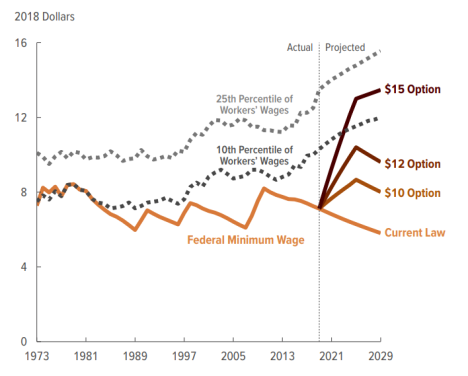
The Congressional Budget Office analyzed the probable effects of raising the Federal Minimum Wage to $15 an hour. Unsurprisingly, they concluded that it would cost jobs, with the median estimate coming in at 1.3 million. The graph below looks at how the constant dollar minimum wage has behaved relative to the bottom 10th and 25th percentile of workers over time.


minimum wage


Mortgage delinquencies are the lowest in 20 years, according to CoreLogic. 30 day DQs fell 0.7% to 3.6%, while the foreclosure rate slipped 0.1% to 0.4%. Delinquencies fell pretty much across the board, with the exception of areas that were affected by natural disasters.