Morning Report: Global sovereign yields fall after the UK Government reverses course

Vital Statistics:

 LastChange
S&P futures3,65967.75
Oil (WTI)86.490.88
10 year government bond yield 3.93%
30 year fixed rate mortgage 6.97%

Stocks are higher this morning as bank earnings reports continue to come in. Bonds and MBS are up.

Global sovereign bond yields are falling as the UK reversed its tax plan which weighed on Gilts and the UK pound. Yields on UK Gilts fell 43 basis points overnight, which is pushing down yields on Bunds and Treasuries. IMO this accounts for the rally in Treasuries today. Bottom line: The Bond Vigilantes are back, and they just won a battle.

The upcoming week won’t have much in the way of market-moving data. We will get some housing data, with housing starts, existing home sales and the NAHB Housing Market Index. We will also get the Index of Leading Economic Indicators and industrial production data. The stock market will be driven primarily by earnings.

One thing to keep in mind with bank earnings – we are seeing a big effect from provisions for credit losses. In early 2020, banks took humungous provisions for loan losses due to COVID. Those potential losses never materialized, and by this time in 2021 many banks were reversing these provisions, which has the effect of increasing earnings. In other words, last year’s bank earnings were artificially high, which is creating some strange year-over-year comparisons, especially as banks are beginning to provision for credit losses in anticipation of further slowdowns in the economy. My point is this: year-over-year earnings comparisons should have an asterisk next to them.

Despite all of the fears in the market, residential mortgage backed securities backed by non-QM loans have mirrored their agency counterparts, exhibiting low delinquency rates. As expected, prepay rates have fallen, although that is less of an issue for non-QM RMBS as it is for agency.

Money quote: “Although voluntary prepayment rates have recently fallen, the share of delinquent loans remains low, new delinquency rates are low, serious delinquency cure rates are muted, liquidations are infrequent, loss severity rates are low, and losses are near zero. That said, non-QM RMBS will continue to face growing uncertainties with respect to the near-term economic growth, unemployment rate, household incomes, and home prices. Even if the delinquency rates rise somewhat due to the slowing economy, DBRS Morningstar considers existing non-QM RMBS to have a meaningful cushion to withstand the headwinds, barring a sharp economic downturn coinciding with a sharp drop in home prices.”

IMO, strong performance from non-QM paper should go a long way towards bringing back the buy-side into the non-agency market.

Morning Report: Earnings season kicks off

Vital Statistics:

 LastChange
S&P futures3,70117.75
Oil (WTI)87.26-1.84
10 year government bond yield 3.86%
30 year fixed rate mortgage 6.98%

Stocks are higher this morning after yesterday’s dramatic turnaround. Bonds and MBS are up.

Yesterday’s turnaround was quite dramatic. The S&P 500 briefly broke below 3,500 on its way to a close around 3,670. The 10 year briefly touched 4.05% and this morning yields are back where they were before yesterday’s hot CPI print. The yield curve continues to invert, with 2s-10s now negative 53 basis points.

The strong CPI print from yesterday caused the December Fed Funds futures to price in another 25 basis points in tightening. Pre-report, the consensus was a 75 basis point hike in November and 50 in December. Now we are looking at 75 at both meetings.

JP Morgan reported better-than-expected earnings this morning as third quarter earnings season begins. Mortgage volume declined 45% on a quarter-over-quarter basis to $12.1 billion. A year ago, the company did $41.6 billion in originations in the third quarter, which means JPM’s volumes are down 70% YOY.

Overall revenues rose 7% QOQ and 10% YOY, while earnings per share increased 13% QOQ but fell 17% YOY. JPM is up about 2% pre-open.

Wells reported weaker-than-expected numbers, however there are some special items (litigation expense) that are making comparisons difficult. Q3 mortgage origination volume came in at $21.5 billion, which was down 37% QOQ and 59% YOY.

Despite the miss, Wells is up 5% pre-open.

Retail sales were flat in September, according to the Census Bureau. These numbers are not adjusted for inflation. On a year-over-year basis they rose 8.2%, which more or less matches yesterday’s CPI report.

Consumer sentiment improved in October, according to the University of Michigan Consumer Sentiment Survey. Unfortunately, expectations for the year-ahead inflation rate rose to 5.1%. The Fed pays close attention to this number, so this will encourage the Fed to keep pumping the brakes.

Morning Report: The CPI comes in hotter than expected

Vital Statistics:

 LastChange
S&P futures3,511-77.75
Oil (WTI)86.78-0.54
10 year government bond yield 4.03%
30 year fixed rate mortgage 6.94%

Stocks are lower this morning after the consumer price index came in hotter than expected. Bonds and MBS are down.

The consumer price index rose 0.4% MOM and 8.2% YOY. Ex-food and energy, it rose 0.6% MOM and 6.6% YOY. Both numbers were higher than expected. Gasoline price declined, while food continued to rise. Shelter increased as well, and will continue to increase as it tends to lag home prices by about 18 months or so.

So far, we aren’t seeing anything that looks like deceleration in the core rate.

We will not get another CPI reading before the Fed meets in November. The FOMC meeting is November 1-2, so this is the number they will focus on, along with the PCE Index.

The Fed Funds futures are a lock for at least 75 basis points at the next meeting, and are beginning to handicap a 100 basis point hike as a possibility.

The FOMC minutes were released yesterday, and here is what they were saying about inflation:

Participants observed that inflation remained unacceptably high and well above the Committee’s longer-run goal of 2 percent. Participants commented that recent inflation data generally had come in above expectations and that, correspondingly, inflation was declining more slowly than they had previously been anticipating…. With respect to the medium term, participants judged that inflation pressures would gradually recede in coming years…

In assessing inflation expectations, participants noted that longer-term expectations appeared to remain well anchored, as reflected in a broad range of surveys of households, businesses, and forecasters as well as measures obtained from financial markets. Participants
remarked that the Committee’s affirmation of its strong commitment to its price-stability objective, together with its forceful policy actions, had likely helped keep longer run inflation expectations anchored…

Participants agreed that the uncertainty associated with their economic outlooks was high and that risks to their inflation outlook were weighted to the upside. Some participants noted rising labor tensions, a new round of global energy price increases, further disruptions in supply chains, and a larger-than-expected pass through of wage increases into price increases as potential shocks
that, if they materialized, could compound an already challenging inflation problem. A number of participants commented that a wage–price spiral had not yet developed but cited its possible emergence as a risk.

Anyone thinking the Fed is considering a pivot should be disabused of that thought from these comments. They noted that credit spreads were stable over the inter-meeting period and they think GDP growth will improve. In other words, they aren’t worried about a recession at all.

Morning Report: Home Purchase sentiment returns to 2011 lows.

Vital Statistics:

 LastChange
S&P futures3,61414.75
Oil (WTI)89.31-0.04
10 year government bond yield 3.96%
30 year fixed rate mortgage 6.89%

Stocks are higher after the NASDAQ officially hit a bear market. Bonds and MBS are down small.

Inflation at the wholesale level rose 0.4% MOM and 8.5% YOY, according to the Producer Price Index. Ex-food and energy, the index rose 0.3% MOM and 7.2% YOY. The headline number was a touch above expectations, although tomorrow’s Consumer Price Index report will be the main focus.

Mortgage applications hit a 25-year low last week, falling 2% as rates hit their highest mark since 2006. Purchases and refinances fell by the same amount. “Mortgage rates moved higher once again during the first week of the fourth quarter of 2022, with the 30-year conforming rate reaching 6.81 percent, the highest level since 2006,” said Mike Fratantoni, MBA Senior Vice President and Chief Economist. “Mortgage rates increased across all product types in MBA’s survey, with the largest, a 20-basis-point increase, for 5-year ARM loans. The ARM share of applications remained quite high at 11.7 percent – just below last week’s level. Application volumes for both refinancing and home purchases declined and continue to fall further behind last year’s record levels.”

The pain in the real estate sector isn’t only limited to mortgage bankers. Realtors, brokers, and appraisers are adjusting to the new glacial pace of home sales. “There’s going to be a major shakeout,” said Ken Johnson, a real estate economist at Florida Atlantic University who is also a former broker. “There are roughly 1.5mn realtors, but that number will be down 20 per cent within 24 months. And those aren’t the only members of the real estate industry that are very dependent on the volume of transactions. There are these tertiary jobs like the appraisers, the mortgage lenders, all the way down to termite inspectors.”

Much of this overcapacity came as a result of the hiring spree in response to the COVID pandemic. Home sales rose as people fled the cities, and mortgage bankers feasted on easy refinance opportunities. “That growth was much stronger than the home sales opportunities that were available,” said Lawrence Yun, the chief economist for the National Association of Realtors. “The reality is that not everyone’s going to survive.”

Homebuilder sentiment is approaching all-time lows, according to Fannie Mae’s Housing Sentiment Index. For the first time since the beginning of the pandemic, most respondents expect home prices to decline going forward.

“The HPSI declined this month to its lowest level since October 2011,” said Doug Duncan, Fannie Mae Senior Vice President and Chief Economist. “Consumers’ expectation that home prices will decrease matched a survey high, with a higher percentage of consumers believing home prices will decrease rather than increase over the next year – a shift in survey sentiment that had previously only happened in 2011 and at the start of the pandemic in 2020. Moreover, 75% of consumers still think it’s a bad time to buy a home, with most citing high home prices and unfavorable economic and mortgage rate conditions as primary reasons. As long as supply is limited and affordability pressures continue to constrain potential homebuyers via elevated home prices and mortgage rates, we expect home sales will remain sluggish.”

The hits keep coming. Angel Oak is laying off 15% of staff. “Angel Oak Home Loans, a full-service, retail residential mortgage lender, reduced its headcount by 57 employees or 15% of its workforce to better position itself as it manages through the headwinds currently facing the mortgage industry,” the spokesperson said. “Angel Oak Home Loans continues to serve home buyers across the country and maintains staffing levels to meet the changing dynamics of the residential mortgage market.”

Morning Report: Mortgage credit tightens again

Vital Statistics:

 LastChange
S&P futures3,6168.75
Oil (WTI)89.84-1.51
10 year government bond yield 3.93%
30 year fixed rate mortgage 6.81%

Stocks are lower as the UK continues to support its bond market and supply chain issues impact the chips market. Bonds and MBS are down.

The upcoming week has a lot of important data, especially with the consumer price index on Thursday. We will also get the FOMC minutes on Wednesday. We will also get the University of Michigan Consumer Sentiment data and retail sales on Friday.

Third quarter earnings season kicks off this week with the big banks all reporting late this week.

Small Business Optimism improved in September, according to the NFIB Small Business Optimism Index. Inflation remains the biggest problem, however fewer small business owners are raising prices. Jobs remain tough to fill, and expectations about the future declined.

The small business economy seems to be waiting for the other shoe to drop, as they expect that the economy will weaken as the rate hikes begin to impact the economy. We are looking at another 75 basis points in tightening at the November meeting, and the 225 in hikes since June will begin to have their effect in the coming months. As a general rule, monetary policy acts with a 6-9 month lag, so we are only beginning to feel the impact of these rate hikes. It will get worse before it gets better.

Mortgage credit continues to tighten and has fallen to a 9 year low, according to the MBA. Much of the impact is being felt at the low end of the credit spectrum. We continue to see lenders shrink their FHA footprint and take defensive measures ahead of a potential recession.

“With the likelihood of a weakening economy, which would lead to an increase in delinquencies, there was a smaller appetite for lower credit score and high LTV loan programs, along with a reduction in government streamline refinance programs,” said Joel Kan, MBA Associate Vice President of Economic and Industry Forecasting. “As mortgage rates have more than doubled over the past year, resulting in a drop in refinance activity, lenders have worked to reduce excess capacity and costs by eliminating underutilized loan programs. All the component indices declined last month, with most of the indices falling to their lowest levels in over a year. In particular, the government credit availability index has declined in seven of the last eight months to its lowest level since April 2013.”

Morning Report: Strong jobs report

Vital Statistics:

 LastChange
S&P futures3,7636.75
Oil (WTI)89.841.38
10 year government bond yield 3.86%
30 year fixed rate mortgage 6.74%

Stocks are higher this morning after the jobs report. Bonds and MBS are down.

The economy added 263,000 jobs in September, which was above the Street estimate of 250,000 and the ADP estimate of 208,000. The unemployment rate fell to 3.5% and average hourly earnings increased 5% The labor force participation rate fell to 62.3% as the labor force shrank.

Overall, this report won’t move the needle for the Fed either way. The reaction in the bond market was a slight sell-off, with a continued inversion of the yield. curve. The Fed Funds futures still see a 75 basis point hike in November, and another 50 in December. Looking into 2023, it looks like we are seeing another 25 basis points before the March 2023 meeting, and that is it. So we peak out at a range of 4.5% – 4.75%. This comports with what Chicago Fed President Charles Evans said yesterday.

Interestingly, the futures see the December 2023 rate at 4.25% – 4.5%, which means we begin an easing cycle in 2023. If this plays out, we will be looking at 450 basis points of tightening over a year-long period, which is an aggressive cycle historically.

In 1994, the Fed took up the target rate 275 basis points over the course of a year, which blew up the MBS market (and took out a bunch of mortgage arbitrage hedge funds). From 2003 through 2006, the Fed took up the Fed Funds rate by 400 basis points and blew up the residential real estate bubble. The Fed is banking hard on continued strength in the labor market to soften the blow here, which is comparable to the Volcker tightenings of the early 1980s.

Above is a chart of the Fed Funds rate historically. I extended the line to take into account the projected increases. As you can see, we have done a lot of tightening in a short period of time.

Pennymac was the first correspondent lender to reduce the its bets on the new conforming limits. They took down their levels from 715k to 700k, and it looks like everyone is following. The August FHFA Home Price index will come out on October 25, which will give us 11 out 12 index points. As of now, the new conforming limit would be 716k.

Credit Suisse has launched a buyback for some of its senior bonds. I am hearing that some correspondents won’t accept AOTs from them, so it looks like the Street might be backing away. If there is one thing that can stop a tightening cycle in its tracks, it is a financial contagion.

Morning Report: Cracks are forming in the labor market

Vital Statistics:

 LastChange
S&P futures3,778-15.75
Oil (WTI)87.620.12
10 year government bond yield 3.77%
30 year fixed rate mortgage 6.59%

Stocks are lower this morning on no real news. Bonds and MBS are flat.

OPEC is cutting production, which will drive up oil prices and make the Fed’s job harder. Some strategists are forecasting triple-digit oil prices as the cuts begin to bite. Supposedly the Administration is looking at releasing reserves from the Strategic Petroleum Reserve, but that will be a temporary band-aid at best. Look for consumer sentiment to turn even more negative as gas prices increase.

Home prices rose 4.2% QOQ and 14.8% YOY in August, according to the Clear Capital Home Data Index. This index is about a month ahead of other home price indices like Case-Shiller and FHFA.

Interestingly, we are seeing the biggest quarterly growth in the Northeast and the Midwest, which have been the laggards over this entire housing upturn. The Midwest makes sense in terms of remote work and low overall prices. The Northeast is strange in that it has lagged the rest of the country, but still has high overall prices.

Speaking of home prices, we are seeing some originators trim their forecasts for the new conforming loan limits. Generally speaking the big correspondents will begin to accept loans under the anticipated higher limits ahead of the formal FHFA announcement in December. This year, correspondents have started accepting loans up to $715k.

PennyMac just backed away from that number and reduced it to $700k and I am hearing more are doing the same.

US based employers announced almost 30,000 job cuts in September, which is up 68% compared to a year ago. “Some cracks are beginning to appear in the labor market. Hiring is slowing and downsizing events are beginning to occur,” said Andrew Challenger, Senior Vice President of Challenger, Gray & Christmas, Inc. “The cooling housing market and Fed’s rate hikes are leading to job cuts among mortgage staff at banks and lenders. The recession concerns are leading to increased uncertainty, and companies across sectors are beginning to reassess staffing needs,” said Challenger.

Hiring plans are also the lowest since 2011. Seasonal hiring for the holiday shopping season should be in full swing at this point, however retailers seem to be taking a wait-and-see approach. Bottom line, the Fed’s tightening is gaining traction.

Separately, initial jobless claims rose to 219,000 last week.

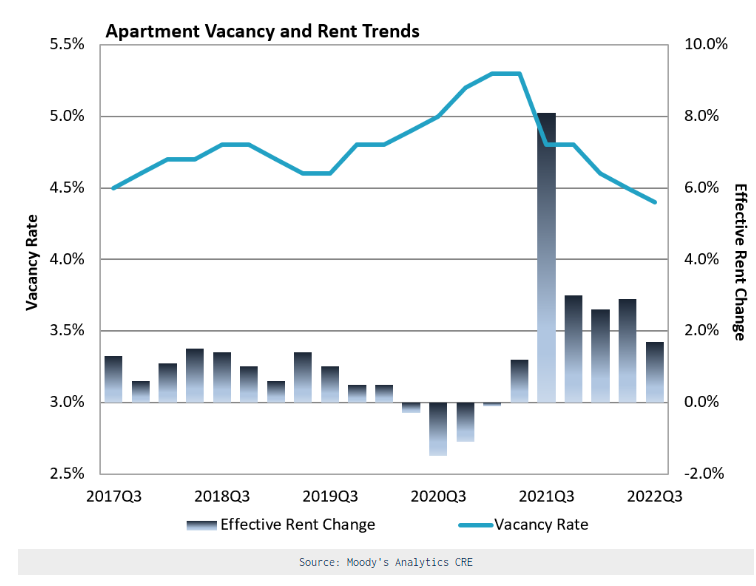
Apartment vacancy rates remain at multi-decade lows, however we continue to see deceleration in rental inflation. Given that rental inflation tends to lag housing inflation by about 21 months, I suspect we might see a re-acceleration in rent prices, especially since homebuilding has been so depressed.

Morning Report: The economy continues to add jobs

Vital Statistics:

 LastChange
S&P futures3,743-59.75
Oil (WTI)86.590.02
10 year government bond yield 3.77%
30 year fixed rate mortgage 6.59%

Stocks are lower as markets adopt a risk-off posture again. Bonds and MBS are down.

The economy added 208,000 jobs in September, according to the ADP Employment Report. Annual pay was up 7.8% on a YOY basis, which will concern the Fed. That said, the pay increase for job changers is beginning to decline. This would comport with the stagnant quits rate we saw in yesterday’s JOLTs report.

The report also noted that it looks like people are returning to the labor market. Demand remains strong from employers. Private employment recently returned to pre-pandemic levels.

The service economy expanded again in September, according to the ISM Services Index, albeit at a slower pace than August. Most of the sub-indices showed declines, although employers still struggle to find employees. The prices index declined as well, which is good news on the inflation front.

“According to the Services PMI®, 15 industries reported growth. The composite index indicated growth for the 28th consecutive month after a two-month contraction in April and May 2020. Growth continues — at a slightly slower rate — for the services sector, which has expanded for all but two of the last 152 months. The services sector had a slight pullback in growth for the month of September due to decreases in business activity and new orders. Employment improved and supplier deliveries slowed at a slightly slower rate. Based on comments from Business Survey Committee respondents, there have been improvements regarding supply chain efficiency, operating capacity and materials availability; however, performance remains less than ideal. Employment continued to improve despite the restricted labor market.”

Higher interest rates continue to depress the mortgage market. Applications fell 14% last week as purchases fell 13% and refinances fell 14.2%. On a YOY basis, purchases are down 37% and refis are down 86%.

“Mortgage rates continued to climb last week, causing another pullback in overall application activity, which dropped to its slowest pace since 1997. The 30-year fixed rate hit 6.75 percent last week – the highest rate since 2006,” said Joel Kan, MBA’s Associate Vice President of Economic and Industry Forecasting. “The current rate has more than doubled over the past year and has increased 130 basis points in the past seven weeks alone. The steep increase in rates continued to halt refinance activity and is also impacting purchase applications, which have fallen 37 percent behind last year’s pace. Additionally, the spreads between the conforming rate compared to jumbo loans widened again, and we saw the ARM share rise further to almost 12 percent of applications.”

Morning Report: Sentiment improves overnight

Vital Statistics:

 LastChange
S&P futures3,74757.75
Oil (WTI)85.351.72
10 year government bond yield 3.60%
30 year fixed rate mortgage 6.64%

Stocks are higher this morning as investors begin to anticipate the end of central bank tightening. Bonds and MBS are up.

Despite the rhetoric from central banks, investors are beginning to anticipate a pivot. Australia’s central bank surprised markets last night with a smaller-than-expected increase in its interest rate. No idea if this is another false dawn, but after a bloody end to Q3, any respite is welcome.

Job openings declined in August according to the JOLTs report. The quits rate was flat at 2.7%. This report is further evidence that the labor market is softening, however it doesn’t indicate weakness or anything like that. The labor market is still quite strong by historical standards.

Home prices dropped 0.98% in August, according to the Black Knight Mortgage Monitor. This is higher than the 0.6% decrease that showed up in the FHFA House Price Index.

“The Black Knight HPI for August marked the second consecutive month that prices pulled back at the national level, with the median home price now 2% off of its June peak,” said Graboske. “Only marginally better than July’s revised 1.05% monthly decline, home prices were down an additional 0.98% in August. Either one of them would have been the largest single-month price decline since January 2009 – together they represent two straight months of significant pullbacks after more than two years of record-breaking growth. The only months with materially higher single-month price declines than we’ve seen in July and August were in the winter of 2008, following the Lehman Brothers bankruptcy and subsequent financial crisis.

Again, for those thinking we are in for a replay of 2006-2008, we aren’t. We don’t have the financial stress that would create the forced selling that characterized the end of the bubble years. I would add, some decline in home prices is expected as part of normal seasonal variation.

The Atlanta Fed’s GDP Now Index now sees Q3 GDP coming in at a positive 2.3%. The personal incomes and outlays report from last week drove the increase.

Morning Report: Manufacturing continues to decelerate

Vital Statistics:

 LastChange
S&P futures3,63837.25
Oil (WTI)84.204.74
10 year government bond yield 3.70%
30 year fixed rate mortgage 6.72%

Stocks are higher this morning on no real news. Bonds and MBS are down.

There is a closed meeting of the Fed at 11:30 this morning. Supposedly about the discount rate, but it is odd. I am wondering if it concerns financial stress which has been triggered by Credit Suisse.

Credit Suisse’s stock has been hammered over the past few months as the bear market sets in and people worry about its credit risk. The CEO sent a memo over the weekend hoping to reassure employees, investors and counterparties over the bank’s risk. It doesn’t seem to have had the intended effect.

Credit Suisse and its issues are a long way away from the US mortgage market, however it is a good canary in the coal mine about overall financial stress. This is particularly important to non-QM lending, however it also can act as a yellow light for central banks. It is something to keep an eye on.

The week ahead will contain the jobs report, along with a slew of Fed-Speak. We will also get the ISM data and construction spending.

The manufacturing economy expanded in September, according to the ISM Manufacturing Index. That said, the expansion is the weakest since May of 2020. New Orders contracted, and employment plans seem to be getting put on hold. Prices are at the lowest level since June 2020.

“Manufacturing expanded for the 28th straight month. Panelists’ companies slowed hiring activity; month-over-month supplier delivery performance was the best since December 2019; prices growth slowed notably (with the index at 60 percent or lower) for the third consecutive month; and lead times continue to ease for capital equipment and production materials. Markedly absent from panelists’ comments was any large-scale mentioning of layoffs; this indicates companies are confident of near-term demand, so primary goals are managing medium-term head counts and supply chain inventories”

Construction spending fell 0.7% MOM but increased 8.5% YOY, according to the Census Bureau. Residential construction fell 1% MOM and is up 12.4% YOY.