Morning Report: Purchase Applications increase in New York

Vital Statistics:


Last Change
S&P futures 2853 3.1
Oil (WTI) 25.59 0.29
10 year government bond yield 0.67%
30 year fixed rate mortgage 3.36%


Stocks are flat this morning on no real news. Bonds and MBS are up.


Mortgage Applications rose 0.3% last week as purchases rose 11% and refis fell 3%. “There continues to be a stark recovery in purchase applications, as most large states saw increases in activity last week. In the ten largest states in MBA’s survey, New York – after a 9 percent gain two weeks ago – led the increases with a 14 percent jump. Illinois, Florida, Georgia, California and North Carolina also had double-digit increases last week,” said Joel Kan, MBA’s Associate Vice President of Economic and Industry Forecasting. “We expect this positive purchase trend to continue – at varying rates across the country – as states gradually loosen social distancing measures, and some of the pent-up demand for housing returns in what is typically the final weeks of the spring home buying season.” Interesting comments about New York. It looks like people are fleeing NYC after the COVID-19 issue, and why not? NYC is expensive as heck, and the main thing to recommend it is the easy commute if you work there and all the great bars and restaurants. With work at home now becoming mainstream, is it worth the expense and the risk?


Delinquencies ticked up in the first quarter after hitting a record low in the fourth, according to the MBA. “The mortgage delinquency rate in the fourth quarter of 2019 was at its lowest rate since MBA’s survey began in 1979. Fast-forward to the end of March, and it is clear the COVID-19 pandemic is impacting homeowners. Mortgage delinquencies jumped by 59 basis points – which is reminiscent of the hurricane-related, 64-basis-point increase seen in the third quarter of 2017,” said Marina Walsh, MBA’s Vice President of Industry Analysis. “The major variances from the fourth quarter of 2019 to this year’s first quarter are tied to the increase in early-stage delinquencies for all loan types. For example, the 30-day FHA delinquency rate rose by 113 basis points, the second-highest quarterly ramp-up in the survey series. The 30-day VA delinquency rate rose by 78 basis points – the highest quarterly increase.”


Wholesale prices fell in April, according to the PPI. The headline number was down 1.3% MOM and 1.2% YOY. Even ex-food and energy, trade services, etc, it was down on a YOY basis.


Jerome Powell warned of a prolonged recession after the Coronavirus issue get sorted out. He points out that this recession was not caused by a burst bubble or an inflationary spate which caused a tightening. “This downturn is different from those that came before it. Earlier in the post–World War II period, recessions were sometimes linked to a cycle of high inflation followed by Fed tightening. The lower inflation levels of recent decades have brought a series of long expansions, often accompanied by the buildup of imbalances over time— asset prices that reached unsupportable levels, for instance, or important sectors of the economy, such as housing, that boomed unsustainably. The current downturn is unique in that it is attributable to the virus and the steps taken to limit its fallout. This time, high inflation was not a problem. There was no economy-threatening bubble to pop and no unsustainable boom to bust. The virus is the cause, not the usual suspects—something worth keeping in mind as we respond.”  For this reason, I think the economic damage won’t be as bad as the media is hoping. I also think a prolonged period of social distancing is not in the cards either, people aren’t going to put up with that, not even in deep blue states like NY and CA.

Morning Report: Inflation falls

Vital Statistics:


Last Change
S&P futures 2928 3.1
Oil (WTI) 25.59 0.29
10 year government bond yield 0.71%
30 year fixed rate mortgage 3.36%


Stocks are higher this morning on no real news. Bonds and MBS are down.


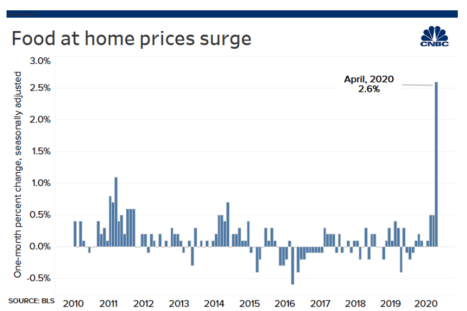
Inflation at the consumer level fell in April, which was the biggest drop since 2008. The headline index fell 0.8% MOM and rose 0.3% YOY. This was primarily due to energy and airline flights. Ex-food and energy it fell 0.4% MOM and rose 1.4% YOY. Energy was the dominant trend, however food prices increased due to supply chain issues.


food prices


Small business optimism fell in April according to the NFIB. “The impact from this pandemic, including government stay-at-home orders and mandated non-essential business closures has had a devasting impact on the small business economy,” said NFIB Chief Economist William Dunkelberg. “Owners are starting to benefit from the PPP and EIDL small business loan programs as they try to reopen and keep employees on staff. Small business owners need more flexibility, though, in using the PPP loan to support business operations and liability protection so that all these efforts to support small businesses are not ultimately lost in costly litigation.”


Homebuilders are beginning to offer incentives to entice buyers. FWIW, D.R. Horton noted in its first quarter earnings that it hasn’t had to resort to price cutting. For the most part, the builders went into the crisis without a ton of inventory, so we shouldn’t see big price drops.

Morning Report: What will be the shape of the recovery?

Vital Statistics:


Last Change
S&P futures 2900 -23.1
Oil (WTI) 24.79 0.29
10 year government bond yield 0.67%
30 year fixed rate mortgage 3.36%


Stocks are lower this morning on no real news. Bonds and MBS are flat.


About 80% of renters made a full or partial May payment as of May 6, according to the National Multifamily Housing Council’s Rent Tracker.  “Despite the fact that over twenty million people lost their jobs in April, for the second month in a row, we are seeing evidence that apartment renters who can pay rent are stepping up and doing so,” said Doug Bibby, NMHC President. “We expect May to largely mirror April, when the payment rate increased throughout the month as financial assistance worked its way to people’s bank accounts.” Meanwhile, New York extended its eviction moratorium until August. Note that rent strikes are a thing now.


Matt Taibbi discusses the mortgage servicers. The balloon payment issue is a hot button one for the left, and they are sounding the alarm. Basically Taibbi interviewed all the usual consumer advocate types on the left – guys like Richard Cordray, analysts at liberal think tanks and advocacy groups, and take the servicers to task for not having 4 months of advances laying around.

Should the Fed open its war chest and create a “liquidity facility” to help mortgage servicers? It seemed like the obvious move — this really was a problem caused by a bailout that encouraged even people who didn’t need forbearance to accept it — but how could this be done in a way that didn’t put homeowners at more risk?

“This is the script of a heist flick, where homeowners get screwed in the end while servicers get the money,” says Carter Dougherty of Americans for Financial Reform. “If you combine money for servicers with strong consumer protections and a vigorous regulator, then the film could have a happy ending. But I’m not holding my breath.”

That said, this unfortunately IS what the industry is up against, and a good indicator of how the regulators (at least on the left) view the industry. It is why getting some sort of liquidity facility for the servicers might be harder than it looks. Which is pretty sad when the Fed is considering buying corporate junk bonds to stabilize the economy.


More economic forecasters are predicting a “swoosh” style recovery. “This is not going to be a quick recovery,” said Mark Schneider, chief executive officer of Nestlé SA, the world’s biggest packaged foods maker, recently. “This is going to be a several-quarter, if not several-year kind of process.”

recoveries

For what its worth, I am somewhat skeptical of the long, drawn out recovery argument. Most recessions in the past started for a reason – a long expansion encouraged a buildup of inventory, or asset bubbles. Once the economy slows down the problems that have been building become apparent. That isn’t what happened this time around. We didn’t have a slowdown driven by organic issues in the economy. We had a government-engineered crash. Sure, there were pockets of the economy like retail which were weak to begin with, but for the most part the economy was super healthy going into the COVID Crisis. I think comparing this to the Great Depression or the Great Recession has to be done carefully. Both were driven by rotten timbers in the economy that finally collapsed. That wasn’t the case this time around, and I think that argues for a V-shaped recovery.

Morning Report: Jobs Day

Vital Statistics:


Last Change
S&P futures 2900 23.1
Oil (WTI) 24.27 0.29
10 year government bond yield 0.66%
30 year fixed rate mortgage 3.36%


Stocks are higher this morning after the jobs report. Bonds and MBS are up.


Jobs report data dump:

  • Nonfarm payrolls down 20.5 million
  • Unemployment rate 14.7%
  • Labor force participation rate 60.2%
  • Average hourly earnings up 4.7% MOM / 7.4% YOY

The report was not as bad as feared. One stat jumped out at me, which is how the COVID Crisis has disproportionately affected lower wage earners. Average hourly earnings increased almost 5%, simply due to hourly workers getting laid off, which means the higher wage people who are able to work from home pull the average up. Average hourly earnings increased to $30.01 an hour in April from $28.67 an hour in March.


That stat may also explain why the stock market doesn’t seem to care all that much about COVID any more. The people who are most affected are the least likely to hold stocks and vice versa. I am hoping however that the stock market, being a forward-looking indicator, is looking over the valley and signalling that this whole thing is on the downside. If so, then we could see a V-shaped recovery as well. FWIW, I don’t think American have the appetite to shelter in place past Memorial Day, regardless of what the health professionals say.


Fannie Mae’s Home Purchase Sentiment Index plunged in April, which isn’t surprising given the jobs report. “The HPSI experienced another unprecedented decline in April, falling to its lowest level since November 2011,” said Doug Duncan, Senior Vice President and Chief Economist. “The 17.8-point decrease reflected consumers’ deepening concerns about both their incomes and the housing market. Attitudes about whether it’s a good time to sell a home fell most sharply, dropping an additional 23 points this month. Individuals’ heightened uncertainty about job security, as registered in the survey over the last two months, is likely weighing on prospective homebuyers, who may be more wary of the substantial, long-term financial commitment of a mortgage. On average, consumers expect home prices to fall 2 percent over the next 12 months, the lowest expected growth rate in survey history. While consumers did grow more pessimistic in April about whether it’s a good time to buy a home, low mortgage rates remain a driver of purchase optimism. We expect that the much steeper decline in selling sentiment relative to buying sentiment will soften downward pressure on home prices.”


Speaking of homebuying, Redfin is resuming iBuying, and Zillow Offers isn’t far behind.

Morning Report: Mortgage Credit Tightens

Vital Statistics:


Last Change
S&P futures 2876 43.1
Oil (WTI) 26.27 2.29
10 year government bond yield 0.69%
30 year fixed rate mortgage 3.36%


Stocks are up this morning on no real news. Bonds and MBS are up as well.


Initial Jobless Claims fell to 3.2 million, taking the COVID total of job losses to 33.4 million.


Challenger, Gray and Christmas reported 671,000 job cuts were announced last month.


Productivity fell 2.5% in the first quarter, which was better than the expectations of a 5.5% drop. While next quarter will be the big test, it certainly looks like businesses are figuring out a way to work around COVID restrictions.


I was listening to Fannie Mae’s Q1 conference call, and their baseline scenario for forbearance is 15%. Their baseline scenario is a second half recovery, with overall negative GDP growth for 2020 and massive growth in 2021.


Mortgage Credit Availability fell to a 6 year low in April according to the MBA. “The abrupt weakening of the economy and job market – and the uncertainty in the outlook – drove credit availability down in April for the second consecutive month,” said Joel Kan, MBA’s Associate Vice President of Economic and Industry Forecasting. “The overall index fell to its lowest level since December 2014, and the sub-indexes pointed to tightened credit supply for all loan types. The decline was largely driven by lenders dropping many low credit score and high-LTV programs, as well as further reduction in jumbo and non-QM products.”

To be honest, I was expecting worse. Given the issues with forbearance and cash-outs, it probably will get worse.


MCAI


Treasury is celebrating the sequel to Top Gun by reviving the 20 year bond, last seen when aviator glasses, leather jackets, and Val Kilmer having a career.


Hydrogen for Energy? Splitting Water Molecule on the Cheap

FYI

Water-splitting module a source of perpetual energy

by Mike Williams,  
Water-splitting module a source of perpetual energy
A schematic and electron microscope cross-section show the structure of an integrated, solar-powered catalyst to split water into hydrogen fuel and oxygen. The module developed at Rice University can be immersed into water directly to produce fuel when exposed to sunlight. Credit: Jia Liang/Rice University

Rice University researchers have created an efficient, low-cost device that splits water to produce hydrogen fuel.

The platform developed by the Brown School of Engineering lab of Rice materials scientist Jun Lou integrates catalytic electrodes and perovskite solar cells that, when triggered by sunlight, produce electricity. The current flows to the catalysts that turn water into hydrogen and oxygen, with a sunlight-to-hydrogen efficiency as high as 6.7%.

This sort of catalysis isn’t new, but the lab packaged a perovskite layer and the electrodes into a single module that, when dropped into water and placed in sunlight, produces hydrogen with no further input.

The platform introduced by Lou, lead author and Rice postdoctoral fellow Jia Liang and their colleagues in the American Chemical Society journal ACS Nano is a self-sustaining producer of fuel that, they say, should be simple to produce in bulk.

“The concept is broadly similar to an artificial leaf,” Lou said. “What we have is an integrated module that turns sunlight into electricity that drives an electrochemical reaction. It utilizes water and sunlight to get chemical fuels.”

Perovskites are crystals with cubelike lattices that are known to harvest light. The most efficient perovskite solar cells produced so far achieve an efficiency above 25%, but the materials are expensive and tend to be stressed by light, humidity and heat.

“Jia has replaced the more expensive components, like platinum, in perovskite solar cells with alternatives like carbon,” Lou said. “That lowers the entry barrier for commercial adoption. Integrated devices like this are promising because they create a system that is sustainable. This does not require any external power to keep the module running.”

Liang said the key component may not be the perovskite but the polymer that encapsulates it, protecting the module and allowing to be immersed for long periods. “Others have developed catalytic systems that connect the solar cell outside the water to immersed electrodes with a wire,” he said. “We simplify the system by encapsulating the perovskite layer with a Surlyn (polymer) film.”

The patterned film allows sunlight to reach the solar cell while protecting it and serves as an insulator between the cells and the electrodes, Liang said.

“With a clever system design, you can potentially make a self-sustaining loop,” Lou said. “Even when there’s no sunlight, you can use stored energy in the form of chemical fuel. You can put the hydrogen and oxygen products in separate tanks and incorporate another module like a fuel cell to turn those fuels back into electricity.”

The researchers said they will continue to improve the encapsulation technique as well as the solar cells themselves to raise the efficiency of the modules.

Morning Report: Home Prices holding up

Vital Statistics:


Last Change
S&P futures 2863 30.1
Oil (WTI) 23.15 2.79
10 year government bond yield 0.66%
30 year fixed rate mortgage 3.43%


Stocks are higher this morning as earnings continue to come in. Bonds and MBS are down.


Despite the COVID-19 crisis, home price appreciation is holding up. Prices rose 1.3% MOM in March and are up 4.5% YOY. April might be a better read, but still… D.R. Horton mentioned on its earnings call that pricing is holding up, and while they are offering some incentives (free fridge friday), they aren’t cutting prices to move inventory.


Here are the cities with the biggest drop in new listings. Allentown PA, Milwaukee WI, Scranton, PA, Detroit MI, and Buffalo NY. The Northeast and Upper Midwest seem to have been hit the hardest.


If you look at the CoreLogic map, most of these areas are on the undervalued side.


CoreLogic overvalued metros


Ex-MBA President Dave Stevens weighs in on how the CARES Act drove a massive tightening of mortgage credit. Comments from Mark Calabria about letting servicers fail and musing that borrowers might be better off with a bank servicer were unhelpful to say the least. The added LLPAs on first payment forbearance requests basically killed the cash-out market. He makes a point that Fannie has the liquidity (between its own net worth and the Treasury facility) to extend lines of credit. He makes a great point as well – Fannie was created during the New Deal to smooth the mortgage market during disruptions, and this one is probably the biggest since the New Deal days.

Morning Report: Further stimulus probably not forthcoming

Vital Statistics:


Last Change
S&P futures 2800 -20.1
Oil (WTI) 19.17 -0.79
10 year government bond yield 0.61%
30 year fixed rate mortgage 3.43%


Stocks are lower this morning on no real news. Bonds and MBS are down small.


The big economic event this week will be the jobs report on Friday. The street is looking for a loss of 21.3 million jobs and a 16% unemployment rate.


Meanwhile about half the states are beginning to open. Note that most of the world has begun to relax restrictions as well. New York States has closed schools for the year, and will probably be the last place to emerge from the bunker.


The running joke is that the use of the word “unprecedented” is unprecedented. The dire predictions of the virus never panned out (no millions of deaths). I expect the predictions of lasting economic implications (Great Depression II!!!!) of this are probably going to be just as wrong.


Treasury Secretary Steve Mnuchin is cautious on the need for more Coronavirus aid. As states re-open it may turn out that more aid is not needed. Note that lawsuit relief and vote-by-mail will be two partisan issues that both sides will push. The door might be closed for further relief.


Fannie and Freddie are preparing to cover advances after 4 months, according to the FHFA. “To provide servicers with stability and clarity regarding their payment obligations and to align our servicer advance requirement with Freddie Mac, FHFA’s instructions require that, effective August 2020, we cease requiring servicers to advance missed scheduled principal and interest payments after four months of missed borrower payments on a loan,” Fannie Mae said in its 10-Q filing with the Securities and Exchange Commission. Many consumers believe that the missed payments will just get tacked on to the end of the mortgage. Given Fannie’s cash position and equity that might not be possible without further government support. That will drive the whole request for balloon payments at the end of forbearance. I suspect the government is going to have to make some tough decisions in August. Especially if forbearance doubles.


HELOCs are disappearing quickly. Wells and Chase have already suspended these products, and other lenders will probably follow. Homeowners who are looking for liquidity should think about getting one while the getting is good.


Morning Report: Rent and Mortgage Payments are due

Vital Statistics:


Last Change
S&P futures 2650 -48.1
Oil (WTI) 19.81 1.29
10 year government bond yield 0.61%
30 year fixed rate mortgage 3.43%


Stocks are lower this morning after disappointing comments out of Exxon, Apple and Amazon. Bonds and MBS are flat.


It is May 1. Mortgage and rent payments are due. I suspect we will see a deluge of missed payments. Meanwhile, about half of US states are looking to loosen restrictions.


Construction spending rose 0.9% in March, despite the COVID-19 concerns. The ISM Manufacturing Index fell, but not as much as feared.


Fannie Mae reported net income of $461 million in the first quarter compared to $4.4 billion in the fourth quarter of 2019. Increased provisions for loan losses drove the decline. Fannie estimates that 7% of its book (or about a million loans) is in forbearance right now. Net worth fell by a billion to 13.6 billion. 1 million loans, $13.6 billion in equity.


According to Black Knight, 3.8 million mortgages are in forbearance. 1.7 million are Fannie / Freddie, 1.2 are GNMA and the rest are private label / other. UPB is $238 billion. Black Knight estimates that there will need to be $8 billion in P&I advances and another $1.7 billion in T&I advances.


Many large corporations are thinking of keeping work-from-home a permanent thing. It looks like productivity hasn’t suffered as much as employers have feared, and this could be a win-win for both employers and employees.