Morning Report: NFIB Small Business Optimism strong

Vital Statistics:


Last Change
S&P futures 2746 18
Eurostoxx index 364 2.1
Oil (WTI) 58.73 -1.25
10 year government bond yield 3.17%
30 year fixed rate mortgage 4.98%


Stocks are rebounding after yesterday’s sell-off. Bonds and MBS are up small.


Slow news day as bond investors return from a long weekend. Neel Kashkari speaks at 10:00 am EST.


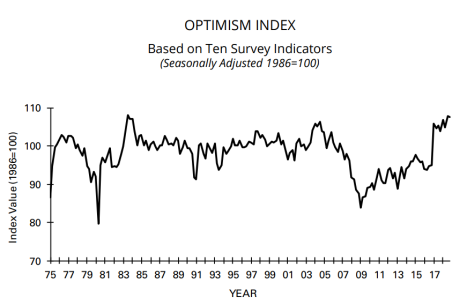
Small Business Optimism continued to hit record levels going back to the early 70s. The NFIB Small Business Optimism Index rose to 107.3 in October. Job creation was strong, with small business adding about .15 workers. 59% of businesses reported spending on expansion, while reports of sales and new orders continued their solid showing. Inflation remains on a slight upward path, while not exhibiting any rapid rises. As commodities fall (oil especially) the big source of inflation remains transportation (driven by labor costs) and anything tariff-related.


NFIB

Housing affordability dropped again, according to the NAHB / Wells Fargo Housing Opportunity Index. We are back at levels last seen around 2004 and 2009.


Lower affordability means that people are spending on their home improvement projects. The Despot reported earnings that easily topped analyst expectations. I guess when it is hard to move up, people fix up.


Morning Report: Commodity Prices falling

Vital Statistics:


Last Change
S&P futures 2778 -30
Eurostoxx index 364.14 -1.6
Oil (WTI) 60.5 0.31
10 year government bond yield 3.19%
30 year fixed rate mortgage 4.98%


Stocks are lower this morning on no real news. Bonds and MBS are flat.


Markets are open today, however many people are taking the day off in observance of Veteran’s Day.


There won’t be much in the way of market-moving data this week (CPI on Wednesday and retail sales on Thursday are the only potential market movers), however we do have a lot of Fed-speak, with Jerome Powell speaking on Wednesday.


Inflation at the wholesale level was a little hotter than expected, rising 0.6% MOM and 2.9% YOY. Ex food and energy, it rose 0.5% / 2.8% and ex food, energy and trade services (the core rate) it rose 0.2% / 2.8%. Inflation using the PPI metric is higher than the Fed’s 2% target, but the PPI isn’t the measure they target. We will get inflation at the consumer level on Wednesday.


Consumer sentiment improved in the first reading of the November numbers, according to the University of Michigan sentiment survey.


Amazing statistic: 20% of China’s apartments are vacant. That works out to be 50 million apartments. One of the biggest symptoms of a bubble is oversupply, and a 20% vacancy rate would qualify. In the big cities, apartments are ridiculously expensive, trading for something like 40 – 50 times income. For reference, prices in the US topped out at just under 5 times income in 2006. Chinese economic statistics are heavily massaged by government, but there is no doubt that they have the sort of real estate bubbles that seem to occur after decades of rapid growth, similar to the US in the 20s and Japan in the 80s. Once their bubble bursts, China will try and export their way out of it, which will probably spark more trade tensions, but will also put downward pressure on inflation and interest rates globally. The US could go through another period of having its cake and eating it too – a period where they go through strong economic growth without inflation worries.


Speaking of inflation, oil has been getting shellacked over the past month, losing over 20% from mid-October. Part of this has been driven by the US allowing 8 companies to buy Iranian oil despite sanctions. OPEC is now entertaining production cuts, which has stabilized prices at least today.


Also note that lumber prices (which have been soaring due to Canadian tariffs) have now reversed and are heading lower. This should help lower new home construction costs, although the biggest bottleneck remains labor and affordable lots.


lumber


So, while we are seeing inflationary pressures building in the labor market, commodities are going the other way.


California passed a couple of housing affordability initiatives last week, which were mainly targeted to the Bay Area. Similar measures in Oregon and Florida also passed.

Morning Report: An anticlimactic decision

Vital Statistics:


Last Change
S&P futures 2794 -14.75
Eurostoxx index 364.5 -2.58
Oil (WTI) 59.81 -0.86
10 year government bond yield 3.21%
30 year fixed rate mortgage 4.98%


Stocks are lower this morning on no real news. Bonds and MBS are up.


As expected, the Fed made no changes to monetary policy yesterday. The language in the statement was almost identical to the September release, with some small changes regarding the deceleration in business fixed investment. Bonds didn’t have much a of reaction to the decision. The December Fed Funds futures contracts are handicapping a 76% chance of another 25 basis points next month.


Initial Jobless Claims ticked up slightly to 214k last week. The labor economy continues to plug along.


A lack of housing inventory translates into a “new normal” for home sales, which is about 1 million units less per year than the pre-bubble days – in other words, the early 2000s, before the big jump in sales driven by the bubble years. The problem is that household formation has outstripped homebuilding for over a decade, and if you correct for population growth, we are still way below what is needed.


home sales


D.R. Horton reported earnings yesterday that missed street estimates and the stock was rocked to the tune of 9%. Earnings were up 41%, but on the call, DHI CEO David Auld said the market was “choppy” and noted some “momentum slipping from the market.” D.R. Horton focuses on starter homes, so this is worrisome given that luxury is already struggling a bit. The whole sector is struggling this year, with the homebuilder ETF down 25% from its high set earlier this year.

Morning Report: Fed Day

Vital Statistics:

Last Change
S&P futures 2805 -11
Eurostoxx index 367.48 1.08
Oil (WTI) 61.92 0.45
10 year government bond yield 3.22%
30 year fixed rate mortgage 4.96%

Stocks are lower this morning on no real news. Bonds and MBS are flat.

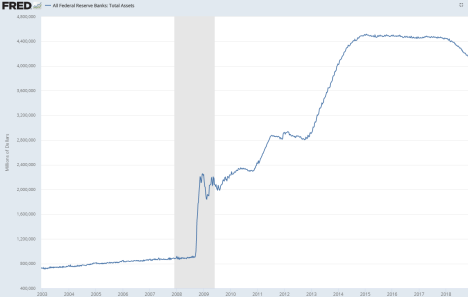
The FOMC announcement will come out at 2:00 pm EST today. No changes in rates are expected, and it should be a nonevent. Don’t expect to see any discussion of the recent sell-off in the stock market. About the only thing that could be interesting would be any discussion of how to quickly to shrink the Fed’s balance sheet, which is sitting at $4.1 trillion in assets, down from a peak of $4.5 trillion. That is still much lower than pre-crisis levels of below $1 trillion.

Fed assets

Donald Trump indicated that he would entertain an increase in the corporate tax rate if it was used for middle class tax relief. Democrats have complained that the middle class didn’t get a big enough tax cut, and the wealthy / corporations got too big of one. Don’t expect Democrats to bite, however. They want more healthcare entitlement spending and to raise taxes. Republicans aren’t going to vote to raise taxes, period.

UBS said it will fight an expected Justice Department civil suit over mortgage backed securities from 2007. They say they weren’t a “significant originator” of these mortgages.

The Fannie Mae Home Purchase Sentiment Index dipped in October. Affordability concerns are having an effect, as are higher mortgage rates. Despite the recent strong jobs numbers, more people are beginning to have job security worries. This is even more surprising when you consider that the number of respondents who said the economy is on the right track is at a record high.

Morning Report: Blue Wave doesn’t show up

Vital Statistics:


Last Change
S&P futures 2782 25
Eurostoxx index 366.66 0.41
Oil (WTI) 62.93 0.71
10 year government bond yield 3.20%
30 year fixed rate mortgage 4.96%


Stocks are higher this morning after Midterm elections. Bonds and MBS are flat.


Democrats took a narrow 7 seat majority in the House last night, while Republicans increased their majority in the Senate. There were largely no surprises last night – urban voters stayed reliably Democrat, rural voters stayed reliably Republican, however some suburban voters flipped from Republican to Democrat. That change could have been due to either (a) the tendency of educated voters to skew more Democrat, or (b) tax reform. I wonder if tax reform played a part, since higher income suburban voters probably got hit the hardest from the deduction limits on property taxes and state / local taxes.


One takeaway from the election: Progressive darlings flopped. Beto O’Rourke, Richard Cordray, and Andrew Gillum all lost. So while the energy in the D party is with the resistance, that doesn’t necessarily mean the voters are there too. The Blue Wave never materialized. The other takeaway: The Never Trump Republicans (the John McCains and the Bob Corkers) are gone as well. So DC is going to be more polarized than ever.


What will the election mean for markets? Nothing. Gridlock is generally positive for the stock market, and the bond market is being driven by the Fed. Oh, by the way there is a Fed FOMC meeting starting today.


There were about 7 million job openings at the end of September, according to the JOLTs report. This is a decrease of about 285k jobs from August’s record 7.3 million number. The quits rate was flat at 2.4%. While anecdotal evidence abounds regarding the inability of companies to fill positions and retain workers, that has yet to really show up in the government’s numbers.


Home prices rose 5.6% MOM in September, according to CoreLogic. They estimate that 38% of all MSAs are now overvalued, when looking at home prices versus incomes. Just under 20% were undervalued. Of course overvaluation / undervaluation is a moving target, so that can all change if incomes rise, especially if mortgage rates stay the same. Betting on a flattening yield curve late in an economic cycle is usually a decent bet, especially after the Fed finishes a round of monetary tightening.


Mortgage credit availability increased in October according to the MBA Mortgage Credit Availability Index. “Credit availability increased in October, driven largely by an expansion in the supply of conventional credit, while government credit fell slightly over the month,” said Joel Kan, MBA’s associate vice president of economic and industry forecasting. “Reversing a trend from last month, lenders made more conventional and low down payment programs available to prospective borrowers. This increase in supply was likely in response to a growing number of first-time home buyers in the market, as home price appreciation has slowed and wage growth has picked up. Jumbo credit availability also expanded last month, with the jumbo index increasing again to its highest level since the survey began.”


MCAI


Last week’s drop in interest rates didn’t have much of an effect on mortgage applications, as the MBA’s index fell 4%, driven by a 3% drop in refis and a 5% drop in purchases. Activity hit a 4 year low.


Zillow is getting into the home buying business in Houston, by making cash offers for homes from qualified sellers and then listing the home for sale. It looks like Zillow is selling this as a service to make it easier to sell a home rather than just real estate speculation, but who knows? We do know that Z-estimates are often wildly inaccurate, so Zillow might not have such a big edge.

Morning Report: Homes are still affordable, but for how long?

Vital Statistics:


Last Change
S&P futures 2732.75 -6.85
Eurostoxx index 362.55 -0.95
Oil (WTI) 62.68 -0.42
10 year government bond yield 3.20%
30 year fixed rate mortgage 4.96%


Stocks are lower as voters head to the polls for Midterm elections. Bonds and MBS are flat.


Regardless of what your politics are, I think everyone will agree that it will be refreshing to not get spammed everywhere with political ads, starting tomorrow.


The Midterm elections will hold the press’s attention today, however they won’t have much (if any) of an impact on markets. Expect Democrats to take the House and a few governorships and Republicans to hold the Senate. This means gridlock for the next two years, which is good news for stocks and bonds.


The ISM Non-Manufacturing Index slowed a touch in September, but was still pretty strong. New Orders rose while employment was a drag on the index. Employment issues referred to the labor supply, with comments like: “Low unemployment causing team members to leave for higher wages in other businesses and industries” and “Challenging to replace vacant positions.” Expect to see more wage inflation ahead. Tariffs are still worrying some respondents and construction is experiencing cost push inflation. Retailers are reporting strong traffic and expect it to continue through the rest of the year. All of this adds up to a probable hike in December.


Rising mortgage rates have cut the size of the refinanceable pool of mortgages to 1.85 million, a 56% drop from the beginning of the year. Overall, there apparently were 6.5 million borrowers in total who had the opportunity to refinance during the ZIRP years that missed the boat. Despite the concerns about affordability, it takes 23.6% of median income to make the monthly payment on the average house which is lower than the pre-bubble benchmark of 25.1%. (Note: I did a deep dive into that metric earlier this year in the Scotsman Guide: Homes are Not Overpriced.) Black Knight estimates that an additional 50 basis points rise in the mortgage rate will push the monthly payment metric above the historical average, even if home prices don’t rise further.


refinance candidates


The residential homebuilding sector has had a lot of headwinds to deal with, from labor shortages, to rising materials prices and also the lack of buildable lots. The issue is that in the areas where demand is highest (places like Seattle and SF) there are geographical issues that make building out hard. On the other hand, in places like the Midwest, where there is less demand, there is plenty of land available.

Morning Report: October was not kind to MBS investors

Vital Statistics:


Last Change
S&P futures 2728 4
Eurostoxx index 364.84 0.76
Oil (WTI) 62.92 -0.35
10 year government bond yield 3.21%
30 year fixed rate mortgage 4.96%


Stocks are higher this morning on no real news. Bonds and MBS are down small.


The highlight of this week will be the FOMC meeting on Wednesday and Thursday. Typically they fall on Tuesday and Wednesday, but I guess they moved it for election day this year. No changes in monetary policy are expected and the Fed Funds futures market is assigning a 93% probability of no change in rates. Aside from the FOMC meeting, the only other market moving news will be PPI on Friday. Whatever happens Tuesday is probably not going to be market-moving. Best bet: Ds narrowly take the House, Rs retain the Senate, gridlock rules Washington.


October was a rough month for MBS investors, the kind folks who set our rate sheets. MBS underperformed Treasuries by 37 basis points, the worst since immediately after the election. Yes, the Fed is reducing the size of its MBS holdings, but that isn’t what makes MBS outperform and underperform. Volatility in the Treasury markets can be great for bond investors, but is is toxic for MBS investors, and when you have a period of high volatility in the bond market (shown below with a “VIX” for Treasuries) shows a marked increase. The Fed’s reduction of its balance sheet has been going on for years, and it isn’t all of a sudden going to manifest itself in rates.

TYVIX


Fannie and Freddie reported strong numbers and paid about $6.6 billion to Treasury between them. Fannie Mae has paid in total about $172 billion to Treasury since the bailout.


Jerome Powell thinks the current period of low inflation and low unemployment could last “indefinitely.” Historically, inflation usually increased as unemployment fell (which was measured by the Phillips Curve). He thinks that relationship has broken down over time. He notes that the last two booms were not ended by goods and services inflation, they were ended by burst asset bubbles. Since we don’t seem to have any asset bubbles brewing at the moment, this set of affairs could last a while. I wonder how much of the historical unemployment / inflation was due to union contracts which included explicit inflation cost of living increases. Regardless, he is correct that we don’t have anything resembling a stock market bubble or real estate bubble, and changes in inventory management have probably done a lot to get rid of the historical cause of recessions, which is an inventory glut.


Isn’t this a perfect encapsulation of the cognitive dissonance in the business press right now? They don’t like the guy in office, so they constantly feel like the economy is awful (Consumer confidence is definitely a partisan phenomenon). Classic example of why you always have to take consumer confidence numbers (and the business press) with a grain of salt….

Cognitive DIssonance


Morning Report: Blowout jobs report

Vital Statistics:


Last Change
S&P futures 2752 12.25
Eurostoxx index 364.42 2.24
Oil (WTI) 63.42 -0.46
10 year government bond yield 3.18%
30 year fixed rate mortgage 4.89%


Stocks are higher this morning after a strong employment report. Bonds and MBS are down.


Jobs report data dump:

  • Nonfarm payrolls up 250,000
  • Unemployment rate 3.7%
  • Average hourly earnings up 3.1%
  • Labor force participation rate 62.9%
  • Employment-Population ratio 60.6%


Overall, an exceptionally strong report, with nothing to dislike. Strong wage growth, increasing labor utilization rates, low unemployment. Simply  put, this is a blowout jobs report, the best we have seen in years.


The sell-off in the stock market was beginning to push the Fed Funds futures towards the dovish direction, but this report pretty much ended that. While  we will get one more job report before the December FOMC meeting, it is looking like we are going to see another 25 basis points.


Productivity increased 2.2% in the third quarter, which was a deceleration from the 2.9% we saw in Q2. Unit labor costs rose 1.2%. We are seeing rising compensation costs (up 3.5%) while output is also up. Rising comp costs are much higher than the inflation rate, and while it is easy to focus solely on wages, the cost of an employee is more than just wages – it includes benefits and other regulatory costs as well.


Construction spending was flat in August and rose 7.2% YOY. Residential construction rose 0.5% MOM and 4.9% YOY. Office and lodging rose smartly on a YOY basis. Interestingly, education building is still going strong, just as the tail end of the Millennial generation is graduating. You would think colleges would figure out how to compete on price, but for the moment they are competing on amenities and infrastructure. Which is partly why college is so expensive. There is going to be a reckoning, IMO when a demographic dearth of students meets falling affordability driven by rising interest rates.


Manufacturing slowed somewhat last month according to the ISM Manufacturing Survey, however it remains robust, despite what is going on with trade.  That said, many of the comments from survey participants noted that prices are rising, partially driven by tariffs. Supply lines are stretched and more firms are running at capacity. That said, the higher anecdotal capacity utilization isn’t translating into the numbers, at least not compared to historical norms:


capacity utilization


Rising interest rates have pulled back corporate bond issuance. Corporate bond issuance is often the canary in the coal mine for the economy and therefore bears watching. Many companies tapped the markets during the ZIRP years to refinance pre-crisis debt and the fund stock buybacks, so perhaps the comparisons aren’t really all that valid. Investor appetite is waning, however that may be due to the fact that shorter duration paper is beginning to earn a return, so funds are getting defensive with the Fed in tightening mode. So far we aren’t seeing a material widening of credit spreads. Still, in the summer of 2007, a few leveraged buyouts were unable to sell the paper from M&A deals, and the buyside went on a buyer’s strike against structured products. At the time, nobody had any idea what it would turn into.

Morning Report: Lots of labor data

Vital Statistics:


Last Change
S&P futures 2723 12.25
Eurostoxx index 364.42 2.24
Oil (WTI) 64.81 -0.46
10 year government bond yield 3.16%
30 year fixed rate mortgage 4.89%


Stocks are higher this morning after yesterday’s end of month window dressing. Bonds and MBS are down again.


The ADP report showed the US economy added 227,000 jobs in October, which is well ahead of the Street estimate for Friday’s BLS report. There was a big (typically seasonal) increase in transportation and retail, although professional / business services was strong as well. Mark Zandi, chief economist of Moody’s Analytics, said, “The job market bounced back strongly last month despite being hit by back-to-back hurricanes. Testimonial to the robust employment picture is the broad-based gains in jobs across industries. The only blemish is the struggles small businesses are having filling open job positions.” Large and medium sized employers (50 employees +) accounted for the lion’s share of new jobs.


ADP jobs report


With added employees comes added employee cost. The Employment Cost Index rose 0.8% QOQ and 2.8% YOY. The wage component of employment costs rose 2.9% while the benefit portion rose 2.4%. The drop in healthcare costs is helping wages as higher healthcare costs of consumed a lot of employee raises. Your cost of healthcare ate your cost of living raise.


Mortgage Applications decreased 2.5% last week as purchases fell 2% and refis fell 4%. Rates held steady. “The 30-year fixed-rate mortgage held steady over the week, but total applications decreased overall. Purchase applications inched backward from the previous week, as well as compared to one year ago – the first year-over-year decline in purchase activity since August,” said Joel Kan, AVP of economic and industry forecasts. “Purchase applications may have been adversely impacted by the recent uptick in rates and the significant stock market volatility we have seen the past couple of weeks. Additionally, the ARM share of applications increased to its highest level since 2017, but since this is a compositional measure, it was driven by a greater decrease in applications for fixed-term loans relative to the decrease in ARM applications.”


The Challenger and Gray job cut report rose last month, but it is a third-tier employment data point. It focuses on job cut announcements, which may or may not happen.


The homeownership rate rose 64.4% according to the Census Bureau. This was up 0.1% from the second quarter and 0.4% from a year ago. The homeownership rate has been ticking up, although the big jump in homeownership from 1994 to 2005 was partially driven by aggressive social engineering out of Washington and probably was artificially high.


homeownership rate NAD