Morning Report: Inflation still tame 3/14/18

Vital Statistics:

Last Change
S&P Futures 2779.5 6.8
Eurostoxx Index 376.9 1.4
Oil (WTI) 61.1 0.4
US dollar index 83.4 -0.1
10 Year Govt Bond Yield 2.84%
Current Coupon Fannie Mae TBA 102.375
Current Coupon Ginnie Mae TBA 102.75
30 Year Fixed Rate Mortgage 4.43

Stocks are higher this morning on no real news. Bonds and MBS are flat as well.

Inflation at the wholesale level rose 0.2% MOM / 2.8% YOY. Ex-food and energy, they rose 0.2% MOM / 2.7% YOY. The core index (ex food, energy and trade services) rose 0.4% MOM / 2.7% YOY. Overall, the report came in a touch hotter than expectations, but nothing major. In terms of services, hotel demand drove the increase, while goods were impacted by lower energy prices. This report shouldn’t have any effect on the Fed’s decision next week.

Retail Sales came in weaker than expected, and this is providing some support for bonds. The headline number was down 0.1%, while the control group was up 0.1%. Census has made some technical changes to the way it measures and calculates the index, so these numbers are going to contain a bit of noise. That said, people who were hoping that tax cuts would propel spending are disappointed this morning, however it might take a month or two to show up in the data.

Not much of a reaction in the Fed Funds futures, with March futures handicapping a 89% chance of a 25 basis point hike, and the December futures coalescing around a total of 75 basis points this year.

Mortgage Applications increased 0.9% last week as purchases rose 3% and refis fell 2%. The average contract rate rose 4 basis points to 4.69%, the highest level since January 2014. Refis comprised 40% of all mortgages, the lowest level in almost 10 years. The government share of mortgages increased.

The leading candidate to replace Gary Cohn is Larry Kudlow, a free-trade, supply-side economist. A veteran of Wall Street and Washington, he recognizes that some saber rattling in trade issues can be a useful negotiating tactic. He also is a regular on TV, which is crucial for selling the Administration’s policies to the public. Finally, he is well-liked in Washington, and while Democrats might not agree with him on policy, he doesn’t strike a nerve with them. This will be helpful in navigating budgetary decisions.

10 years ago, Bear Stearns collapsed, pretty much setting the stage for the financial crisis. The public didn’t pay attention until Lehman went under. At the end of the day, Bear and Lehman were symptoms, not the disease. The disease was a burst residential real estate bubble. Keep that in mind as the business press will undoubtedly publish a bunch of “Are we at risk for another financial crisis?” articles this week. Residential real estate bubbles are the Hurricane Katrinas of banking, and when they burst, they take down the system with it. We do not have one at the present, and while there is evidence of excessive risk taking in some corners of the market (subprime auto, etc) it simply isn’t big enough to dent the economy in a material way.

Hard to believe, but true. Last night not a single Japanese government bond traded. Between the central bank vacuuming up the supply as a part of QE and Japanese pension funds buying and holding, there is almost no liquidity in the market. Makes the yield curve pretty easy to manipulate, though. Japan has always had a different attitude about markets – it thinks interest rates and stock prices are too important to be determined by a mere market – but it will be interesting to see how the economy gets out from under such determined government support. Ultimately, accurate, unmanipulated interest rates and asset prices are a necessary part of the plumbing for a functioning economy.

Morning Report: Bonds rally on tame inflation data 3/13/18

Vital Statistics:

Last Change
S&P Futures 2803.0 14.0
Eurostoxx Index 378.4 -0.8
Oil (WTI) 61.0 -0.4
US dollar index 83.7 0.0
10 Year Govt Bond Yield 2.84%
Current Coupon Fannie Mae TBA 102.375
Current Coupon Ginnie Mae TBA 102.714
30 Year Fixed Rate Mortgage 4.46

Stocks are higher this morning after the CPI came in lower than expected. Bonds and MBS are up.

Consumer prices rose 0.2% MOM and 2.2% YOY, however the core rate, which excludes food and energy rose 0.2% MOM and 1.8% YOY. Communications (cell phones, data) costs were a drag on the index, while apparel prices pushed it higher. Owner-equivalent rent moderated as well, which is a proxy for house prices.

The NFIB Small Business Optimism Index just missed the record high set in 1983, rising 0.7 points to 107.6. Lack of qualified workers was the #1 problem again, and reports of compensation increases were the highest since 2000. Reports of CAPEX spend were the highest since 2004 as well. For all of the talk about how things are going on Wall Street, Main Street has switched into a higher gear. Probably the biggest constraint to higher growth right now is a lack of qualified workers. Of course, if the labor markets were truly tight, we would see widespread wage inflation. There are pockets of strength as noted below, but some parts of the labor market are still relatively stagnant.

Separately, the Conference Board’s Employment Trends Index rose in February, and is up 5.6% YOY. The six month growth rate is the highest in 4 years, when the labor market was still in recovery mode.

One of the strange things in this labor market has been wage growth at the lower end of the wage scale, but not in the upper half. Between minimum wage laws and voluntary raises provided by companies like WalMart in the aftermath of tax reform have boosted wages at the lower end of the scale. This is squeezing the middle to upper middle class, as things like child care and entertainment, become more expensive, while their own disposable income remains relatively unchanged. This might just be a delayed reaction, and we will see more widespread wage growth. However, it might also crimp demand for housing as people feel like they don’t have the disposable income for homeownership. More issues for the first time homebuyer.

Rex Tillerson is out as Secretary of State. CIA Director Mike Pompeo has been appointed to the role. Meanwhile, Larry Kudlow is seen as the favorite to replace Gary Cohn, who is leaving the Admin as well.

While most people in the mortgage markets are focused primarily on long rates, rising short term rates are having a large impact as well. Short rates (LIBOR / 1 year T-bill) are the highest in 10 years. This affects ARMs and their relative attractiveness to the 30 year fixed rate mortgage. As the yield curve steepens (in other words, the difference between the 30 year bond yield and LIBOR increases) the more attractive ARMS become. As that spread falls, the 30 year fixed becomes more attractive. While ARMS provide a borrower with a lower monthly payment out of the box, paying the extra yield may be a better bet this time around. ARMs perform best in secular bond bull markets, like we experienced from 1981 to a couple of years ago. In a rising rate environment, they won’t be as attractive.

The rise in short term rates is also going to have knock-on effects in the stock and bond markets. For the past 10 years, short term bonds have paid next to nothing, so stocks and longer duration bonds have had no competition. That is changing, and we will see an effect on stocks as funding costs for companies increase.

Morning Report: Demand is falling for Treasuries 3/12/18

Vital Statistics:

Last Change
S&P Futures 2794.5 6.0
Eurostoxx Index 379.2 0.9
Oil (WTI) 61.5 -0.6
US dollar index 83.8 0.0
10 Year Govt Bond Yield 2.89%
Current Coupon Fannie Mae TBA 102.25
Current Coupon Ginnie Mae TBA 102.5
30 Year Fixed Rate Mortgage 4.4

Stocks are higher on no real news. Bonds and MBS are flat

This week will have some important economic data with housing starts on Friday and inflation data on Wednesday and Thursday. No Fed-speak as we are in the quiet period ahead of next week’s FOMC meeting.

As part of Dodd-Frank reform, Congress is looking at broadening the credit box for a qualified mortgage. Rural buyers, who typically use a smaller community bank, tend to have the biggest issues in getting a mortgage. Banks with $10 billion or less in assets could still get QM protection provided they meet some of the requirements and also hold the loan on their balance sheet. This change has bipartisan support – most everyone agrees that Dodd-Frank was too onerous for smaller banks.

Investors are beginning to have less of an appetite at Treasury auctions. Treasury auctions are generally non-newsworthy events that happen every Monday. While there is no real risk of a failed auction, we are starting to see less demand for Treasuries, which is to be expected in a rising interest rate environment. That said, you might start to see interest rates move on auction results. Bid / Cover ratios are not yet part of the business press vernacular, but we could be heading there. Something to keep in mind if rates suddenly move on a Monday afternoon.

Demand for Treasuries will drop if we see an honest-to-goodness trade war. Politicians make a big deal out of trade deficits, which sound worse than they really are. I run a massive trade deficit with my local deli: I buy lunch from them every day, and they never so much as buy a cup of coffee from me. China has chosen to accept Treasuries instead of our goods and services. If we buy less from them as the result of a trade war, they will buy less Treasuries, which would imply higher interest rates at the margin.

That said, China (and to a less extent Canada) have real estate bubbles on their hands, and residential real estate bubble generally lead to banking crises. What happens when you have banking crises? Demand for risk-free assets rise. In China especially, we should see the trade deficit balloon if that happens, as they will try and export their way out of the recession, and their own workers will have less disposable income to buy US goods and services. A burst China bubble could recreate the economy of the 1990s, where the US gets a free lunch with non-inflationary low interest rates. In the 90s, Japan and China were “exporting deflation” to the US, which is part of the reason why the 90s felt so good. Of course instead of price inflation, we got asset bubbles instead which caused their own headaches. This time around, we won’t have the same problem. People know that stocks and real estate aren’t special assets that can only increase in price.

Morning Report: Goldilocks Jobs Report 3/9/18

Vital Statistics:

Last Change
S&P Futures 2762.3 17.0
Eurostoxx Index 376.8 0.2
Oil (WTI) 60.6 0.4
US dollar index 83.9 0.0
10 Year Govt Bond Yield 2.9%
Current Coupon Fannie Mae TBA 102.25
Current Coupon Ginnie Mae TBA 102.5
30 Year Fixed Rate Mortgage 4.4

Stocks are higher after the strong jobs report. Bonds and MBS are down.

Jobs report data dump:

  • Nonfarm payrolls up 313,000 vs expectations of 205,000
  • Unemployment rate 4.1% vs expectations of 4.0%
  • Labor Force Participation rate 63% vs expectations of 62.7%
  • Average Hourly Earnings up .1% / 2.6% vs expectations of .2% / 2.9%

Overall a great report for the stock market. Strong growth in payrolls, without a massive increase in wage growth. The civilian employment to population ratio increased from 60.1% to 60.4%, which matched the post-crisis record set in September. The labor force increased by 800k, while the population increased by 150k. The civilian employment to population ratio peaked in 2000 at 64.7% and bottomed in 2009 at 58.3%, and we are much closer to the low than we are to the high. Some of that is demographics, however there is undoubtedly still slack in the labor market that number bears it out. Which is why we still have the wage inflation typically associated with 6% unemployment and not 4% unemployment.

The Fed funds futures didn’t do much on the report – as we approach the March meeting, the probabilities of a hike continue to increase and are sitting at 89%, and the December futures are still coalescing around a prediction of 3 hikes this year. Chicago Fed President Charles Evans says he would argue against a March hike.

Home Depot is donating $50 million to train 20,000 construction workers over the next decade. “It’s important that we support the trades,” Home Depot CEO Craig Menear said in an interview. “Not only do we sell product to professionals like plumbers and electricians,” but the company also partners with service providers that install kitchen flooring, hot water heaters and other equipment in consumers’ homes. There are still 158,000 job openings in the construction sector that need to be filled.

Donald Trump announced tariffs of 25% on steel and 10% on aluminum yesterday, with temporary relief for Canada and Mexico while we renegotiate NAFTA. Senator Jeff Flake introduced legislation to overturn these tariffs. I would bet there are enough votes in both chambers to pass the bill, and there might be enough to override a veto.

File under “Only Nixon could go to China:” Donald Trump will meet North Korean President Kim Jong Un in May, to discuss the country abandoning its nuclear weapons program.

Mortgage credit decreased in February, according to the MBA’s Mortgage Credit Availability Index. Apparently the decrease was due to a single large investor in the conventional space. While we are close to post-crisis levels in the index, we are a long way from the go-go days of the bubble.

Soaring stock and real estate prices have sent net worth as a percent of disposable income to record levels.  I wouldn’t be surprised to see this number fall as the Fed pulls back support for the asset markets and we finally start seeing wage inflation.

Morning Report: Fed Beige Book points to strong labor market 3/8/18

Vital Statistics:

Last Change
S&P Futures 2729.3 6.0
Eurostoxx Index 374.0 1.3
Oil (WTI) 61.2 0.0
US dollar index 83.6 0.1
10 Year Govt Bond Yield 2.87%
Current Coupon Fannie Mae TBA 102.25
Current Coupon Ginnie Mae TBA 102.5
30 Year Fixed Rate Mortgage 4.4

Stocks are higher this morning on no real news. Bonds and MBS are up small.

Donald Trump is set to impose tariffs on steel and aluminum, however there is talk of exempting Canada and Mexico from them (which is where we get most of our foreign steel to begin with). That exemption will be used as leverage to renegotiate NAFTA. So far, the trade war is largely symbolic – Trump tweeted that he wanted to see a $1 billion decrease in our trade deficit with China, which is about $375 billion. In other words, it is a drop in the bucket, and all for show. That might have been an error however, some reports are saying he meant $100 billion, which probably makes more sense. That said, stocks are taking the trade war in stride, and bonds seem to have found a level here.

Initial Jobless Claims rose to 231k last week from 220k. Job outplacement firm Challenger, Gray and Christmas reported that companies announced 35,369 job cuts in February.

The overall economy grew at a modest to a moderate pace in January and February, according to the Fed’s Beige Book survey. With regard to employment, it said: “On balance, employment grew at a moderate pace since the previous report. Across the country, contacts observed persistent labor market tightness and brisk demand for qualified workers, as well as increased activity at staffing placement services. Several Districts reported continued worker shortages across most sectors, with contacts often mentioning shortages in the construction, information technology, and manufacturing sectors. In many Districts, wage growth picked up to a moderate pace. Most Districts saw employers raise wages and expand benefit packages in response to tight labor market conditions. Contacts in a few Districts conveyed reports of modest increases in compensation following passage of the Tax Cuts and Jobs Act.” The increases in wage inflation are a good sign for the economy overall, but not so much for interest rates. The Street is looking for a strong reading in wage growth in tomorrow’s Employment Situation Report: an increase of 2.9% YOY.

Buyer sentiment fell last month, according to the Fannie Mae Home Purchase Sentiment Index. “Volatility in consumer housing sentiment continued into February, with the new tax law beginning to impact respondents’ take-home pay and the stock market creating negative headlines due to early-month turbulence,” said Doug Duncan, senior vice president and chief economist at Fannie Mae. “Additionally, consumers’ expectations for higher mortgage rates suggest that consumers expect the Fed to hike rates a few more times in 2018. We will continue to track how consumer housing attitudes trend in the coming months as these various market forces play out.”

Morning Report: WH adviser Gary Cohn resigns 3/7/18

Vital Statistics:

Last Change
S&P Futures 2703.3 -21.0
Eurostoxx Index 371.3 -2.4
Oil (WTI) 62.1 0.5
US dollar index 83.5 -0.3
10 Year Govt Bond Yield 2.86%
Current Coupon Fannie Mae TBA 102.25
Current Coupon Ginnie Mae TBA 102.5
30 Year Fixed Rate Mortgage 4.4

Stocks are lower this morning on the prospect of a trade war. Bonds and MBS are up.

White House Economic Adviser Gary Cohn has resigned after losing the argument on tariffs. Cohn, a Democrat, was one of the more moderate voices in the Trump Administration, and his resignation cements the idea that the Administration is turning away from globalization, which has marked Washington establishment for decades.

So far the potential trade war hasn’t had much of an effect on the Fed Funds futures, which are handicapping a 86% chance of a hike in May and have centered on 3 hikes for the full year. The impact of a trade war will be an interesting question for the Fed. On one hand, they raise prices, which should translate into higher inflation. On the other, they depress economic activity which should translate into slower growth and higher unemployment. The first effect is more near term, while the second order effect is longer-term.

Bolstering the Administration’s case for tariffs is the fact that the trade deficit rose to a 9 year high last month.

Atlanta Fed President Raphael Bostic says that the Fed should take a “wait and see” approach to a trade war. While the Trump Administration may be pushing back from globalization, Congress has not, and the courts provide another speed bump to tariffs. Note as well, that the US “ask” in trade negotiations usually centers on intellectual property protection, and that means Hollywood and Big Tech. Their partisanship will probably come back to haunt them. Think Trump is going to care about the Chinese pirating the latest Michael Moore flick? Or the latest left-wing Netflix “documentary?”

The economy added 235,000 jobs in February, according to the ADP Employment survey. The Street is looking for 205,000 jobs in Friday’s jobs report. The ADP report has been coming in higher than the BLS reports lately, so this should have a muted effect. Secondly, the focus on the jobs report (at least from the Street’s perspective) has shifted from payroll growth to wage inflation.

Mortgage Applications rose 0.3% last week as purchases fell 1% and refis rose 2%. The average 30 year mortgage rate rose 1 basis point to 4.65%, the highest since early 2014.

Nonfarm productivity for the fourth quarter was revised upward to flat, while unit labor costs were revised upward to 2.5% from 2.0%. Compensation costs drove the increase. So far, companies have been unable to pass on higher costs in the form of higher prices, which should mean profit margins will come in, making stocks vulnerable.  This should translate into lower interest rates at the margin.

A real estate startup called Knock is looking to disrupt the real estate industry by acting as a market maker for homes. They will buy a seller’s home, move them into a new one, and then sell the old home. The benefit for the home seller is that they will now be able to compete in bidding wars without having any sort of home sale contingencies. That said, this is clearly a bull market phenomenon, and in this market the tough part is not selling your current house – it is getting (and winning) your new one. Still an interesting idea.

Morning Report: Fears of a trade war easing 3/6/18

Vital Statistics:

Last Change
S&P Futures 2727.3 9.0
Eurostoxx Index 373.3 2.4
Oil (WTI) 63.1 0.5
US dollar index 83.5 -0.3
10 Year Govt Bond Yield 2.89%
Current Coupon Fannie Mae TBA 102.25
Current Coupon Ginnie Mae TBA 102.5
30 Year Fixed Rate Mortgage 4.4

Stocks are higher this morning on no real news. Bonds and MBS are down.

The EU proposed tariffs on some US goods if Trump follows through on his plan to institute higher tariffs on steel and aluminum imports. White House Gary Cohn is working with business leaders in an attempt to change the President’s mind. Think about that. An economic advisor is reaching out to administration outsiders to try and get the President to change his mind. Imagine Austan Goolsbee soliciting the input of the financial industry in 2009 in an effort to derail Dodd-Frank. Supposedly Cohn plans to resign if Trump doesn’t relent on a trade war. House Speaker Paul Ryan has also come out against tariffs. Despite Trump’s warning that he “won’t back down” on tariffs, the markets are starting to bet that a trade war isn’t going to happen, which is probably why futures are up.

Don’t forget that we already have tariffs on Canadian softwood lumber. Prices are at record levels. This is yet one more reason why we have such an affordability problem – not enough (cheap) new construction.

lumber

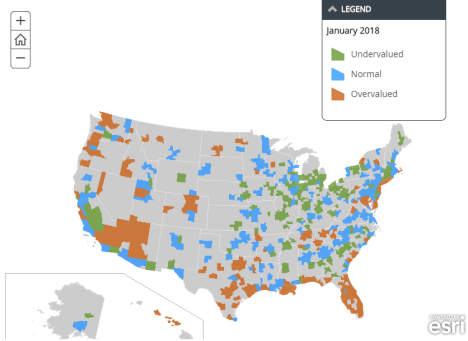
House prices rose 0.4% MOM from December to January, according to CoreLogic. Prices are up 6.6% YOY. They are forecasting prices to rise 5% this year. The fastest appreciation is at the lower price points, where prices are increasing 9% for homes at the 75% of the area’s median home price, while appreciating only 5% for homes at 125% of the area’s median home price. This demonstrates the struggle that the first time homebuyer is facing: rising rates and higher home price appreciation. Below is a chart of where home prices are overvalued and undervalued

Corelogic overvalued

Factory orders fell 1.4% in January reversing a string of gains. This is interesting simply because most of the regional Fed reports and the ISM data are showing strength in new orders, which was the weakness in this report.

Morning Report: Trade war tensions pushing rates lower 3/5/18

Vital Statistics:

Last Change
S&P Futures 2681.3 -9.0
Eurostoxx Index 369.2 2.2
Oil (WTI) 61.4 0.1
US dollar index 83.8 0.1
10 Year Govt Bond Yield 2.84%
Current Coupon Fannie Mae TBA 103.591
Current Coupon Ginnie Mae TBA 103.688
30 Year Fixed Rate Mortgage 4.4

Stocks are lower this morning the trade cold war between the US and the world escalated. Bonds and MBS are up.

Those hoping that Donald Trump would re-think his position on trade over the weekend were disappointed. He is now threatening EU automakers and demanding a re-negotiation of NAFTA to ease steel and aluminum restrictions with Mexico and Canada. Exiting and / or renegotiating NAFTA will probably not be as easy as he thinks it will be. The US has always had the leadership position globally in encouraging free trade. There is no doubt it that has accepted some protectionism from other countries as a cost of doing business, and in the spirit of moving the ball on free trade in general. In other words, the US has accepted a disadvantaged position, and these “free trade” agreements were in reality a negotiation over how many points the US would spot other countries.

Rates this week will be primarily determined by the fluid state of trade announcements. We will get  some important market-moving data this week with the jobs report on Friday, and productivity on Wednesday. There will also be Fed-Speak all week.

Big picture, trade tensions are causing a flight to quality, which is pushing down interest rates. This is probably going to be only a temporary phenomenon so I would encourage LOs to push their customers to lock. Despite rising rates, we are not seeing an influx of foreign money into Treasuries, and we are seeing European investors and Japanese investors investing in Bunds and JGBs despite the lower yields. Why would investors accept 62 basis points in Germany or 5 basis points in Japan when they could get 2.8% in the US? Currency hedging costs wipe out the differential.

Trade battles are generally bad for everyone involved, except for domestic producers in the industries being protected. Note that Secretary of Commerce Wilbur Ross is an ex-steel guy himself and is not an idealistic free-trader. I suspect that is where Trump is getting his advice, although the media claims it was a petulant decision out of the blue as a result of negative headlines.

Tariffs on steel and aluminum will be bad for the construction industry, especially multi-fam. Don’t forget, the housing business is already dealing with a 20% tariff on Canadian soft lumber. Building Material prices are already at record highs.

The services economy continues to expand, with the ISM Non-Manufacturing index hitting 59.5 in February. This was lower than the exceptionally strong January reading of 59.9. The internals of the report were good, with the New Orders and Employment indices coming in over 60. Some of the comments from business below:

  • “Lumber-related costs continue to increase as supply is also starting to become a problem. The market volatility of construction materials and the short supply of construction labor have added difficulty to long-term planning.” (Construction)
  • “Slight increase in activity; beginning to see some higher cost for goods and services.” (Finance & Insurance)

Strong growth and inflation is the takeaway.

Amazon is in talks with JP Morgan to start providing checking account services. Amazon mortgages can’t be far behind. Has Bezos ever looked at banking P/E ratios? They aren’t triple digit.

Morning Report: Tariff Threats cause a bond market rally 3/2/18

Vital Statistics:

Last Change
S&P Futures 2658.0 -20.0
Eurostoxx Index 368.8 -6.1
Oil (WTI) 60.8 -0.2
US dollar index 83.8 -0.2
10 Year Govt Bond Yield 2.84%
Current Coupon Fannie Mae TBA 102.313
Current Coupon Ginnie Mae TBA 102.531
30 Year Fixed Rate Mortgage 4.4

Stocks are lower this morning on news of a possible trade war. Bonds and MBS are flattish.

Donald Trump has announced plans to impose 25% tariffs on steel imports and 10% tariffs on aluminum imports. The dollar has weakened in response, and we have seen bond yields fall as well. He characterized trade wars as “good” and “easy to win.” As a general rule, nobody wins trade wars – they depress economic growth – but the silver lining is that you are seeing a bit of a flight to quality, which means Treasuries have a bid for once. This is pushing rates down. Don’t know how long it will last (he may be bluffing, or someone will probably talk him out of it), but take advantage of it. I could see him re-thinking and abandoning this idea over the weekend, and we could be looking at a 2.9% 10 year on Monday.

Consumer sentiment was flat in February, according to the University of Michigan Consumer Sentiment Survey.

Jerome Powell’s testimony in front of the Senate wasn’t all that dramatic. The main subjects were wage growth (or the lack of it), fair lending, and regulation. Elizabeth Warren spent her time harping on Wells Fargo. These events are mainly for political posturing and not much else. One Senator asked him about climate change, which Powell took in stride. I was hoping he would ask the Senator to lay out the connection between the Fed Funds rate and atmospheric CO2, but alas he played it straight.

On the subject of the labor market and wage growth, he said that nobody really knows what full employment actually is. The unemployment rate suggests that we are, while wage growth and the labor force participation rate suggest we are not. His view is that if you take all of the data, we are probably at or very close to full employment. He did say that the Fed has been modeling something like a 25 basis point annual decline in the labor force participation rate due to demographics – i.e. the retiring Baby Boomers, and that it has now caught up with that demographic model.

Acting Director of the CFPB Mick Mulvaney said yesterday that the Bureau will rely more on state AGs when deciding on enforcement actions. He reiterated the plan to spend resources on cases that are on “solid legal ground” and less on “creative claims.” Regulation by enforcement is also on the way out, and the CFPB intends to be much more forthcoming in telling the industry what the rules of the road are.

Elmer Fudd says we are in a bond market bubble.

Morning Report: ISM Survey points to higher inflation going forward 3/1/18

Vital Statistics:

Last Change
S&P Futures 2708.3 -6.3
Eurostoxx Index 375.7 -4.0
Oil (WTI) 61.2 -0.5
US dollar index 84.3 0.1
10 Year Govt Bond Yield 2.84%
Current Coupon Fannie Mae TBA 102.313
Current Coupon Ginnie Mae TBA 102.531
30 Year Fixed Rate Mortgage 4.4

Stocks are lower this morning on no real news. Bonds and MBS are up.

Jerome Powell is set to testify in front of the Senate this morning. On Tuesday, he made some hawkish statements about inflation that sent bond yields higher. I doubt we will see a repeat today, but just be aware.

Initial Jobless Claims fell to 210,000 last week, the lowest number since the 1960s. Last week included the President’s Day holiday, which means we could have some sort of funky adjustment going on,  but regardless it speaks to a labor market where employers are hanging onto their employees.

Personal Incomes rose 0.4% last month, while consumer spending rose 0.2%. The incomes number was a little better than expected. The inflation numbers show a modest pickup, but the core annual growth came in at 1.5% YOY, which is below the Fed’s 2% target.

Construction spending came in flat for January, and is up 3.2% YOY. Residential Construction was up 0.2% MOM and rose 4.3% YOY.

The ISM Manufacturing Index improved to 60.8 in January. New Orders drove the improvement and employment improved markedly as well. The report often includes some snippets from respondents, and many of them are touching on the same thing:

  • “Availability of electronic components, long lead times, allocations and constraints continue to wreak havoc in the purchasing cycle, with no end in sight at this time.” (Computer & Electronic Products
  • “Steel market is doing rather well. Everybody is out of what I need.” (Fabricated Metal Products)
  • “Employment is one of our biggest challenges. No labor available.” (Food, Beverage & Tobacco Products)
  • “Business is very strong, and our lines are running at full capacity.” (Plastics & Rubber Products)

All of these statements relate to demand-driven bottlenecks and point towards inflation going forward. In fact, an ISM reading of this level would normally correspond with GDP growth over 5%. Note that the Fed pays close attention to the ISM numbers.

CoreLogic has a good retrospective on the state of the housing markets in the US.

Interesting development in the capital markets: Streaming music site Spotify is going public, without doing an IPO. Instead of selling a chunk of the company to an investment bank, who then sells it to the public, Spotify will skip the whole process and do a direct IPO, where it sells stock directly to the public on the NYSE. Without the certainty of a set number of shares, a set price for the shares and any sort of lock up period, SPOT could be a volatile stock out of the gate.

The Senate looks poised to tackle banking reform, which essentially eases some of the Dodd-Frank restrictions on smaller banks. The asset threshold will be moved from $50 billion in assets to $250 billion in assets, which will prevent banks like M&T or Zions from having to conduct the detailed, 20,000 page stress tests that the bigger banks have to do. Aside from a few on the far left, there is general bipartisan support for easing the regulatory burden on smaller banks.