Morning Report: Corporate America senses a shift in the winds 1/4/17

Vital Statistics:

Last Change
S&P Futures 2257.0 4.5
Eurostoxx Index 365.7 0.0
Oil (WTI) 52.5 0.1
US dollar index 93.2 -0.3
10 Year Govt Bond Yield 2.47%
Current Coupon Fannie Mae TBA 103
Current Coupon Ginnie Mae TBA 104
30 Year Fixed Rate Mortgage 4.17

Stocks are higher this morning on some good economic news out of Europe. Bonds and MBS are up small.

The FOMC minutes are scheduled to be released at 2:00 pm EST today. The focus will be on the dot plot, which showed the Committee members predicting 3 Fed Funds rate hikes this year. At her press conference, Janet Yellen downplayed the change, so investors will be looking closely at the discussion to get some more color on what the Fed is thinking. There is a chance that rates could get volatile around 2:00 pm, so just be aware if you are looking to lock around then.

HSBC took up their estimate for world growth on better US and Chinese growth prospects.

Mortgage Applications fell 12% last week as purchases fell 2% and refis fell 22%. It was a holiday week, so the numbers aren’t as bad as they look.

The Gallup Job Creation Index was unchanged last week and is at post-crisis highs.

China recently imposed new capital controls in order to prevent outflows of their currency, which restricts Chinese companies from buying foreign real estate. You are starting to see the effect of that in the high end real estate markets. Apartment prices fell 6.3% in Manhattan and you are seeing the same thing in Central London (which has been in bubble territory for years). Though we have yet to see it, you should expect to see some of the froth come off other high flying real estate markets, particularly on the West Coast.

CoreLogic looks at the change in Administrations (and ideologies) regarding housing going forward. Think tanks like the Urban Institute will take a backseat to think tanks like Cato. Expect to see a de-emphasis on fair housing issues like zoning and more of a focus on free-market solutions. Steve Mnuchin has been out calling for a re-privatization of Fannie Mae.

“Buy the election, sell the inauguration” is Morgan Stanley’s advice to equity owners. Their call is that uncertainty about Trump’s policies and the Fed will overshadow the optimism over regulatory relief and lower taxes going forward.

Wall Street lawyer Jay Clayton is the leading candidate to run the SEC. Along with Treasury Secretary Steve Mnuchin, they will hopefully get the private label securitization market back on track.

A fascinating read on the CFPB and how it operates.

It is interesting to see Corporate America begin to tout bringing jobs back to the US post-election. You have seen Ford, GM, Sprint, etc all out with headlines about planned job creation and shifting production back to the US. This could be the beginning of a trend. IMO, Corporate America has read the tea leaves from the election and realizes that they too are in the spotlight and want to get ahead of it. Ironically, Obama would have been crucified if he took on companies directly via Twitter the way Trump has. I guess only Nixon could go to China.

Morning Report: Manufacturing improves in November 1/3/17

Vital Statistics:

Last Change
S&P Futures 2250.5 15.0
Eurostoxx Index 366.1 3.0
Oil (WTI) 54.9 1.2
US dollar index 93.7 0.4
10 Year Govt Bond Yield 2.51%
Current Coupon Fannie Mae TBA 103
Current Coupon Ginnie Mae TBA 104
30 Year Fixed Rate Mortgage 4.28

Stocks are starting the year on an up note on overseas optimism. Bonds and MBS are down.

The highlight of the week will be the jobs report on Friday and the FOMC minutes from the December meeting on Wednesday. We have no Fed-speak until Friday.

Home prices rose 7.1% YOY, according to CoreLogic. They are forecasting an increase of 4.7% for 2017, as higher rates and prices affect buyers. Home prices in 27 states are now above their pre-crisis peaks. Remember, these are nominal prices, not inflation-adjusted prices.

Delinquency rates ticked up slightly in November, from 1.21% to 1.23%. On a year-over-year basis they were down from 1.58%. The peak DQ number was in early 2010 when it hit 5.59%.

Manufacturing improved in December, according the Markit PMI Index and the ISM Manufacturing Index.  New orders and pricing drove the increase. Pricing had been an issue for years. This may simply be a blip, however it does hint at inflation beginning to stir. The current level for the PMI Manufacturing Index (54.7) historically corresponds with GDP growth of 3.6%.

Construction spending rose 0.9% in November and is up 4.1% YOY. Residential Construction rose 1% and is up 3% YOY.

Barry Ritholz has his advice for 2017. His take: the secular bond bull market is over, however inflation is the real risk to bond investors, not mark-to-market losses. He also believes that secular bull markets in stocks aren’t measured from where they bottom, but from where they break out of their bear market range. This would put the beginning of the secular bull (assuming we are in one) around early 2013, not 2009. We had a secular bear market from 1966 to 1982, a secular bull market from 1982 to 2000 and a secular bear from 2000 to 2013 (if this is in fact a change of trend).

Note that corporate tax reform is a priority for the new administration. If you cut corporate taxes, then that means earnings are increasing, and the current forward P/E ratios of the S&P 500 are overstated. Of course higher interest rates, a higher dollar, and increasing wages will offset that somewhat.

Doug Kass has his surprises for 2017. This is usually a fun read and these should be looked as improbables that the markets are assigning a too-low probability to. The punch line is that the year starts off strong, however Trump’s inexperience begins to take its toll on politics and the markets, and the Administration devolves into chaos. Stocks peak in January and end the year down 15%. The 10 year shoots through 3% before falling back to 1.5% as the Fed begins QE unlimited to hold the 10 year at a specific level. Overall, it is a pessimistic take, but remember these are all “go out on a limb” sort of predictions – they aren’t base case scenarios.

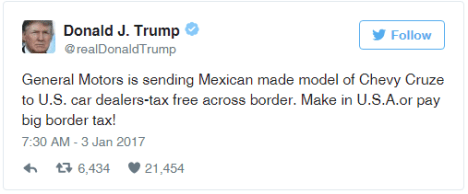
Another one of Kass’s predictions is that Trump’s security advisors finally convince him to stop Tweeting and close down his Twitter account, which causes the stock to drop 20%. Meanwhile this morning, Trump fired a shot across the bow of GM:

trump-gm

GM’s stock is down slightly pre-open, however tweets like this could give investors fits.

Larry Summers is skeptical that any sort of repatriation tax break for companies will find its way into re-investment. His view is that repatriated cash will be used for dividends, buybacks and M&A. Of course if companies don’t think there are opportunities for investment, they will return the money to stockholders, however that isn’t necessarily a given that there are no investment opportunities. Capital Expenditures have been moribund for a decade. You can only put that off so long. Secondly, if the psychology of CEOs changes from being worried about costs to being worried about missing out on business, then you will see more investment.

Iowahawk knows best 1/3/17