

 Brent Nyitray
 Fairlington Blade
 Let the mutherfuker burn!
 jnc4p
jnc4p Kevin S. Willis
 Michigoose
 lmsinca
 markinaustin
 Arcanaut
 novahockey
 quarterback
 ScottC
 yellojkt
Stocks are up this morning as struggling Greek banks get a bit more breathing room. Bonds and MBS are down.
Mortgage Applications rose 2.3% last week, according to the MBA. Purchases were up 5% while refis were up .6% and accounted for 56% of all loans.
Existing Home Sales rebounded to 5.19 million in March, according to the National Association of Realtors. Inventory remains tight at roughly 4.6 months (6 months is considered “balanced”). The median home price was 212,100, which is 7.6% higher than a year ago. The first time homebuyer was 30% of all sales, which is starting to inch up. More inventory and more construction is needed to see these numbers improve. Cash sales as a percent dropped to 24% as professional investors exit and “real” buyers return.
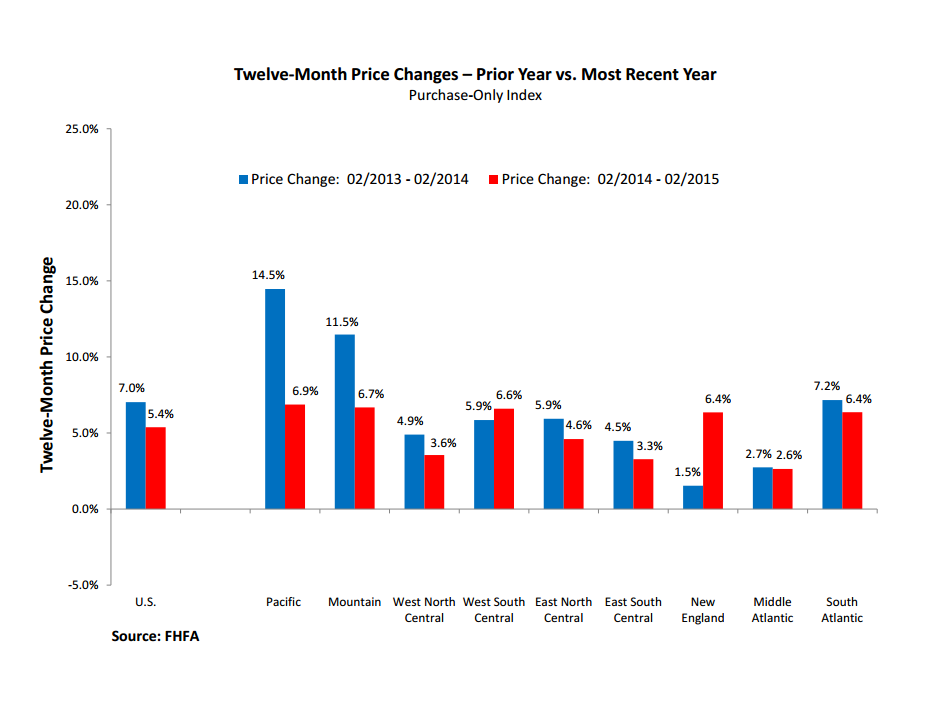
The FHFA Home Price increased .7% in February, well above the .5% expectation. On a year-over-year basis, prices were up 5.4% and we are now within 3% of peak levels, which puts it roughly at January 2006 levels. If you take a look at the geographic returns, the West Coast is slowing down from its torrid pace in 2014, however it is still strong. The bright spot seems to be the turnaround in the Northeast, where home price appreciation is finally higher than the national average. For a long time, Southern California and New England have been polar opposites, with a red-hot market out west and an ice cold market in New England. The big Northeast judicial states appear to be finally cleaning out the inventory of foreclosed homes, which has been weighing on the market.
If you were wondering how Treasury views Fannie mae stock, look no further. Senator Chuck Grassley (R., Iowa) sent a letter to Treasury asking how the government was going to treat Fannie Mae shareholders now that taxpayers have recouped their bailout funds. Treasury’s response – that was not a “loan” that can be paid back – it was an “investment” that should earn a huge return given the risk that taxpayers took. In other words, this will come down to litigation between Fannie Mae shareholders and the government and Fannie Mae stock is a litigation lottery ticket.
The German Bund is the “short of a lifetime” according to Bill Gross. Separately, Paul Singer of Elliott Management characterized the sovereign debt bubble as on par with the subprime bubble. The Fed inflated the stock market bubble which subsequently burst, then inflated a residential real estate bubble to ease the pain of the burst stock market bubble, and then inflated a sovereign debt bubble to ease the pain of the burst residential real estate bubble. As I have said before, stock prices are pricing in a 100% probability that the Fed can raise rates with no one blowing up. Not sure that is a good bet. It also raises on more thing to think about – Hillary’s most formidable opponent will not be the GOP candidate – it will be Janet Yellen.
Filed under: Morning Report |
 All Things in Moderation
Frist! It’s a miracle sense I can’t seem to get here from work anymore.
LikeLike
*since
LikeLike
This story encapsulates so much that is wrong with the US government.
http://www.wsj.com/articles/the-incredible-raisin-heist-1429570964
First, naturally, there is the presence of the unconstitutional regulatory state. The Raisin Administrative Committee? Really? Yes, it is an actual thing in these United States, not the villain in some dystopian novel.
Then there is the perpetual nature of government programs created ostensibly to solve temporary problems. Raisin farmers continue to be saddled with a regulation aimed at supporting prices during the Great Depression some 80 years ago. The deleterious effects of the election(s) of FDR seem to have no end.
Finally, we have judges guided by personal whim rather than by the constitution, particularly in the Ninth Circuit which in this case has come up with 3 separate rationales for denying that the 5th amendment means what it actually says.
(BTW, have there been any studies on which appeals court, and which justices on those courts, produce results that are most often reversed or vacated on appeal?)
LikeLike
Thank goodness the government regulates raisins. They are a national resource, and critical to our national defense. If we do not micromanage our nations raisin production, America as we know it would be over. And won’t someone please think of the children?
LikeLike
I always heard the 9th circuit was the most reversed.
LikeLike
I think there ought to be penalties placed on any judge who issues a ruling that subsequently gets reversed by a unanimous vote of the Supreme Court.
LikeLike
I think there ought to be penalties placed on any judge who issues a ruling that subsequently gets reversed by a unanimous vote of the Supreme Court
Sometimes the Supremes unanimously reverse themselves. What’s a poor lower court judge to do?
LikeLike
Mark:
Sometimes the Supremes unanimously reverse themselves. What’s a poor lower court judge to do?
We’ll make an exception for decisions that actually apply SCOTUS precedent which subsequently gets unanimously reversed. I’m guessing, however, that such instances are vanishingly rare. When the Ninth gets unanimously reversed, I’m pretty confident it’s not because the Supremes, from Scalia to our Wise Latina, have unexpectedly changed their minds out of the blue.
When was the last time SCOTUS unanimously reversed existing precedent?
LikeLike
Scott, I was half joking, but appellate court judges do hate trying to foretell what the Supremes will do and do try to conform their opinions to precedent.
Posner (of course) has written on the political nature of the Supremes, and here he examines the political nature of their unanimous decisions. In passing he notes the higher frequency for which the 9th has been recently unanimously reversed, but points out the frequency is pretty high for all Circuits.
I thought you would like it.
http://tinyurl.com/Posner-on-unanimity
Also, I only recall unanimous reversals of prior precedents from the civil rights era – Brown and Loving come to mind. I am sure there have been more recent ones. Perhaps they can be googled.
Posner implies that this is continuing.
LikeLike
Mark:
appellate court judges do hate trying to foretell what the Supremes will do and do try to conform their opinions to precedent.
I’m sure that is true for some, and maybe even generally true, but from what I have read about the Ninth, there seem to be some judges who just don’t give a crap about either the constitution or precedent. Reinhardt is one that comes to mind.
LikeLike
I always heard the 9th circuit was the most reversed.
In the last 20 years this is definitely true.
LikeLike