Morning Report – Obamacare goes before the Supreme Court 3/4/15

Markets are flattish on no real news. Bonds and MBS are up small.

The ADP Employment number came in at 212k, slightly lower than expectations. The Street is forecasting Friday’s payroll number to come in at 235k. The key number on Friday will be average hourly earnings, not payrolls.

Mortgage Applications rose .1% last week. Purchases were down .2%, while refis were up .5%. Refis as a percentage of applications dropped to 61.5%. A month ago, they were 71.5%.

Great interview with Stuart Miller, CEO of Lennar on CNBC. Key points: Spring Selling Season is just getting started, but initial indications look good, not seeing any sort of slowdown in the energy states, and a hike in interest rates will probably mean the economy (and wages) are improving, so it isn’t necessarily a negative for the builders.

Oral arguments over Obamacare will be heard at the Supreme Court today. At issue is what the term “established by the state” means. 33 states refused to set up exchanges for Obamacare health plans. Does this mean they are ineligible for Federal subsidies? Does “the state” = “the government” or does it mean a particular state?  The Administration is arguing that the intent was to provide subsidies to everyone, even if they didn’t set up an exchange. Others have pointed out emails showing it was meant to be a carrot to encourage states to establish exchanges, and regardless of intent, the law says what it says. If the SC rules for the plaintiffs, the issue gets punted back to Congress to fix, and since Republicans control the House and Senate, there will be a negotiation over the fix. If the SC rules for the Administration, then nothing changes. The decision is expected in June.

The CFPB is going after forced arbitration language in credit card loans, auto loans, etc. So other lenders are going to share in all the fun the mortgage industry has had over the past 5 years or so.

Morning Report – Household formation back to normalcy 3/3/15

Stocks are lower this morning on no major news. Bonds and MBS are down small.

January auto sales are generally coming in below estimates this morning, which has largely been attributed to the weather.

Bad weather in the Northeast didn’t stop the ISM New York survey from jumping to 63.1 from 44.5. This is the highest reading since September.

The IBD / TIPP Economic Optimism Survey rose to 49.1 from 47,5.

CitiGroup is selling its subprime lender OneMain Financial to Springleaf for $4.25 billion in cash. Springleaf is controlled by Fortress. The demolition of the House that Weill Built continues…

Lumber Liquidators fell 25% yesterday after a 60 Minutes report said that there were unsafe levels of formaldehyde (a carcinogen) in its Chinese-made flooring. The company disputes the report and made a filing with the SEC claiming that all of its flooring meets the safety standards set by US regulators. The company blames short sellers for feeding the report to 60 minutes. FWIW, the days to cover has jumped over the past month from about 8 to 14.5. While not quite Herbalife, this one could become a battleground stock.

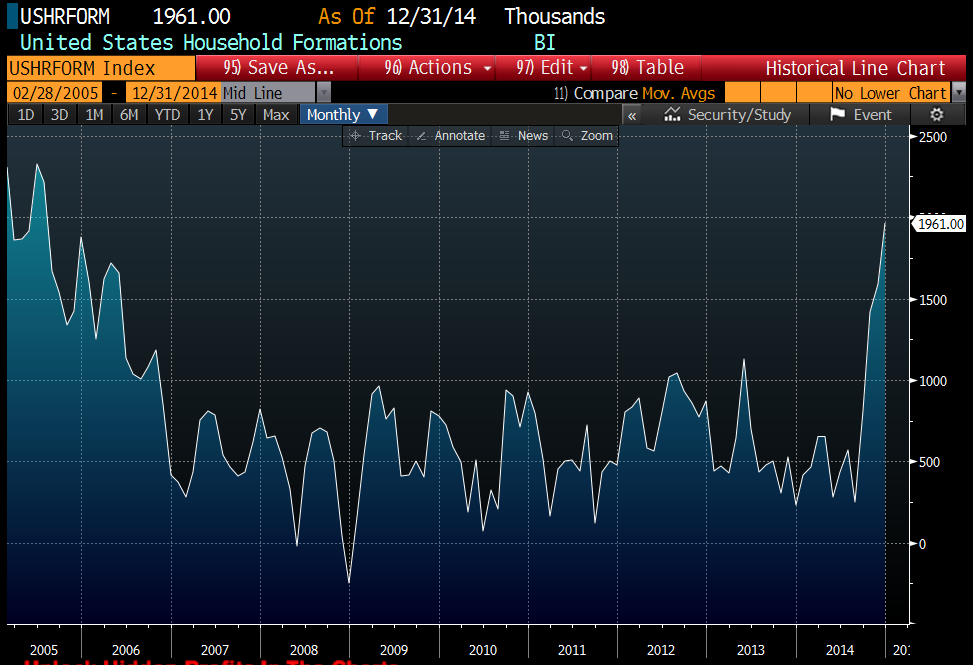
The absence of the first time homebuyer has been an issue for the real estate market, both in terms of transactions and new building. Housing formation has been depressed since 2006 as a combination of unaffordability during the bubble years and a tough job environment for new grads post-bubble has kept household formation low. Note the Millennial Generation is actually bigger than the Boomers – so this isn’t due to fertility rates 25 years ago. It appears that household formation has finally rebounded at long last. Granted, many of these new households will be renters, but it seems like we have at least made the leap back to normalcy (latest reading is just under 2 million) and we are out of this depressed range of 250k – 750k households forming a year. Now if we could only get housing starts back to a normal range of 1.5 million to 2 million, we would be in good shape economically.

Morning Report – The Great American Deleveraging Continues 3/2/15

Markets are flattish this morning on no major news. Bonds and MBS are down small.

Merger Monday is back with a couple of big deals in the tech space. NXP is buying Freescale Semi for 11.8 billion, and HP is buying Aruba Networks for $2.7 billion.

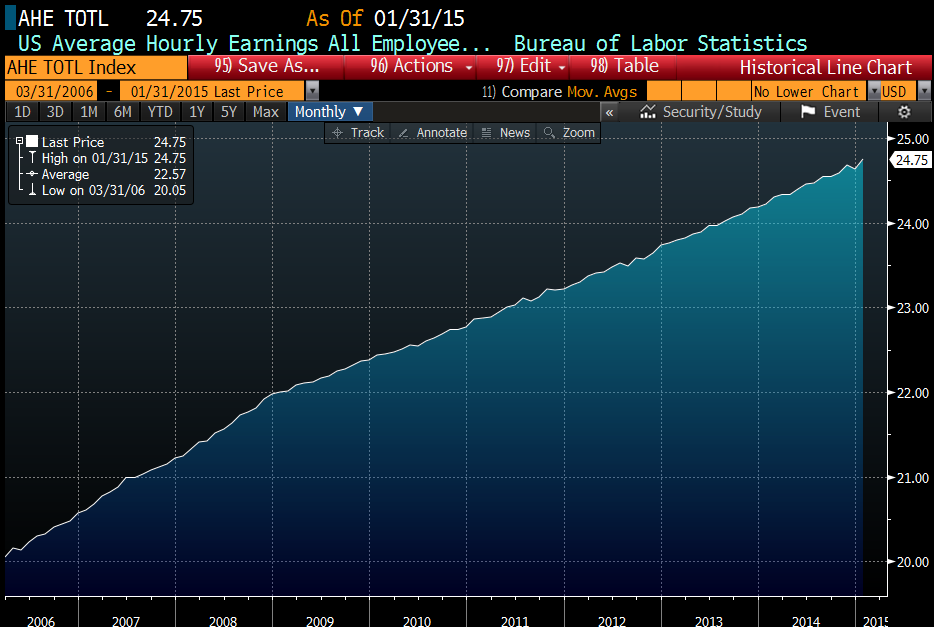
Lots of important economic data this week, but the jobs report on Friday will be the highlight of the week. Bond Markets will be focused on average hourly earnings. Below is a chart of average hourly earnings. Note the change in the slope of the line starting in 2009. That is a change from roughly 3.2% annual growth to 2% annual growth, which is more or less in line with inflation. Later on this week, we will get non-farm productivity, which is expected to fall, and unit labor costs which are expected to increase 3.3%.

Personal Income rose .3% in January, which was below expectations, but flat with December. Wages and salaries were up .6%, which was a big increase from the .1% reading in December. This tends to be a volatile component however, so don’t read too much into one data point. Disposable income rose .9%. The savings rate increased to 5.5% from 5% last month as well.  Personal spending fell .5%, however that was partially driven by lower energy prices. Stripping out food and energy, spending increased .1%, which is pretty much in line with what we have been seeing. The punch line: The Great American Deleveraging continues. As incomes increase, that money is used to pay down debt or is getting put in the bank. Investors hoping for another late 90s or mid aughts debt-driven consumption boom are probably going to be disappointed.

Construction Spending fell 1.1% in January, a disappointment. December was revised upward from .4% to .8%. Month to month numbers tend to be volatile. Where is the money going? Lodging, office and commercial space as well as manufacturing. Also public infrastructure spending with increases in transportation, and sewage. Where is it not going? Residential (still). Given the price increases and the current tight inventory, you should expect to see more homebuilding. If the personal income numbers continue to improve that will hopefully change.

Note that optimism about 2015 construction is the highest in 20 years, according to Wells Fargo. Nonresidential construction is the driver, not resi however. Still, that means we are finally seeing some capital expenditures which is encouraging.

The ISM Manufacturing PMI dropped in February to 52.9 from 53.5. The West Coast port slowdown is impacting exporters. The current level of 52.9 corresponds to a GDP growth rate of 3.1%.

Stanley Fischer is telling the markets not to get used to being spoon-fed by the FOMC. Once rates start increasing, the guidance will become more and more murky.

Warren Buffet’s annual letter to shareholders is out. There is nothing earth-shattering in the letter, except for the usual schedule of events for Buffetapalooza, where you can try to throw a newspaper more accurately than Warren. No mention if he is going to bust out the ukulele and jam with the Fruit of the Loom guys however.