

 Brent Nyitray
 Fairlington Blade
 Let the mutherfuker burn!
 jnc4p
jnc4p Kevin S. Willis
 Michigoose
 lmsinca
 markinaustin
 Arcanaut
 novahockey
 quarterback
 ScottC
 yellojkt
Stocks and bonds are lower after yesterday’s furious post-FOMC rally. MBS are flattish.
Initial Jobless Claims rose to 291k from 290k last week. Consumer comfort fell to 51.5 from 54, according to the Bloomberg Consumer Comfort Index. In other economic indicators, the Philly Fed Index was largely flat at 5, while the Index of Leading Economic Indicators was flat at .2%.
The Fed did indeed remove the word “patient” from the FOMC statement. However, they noted that growth moderated, which is unsurprising given the weather in the Northeast. They did take down their economic projections for unemployment, GDP, and inflation. 2015. GDP is now forecasted to be in the 2.3% – 2.7% range, which was revised lower from their 2.6% – 3.0% forecast at the December 2014 meeting. Unemployment was taken down to 5.0% – 5.2% from 5.2% to 5.3% in December, and inflation was taken down to 0.6% to 0.8% from 1.0% to 1.6%.
The dot graph was what got the markets all excited. The Fed is forecasting a flatter trajectory to higher rates than they were in December. In the march dot graph, it looks like the median projection by the members is 50 basis points for a year end Fed Funds rate.

Compare that to the December forecast, where the median was closer to 75 basis points or so.
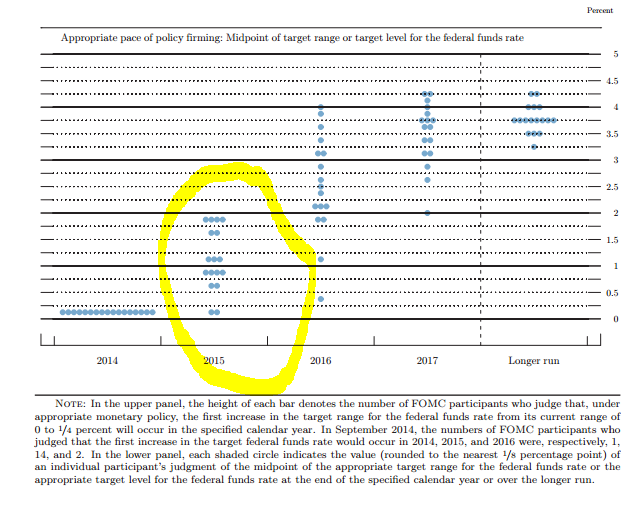
It looks like the 2016 and the 2017 forecasts are slightly lower as well. These dot graphs are what got the market going (although a major bond rally in Europe yesterday probably contributed to the move). Note the makeup of the FOMC is different now than it was in December, and decidedly more dovish. The flatter trajectory for higher rates clearly calmed the markets. The Fed made no change in its plan to shrink its balance sheet. For the time being, they will continue to re-invest maturing proceeds back into Treasuries and MBS.
Homebuilder Lennar reported good earnings this morning. Revenues were up 21%, while gross margins held up surprisingly well at 23.1%. Average selling prices increased about 3% to 326k, which shows that builders have hit the ceiling on price hikes. Incentives increased slightly. New orders were up 18% in units and 25% in dollar value.
Stuart Miller, Chief Executive Officer of Lennar Corporation, said, “Despite severe weather conditions which constrained production and sales in parts of the country, the housing market continued its slow and steady recovery. Early signals from this year’s spring selling season indicate that the housing market is improving, and disappointing single family starts and permits numbers should rebound shortly. The sizable production deficit of the past years continues to drive demand improvement in spite of the constrained mortgage market.”
Lennar will hold a conference call this morning around 11:00 am. The stock is up about a buck and quarter (or about 2.5%)
Filed under: Morning Report |
 All Things in Moderation
Re: SGR, the a change to Medigap first dollar coverage. thanks jeebus.
LikeLike
Frist!
That is all (for now).
EDIT: Dang it, NoVA!!
LikeLike
Mark – this may be of interest to you.
http://www.slate.com/articles/news_and_politics/jurisprudence/2015/03/david_dow_support_from_300_lawyers_petition_to_texas_supreme_court_to_overturn.html
LikeLike
Yes, Dow’s “suspension” is suspect, but for no other reason than it is outside the authority of the C Crim App.
His office has repeatedly mishandled death pealty appeals.
For example, CJ Keller was properly criticized in the Richard case [you know it as the 5PM closing case] but not for the right reason. The duty judge was Cheryl Johnson, long time client and friend of mine. Neither Dow nor the Clerk nor Keller notified Cheryl about the proposed late filing, which Cheryl would have granted as a matter of course, in the light of the SCOTUS granting of cert in two similar cases that day. It was Dow’s duty to notify Cheryl, first, the clerk’s duty, second, and CJ Keller’s duty third. As much as I disapprove of CJ Keller, I don’t think much of Dow.
This latest incident was one of many, for Dow. But it should have resulted in the Court of CrimApp petitioning the TX Supremes, not sanctioning Dow on its own by suspension. Alternatively, the CourtCrimApp could have held a contempt hearing and probably found Dow in contempt, and if he had a different interpretation of the filing rules [he does] he could have appealed his contempt conviction and fine to the TX Supremes.
LikeLike
Some of you may need to remodel next time you replace a water heater in a closet or an attic.
Who knew that the standard storage tank water heater needed a makeover? But that’s what’s coming April 16, 2015. This change could limit which water heaters are available for you to choose from, and increase the cost.
Per the National Appliance Energy Conservation Act, water heaters manufactured after April 16, 2015, must meet new energy requirements. This goes for gas, propane, oil and electric water heaters. But this win for conserving energy and reducing emissions is not without growing pains.
According to the U.S. Department of Energy, new mandatory standards will “result in approximately $63 billion in energy bill savings for products shipped from 2015-2044. The standard will avoid about 172.5 million metric tons of carbon dioxide emissions, equivalent to the annual greenhouse gas emissions of about 33.8 million automobiles.”
Out with the old
Improving energy conservation is better for the environment and benefits all of us in the long run. And a more efficient use of energy can reduce utility costs for the average home owner.
All the ways that future water heaters will change are still unknown, but manufacturers say there are some things we should be aware of as the deadline approaches. After April 16, only water heaters that meet the new NAECA standard will be manufactured. This doesn’t mean that non-conforming water heaters can’t be sold or installed, but once the old stock is gone, it’s gone.
After the deadline, if you want a water heater that meets the new standards you should specify this to ensure you don’t receive one of the older models.
Expect the unexpected
Though these water heaters are going to improve efficiency, it won’t come without a price.
Size
Some models will no longer be built, so there will be fewer options when it comes to size and specific products.
As an example, a standard 50-gallon gas water heater from one manufacturer will increase in diameter as much as two inches. Not a big deal where there is plenty of clearance … but we’ve run into plenty of water heater installations where there isn’t even half an inch to play with.
If your water heater is in a narrow closet or other space with no room to spare, this could make a big difference.
That access through a tight opening; a spot squeezed between the furnace and the garage wall; the enclosure with zero clearance to three sides of the tank … in all of these situations, a minor increase in the size of the water heater could dramatically affect whether a replacement would fit, or need to be completely relocated.
Manufacturing cost
Another added cost will come from manufacturing to the new standards. We may see various water heaters equipped with additional energy-saving technology. This could be anything from more insulation to an electronic ignition system that replaces a conventional standing pilot on gas models.
Gas water heaters over 55 gallons will need to incorporate condensing technology to meet the new requirements. For electric water heaters over 55 gallons, it may mean a heat pump water heater to gain the required EF (Energy Factor) rating. One manufacturer we work with has told us to expect these changes to increase production costs from 10 to 30 percent.
Manufacturers are doing their best to produce products that can directly replace the old models and still meet the new standards. However, some water heaters will not be a standard “drop-in” replacement and will require additional work to install.
LikeLike
NoVA, as usual your theory on Boehner going to Pelosi to jam the Senate Democrats makes a lot more sense than Waldman’s blather.
LikeLike
I thought this was interesting, re the Dolce & Gabbana/Elton John uproar:
Speaking as two donor-conceived young women—alive because of reproductive technologies—we felt an urgent need to respond…in support of Dolce and Gabbana…
I am indeed a human being. My liver, heart, hair, and enzymes all work the same. I’ve discovered it is my psychology that is different and not-quite-right, due to my conception. It’s not a matter for doctors to fix; it’s a spiritual problem. My father accepted money, and promised to have nothing to do with me. My mother was wonderful and I have always loved her deeply, as she has loved me. But my journey is a battle against the void left by my father’s absence, and a particular disability in understanding the difference between sacred and commercial, exploitation and cooperation. Those torments for me far outweigh any social stigma or momentarily painful gossip I’ve endured from ignorant people.
http://thefederalist.com/2015/03/19/we-are-synthetic-children-and-we-agree-with-dolce-gabbana/
LikeLike
Mark, what is your theory for the mandated change in water heaters?
LikeLike
Apparently it went through APA and the mfrs were OK and consumer groups either did not know the unintended consequences or did not care loudly enough.
Or: IDK.
It was conjured by a regulatory agency, of course. Congress set the initial efficiency standards at the start of the act then set a schedule for the United States Department of Energy to review them.
LikeLike
What would you say if I posited that this is a prime exame of regulatory and legislative capture?
LikeLike
As stupid as I think the result is, once Congress delegated and the Agency properly published and took comment, it was all part of our glorious system.
I believe that this consequence should have been debated in the publication process. If it wasn’t, the process should be reopened.
LikeLike
Mark:
As stupid as I think the result is, once Congress delegated and the Agency properly published and took comment, it was all part of our glorious system.
I disagree. It is not a part of our system at all. It is entirely an a-/un-cnostitutional process. Regulatory agencies have no constitutional authority to set standards for anything, and congress has no constitutional authority to delegate that task to anyone else, much less a non-democratic functionary of the executive branch.
I believe that this consequence should have been debated in the publication process. If it wasn’t, the process should be reopened.
I believe it should have been debated and voted on by our actual elected representatives. That is how law is supposed to be created as per the constitution.
LikeLike
McWing:
What would you say if I posited that this is a prime exame of regulatory and legislative capture?
I’d say you are on to something.
LikeLike
Mark, is that a yes?
LikeLike
Honestly, George, IDK. I would have a better feel for that if I poured through the comments at the Federal Register. I know that it could be, of course.
Scott, from what I recall, dimly, the first delegation case that truly breached the wall you and strict constructionists pose between the legislative and executive branches was the delegation of tariff making authority in the early 1890s. So now it is the way our glorious system has worked since before any of our parents were born. And, of course, rule making authority for the federal court system has been divided between Congress and the Supremes on a “nobody squeeze too hard” basis since the founding.
LikeLike
Mark:
Scott, from what I recall, dimly, the first delegation case that truly breached the wall you and strict constructionists pose between the legislative and executive branches was the delegation of tariff making authority in the early 1890s.
It is not a wall that I pose. It is a wall pretty clearly written into the constitution. Congress, not the executive, is charged with making new laws.
LikeLike
Mark, are you saying regulatory and legislative capture only started in the 1890’s or that you are unclear if the new water heater mandates are an example of regulatory capture?
LikeLike
Funny, George – but to be serious, it could be that the Energy Department fashioned the reg to suit the appliance mfrs – IDK.
LikeLike
The water heaters is the same BS as the toilets & light bulbs.
Someone needs to start running bootleg heaters across the border.
LikeLike
JNC, did you see my answer to you on Dow’s “suspension”?
LikeLike
Would you say that’s the logical answer unless new facts come to light? IE, regulatory capture is the default reason?
LikeLike
Mark:
BTW, I don’t think one needs to be a “strict constructionist” to see that the constitution doesn’t authorize the executive branch to make law. The argument that the executive branch should be making law is not an instance of “loose” or “easy” constitutional interpretation, but is rather a rejection of the fundamental philosophy that animates the constitution in the first place, namely the separation of powers.
LikeLike
Ok, thanks Mark. My default is that it’s regulatory capture.
LikeLike