Morning Report – Lots of labor data 9/4/14

Markets are higher this morning after the ECB cut rates to 5 basis points and committed to start buying securitized debt and covered bonds in October. Bonds are flat as this decision had been priced in already.

Just something to think about – the “buy the rumor, sell the fact” effect. In other words, the big move for ECB QE was over the past six months, and it wouldn’t be surprising to see a sell-off in sovereigns as the announcement is out of the way and speculative players unwind their positions. Euro sovereigns are driving the US bond market at the moment.

Fun fact, 45% of global sovereign bonds yield under 1% according to Bank of America.

Denmark just cut its deposit rate to negative 5 basis points. They are in the throes of a burst real estate bubble.

The ISM Non-Manufacturing index rose to 59.6, the highest since August 2005. The manufacturing index rose to 59, and would correspond to a GDP growth rate of 5.2%. Of course manufacturing doesn’t have the impact on the US economy it used to, but still….

ADP is forecasting the economy will add 204,000 jobs in August. ADP has been spot-on the last couple months. The Street is forecasting 215k tomorrow.
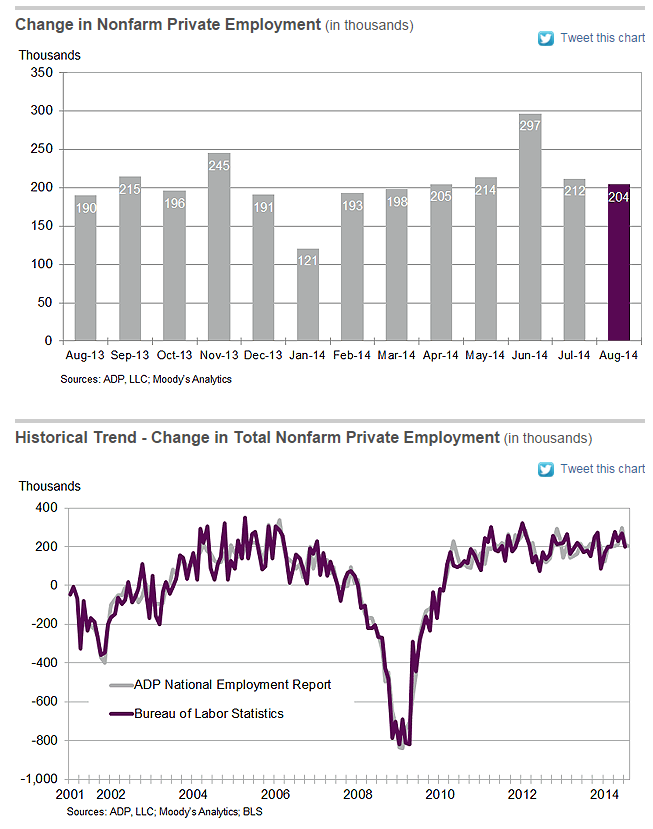
 ADP employment

In other labor market data, announced job cuts fell 21% according to outplacement firm Challenger, Gray and Christmas. Unit Labor Costs fell .1% in the second quarter as productivity rose 2.3%. Finally, initial jobless claims ticked up slightly to 302,000. Initial Jobless Claims levels are back to boom-time levels, and as a percent of the population are back to levels not seen since the late 1960s.
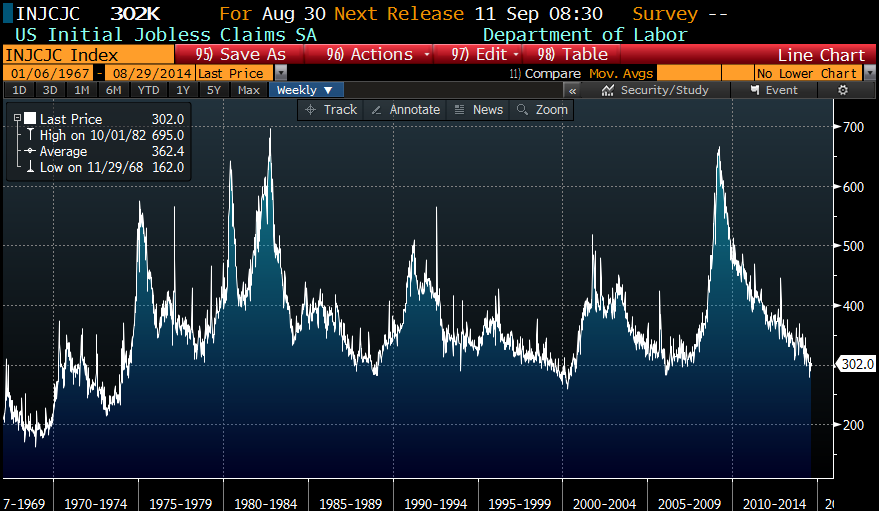
 Initial Jobless Claims long term

What is holding back wage inflation? Pent-up deflation. As Keynes pointed out, during recessions wages should fall as the demand for labor falls. However, employers are loath to cut pay (a phenomenon called sticky wages) which means that by not cutting wages, employers are overpaying during a recession. As the recovery builds steam, therefore they are not feeling pressure to raise them either. Interesting theory, and one thing the researchers say is that once this runs its course, wages could rise more quickly than economic models suggest as businesses that kept wages low for too long are forced to play catch up. This may in fact be what was behind the language in the FOMC minutes about there being less slack in the labor market than people think. We will see tomorrow with the jobs report. Separately, the average weekly hours worked by a full time employee inched up to 46.7 hours.

Constitutional Authorization

A question for all….

The powers of the congress are layed out in Section 8 of Article I of the constitution, which reads as follows:

The Congress shall have Power To lay and collect Taxes, Duties, Imposts and Excises, to pay the Debts and provide for the common Defence and general Welfare of the United States; but all Duties, Imposts and Excises shall be uniform throughout the United States;

To borrow Money on the credit of the United States;

To regulate Commerce with foreign Nations, and among the several States, and with the Indian Tribes;

To establish an uniform Rule of Naturalization, and uniform Laws on the subject of Bankruptcies throughout the United States;

To coin Money, regulate the Value thereof, and of foreign Coin, and fix the Standard of Weights and Measures;

To provide for the Punishment of counterfeiting the Securities and current Coin of the United States;

To establish Post Offices and post Roads;

To promote the Progress of Science and useful Arts, by securing for limited Times to Authors and Inventors the exclusive Right to their respective Writings and Discoveries;

To constitute Tribunals inferior to the supreme Court;

To define and punish Piracies and Felonies committed on the high Seas, and Offences against the Law of Nations;

To declare War, grant Letters of Marque and Reprisal, and make Rules concerning Captures on Land and Water;

To raise and support Armies, but no Appropriation of Money to that Use shall be for a longer Term than two Years;

To provide and maintain a Navy;

To make Rules for the Government and Regulation of the land and naval Forces;

To provide for calling forth the Militia to execute the Laws of the Union, suppress Insurrections and repel Invasions;

To provide for organizing, arming, and disciplining, the Militia, and for governing such Part of them as may be employed in the Service of the United States, reserving to the States respectively, the Appointment of the Officers, and the Authority of training the Militia according to the discipline prescribed by Congress;

To exercise exclusive Legislation in all Cases whatsoever, over such District (not exceeding ten Miles square) as may, by Cession of particular States, and the Acceptance of Congress, become the Seat of the Government of the United States, and to exercise like Authority over all Places purchased by the Consent of the Legislature of the State in which the Same shall be, for the Erection of Forts, Magazines, Arsenals, dock-Yards, and other needful Buildings;—And

To make all Laws which shall be necessary and proper for carrying into Execution the foregoing Powers, and all other Powers vested by this Constitution in the Government of the United States, or in any Department or Officer thereof.

Which of these explicit powers authorizes the creation of (to take just one of many examples) the Environmental Protection Agency and the law/regulations that it promulgates?

Morning Report – Where’s the beef? 9/3/14

Markets are stronger this morning as tensions ease in Ukraine. Bonds and MBS are down small.

The ISM New York Index fell to 57 from 68, while factory orders rose 10.5%.

Luxury builder Toll Brothers reported earnings this morning. The luxury end of the market is doing just fine, with deliveries up 53% in dollars and 36% in units. ASPs increased 12% to 732k. Net signed contracts fell however, and the average price for signed contracts increased only 1.4% year-over-year, Perhaps we have seen the point where buyers are finally balking at higher prices.

Mortgage Applications rose .2% last week. Purchases fell 1.5% while refis rose 1.4%. Refis are back up to 57% of total number of loans.

Part of the reason why purchases are slipping is due to seasonality, however mortgage rates have not been falling with Treasury rates. The average 30 year fixed rate mortgage has been stuck in the same 4.1% to 4.2% range for the past 3 months, while the 10 year has rallied from 2.6% to 2.34%. The last time rates were this low, the average 30 year fixed rate mortgage was 3.93%. I think there are two things going on here – first I think banks view this move in rates as being driven by overseas events and therefore temporary. Second, I think that lenders are taking more risk than they were a year ago, which means higher rates on average.

Have you noticed that chocolate bars are getting smaller? That your “pint” is no longer a pint at your local watering hole? Welcome to shrinkflation, a state of affairs where companies maintain the same price, but give you a little less. We saw this movie before in the 1970s and 1980s, which was captured quite eloquently in Wendy’s “Where’s the Beef” ad campaign. This actually started in the 1970s, and shows that inflation can take two forms – price increases and quantity (or quality) decreases.

Morning Report – Short week, but lots of data 9/2/14

Markets are higher this morning on no real news. Bonds and MBS are down.

Short week, but a lot of important economic data. Today, we get the ISM Manufacturing Survey and Construction Spending. On Thursday, we get the ISM Non-Manufacturing Index, and on Friday, we get the jobs report. Between the data and European events we could have a volatile week for rates.

The ISM Manufacturing Index rose than expected, while the ISM prices paid index dropped. Production and New Orders jumped. Employment ticked down slightly. The production and new orders numbers bode well for 3Q GDP.

Construction spending rose 1.8% month-over-month as residential construction increased .7% and non-residential rose 2.5%. Of private residential construction, 52% was single family construction, 12% was multi-fam, and 36% was home improvement.

The IBD / TIPP Economic Optimism Index rose slightly, but came in a bit light. Note that this Thursday we will be getting same store sales from the retailers and back-to-school shopping numbers. BTS is a good indicator for holiday shopping. We have seen strong consumer sentiment numbers, but so far that hasn’t translated into actual spending.

Euro sovereigns are weaker this morning, which means US Treasuries are weaker. Speculation over whether the ECB will start quantitative easing is going to be driving bonds as much, or even more, than US economic data. Note that hedge funds are getting long Treasuries. It finally happened. People are momentum trading bonds.

Angelo Mozillo has no regrets over what happened with Countrywide. As he puts it: “Countrywide didn’t change. I didn’t change. The world changed.” Compared to other CEOs of that era, Mozillo has not shied away from the public spotlight. The US Attorney’s Office in Los Angeles is suing him now.

Finally, I appeared on Louis Amaya’s Mortgage Markets Today show last week and discussed interest rates and the housing market. The full interview is here.