Morning Report – More unintended consequences of ZIRP 7/22/14

Stocks are higher this morning as earnings reports pour in. Bonds and MBS are flat.

Existing Home sales rose 2.6% month over month to an annualized 5.04 million pace, according to NAR. The median home price rose to $223.3k (up 4.3% YOY), while the average price rose to $269.1 (up 3.1% YOY). Distressed sales accounted for 11% vs 15% a year ago, while the first time homebuyer slipped a point to 28%. All cash deals were basically flat at 32%, and days on market rose from 37 to 44. The housing market is becoming more balanced as inventories are increasing and prices are leveling off.

Home prices rose .4% in May, according to FHFA. This is up 5.5% year-over-year. Remember the FHFA index only looks at homes with conforming mortgages, so it is a narrower index than Case-Shiller. The West Coast performed the best, and the Midwest / Mid-Atlantic performed the worst.
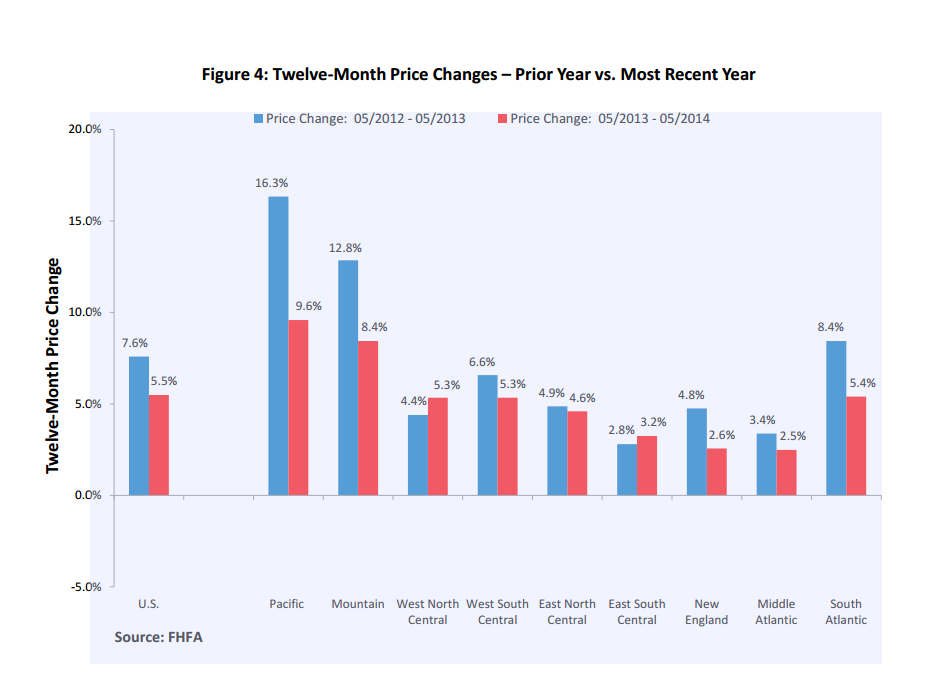
FHFA HPI Geographic

The Consumer Price Index came in at .3%, bang in line with expectations. Ex-food and energy, it rose .1%. On a year over year basis, the CPI headline number increased 2.1% and ex food and energy it was 1.9%, more or less where the Fed would like to see the inflation numbers. Note that the Fed prefers to use PCE (Personal Consumption Expenditures) not CPI.

A good backgrounder on Bloomberg about returning vets and VA loans. The VA’s share of new mortgages is at a 20 year high. The stat that jumped out at me was this: VA loans accounted for 8.1% (just under $20 billion) of mortgages made in the first quarter. Last year, VA’s share in Q1 as 6.9% and 10 years ago it was under 2%. The record was 28% in 1947. VA and FHA are tailor made for the first time homebuyer, who wants to buy, but feels shut out of the market.

Speaking of first time homebuyers, here is another article discussing how the economy is depressing birth rates, which would influence household formation numbers. Classic catch-22: The economy needs the housing sector to at least get back to historical norms, but the first time homebuyer is the key to that and they won’t get in until the economy improves.

As a follow-up to yesterday’s comment about the Fed and their belief that (a) low interest rates don’t cause bubbles, and (b) bubbles can be prevented by smart regulation, the appetite for second-lien junk is increasing. Formula One is paying L+6.75 for a $1 billion covenant-light junior loan. Second lien paper is yielding about 9%, while first-lien is yielding about 5.3%. Interestingly, the better credit spreads are widening, while the junkier stuff is tightening. This is of course the unintended consequence of ZIRP, and the biggest risk for 2015 / 2016. The markets are blithely assuming the Fed can start raising rates without any negative consequences for the economy. The economy shook off the end of QE, so there is reason for hope, but I wouldn’t rule out someone big blowing up as rates start increasing, and it will be the junkiest stuff that gets hit the hardest.

Morning Report – What fair lending laws really do 7/21/14

Markets are lower this morning on no real news. Bonds and MBS are up small.

Earnings season kicks off in earnest this week, with a lot of market heavyweights reporting. With the stock market at record highs, it is vulnerable if companies start missing or guiding down for the second half of the year.

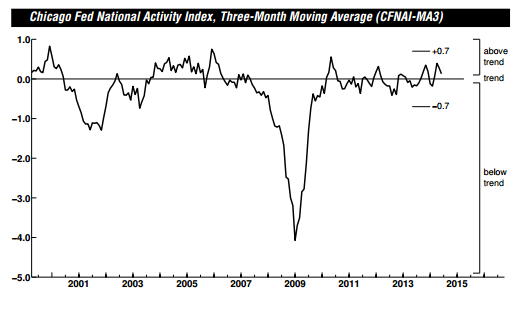
The Chicago Fed National Activity Index decreased to .12, lower than estimates. May was revised downward as well. Production indicators were flat, however employment was a big positive contributor. This index is notoriously volatile, so it makes sense to look at the 3 month moving average, which has been declining over the past couple of months.

Chicago Fed Natl Activity Index

As bonds have rallied these past couple of week, mortgage rates have gone up. The spread between the Bankrate 30 year fixed rate mortgage and Treasuries has blown out. Not sure why this is happening – TBAs have been rallying with bonds, so it isn’t necessarily MBS related. It could simply be something funky with the data which will get corrected. Another possibility is that mortgage bankers are moving out on the risk curve and doing loans they would have turned down a year ago.

Mortgage spreads

Jamie Dimon’s comments about ending FHA loans raises questions about how it can meet its CRA goals. If it doesn’t do FHA loans, it will have to portfolio some more CRA loans. Jamie Dimon said on the conference call regarding fair lending quotas: “Yes, if you don’t do any FHA, that hurts you a little bit. But to do FHA and lose billions of dollars, that’s a whole different level of shareholder irresponsibility.” Implicit in that statement is the idea that CRA loans are losers and a cost of doing business. Which flies in the face of the standard fair lending talking points that banks are avoiding perfectly good loans out of racism. The truth is that the fair lending advocates are forcing banks to subsidize low income borrowers. Who pays? Everyone else who has a mortgage. It would be nice if the government was intellectually honest about CRA loans – saying we want low-income people to get mortgages, we don’t want banks to fully charge the borrower for the added risks they represent, and we don’t want to pay for it. So we will force other borrowers to subsidize these loans. The government is simply being generous with other people’s money.

Speaking about talking points, one of the big ones out of the Fed is their belief that bubbles are (a) not caused by too-low interest rates and (b) regulation of banks can prevent them from taking risks they shouldn’t be taking. This theory is being tested as we speak, in the high yield market. The issue is that when rates are super-low, investors HAVE to move out on the risk curve to make any money. The demand is there. Think about it this way: if you are an insurer or pension fund, the actuarial tables couldn’t care less that money is free. You still have to hit your return bogey. And if you can’t do it in low-risk products, you’ll have to do it in high risk products.

Liberal Linguistic Lies

I have long believed that a key component of the left’s political success over the last century has been its masterful use of deceptive language to frame both issues and their own political positions in ways that make them much more palatable to an unthinking public than they otherwise would be if they were presented more honestly. Indeed, even the use of the term “liberal” to characterize themselves is a bit of a deception in historic terms, since liberal originally indicated someone who favored free trade and limited government, quite the opposite of what liberals have now become. Anyway, with that in mind, I have cobbled together a list of common liberal linguistic lies of our modern age. Feel free to add to the list.

1. Women’s Health – When liberals speak about “women’s health” in a political context, they aren’t really talking about the health of women. They are actually speaking about abortion. So when someone says, for example, that “It’s time to remove politics from women’s health care”, what they really mean is “Abortion should be legal and immune to the processes of democracy.”

2. Reproductive rights/freedom – Like “women’s health”, this is just another liberal euphemism for abortion. Which is a bit bizarre if you think about it, because, if one did not already possess the freedom/right to reproduce, how could one possibly be in a position to need/want an abortion?

3. Marriage Equality – We’ve talked about this one extensively here at ATiM in the past. “Marriage equality” actually has nothing do with equal rights to marry, as liberals try to deceive us into believing, but is instead a call for changing the very definition of marriage from what it has always been to something new such that it can encompass homosexual relationships. Throughout US history homosexuals have always had the very same right to marry someone of the opposite sex that heterosexuals have had. But what they want is a new right, namely the right to “marry” someone of the same sex. Since, due to the very meaning of the term “marriage”, no one, not even heterosexuals, has ever had that right ever before in the US, what they want is not “equality” but rather a new conception of the notion of marriage.

4. War on (fill in the blank) – When liberals say that someone is engaging in a War on X, they don’t mean that one is literally or even figuratively waging a war on X. They simply mean that the person disagrees with them over some political issue that is really important to them. And often the issue isn’t even related to X. For example, the War on Women usually refers to just advocacy for stricter abortion laws. When Obama spoke of Bush’s War on Science, what he really meant was that he had a moral/ethical disagreement with regard to what the government should be funding.

5. Deny – The other day, following SCOTUS’ Hobby Lobby decision, Democrat Elizabeth Warren characterized the decision as giving corporations the power to “deny their employees access to birth control.” Of course the court gave no such power to “deny access” to anything at all. What she actually meant was that the court recognized that certain corporation owners have the right not to have to pay for certain kinds of birth control that are, nonetheless, still legally accessible to their employees. And this is not an isolated instance of such an idiosyncratic use of the term “deny” by liberals. For example, if one thinks that the government shouldn’t dictate what an employer has to pay employees, then one wants to “deny equal pay to women”.

6. invest/subsidize – Liberals often use the word “investment” when what they actually mean is “subsidy”, and then they use “subsidize” when what they actually mean is “not force to pay more money”. So when the government gives money or guarantees to companies like Solyndra and Tesla, it is “investing”, but when doesn’t raise the minimum wage, it is “subsidizing” corporations.

Morning Report – House Prices Overvalued? 7/18/14

Markets are higher this morning after yesterday’s bloodbath. Bonds are down, but still firmly below the 2.5% level. This has the feel of a summer Friday, where the senior traders are bolting for the beach around noon and the rest of the traders are watching the British Open and not their screens.

The catalyst for the sell off yesterday was the Malaysian jetliner that was shot down over Ukraine. Ukraine and Russia are blaming each other for the incident. We had a typical “risk off” trade, where investors sold stocks and bought Treasuries. Yesterday was the first – 1% down day in the market since April. The VIX spiked to 14.5, again the highest reading since April.

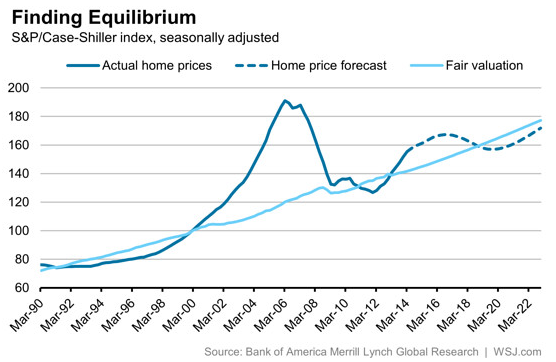
Merrill Lynch thinks home prices are overvalued and will go nowhere over the next few years. Home prices were undervalued about 6% relative to incomes at the end of 2011, and have now rebounded to levels that are 9.7% overvalued. Of course all real estate is local, and there is always the possibility that incomes begin to rise as the labor market tightens.

case-shiller fair value

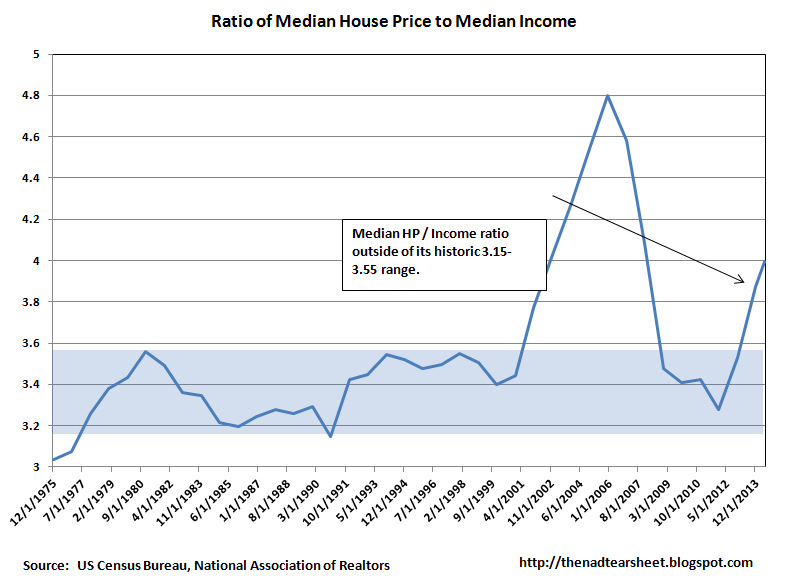
For what its worth, I kind of come to the same conclusion, using the median income to median price ratio. The historical ratio of median house price to median income has been in the low 3s. Current median income is around $53,300. The median home price according to NAR is 213,400, so the ratio is 4x, a bit higher than its traditional 3.15 – 3.55x range.

Median House Price to Median Income Ratio

One note of caution with this analysis: the extremes of the housing market (distressed and luxury) have accounted for the majority of transactions. In other words, the median house price is distorted. That said, I do not think we will see meaningful home price appreciation until incomes start rising.

Morning Report – Bad housing starts number 7/17/14

Markets are lower this morning after a lousy housing starts numbers. Bonds and MBS are rallying, with the 10 year below 2.5%.

Housing starts came in at 893k, the lowest level in 10 months. Building Permits came in at 963k, a disappointing number as well. Housing continues to punch below its weight, and is the biggest reason why the economy is not experiencing the robust recovery it should be. That said, it looks like all of the decline was in the South – the rest of the geographic areas were flat / up. This is a hard number to reconcile with the NAHB confidence number of 53. It shows that builders are happy to increase the top line through raising prices, not pushing through volume.

In other economic news, initial jobless claims fell to 302k, the Bloomberg Consumer Comfort index fell to 37.5 and the economic expectations index fell to 46. Philly Fed rose to 23.9 from 17.8.

Microsoft is shedding 18,000 jobs. Most of the cuts will be in the Nokia handset area.

Another major merger in the news: Reynolds America is buying Lorillard. Both stocks got whacked on the deal.

The DOJ and Bank of America remain at loggerheads over a settlement over mortgage backed securities. These securities mainly came from Merrill Lynch, who was bought by Bank of America during the crisis. The government pushed these mergers, and is now pleasing the populist peanut gallery by coming after the companies for doing what was requested in the first place.

Treasury Secretary Jack Lew is accusing CEOs and Boards who pursue their fiduciary duty of maximizing shareholder value of lacking “economic patriotism.” Yes, it has come to this. And of course Congress has a plan to limit this. The number that stuck out: $20 billion – the amount of money closing the loophole would raise over 10 years. In budgetary terms, $2 billion a year is rounding error. If the potential revenue is that small, maybe people should think about cutting corporate tax rates so that we are closer to the rest of the world. Certainly not possible before the election, but maybe after.

Morning Report – JP Morgan exiting FHA? 7/16/14

Vital Statistics:

Last Change Percent
S&P Futures 1976.4 8.4 0.43%
Eurostoxx Index 3197.4 43.7 1.38%
Oil (WTI) 100.8 0.8 0.79%
LIBOR 0.234 0.001 0.21%
US Dollar Index (DXY) 80.56 0.173 0.22%
10 Year Govt Bond Yield 2.56% 0.01%
Current Coupon Ginnie Mae TBA 106.3 -0.1
Current Coupon Fannie Mae TBA 105.3 0.0
BankRate 30 Year Fixed Rate Mortgage 4.25

Stocks are higher this morning on good numbers out of Apple and Intel, along with news that Fox approached Time Warner for a deal. Bonds and MBS are down.

Mortgage Applications fell 3.6% last week. Purchases were down 7.6% and refis were down .1%. Interestingly, the 30 year fixed rate mortgage increased by a basis point while the 10 year bond yield fell 11 basis points. Not sure what to make of that.

Some disappointing industrial data this morning – Manufacturing production increased .1% versus expectations of a .3% increase and May was revised downward. Capacity Utilization was flat at 79.1%, while the Street was expecting an increase to 79.3%.

Inflation remains relatively tame, although the headline PPI number came in a little hot. On a year-over-year basis inflation at the wholesale level remains under the Fed target. Janet Yellen gave relatively dovish testimony yesterday at Humphrey-Hawkins, which continues today. We will also get the Beige Book this afternoon.

JP Morgan is considering getting out of the FHA business. CEO Jamie Dimon said on the second quarter earnings conference call that the bank lost “a tremendous sum of money on FHA… So the real question is, should we be in the FHA business at all? We are still struggling with that.” Consider this a brush-back pitch to the government, who has been suing the banks left and right (which is one way to impose a financial surtax).

In merger mania, Rupert Murdoch is willing to pay more than $85 a share for Time Warner. Time Warner has rejected the approach. This is probably a function of the Comcast / Time Warner deal, where content providers need more negotiating leverage to deal with new cable giants. I have no idea if this deal will pass regulatory muster, although the story says that Fox is willing to sell CNN to appease antitrust regulators. Never mind the antitrust regulators – an Obama FCC would never allow Rupert Murdoch to own another news outlet. TWX is trading at $82.00 pre-open.

Speaking of mergers, the Administration wants to curb tax inversion deals through new legislation. Interestingly, the proposal would raise $17 billion over the next decade. For the record, in budgetary terms, $1.7 billion a year is peanuts. I guess the Administration must imagine that this is just a way for the government to say it did something, but it knows that there is a corporate work-around. Anyway, there is room for bipartisan agreement on corporate tax reform, but Republicans want to swap lower rates for closing loopholes and Democrats want to close loopholes only.

Morning Report – Humphrey Hawkins 7/15/14

Vital Statistics:

Last Change Percent
S&P Futures 1972.8 1.8 0.09%
Eurostoxx Index 3180.1 -5.8 -0.18%
Oil (WTI) 99.69 -1.2 -1.21%
LIBOR 0.233 0.001 0.21%
US Dollar Index (DXY) 80.21 0.018 0.02%
10 Year Govt Bond Yield 2.55% 0.01%
Current Coupon Ginnie Mae TBA 106.3 -0.1
Current Coupon Fannie Mae TBA 105.4 0.0
BankRate 30 Year Fixed Rate Mortgage 4.24

Markets are higher this morning on decent earnings reports out of JP Morgan, Goldman, and Johnny John. Bonds and MBS are up small.

Retail Sales increased .2% month-over-month in June. Ex autos and gas, they increased .4% versus a .5% estimate. The numbers were generally below the Street’s lofty expectations. May’s numbers were revised upward across the board. There is tremendous pent-up demand and we are finally seeing it get released.

JP Morgan announced that mortgage originations were $16.8 billion, down 66% from the prior year and 1% from the prior quarter. They expect Q3 to be flat to below Q2. Jamie Dimon, who has been diagnosed with throat cancer, said that he will be involved in the business during his treatment and that JPM is in “great shape” regarding succession. He also lobbed in a warning against “moralizing” against tax inversion trades, a comment sure to infuriate the left. For a glimpse of how the left hates these things, check out this column.

Janet Yellen is scheduled to testify in front of the Senate Banking Committee at 10:00 am. Bonds rallied small on the dovish language in the prepared remarks. As I said yesterday, Humphrey-Hawkins is more for the benefit of politicians to posture about their pet concerns, not for the benefit of investors to gain insight into the Fed’s thinking. Punch line: QE ends in October, there is still a lot of slack in the labor market, inflation remains low, and just because the Fed is talking about “normalization” doesn’t mean a rate hike is imminent.

The latest Black Knight Financial Services (formerly Lender Processing Services) Mortgage Monitor is out. Total DQs were flat at 5.62% in May, while foreclosure starts ticked up a hair to 86k. This is the fifth consecutive month with foreclosure starts below 100k. Purchase originations through April are on par with 2013, so the increase in rates isn’t affecting the purchase market. Refis, however are way down. Credit scores are falling as originators are reaching out of the credit curve.

purch and refi

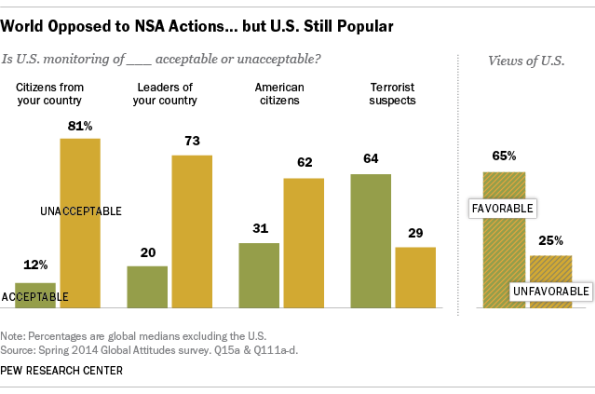
Feel Good Poll of the Day 7/15/14

pew1

Morning Report – The tax inversion trade continues… 7/14/14

Vital Statistics:

Last Change Percent
S&P Futures 1970.7 8.3 0.42%
Eurostoxx Index 3174.4 17.3 0.55%
Oil (WTI) 100.7 -0.1 -0.09%
LIBOR 0.233 -0.001 -0.43%
US Dollar Index (DXY) 80.16 -0.023 -0.03%
10 Year Govt Bond Yield 2.54% 0.02%
Current Coupon Ginnie Mae TBA 106.6 0.2
Current Coupon Fannie Mae TBA 105.6 -0.1
BankRate 30 Year Fixed Rate Mortgage 4.24

Markets are higher this morning after Citigroup announced earnings and a settlement with the Feds. Bonds and MBS are down small.

This week will have a deluge of earnings report, with most of the major banks reporting. We will also hear from heavyweights GE and Google. Economically, the big events will be housing starts / building permits and industrial production.

Score one for Jana. After taking a 9.8% stake in URS Corp and pushing for a management shake-up ended up seeing the company sold to Aecom for $4 billion.

The tax inversion trade in the pharma sector continues, with US drug giant AbbVie closing in on a deal to buy Irish-based Shire Pharmaceutical for about $54 billion. Shire seems ready at last to recommend the offer to shareholders pending resolution of “other terms” of the offer. At some point the government is going to try and put a stop to this, but the chances of it happening the right way (through lowering corporate tax rates and closing loopholes) are slim to none. Remember, we have the highest corporate taxes in the world. Yes, as a percent of GDP corporations pay less than in other countries, but that is a function of our high taxes. High taxes here incentivize corporations to play all sorts of transfer pricing games in order to maximize costs in the US and maximize revenues overseas. The solution is not to raise corporate taxes further, as it will only incentivize more of this behavior. Not to mention it effectively subsidizes foreign governments, as the overseas subs of these companies are declaring artificially high levels of profit. The answer is to lower taxes to be in line with our competitors. If you are the most expensive gas station in town, and you want to increase revenues, you don’t hike prices more – you lower prices and capture more market share.

Janet Yellen will be in front of Congress on Tuesday and Wednesday. If there is going to be anything market moving, it will probably be in the prepared remarks. The Humphrey-Hawkins testimony is largely a dog-and-pony show where politicians are more interested in making their political points than getting an answer out of the Fed Chairman. Expect the left to complain about income inequality and to push Yellen to claim it is a drag on the economy. Expect the right to complain about government spending and to push Yellen to claim the high level of debt is a drag on the economy. The elephant in the room will be how the Fed extricates itself from QE and ZIRP with a balance sheet the size of Jupiter.

The CFPB is warning mortgage brokers that they cannot escape compensation caps by switching to a mini-correspondent model.

No more beep beep boop

Finally was able to get past this screen. New post interface. Oh well, back on Monday