Morning Report – China’s bubble bursting? 3/19/14

Vital Statistics:


  Last Change Percent
S&P Futures  1866.7 2.9 0.16%
Eurostoxx Index 3084.8 11.0 0.36%
Oil (WTI) 100.3 0.5 0.55%
LIBOR 0.234 -0.001 -0.43%
US Dollar Index (DXY) 79.43 0.019 0.02%
10 Year Govt Bond Yield 2.69% 0.02%  
Current Coupon Ginnie Mae TBA 105.4 -0.1  
Current Coupon Fannie Mae TBA 104.3 -0.1  
RPX Composite Real Estate Index 200.7 -0.2  
BankRate 30 Year Fixed Rate Mortgage 4.31    


Markets are up small on no real news. Bonds and MBS are flat. Mortgage Applications fell 1.2% last week. Later on today we will get the FOMC rate decision. Expect to see another 10 billion reduction in asset purchases and a change in the language regarding the threshold for raising rates. The Fed is expected to de-emphasize a single number (6.5% unemployment) and move to a more holistic threshold. Right now, the futures are forecasting that the first rate hike will be in Q4 next year. Watch to see if that forecast changes after the meeting
 
Housing starts came in about as expected at 907k. January was revised upward from 808k to 909k. We are still running at pretty much depressed levels. Weather undoubtedly played a part, as starts in the Northeast fell pretty dramatically. Building Permits increased to just over 1 million, but most of the growth was multi-fam, not single fam.
 
KB Home reported better-than-expected first quarter numbers. Revenues rose 11%,while orders grew 18% and backlog increased 21%. Deliveries were down about 3% in units, and average selling prices rose 12%. Part of the increase in ASPs is due to a strategic change in KB’s business so you might not be able to draw many conclusions from that number. Gross margins continue to expand, and their 17.7% margins are the highest since 2006. No comments about traffic in the PR, maybe they will address the Spring selling season at the 11:30 EST conference call.
 
In a development that could impact rates here, a big Chinese developer has gone belly up and cannot repay $600 million in loans. We have known for some time that China has an epic real estate bubble and that it may finally be bursting. We are seeing a big drop off in commercial building sales, and that combined with a a historic investment rate topping 20% spells trouble. House price to income ratios in China are over 11. In Shanghai and Beijing that number is 23. To put that number in perspective, in Japan’s bubble in the 80s, the ratio topped out at 15 times income. In the US, it got to about 5x. Fast growing economies have these episodes (we did in the 1930s, Japan did in the 1990s, and China is having theirs now). 
 
What will be the spillover when it bursts? The biggest one will be economic – a burgeoning Chinese middle class had been a big component of global demand growth, and that will undoubtedly get depressed. This could be the catalyst that bursts the Canadian real estate bubble, as Chinese money is behind a lot of that as well. The biggest question will be what effect it has on rates in the US. Will Chinese investors dump Treasuries and MBS (remember, in crises, you sell what you can, not necessarily what you want to) or will there be a massive flight to safety which means rates go lower? My gut tells me that rates go lower because commodity price inflation is about to get slammed and China will attempt to export its way out of the predicament. This means even lower inflation in the US. That is something that will worry the Fed. 

Morning Report – Lots of housing data this week 3/17/14

Vital Statistics:

Last Change Percent
S&P Futures 1841.7 8.8 0.48%
Eurostoxx Index 3027.9 23.3 0.77%
Oil (WTI) 98.14 -0.8 -0.76%
LIBOR 0.234 0.000 -0.17%
US Dollar Index (DXY) 79.45 0.000 0.00%
10 Year Govt Bond Yield 2.66% 0.01%
Current Coupon Ginnie Mae TBA 105.8 -0.1
Current Coupon Fannie Mae TBA 104.4 0.0
RPX Composite Real Estate Index 200.7 -0.2
BankRate 30 Year Fixed Rate Mortgage 4.28
Markets are higher this morning on no real news. Bonds and MBS are down on the risk-on trade.
We have lots of housing data this week, starting with the NAHB sentiment numbers later today, housing starts and building permits tomorrow, and existing home sales on Friday. We will also have earnings announcements from Lennar and KB Home. The big things I will be listening for in the earnings announcements will be (a) color on the traffic for the Spring Selling Season, and (b) how much of an increase in ASPs (average selling prices). I think we may be at the point where buyers are balking at higher prices and that means that builders will have to sell more units to move the needle on the top line. This means more sales, and stronger economic growth. A return to normalcy in home construction has been one of the last pieces of the puzzle in this economic recovery.
95.5% of Crimeans want to join Russia, according to a vote. This referendum certainly ups the ante in the volatile Ukranian situation. The White House has insisted the referendum was illegal and would not be accepted. The EU is meeting today to discuss sanctions.
Some manufacturing economic data this morning:  Industrial Production rose .6%, much higher than expected. Manufacturing Production rose .8%, and capacity utilization ticked up to 78.8%. The New York Fed Empire State Manufacturing Survey showed manufacturing is improving, albeit slowly, in the New York State region. All good numbers – the Industrial Production numbers are subject to variations based on the weather and mining (think fracking), but the manufacturing number is strong too. Definitely positive data.
Here is the draft of the bipartisan Senate Housing Finance Reform Bill. Fannie and Fred go away and the Federal Mortgage Insurance Corporation is established. Private capital will take the first 10% loss on MBS and then FMIC bears the rest. The HUD affordable housing goals go away, but we still will be in the social engineering business, except it will be lenders paying for it with a 10 basis point fee on all origination. Of course this will simply get passed on to borrowers. The FMIC will get to dole out the funds.

Weekend Thread!

Where is the plane? Malayan PM now saying it flew for 7 hours.

http://abcnews.go.com/m/story?id=22922961

Morning Report – Happy Pi Day 3/14/14

Vital Statistics:

Last Change Percent
S&P Futures 1838.4 -1.3 -0.07%
Eurostoxx Index 3068.2 2.8 0.09%
Oil (WTI) 98.16 0.2 0.17%
LIBOR 0.233 -0.001 -0.32%
US Dollar Index (DXY) 79.38 -0.228 -0.29%
10 Year Govt Bond Yield 2.74% 0.01%
Current Coupon Ginnie Mae TBA 105.6 0.0
Current Coupon Fannie Mae TBA 104.1 0.0
RPX Composite Real Estate Index 200.7 -0.2
BankRate 30 Year Fixed Rate Mortgage 4.34
Markets are flattish after the Producer Price Index came in lower than expected. Bonds and MBS are up.
A paper out of Estonia is reporting that a Russian invasion of Ukraine is imminent.
Inflation remains muted at the wholesale level, with the Producer Price Index coming in at -.1% month-over-month and .9% on a year-over-year basis. While the Fed prefers to look at the PCE (Personal Consumption Expenditures) when measuring inflation, the other measures do get consideration. This shows inflation well below the Fed’s comfort zone, which is another reason why they are backing off that 6.5% unemployment target. The last thing the Fed needs is a bond market sell-off when we get to that threshold.
Foreclosure activity decreased 10% in February, to the lowest level in more than 7 years, according to RealtyTrac. They mention the issue of zombie foreclosures, where a vacant house in the foreclosure process sits for a long period of time and is not maintained. This is a natural for the 203k business. The average is 20% zombie foreclosures, however in some cities it is closer to 33%. The biggest states: Florida, Illinois, New York, New Jersey, and Ohio.

Morning Report – More on GSE reform 3/13/14

Vital Statistics:

Last Change Percent
S&P Futures 1871.8 4.1 0.22%
Eurostoxx Index 3068.2 2.8 0.09%
Oil (WTI) 98.16 0.2 0.17%
LIBOR 0.233 -0.001 -0.32%
US Dollar Index (DXY) 79.38 -0.228 -0.29%
10 Year Govt Bond Yield 2.74% 0.01%
Current Coupon Ginnie Mae TBA 105.6 -0.2
Current Coupon Fannie Mae TBA 104.1 -0.1
RPX Composite Real Estate Index 200.7 -0.2
BankRate 30 Year Fixed Rate Mortgage 4.34
Markets are up this morning after some decent economic news. Bonds and MBS are down.
Retail Sales increased .3% in February, which was better than the .2% estimate. January was revised downward. Blame the weather. Initial Jobless Claims came in at 315k, lower than expected, and import prices rose .9%.
We are still waiting for more clarity on the Johnson-Crapo bill which will eliminate the GSEs. Cantor Fitzgerald made a great point, though – Fan and Fred are huge MBS dealers, and what happens to the TBA market when they go away? The GSEs are the backbone of the TBA market, and if they go away, how will the market function? Liquidity risk is real, and if liquidity dries up in a market that will get priced in. If investors lower their bids for mortgage backed securities to take this into account, it means higher mortgage rates. As it stands, the GSEs are still probably going nowhere as they are shoveling money to Treasury and the “protect the taxpayer / lower the government footprint” crowd will probably fight the affordable housing advocates to a draw.
Speaking of politics, it looks like the individual mandate in obamacare has been pruned again. Now if you lost your insurance and consider the plans under obamacare to be unaffordable, you are excused from having to purchase insurance. Given that the Administration imagined we would greet obamacare with a chorus of hosannas, it is interesting to watch them try and reduce the footprint of the bill ahead of the midterm elections. Immigration reform is also on the back burner as the right cannot reconcile the pro-business / pro-immigration wing with the party base who wants less immigration. The left is pushing this hard because it senses an opportunity to split the Republican party, but Republicans aren’t really playing along because immigration reform simply isn’t a high priority item for them to begin with.
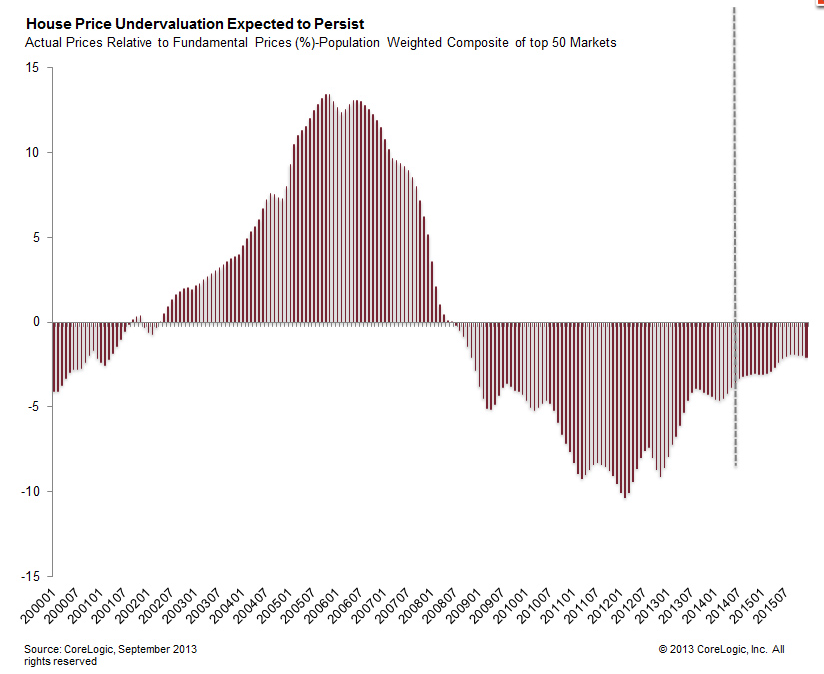
CoreLogic has an interesting piece on whether home prices are undervalued or overvalued relative to incomes. In their view, home prices overshot on the upside, overshot on the downside and are likely to remain undervalued until income growth picks up.

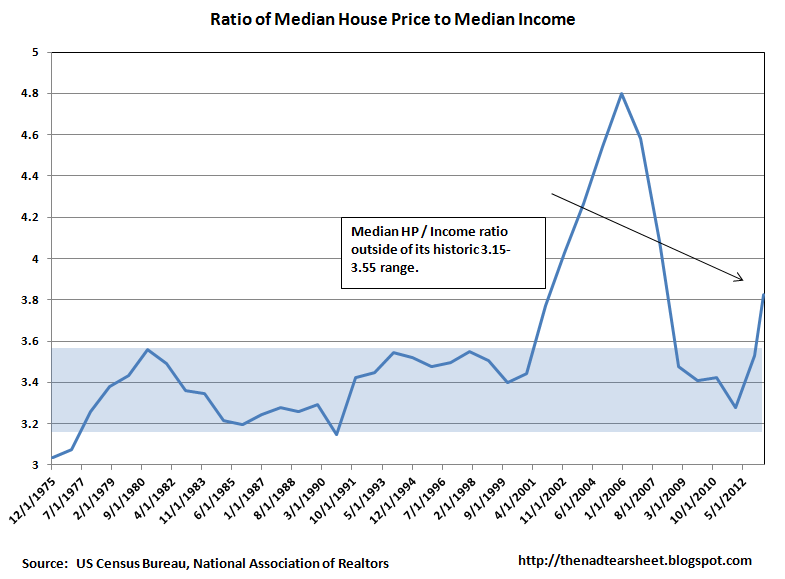
What I find interesting is that when I look at median income to median house price, I see that we have bounced back out of the range again. Historically, the median income to median house price ratio was in the range of 3.2 – 3.5x. Right now, the median house price (according to NAR) is 188,900, and median income is about $51k, which puts the ratio at 3.7x. In all honesty, I take that number with a grain of salt because the existing home sale repeat methodology method overemphasized prices in hot markets. This means that home prices may be soaring in California, and if most of the transactions are in California, the index will reflect that. If there are few transactions in the rest of the country, the index will de-emphasize them. So until the markets really clear, especially in the judicial states, the ratio may be somewhat misleading.

Morning Report – Preparing for life after Fan and Fred 3/12/14

Vital Statistics:

Last Change Percent
S&P Futures 1860.0 -5.2 -0.28%
Eurostoxx Index 3052.9 -39.6 -1.28%
Oil (WTI) 98.3 -1.7 -1.73%
LIBOR 0.234 0.001 0.34%
US Dollar Index (DXY) 79.66 -0.073 -0.09%
10 Year Govt Bond Yield 2.74% -0.03%
Current Coupon Ginnie Mae TBA 105.6 0.1
Current Coupon Fannie Mae TBA 104 0.1
RPX Composite Real Estate Index 200.7 -0.2
BankRate 30 Year Fixed Rate Mortgage 4.35
Markets are weaker this morning on no real news, except for general concerns about overseas economic growth. Bonds and MBS are up
Mortgage Applications fell 2.1% last week as purchases fell .5% and refis fell 3.1%. Mortgage rates rose five bps last week, according to the MBA. Refi activity dropped to 56.7% of all mortgages.
The Senate Banking Committee released the broad outlines of a plan that revamp the nation’s housing finance system and they plan on releasing more details in the coming days. The biggest change is that the government moves into a re-insurance role with private capital bearing the first 10% severity risk. It also eliminates the affordable housing mandates out of Fannie and Fred, but requires a fund paid for with industry fees that would go toward ensuring affordable housing. The government’s continued presence would maintain the 30 year fixed rate mortgage, which Americans consider their birthright.
The government’s big problem is that Fannie and Fred had historically undercharged for their insurance product. In order to attract (or “crowd in”) private capital, they have to price as if they have no government backing or subsidy. Ex FHFA Chairman Ed DeMarco raised g-fees, which Mel Watt has put on hold. If they charge too little for insurance, you won’t see private capital enter the market, and if they charge too much, the industry and affordable housing advocates begin to complain. The government really has to walk a fine line with this.
The stocks of Fannie and Fred got clobbered yesterday, and are down big pre-market. That said, Fannie Mae still sports a  $23 billion market cap, which IMO is a hefty price for what is simply a litigation lottery ticket at this point.
Bill Gross has been scaling out of MBS. The PIMCO Total Return Fund cut its holdings of MBS from 36% to 29%. Bill has also been shortening duration, taking the fund’s effective duration from 5.1 years to 4.7 years. This means Bill is piling into shorter-dated, lower return bonds, which is a bet you would make if you think interest rates are going up faster / quicker than the market consensus. Bill has been making bullish statements in the press on bonds, so this is yet one more instance of Bill talking his book. Don’t pay attention to what Bill says, watch what he does.
The Fed is close to ditching its 6.5% unemployment threshold for considering a rate rise and will substitute less granular language in its FOMC statement next week. This is interesting because Yellen had come out very much in favor of more communication out of the Fed, not less. The problem of course is that the unemployment rate has been falling, but the jobs market is still weaker than the headline numbers suggest. They want to de-emphasize the 6.5% numerical target and embrace a more holistic view of the labor market that includes the labor force participation rate, underemployment rate, etc – factors that can’t be captured if you simply focus on the unemployment rate.

Morning Report – Sentiment Remains in Hibernation 3/11/14

Vital Statistics:

Last Change Percent
S&P Futures 1878.7 1.5 0.08%
Eurostoxx Index 3094.6 1.8 0.06%
Oil (WTI) 100.7 -0.4 -0.43%
LIBOR 0.233 -0.001 -0.45%
US Dollar Index (DXY) 79.85 0.081 0.10%
10 Year Govt Bond Yield 2.78% 0.00%
Current Coupon Ginnie Mae TBA 105.7 0.0
Current Coupon Fannie Mae TBA 104.3 0.0
RPX Composite Real Estate Index 200.7 -0.2
BankRate 30 Year Fixed Rate Mortgage 4.36
Markets are flattish this morning on no real news. Bonds and MBS are unchd.
The NFIB Small Business Optimism Report showed sentiment took a hit in February, falling from 94.1 to 91.4. January’s big hiring plans seem to have been reversed. Aside from a plan to increase capital expenditures, there is not a lot to hang your hat on in this report. Small business sentiment remains firmly mired at recessionary levels, which is astounding when you consider the S&P 500 is at record levels.

Future expectations of home price appreciation took a step upward in February, according to Fannie Mae. Homeowners expect to see 3.2% home price appreciation over the next 12 months, which was a step up from January’s 2% reading. 56% expect mortgage rates will increase over the next 12 months, while 33% expect them to be flat.

And finally, given the theme of sentiment, economic confidence is waning, according to Gallup. This probably doesn’t bode well for retail sales data coming out on Thursday. It is possible that weather is impacting this number, as it seems to have been blamed for everything else, but it is a bad omen for a 2H acceleration, which everyone seems to be forecasting.

Morning Report – Slow News Week 3/10/14

Vital Statistics:


  Last Change Percent
S&P Futures  1875.0 -3.1 -0.17%
Eurostoxx Index 3104.7 9.4 0.30%
Oil (WTI) 101.4 -1.2 -1.17%
LIBOR 0.234 -0.001 -0.55%
US Dollar Index (DXY) 79.74 0.024 0.03%
10 Year Govt Bond Yield 2.78% 0.00%  
Current Coupon Ginnie Mae TBA 105.5 0.0  
Current Coupon Fannie Mae TBA 104.2 0.0  
RPX Composite Real Estate Index 200.7 -0.2  
BankRate 30 Year Fixed Rate Mortgage 4.37    


Markets are lower on no real news. Bonds and MBS are flattish.
 
We have a data-light week coming up, with nothing today, and then a few reports that aren’t really market moving. The biggest one will probably be retail sales on Thursday.
 
Man Bites Dog:  CFPB is guilty of discrimination under the disparate impact theory.
 
The NAHB Leading Markets index shows that 59 out of 350 metro areas returned to or exceeded their last normal levels of economic and housing activity. This index is based on housing and jobs activity. Overall, the nation is running at 87% of normal economic and housing activity. 


Professional Investors have been driving up the price of housing in some areas to unaffordable levels. We are seeing that happen in South Florida, and probably Southern California as well. Which begs the question: What is their exit strategy? 

It’s The Weekend!

Insert content here.

Mutiple Choice:

Sex is:

1] good.

2] sinful.

3] morally relative depending on the circumstances.

4] all of the above.

5] none of the above.

Morning Report – Decent jobs report 3/7/14

Vital Statistics:

Last Change Percent
S&P Futures 1886.3 10.0 0.53%
Eurostoxx Index 3146.7 2.2 0.07%
Oil (WTI) 102.1 0.5 0.49%
LIBOR 0.236 0.001 0.23%
US Dollar Index (DXY) 79.75 0.090 0.11%
10 Year Govt Bond Yield 2.80% 0.06%
Current Coupon Ginnie Mae TBA 105.7 0.0
Current Coupon Fannie Mae TBA 104.1 -0.3
RPX Composite Real Estate Index 200.7 -0.2
BankRate 30 Year Fixed Rate Mortgage 4.39
Markets are higher after a stronger-than-expected jobs report. Bonds and MBS are getting slammed.
Data Dump from the jobs report
  • Feb payrolls up 175k (149k exp)
  • Two month revision 25k
  • Unemployment rate ticks up to 6.7%
  • Average Hourly earnings up .4% (.2% expected)
  • Average weekly hours dropped to 34.2
  • Labor force participation rate steady at 63%
The tick up in the unemployment rate means that discouraged workers are beginning to start looking for jobs again. Overall, it was a decent report. It won’t change the Fed’s posture by any means, but it shows the labor market is gradually becoming more balanced.
Yesterday, we got the household net worth numbers out of the Fed. In the fourth quarter, the average household net worth increased from $77,710 to $80,664. This shows a lot of the Great American Deleveraging is behind us.

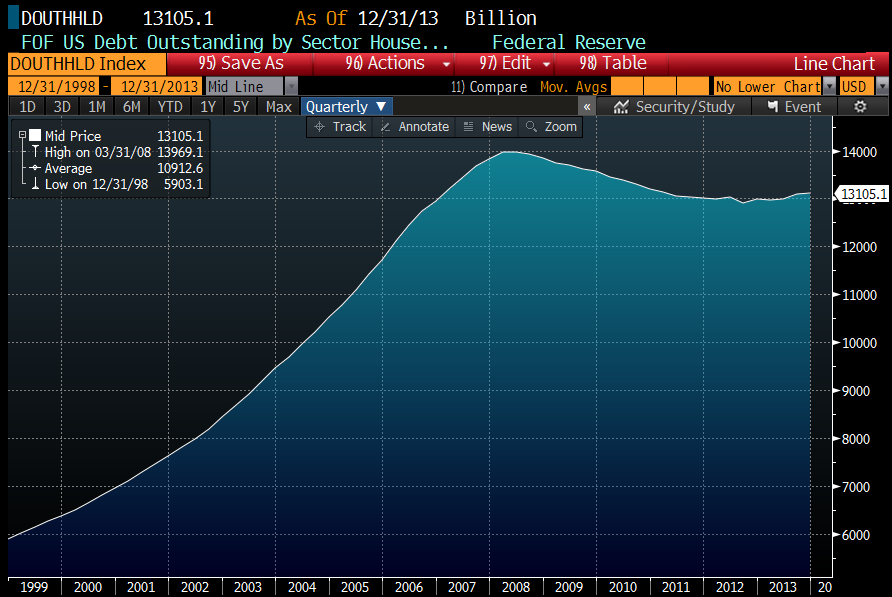
One thing to keep in mind however, is that this increase in net worth has been driven primarily by asset price inflation. If you look at aggregate household debt over the same period, it has fallen, but not dramatically.

What this shows is that it is imperative that the Fed stick the landing with respect to exiting QE and normalizing interest rates. If asset prices (houses, stocks) fall as rates increase, it will undo a lot of the progress that has been made, and will probably be recessionary.