

 Brent Nyitray
 Fairlington Blade
 Let the mutherfuker burn!
 jnc4p
jnc4p Kevin S. Willis
 Michigoose
 lmsinca
 markinaustin
 Arcanaut
 novahockey
 quarterback
 ScottC
 yellojkt
Vital Statistics:
| Last | Change | Percent | |
| S&P Futures | 1634.2 | 5.2 | 0.32% |
| Eurostoxx Index | 2772.8 | 3.1 | 0.11% |
| Oil (WTI) | 92.68 | 0.7 | 0.77% |
| LIBOR | 0.273 | -0.002 | -0.73% |
| US Dollar Index (DXY) | 83.15 | -0.228 | -0.27% |
| 10 Year Govt Bond Yield | 2.16% | 0.03% | |
| Current Coupon Ginnie Mae TBA | 101.8 | -0.1 | |
| Current Coupon Fannie Mae TBA | 100.4 | -0.3 | |
| RPX Composite Real Estate Index | 200.8 | 0.3 | |
| BankRate 30 Year Fixed Rate Mortgage | 4.1 |
Markets are higher on no real news. We will get an important manufacturing report at 10:00 am est with the ISM Manufacturing Report. Bonds and MBS are down small.
Lots of data this week, with the ISM Manufacturing Survey later this morning, Unit labor costs and productivity on Wed and the jobs report on Friday. The jobs report will obviously be the biggest report of the week. The Street is expecting an increase of 177 jobs and a 7.5% unemployment rate. 177,000 jobs is on the low side of recent history.
Federal Reserve Bank of San Francisco President John Williams confirmed the conventional wisdom in the bond market – that the Fed may start reducing asset purchases with an eye towards ending QE by year end. “With continued good signs on jobs and confidence in a substantial improvement, I could see as early as this summer, some adjustment, maybe modest adjustment downward in our bond purchase program.” The program is doing this great job of helping the economy gain momentum and I would want to see that continue well into the second half of the year, but if things, again iff they go well, you could imagine ending the program by the end of the year.”
The sell-off in bonds has been painful for PIMCO: Bill Gross’s Total Return Fund lost 2.2% last month.
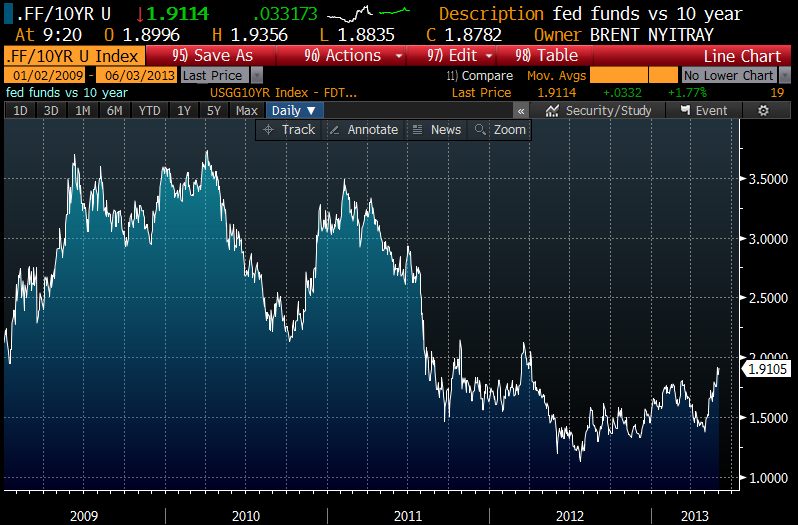
If the Fed ends QE, how high can we expect 10 year yields to go? Actually, a lot higher. The following chart shows the difference between the 10 year bond and the Fed Funds rate since it was set at 25 basis points in early 2009. Since we know the Fed is probably going to wait until unemployment gets closer to 6% before making any moves with the Fed Funds rate, we can assume that stays constant for the near term. But this chart shows we have gotten used to a flat yield curve over the past year. And that may be about to change.
Chart: 10 year bond yield minus the Fed Funds Rate
Filed under: Morning Report |
 All Things in Moderation
The first thing that popped in my head when I read the title was “What would the guy who composed the Star Wars soundtrack know about QE?”
LikeLike
Thanks for the predictive tools, Brent. By that I mean the educated guess that unemployment will have to be below 7% for the Fed to
end QE.raise the Funds rate.Also I changed our quotation to a recent one from the Bernank.
LikeLike
Brent, can you explain, again if I missed it, the relationship between the bond market and stocks and also what the end of QE will mean for equities. I can be pretty dense and am trying to get a sense of where to put or keep my money, such as it is. I’ve never experienced this kind of market before and while my instincts have made us quite a bit of money since 2009 I don’t trust myself right now. I’m not asking for anything definitive, just your impression.
LikeLike
Hi all — i’m back after a week on the http://disneycruise.disney.go.com/ships-activities/ships/fantasy/
LikeLike
I wondered where you were…………………….was it fun? I’ve never been on a cruise before and while I used to think about one…………………lately I’ve been more into road trips………………..hahaha
I’m back too……………..full swing……………..even creating posts again after 5 months. I told everyone that I was the new and improved little lulu……………..hahaha
LikeLike
You missed the self-flagellation post.
LikeLike
as someone who backpacked through SE asia, I never thought I’d be a disney person. but they take care of everything. and with the little guy … it was a ton of fun. play all day with the soon-to-be 4 year old. and after dinner he’d go to the kids club and we’d have 2-3 hours of time for us in teh adults section of the ship – clubs/bars etc.
LikeLike
nova:
as someone who backpacked through SE asia…
Where did you backpack? I traveled extensively throughout SE Asia when I was living in HK. Can’t say I was actually packbacking, but we went to a lot of places. My favorite was Koh Samui in Thailand. That was I think a popular backpacking destination, as it was not quite as commercialized as placed like Phuket or Bali. But that was 15-20 years ago, so not sure what it is like now.
LikeLike
if it happened last week, i missed it. total media blackout.
LikeLike
My one and only cruise was on the very first Disney ship (which was really a rethemed existing ship) back in the early 1990s which was a bit of a dump. That one that you were one looks really opulent.
Someday I’ll take another cruise but all the recent bad publicity has dampened that desire. I really have no desire to be stuck for days on a boat with no working toilets.
My retired parents are devoted cruisers had have been on about every itinerary you can imagine including a seven week cruise around South America.
LikeLike
this was about 6 years ago. we hit bangkok, seim reap, Saigon and Hanoi. over about 3 weeks. so I think we couldn’t really be backpacking either — outside of the fact that we traveled really light. backback only, no checked bags. but we were not doing the hostel thing. I want to go back to hit koh samui and Chiang Mai.
LikeLike
jnc:
“What would the guy who composed the Star Wars soundtrack know about QE?”
Great minds think alike!
LikeLike
NoVA:
Welcome back! Sounds like a great way to vacation with a young son and all of you have fun.
Your mustache twirling has been missed.
LikeLike
good to be back. just have to get the top hat dry cleaned. full of sand.
we did have a stop in grand cayman. we didn’t get off the ship, but I should have to off shore an account just to say I did.
LikeLike
I went to Grand Cayman for vacation several years ago–beautiful place. Did you do any snorkeling while there? I did some great diving, and Sting Ray City was fun.
LikeLike
I just got done clearing out our spam cache, BTW. Mainly for OTC drugs and financial schemes, but this was my favorite comment I came across:
That’s the kind of wisdom that you don’t find every day!
LikeLike
we had a “dolphin encounter” in cozumel. but otherwise just played on the ship. and when the little guy went to the kids club, enjoyed some cocktails.
LikeLike
Sounds nice. . . and I’m very glad that your ship didn’t burn down or infect you all with norovirus! 🙂
I’ve heard that the dinner on the last night would be an appropriate occasion to show off your new tux–or do they not do that any more?
LikeLike
formal night was day 2. and i packed the tux. mostly people in suits, but more than a handful of tuxes on board. including mickey mouse in mess dress with white jacket. so we got a great family photo with mickey. my son was very concerned that he wasn’t on the bridge, as he was convinced he was the captain.
LikeLike
Excellent! I hope Mickey explained that he had a very capable Executive Officer manning the helm while he greeted guests.
LikeLike
I think we need moar bureaucracy.
http://freebeacon.com/richard-windsor-model-employee/
LikeLike
Interesting split on SCOTUS for this DNA/warrantless search case. Kennedy, Roberts, Alito, Thomas, and Breyer in the majority. Scalia, Ginsburg, Sotomayor and Kagan in dissent.
LikeLike
That Scalia, always the extremist.
LikeLike
Yep. Scalia called BS on the whole “identification” argument that the majority uses to dodge the 4th amendment issue. The fact that they were so blatant about not even addressing the constitutional issue is probably what cause him to read the dissent from the bench.
LikeLike
That Scalia, always the extremist.
The other five seem like the extremists though in this case. I don’t understand where we’re headed with all of this and it’s really troubling I think. It’s the one area that shocks me about Republicans because for some reason I never expect it. Their acquiescence to that kind of authority, or whatever you want to call it, baffles me. Not that Dems have been much better lately. Our civil liberties have been shot through with a canon.
LikeLike
“The other five seem like the extremists though in this case. ”
No, the DNA swab = fingerprints is easily the conventional position to take based on getting to an outcome they want and the potential net benefit to capturing more criminals vs the minimal invasiveness of the procedure.. The radical thing to do is to put a stop to “progress” based on something as quaint as the Fourth Amendment.
The only surprise to me was I would figure Sotomayor would have been in the majority and Breyer in the minority.
LikeLike
If you say so jnc………………………I’m no legal eagle, that’s for sure. I only read a brief little bit of the decision and I thought it seemed like more infringement. I can’t stand reading that stuff though, I’ll admit it. 🙂
LikeLike
I’m not disputing it’s an infringement. I’m arguing that infringement is the normal state of affairs now and pushing back is the ‘extreme’ exception to that rule.
LikeLike
Oh, I get it. Sorry, I’m working and not paying enough attention……………better focus on work for awhile before I get in trouble anyway.
LikeLike
The US soccer team beat Germany yesterday in a high scoring thriller, 4-3. Beating Germany is a big deal. But watch the German goalkeeper give a little assistance to the US on the second goal.
LikeLike
Thought I’d stop in for a drive-by to express my anger at the chipping away of our 4th A rights today, but I see you’ve discussed it already.
jnc:
The only surprise to me was I would figure Sotomayor would have been in the majority and Breyer in the minority.
Actually, Breyer (pro-government) and Sotomayor (pro-civil rights) have been pretty consistently on opposite sides of recent closely-decided 4th A cases this term. They were on opposite sides of MO v. McNeely, ruling that a DUI blood draw is a 4th A search. They were on opposite sides of the 2nd drug-sniffing dog case (FL v. Jardines). Scalia, Ginsburg, Kagan, Sotomayor are usually aligned against Alito, Roberts and Breyer, with Kennedy (McNeely) and/or Thomas (Jardines) bouncing back and forth.
Scott:
I’d be more impressed if the US MNT beat the German “A” side, but Bayern was playing Stuttgart for the German Cup. That said, Jozy’s strike was pretty.
LikeLike
Mike:
’d be more impressed if the US MNT beat the German “A” side, but Bayern was playing Stuttgart for the German Cup.
Good point.
LikeLike
http://reason.com/blog/2013/06/03/canadian-student-stops-a-stabbing-attack
lesson. do nothing.
LikeLike
@zachblox: “I doubt the proud men who wrote the charter of our liberties would have been so eager to open their mouths to royal inspection.” -J. Scalia
Jeebus, scarier than a Goldwater quote.
LikeLike
Grist for the Obamacare mill: Whither Juiceboxer’s psshaw’s on rate shock?
http://www.forbes.com/sites/theapothecary/2013/06/03/democrats-new-argument-its-a-good-thing-that-obamacare-doubles-individual-health-insurance-premiums/?partner=yahootix
LikeLike
Yeah, that’s the Roy piece that has been widely debunked all over the place already, McWing. You’re behind the times. . .
LikeLike
What’s been debunked about it?
LikeLike
The whole thing, several times. Avik Roy wrote a shoddy article and got Forbes to publish it, but Ezra Klein, Rick Ungar (in Forbes itself), and Jonathan Cohn have all eviserated it. I’m sure there have been others, but those three all sprang to mind right away.
LikeLike
Well, the Juiceboxer admits to the correctness of Roy’s argument, that the individual rates are going to increase substantially.
Roy responds to them all in the updates at the bottom.
I’m just not convinced of the debunking, rates are going up, even with premium supports.
http://www.forbes.com/sites/theapothecary/2013/05/30/rate-shock-in-california-obamacare-to-increase-individual-insurance-premiums-by-64-146/
LikeLike
Another Ezra Klein article from today about the rates.
LikeLike
From January,
We estimate that almost 80 percent of those aged 21 to 29 with incomes greater than 138 percent of FPL who are enrolled in nongroup single coverage can expect to pay more out of pocket for coverage than they pay today—even after accounting for premium assistance. With a crossover point of about 300 percent of FPL for those aged 30 to 44, we estimate that about one-third of those older than age 29 with incomes greater than 138 percent FPL will see higher premiums even after accounting for premium assistance.
I’ve yet to see this refuted.
http://www.forbes.com/sites/theapothecary/2013/01/12/insurance-analysts-obamacare-to-increase-out-of-pocket-premium-costs-despite-lavish-subsidies/p
LikeLike
McWing:
I just read Klein’s alleged “evisceration” of the Roy piece. It quickly becomes apparent that Klein doesn’t even understand what insurance is.
He also has an incredibly idiotic way of looking at things. He thinks that if the government forces you to buy more expensive insurance than you buy now, it isn’t fair to say that your costs have gone up, because you are getting more insurance than you were before. WTF?
LikeLike
McWing:
I’m just not convinced of the debunking, rates are going up, even with premium supports.
If you read the Ungar piece, he makes the same point that Geanie made the other day, ie that the advertised rates are teaser rates that few people actually get. It is a reasonable point, but that is as far as he goes. He doesn’t attempt to find out what rates people are actually paying in the individual market and compare them to what they will pay under Obamacare. And he doesn’t even acknowledge, much less address, Roy’s initial point that when Covered California triumphantly claimed that the new rates were either the same or lower than existing rates, they were comparing them to existing group plans for small businesses rather than their true analog, the individual market. The fact that he ignored this rather glaring problem suggests to me that it was a good point to which he had no counter.
Even before looking at actual data, it makes no intuitive sense that comparable rates will fall instead of rise. Simple, basic economics tells us that if the government mandates that more things be covered, and that already sick people be “covered” at the same rates as healthy people, the price of the product must rise to cover these additional costs.
LikeLike
I particularly liked this line from the Klein piece:
Some people will find the new rules make insurance more expensive. That’s in part because their health insurance was made cheap by turning away sick people.
Yes, Ezra, their insurance was cheap because it was, well, actually insurance.
LikeLike
Klein says:
To state the obvious: A trillion dollars is a lot of money. Those subsidies are the gamechanger in this market. Absent them — and arguably absent the individual mandate — these rules would simply shift costs around.
To state the even more obvious (except apparently to people like Klein), money doesn’t grow on trees. These “game changing” subsidies have to be paid by someone, which means that the subsidies themselves represent nothing more than cost-shifting.
LikeLike
Michi, I’m curious as to what you think Roy’s point is?
LikeLike
I think Roy is trying to claim that Obamacare will be vastly more expensive than it was sold to be and is doomed to failure.
LikeLike
Ah, yes, Scott. Klein doesn’t hew to your world view. Your eviseration of him is not only complete but inarguable.
Shall we add him to the list with Taibbi and Dayen as Those Who Must Not Be Named?
LikeLike
Most people covering the implementation of the ACA and the cost of premiums have been careful to point out the both the true nature of the savings for some through the subsidies and that premiums will go up for some. It’s not like it’s some kind of surprise. There’s obviously a trade off when you mandate coverage at the same time you require the insurance companies to take all comers.
I think it will be interesting to see how it all shakes out. CA is probably going to be one of the better states to live in if you couldn’t get coverage prior to 2014 because we’re heavily invested in making it work, and for some weird reason our insurance companies (most of them) seem to be cooperating in keeping the rates competitive.
Writers like me who have supported the law treated this a big deal. But I would like to think we were candid about the downsides, even as we highlighted the upsides. Paul Krugman, Kevin Drum, Matthew Yglesias, and I all noted that California was just one state—and, in some respects, a best-case scenario, because its officials are committed to the law’s success and enjoy broad support from corporate, medical, and consumer leaders. We also noted—as we had noted before—that some young and healthy people would have to pay more. Again, a health insurance system that no longer discriminates against the old and sick can no longer discriminate in favor of the young and healthy. We also acknowledged that getting the insurance bids is just one step in the process. As many of us have written, plenty of things could go wrong with Obamacare—and at least a few of them surely will.
http://www.newrepublic.com/node/113362#
LikeLike
This is an interesting speech from Avik Roy, who supports universal coverage btw and believes health care is a right. He would have done it differently of course. Check out his conclusion.
As two commentators recently put it, “equality of opportunity is not a natural state; it is a social achievement, for which government shares some responsibility. The proper reaction to egalitarianism is not indifference. It is the promotion of a fluid society in which aspiration is honored and rewarded.”
A child with Down Syndrome may not have the right to my money. But we are a better community, and a better country, if we give it to him anyway.
http://www.forbes.com/sites/theapothecary/2013/03/28/yes-health-care-is-a-right-an-individual-right/
LikeLike
lms:
This is an interesting speech from Avik Roy, who supports universal coverage btw and believes health care is a right.
You left out the most relevant part:
I argue that health care is indeed a right—but not in the way that most progressives think.
After reading his argument, it is clear to me that he rejects the common and progressive notion of health care as a universal right that the government must provide them. At the end he makes this very plain when he says:
A child with Down Syndrome may not have the right to my money. But we are a better community, and a better country, if we give it to him anyway.
In other words, he supports government helping to pay for certain health care as a matter of prudence, not a matter of individual right.
When he speaks of health care as an individual right, he means that people have the right to pursue the health care they desire with their own money, and so is critical of government regulations which, for example, force someone to enroll in medicare which, in turn, prevents them from using their own money, via a health savings account, to pay for their own health care. In other words, the right he is talking about councils against government regulation, not in favor of it.
LikeLike
Scott,
Klein admits that Roy is right, that 75% of those that applid got the advertised ( low ) rate and that 17% paid more while 12% were turned away. Unger and Cohn treat it derisively as fear mo getting but tellingly never deny it.
Lms, I did read the caveat in regards to cost but felt, at the time and now that it was done in incredibly fine print. The $2500 year in cheaper insurance and if you like your doctor you can keep your doctor are what Obamacare was sold on.
Obviously, it’s nother here nor there as we are saddled with it, I’m jus curious about how long before a death spiral if rates for healthy young males even with premium support at evoking to be higher than they are now. Healthy young people are a necessity and if the choose the tax penalty…
LikeLike
McWing
The $2500 year in cheaper insurance and if you like your doctor you can keep your doctor are what Obamacare was sold on.
Yeah, I didn’t like the way it was sold either. As a matter of fact I fought tooth and nail against the damn thing, I wanted single payer or at least a public option, and even quit OFA over it. So as I’ve said so many times I’m not in love with Obamacare. I am hoping it turns out better than some of the negative predictions though for all our sakes.
But as I’ve also said, I’m in favor of universal care and so I accept it as the way it is and hope it improves or changes to something better over time. I don’t hold out much optimism but I am at least glad that our oldest daughter will be able to have the coverage she couldn’t get before.
I’m also happy I happen to live in CA for the millionth time in my life……haha
LikeLike
Scott I didn’t claim he supported universal coverage the same way I do or even when he said health care was a right, I knew it was different and said so. I just thought some of his ideas were a little different than what you and McWing advocate, or maybe I should say, don’t advocate for. He talked a lot about negative and positive rights.
I just followed Roy’s link when he said he believes in universal care and the right to medical care………………………….an unusual statement.
LikeLike
lms:
I just thought some of his ideas were a little different than what you and McWing advocate…
I definitely agree with him that individuals have a right to pursue health care as they see fit with their own money, and like him I oppose government regulations that obstruct that right. I also agree with him that a community that endeavors to help people who have been disadvantaged by chance or unfortunate circumstances is better than one that does not.
LikeLike
Scott
I also agree with him that a community that endeavors to help people who have been disadvantaged by chance or unfortunate circumstances is better than one that does not.
Could you define community for me in this case? Perhaps I’m missing something when he quotes this? Or maybe my interpretation of the words is different than yours or his? Perhaps you don’t see aspiration as needing support from society? I’m confused. But we may be getting into a philosophical debate that I don’t feel qualified for so I’m not sure I really want the answers…………..hahaha.
As two commentators recently put it, “equality of opportunity is not a natural state; it is a social achievement, for which government shares some responsibility. The proper reaction to egalitarianism is not indifference. It is the promotion of a fluid society in which aspiration is honored and rewarded.”
LikeLike
lms:
Could you define community for me in this case?
Well, a community is a fairly amorphous thing, but I think that the wider the net is cast, the less meaningful it becomes. For example, it is meaningful to me to describe the town in which I live as a community. But I would never refer to the United States as a “community”. And to ever speak of the “world” community is, it seems to me, to strip the word of any meaning whatsoever.
Perhaps you don’t see aspiration as needing support from society?
I’m not sure what you mean by society supporting aspiration, but I do know that one sticking point that I often have with people on the left is that I think society and government are two distinct things. Government is just one aspect of society, not the personification of it.
LikeLike
Scott, I remember talking about community before. I guess I’m wondering what Roy means when he apparently (I think) agrees with the “two commentators”. Is he agreeing with your definition of community do you think? I’m not really convinced of that based on the quote he used.
I wonder what they mean by fluid society? When I read it I thought that aspiration, or whatever heights an individual aspires to, should not be treated indifferently because equality of opportunity isn’t really equal. And so it should be nurtured by society, and government, in some measure.
I could be way off base without knowing much about this Roy guy but if you’re correct, his quote has me confused.
LikeLike
lms:
Is he agreeing with your definition of community do you think?
I honestly don’t know. All I can say is that I have no problem with the principle that a community that helps the worst off within it is a better community than one that doesn’t.
I wonder what they mean by fluid society?
I understood it to mean a society in which social/economic mobility is possible. But I agree it is not entirely clear.
LikeLike
“ScottC, on June 3, 2013 at 9:48 pm said:
Klein says:
To state the obvious: A trillion dollars is a lot of money. Those subsidies are the gamechanger in this market. Absent them — and arguably absent the individual mandate — these rules would simply shift costs around.
To state the even more obvious (except apparently to people like Klein), money doesn’t grow on trees. These “game changing” subsidies have to be paid by someone, which means that the subsidies themselves represent nothing more than cost-shifting.”
In fairness to Klein, he does acknowledge this point as he dismisses it as beneath concern.
“Those subsidies make the market positive sum (though perhaps not for the rich folks who are getting taxed to pay for them, or the Medicare Advantage users who will see their benefits cut). ”
The real flaw in Klein’s argument is this:
“Absent them — and arguably absent the individual mandate — these rules would simply shift costs around.”
The rules are still shifting costs around once you include people who are ineligible by law to participate in the exchanges, but are having to subsidize them via higher taxes.
“Michigoose, on June 3, 2013 at 10:05 pm said:
I think Roy is trying to claim that Obamacare will be vastly more expensive than it was sold to be and is doomed to failure.”
If that’s his argument than he is correct and Klein is wrong. Obamacare will be vastly more expensive in aggregate than it was sold to be and is doomed to failure as a deficit reducing measure. It will increase coverage, so if that’s all you care about, it’s a success.
In reality, some people will pay more under Obamacare and some will pay less. The more and less will take the form of both rate adjustments and tax hikes.
Klein doesn’t care because the right people (i.e. the rich) are paying more and the right people (sick and poor) are receiving the benefits.
Those of us who are getting stuck with the bill dispute that this is a “win win”
LikeLike
The other point to be fair to Klein is he is correct about eHealthInsurance.com bait and switch on the lowest price being a consideration when you are coming up with a weighted average.
LikeLike
Scott,
All I can say is that I have no problem with the principle that a community that helps the worst off within it is a better community than one that doesn’t.
All I can say is that our definition of community and it’s size and magnitude must be different and those who are worse off or disadvantaged might not apply to health care in your view.
Also, a shared responsibility, as in money, is not part of your inventory of remedies, except for in the narrowest sense of perhaps your community of family.
I think you’re probably right about a fluid society. And yet, I’m still confused by the apparent agreement from Roy with the two commentators. Primarily because they specifically mention society, government, aspirations, equality of opportunity and shared responsibility.
LikeLike
jnc:
It will increase coverage
Yes, that was my primary concern with getting it passed. I agree with Lulu that I much rather would have seen single payer, and I think the administration has oversold it as cost saving, but the more people covered the better as a first step, IMO.
LikeLike
That’s fine, just don’t pretend that there aren’t tradeoffs (which you haven’t).
Ezra is stuck in a tough place trying to carry water for the administration and still be intellectually honest. His pieces in 2009 – 2010 were better.
LikeLike
I appreciate that we’re concerned about getting universal coverage … but i think it was the wrong approach to the problem. mostly b/c i’m fairly concerned about access issues.
one other point. you’ll see a lot of Medicaid, as if it is a single program. it’s really not. each state is different and has it’s own quirks. unless you’re just talking about the federal $$ … it’s tough to say what Medicaid is going to do.
LikeLike
Nova
it’s tough to say what Medicaid is going to do
That’s what really scares me here in CA. I think we’re going to have a lot more people on Medicaid than we’re ready for. I don’t see how access is going to work.
LikeLike
in policy lingo, that’s the woodwork effect. people come out of the woodwork particularly when there’s a big push to enroll. I expect a lot of people will come out to sign up for insurance through the exchanges and find out they are eligible for Medicaid. and when that happens, all the budget projections are shot.
see http://www.nejm.org/doi/full/10.1056/NEJMp1104948
from the link:
Nationally, this “woodwork effect” could draw out more than 9 million uninsured adults and children, including 1.1 million in California, 1.0 million in Texas, and 900,000 in New York. Although only a portion of these people are likely to enroll in Medicaid, adding them to the program’s rolls would nonetheless cost states billions of dollars in increased spending. Most affected would be states that currently have generous eligibility criteria for Medicaid, lower participation rates, a higher prevalence of low-income uninsured residents, or some combination of these factors.
edit — the key here is these “woodwork” people ARE NOT part of the generous 90-10 federal cost sharing. it’s whatever the current Federal Medical Assistance Percentages (FMAP) is for the program. for CA, it’s 50-50.
LikeLike
Yep, that’s it. I don’t think TX is accepting the Federal Medicaid money though, so they won’t have what I perceive is going to be a problem for us. I do feel sorry for their citizens though………….I can’t help it. I’m surprised there may be so many in NY.
LikeLike
i wouldn’t feel to bad about. what good is Medicaid coverage if you can’t use it?
LikeLike