Morning Report – S&P earnings 01/22/13

Vital Statistics:

  Last Change Percent
S&P Futures  1477.5 -1.4 -0.09%
Eurostoxx Index 2715.3 -11.3 -0.42%
Oil (WTI) 95.48 -0.1 -0.08%
LIBOR 0.302 0.000 0.00%
US Dollar Index (DXY) 79.92 -0.116 -0.14%
10 Year Govt Bond Yield 1.86% 0.02%  
RPX Composite Real Estate Index 192.8 1.0  

Markets are flattish on no real news.  Japan has announced a 2% inflation target, similar to what the Fed has been doing, in an attempt to weaken the yen.  The World Economic Forum meets in Davos this week. For once, there isn’t a major crisis to deal with.  We don’t have a lot of economic data this week, with the exception of leading economic indicators on the 24th.  Bonds are down half a point and MBS are down a tick or two.

We have decent earnings reports this morning from DuPont, Travelers, Johnny John, and Freeport.  This is one of the heaviest weeks for earnings reports, and erstwhile market darling Apple reports tomorrow after the close.

The WSJ is predicting that companies will increase share buy-backs this year as companies try and figure out what to do with excess cash. This will buoy the S&P 500 and mask the effect of flat earnings. Many strategists believe that US companies have pretty much wrung out all of the excess costs they can and any further earnings growth will have to come from revenue growth.  And if you can’t get revenue growth, how do you show increasing EPS?  You guessed it – buybacks. 

Is the financial system finally back on its feet?  We will see if Silver Lake is able to obtain financing for its planned $24 billion LBO of Dell. This is one of the side effects of the Fed’s QE efforts – in an era of rock-bottom interest rates, pension funds and insurance companies are starving for yield, which makes the splashy LBO possible again.

The Chicago Fed National Activity Index came in +.02 in December, down from +.27 in November. The 3 month moving average is still negative, indicating economic activity is below its historical trend. 

The House will vote on a 4-month extension of the debt ceiling, which seems to take the default issue off the table.  All eyes will then turn to the sequestration cuts and the continuing resolution. 

The CFPB has released a summary of the new broker / LO loan comp rules.  LO comp may not be based on any of the transaction’s terms of conditions. In other words, the interest rate does not matter, and LOs cannot be comped for steering a borrower to purchase title insurance from an affiliate. Pricing concessions are out as well. 

Finally, as a child of the 70s, I note with sadness the passing of Atari.  

Bites and Pieces: West African Edition

I hosted a wine dinner on Saturday. It was a bit too ambitious in that I picked 7 fishes as the theme, from the Italian tradition, and also did dishes from 7 . I cheated a bit on Antarctica—frozen yogurt. The trickiest one for planning was Africa. I know relatively little about African cooking (except Ethiopia). Fortunately, my wife went to West Africa (Mali) for her stint in the Peace Corps and knew exactly what to do. Yassa.

Yassa is a Senegalese dish, traditionally served with chicken (Poulet en Yassa). It also works very well with grilled fish. I tried it with swordfish, which was a good finish to the meal. The key ingredients are onions, lemon juice and peanut oil. One traditionally marinades the meat in the ingredients, but I think separating it works.

Ingredients

1 – 2 pounds of swordfish, cubed*

½ cup of peanut oil


Yassa Sauce

4 – 6 yellow onions, sliced

½ cup of lemon juice

½ cup of cider vinegar

1 tablespoon minced garlic

2 tablespoons mustard

1 tablespoon soy sauce (Maggi is traditional; soy works fine)

1 minced chili pepper (optional)

Pepper and salt to taste

  1. Combine all ingredients and let rest for at least 2 hours
  2. Cube the swordfish and set aside. If you have a favored preparation, go for it. A bit of salt, pepper, cumin and turmeric works with the flavors of this dish. Have fun!
  3. Heat the peanut oil in a large, heavy bottomed pan or dutch oven. Drain the onions, setting aside the marinade, and add to the pan. Cook over medium heat until softened (and possibly browned a bit). Add the reserved marinade and bring to a boil. Cook until the onions form a sauce
  4. Cook the fish however you like. I planned to grill it, but the coals had gone mostly dark by the time I was ready to cook the fish. I heated up a couple of tablespoons of peanut oil in a pan and seared it, then added the sauce.
  5. Combine the fish and sauce. Warm to combine. Serve over rice. 

*For those who have concerns about the mercury content of swordfish, the dish is made traditionally with sea bass (Poisson Yassa). Chicken breast or pork loin would also work.

Best “Whole” Album

I’m taking a page from Ace of Spades,

http://minx.cc/?post=336709

What are the best whole albums? The one’s where every song is great. The author of the post listed the following:

“#1 Dark Side of the Moon, #2 Back in Black, #3 Led Zepplin IV, #4 Who’s Next, #5 Joshua Tree, #6 London Calling, #7 Van Halen, #8 The Cars, #9 Purple Rain, #10 Appetite for Destruction,, with Honorable Mentions to: Quadrophenia, Synchronicity, Making Movies, Los Angeles (X), Bloodletting, Pet Sounds, Armed Forces, Yellow Brick Road, Revolver, Holy Diver, Paulie’s Boutique, Hysteria, OK Computer, Violator, and In the Court of the Crimson King. “

Some I agree with and some I think are wrong. I would add (or substitute):

Allman Bros., Eat a Peach as well as
Live at the Filmore East
Led Zepplin, Led Zepplin II
Sex Pistols, Never Mind the Bullocks
Bob Dylan, Blood on the Tracks
AC/DC, Dirty Deeds
Lynyrd Skynyrd, Pronounced

I’ll add more in the comments. Ace’s commenter’s skew younger than me, but there are some great suggestions in there.

What about your favorites?

Latest interview on Capital Markets Today

We discuss the fiscal cliff, sequestration cuts, debt ceiling, QM rules, Jack Lew, Fexit, and 2013 economic forecasts


http://tobtr.com/s/4257903

Morning Report – Housing starts and bank earnings 01/17/13

Vital Statistics:

  Last Change Percent
S&P Futures  1471.6 6.0 0.41%
Eurostoxx Index 2710.7 8.2 0.30%
Oil (WTI) 94.8 0.6 0.59%
LIBOR 0.302 -0.001 -0.33%
US Dollar Index (DXY) 79.61 -0.198 -0.25%
10 Year Govt Bond Yield 1.87% 0.05%  
RPX Composite Real Estate Index 191.7 0.3  

Markets are higher after a good housing starts number and lower than expected unemployment claims. Bank of America and Citi both reported lower than expected 4Q earnings. Bonds and MBS are down.

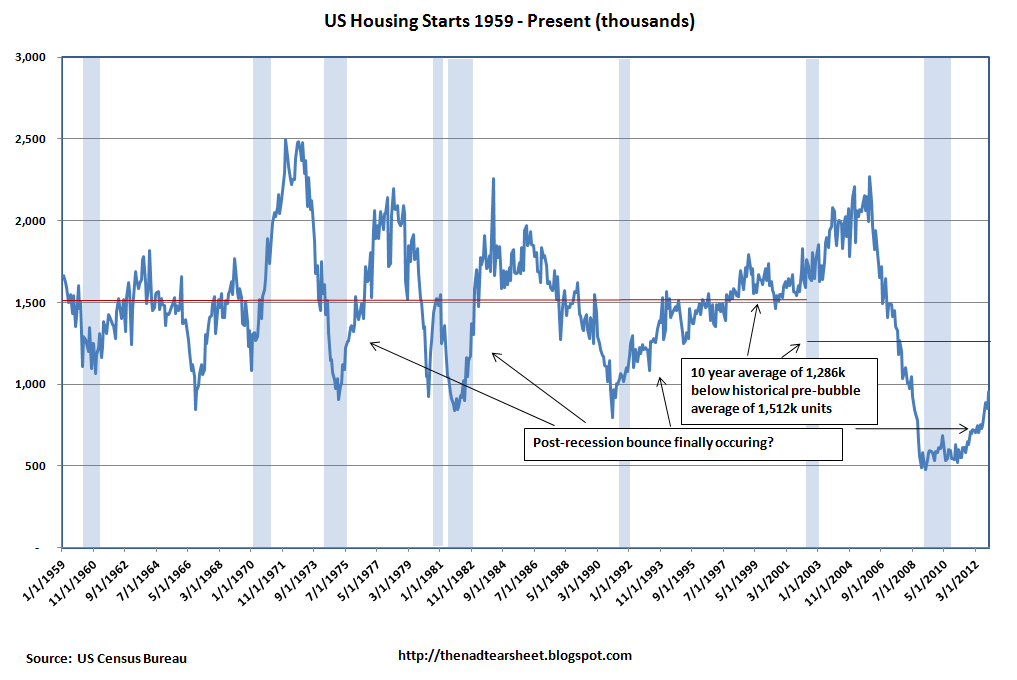
Housing starts took a big jump upward in December, to an annualized pace of 954k, an annualized increase of over 100k. This is the highest level since June 2008. Multi-family starts accounted for about a third of the increase.  Building Permits increased at a 1.8% MOM and 29% YOY.  Remember, we have historically started 1.5 million units per year, and our 954k annual number basically represents the low points of all recessions since 1957 up to the post-bubble recession.

Chart:  Housing Starts


The CFPB is releasing new rules for servicers today.  It essentially eliminates the practice of “dual tracking” where a servicer works to mod a loan and simultaneously initiates foreclosure proceedings in case the mod doesn’t work out or the borrower fails to pay.  That might have the unintended consequence of less mods and more foreclosures.  Foreclosures cannot be initiated until the account is more than 120 days delinquent. This rule pre-empts state law, so timelines will get extended in non-judicial states. Servicers with less than 5,000 loans will be exempt.

Speaking of unintended consequences, the Fed is now worried about bubbles in farmland and junk bonds, the direct result of QE. Unwinding QE (it needs a name – Fed Exit – Fexit?) will be a touchy deal.  The buzzword for Fexit will be “convexity risk” Think Orange County in 1994 on steroids.  Not only will MBS bids fade because of interest rate volatility, they will also have to contend with the Fed dumping paper in an effort to shrink its balance sheet.  A 2014 recession is a distinct possibility. 

What it took to get a mortgage in 2012, according to Ellie Mae:  748 FICO, 23/34 DTI, 21% down.  Average interest rate 3.9%, average time to close, 48 days, 62% were refis. 

Morning Report – What a difference a year makes. 01/16/13

Vital Statistics:

  Last Change Percent
S&P Futures  1462.4 -2.8 -0.19%
Eurostoxx Index 2688.7 -12.9 -0.48%
Oil (WTI) 93.32 0.0 0.04%
LIBOR 0.303 0.000 0.00%
US Dollar Index (DXY) 79.86 0.085 0.11%
10 Year Govt Bond Yield 1.80% -0.03%  
RPX Composite Real Estate Index 191.7 0.3  

Markets are weaker this morning after the World Bank cut its global growth forecast.  Goldman and JP Morgan both reported better than expected earnings. Mortgage applications rose 15% last week and the CPI showed that inflation remains under control. Industrial production rose .3% and capacity utilization rose to 78.8%.  Bonds and MBS are up.

The National Association  Homebuilders Confidence index held at 47 in January, the highest level since April of 2006. A reading of 50 represents the point where builders view conditions as neutral. Conditions improved in all areas of the country, with the West performing the best, while the Midwest and Northeast performing the worst. This is the second sentiment report that has the “what a difference a year makes” theme.

The CoreLogic Home Price Index rose 7.4% YOY in Nov 2012. This is the largest gain since May of 2006.   Excluding distressed sales, home price increased nationally by 6.7%.  December’s gain is forecast to be down .5% MOM (reflecting the typical seasonal pattern) and will be up 8.4% YOY. Mark Fleming, the Chief Economist made a point about QM – “that the recently released Qualified Mortgage rules issued by the CFPB are not expected to significantly restrict credit availability relative to today.”  I am sure Cordray is breathing a sigh of relief on that one… the point of the QM rule was to expand credit.  

Bank of America is intent on growing the mortgage business again after a hasty retreat in 2011. Of course this meant they missed the mother of all refinancing booms. They exited the wholesale business and basically ceded the market leader position to Wells Fargo. It also signals that they believe the worst is behind them with respect to Countrywide. 

It is looking more and more like Republicans will not force a showdown on the debt ceiling (though “clean” debt ceiling increases have been rare in the past).  The polls aren’t with them and the politics aren’t there. Republicans will probably save spending cut demands for the sequester and the continuing resolution.

It looks like the case against Stevie Cohen has hit a wall.


Morning Report – The Debt Ceiling Dance 01/15/13

Vital Statistics:

  Last Change Percent
S&P Futures  1457.5 -6.8 -0.46%
Eurostoxx Index 2701.4 -13.7 -0.51%
Oil (WTI) 93.67 -0.5 -0.50%
LIBOR 0.303 -0.001 -0.33%
US Dollar Index (DXY) 79.65 0.158 0.20%
10 Year Govt Bond Yield 1.82% -0.02%  
RPX Composite Real Estate Index 191.9 0.0  

Futures are deteriorating on fears that Congress won’t find a way to raise the debt ceiling. Fitch ratings said that it would put the US credit rating under review for a downgrade if there is a delay in raising the debt ceiling. The Bernank weighed in on the debt ceiling at the University of Michigan yesterday. The producer price index showed inflation remains under control at the wholesale level and Dec retail sales were better than expected.  Bonds and MBS are up.

The Empire State Manufacturing Survey indicated that conditions for New York State manufacturers continued to decline at a modest pace. Roughly 20% of businesses surveyed expected to increase payroll, while the same number expect to decrease payroll. Capital Expenditures dropped again to its lowest level since 2009. That said, the outlook for 2013 remained mildly positive.

Lennar reported a profit of 56 cents a share for the 4th quarter and FY12 EPS of $3.11 a share.  Revenues were up 42% in Q4, and backlog was up 32%. Margins also increased.  The CEO noted that the housing recovery seemed to accelerate in Q4 as low mortgage rates, affordable home prices, lower foreclosures and a compelling rent vs own comparison drove the recovery.  

The CoreLogic Market Pulse showed that 2012 was better than expected for the housing market. They raise a good point though, that 2012 had no major economic shocks – no Japanese tsunami, no debt ceiling debate / downgrades, no major blow-ups of big financial entities. They characterize 2012 as “a year in recovery, but not one in which the country has actually recovered.”  They foresee further recovery next year, but note that supply has been constrained as many move-up buyers have been underwater.  As prices rise, those properties will be put back on the market. As the economy recovers, the first-time homebuyer will become in a better position to purchase these properties, which will provide the increased demand to meet the increased supply. 

The debt ceiling debate has been getting more confrontational, with the President using hostage-taking metaphors during his speech yesterday. Sen Pat Toomey (R-PA) has introduced a bill to avert default by requiring Treasury to prioritize payments (with interest, SS, and active duty military pay taking precedence) and allowing them to borrow just enough to cover those expenses if revenues aren’t enough. My personal belief is that Republicans know the politics aren’t there for a debt ceiling standoff, but they will accept the full sequestration cuts. The sequestration cuts were designed to never happen – the cuts were supposed to be unpalatable to both sides.  Much to the surprise of Democrats, Republicans are more comfortable with cutting defense than they thought, which means that the roughly $109 billion of spending in 2013 will get left on the cutting room floor. 

To put the sequestration into perspective:  the 2012 budget was $3.729 trillion.  The 2013 budget is $3.803 trillion.  The increase is roughly $74 billion.  In other words, the actual cut to government spending is $109 billion – $74 billion or about $35 billion.  $35 billion is 22 basis points of GDP. We are currently spending 24% of GDP, while the highest taxes as a percent of GDP have ever gotten in a touch over 20%, primarily during the equity bubble when capital gains tax receipts were huge. To get spending down to where we are able to balance the budget under the best of conditions, we would need to lop off $567B from 2012, or about 4% of GDP.  Republicans would be wise to give Obama what he wants on the debt ceiling and then force the Administration to explain why cutting spending by 22 basis points of GDP is somehow intolerable. Of course, the Administration has already telegraphed how it will fight this battle (terrorists will run wild, pollution will increase, airplane accidents will happen, we won’t be able to deal with natural disasters) so Republicans will be well advised to separate out the necessary functions of the government (basic safety net, FAA, FBI, FDA, etc) from the “nice-to-haves” like foreign aid to places like Egypt, agricultural subsidies, green energy subsidies, etc.

Morning Report – The week ahead 01/14/13

Vital Statistics:

  Last Change Percent
S&P Futures  1466.5 -0.7 -0.05%
Eurostoxx Index 2720.1 2.3 0.08%
Oil (WTI) 93.97 0.4 0.44%
LIBOR 0.304 0.000 0.00%
US Dollar Index (DXY) 79.6 0.041 0.05%
10 Year Govt Bond Yield 1.84% -0.02%  
RPX Composite Real Estate Index 191.9 0.4  

Markets are down small after disappointing iPhone data out of Apple. There is no economic data this morning, although the Bernank speaks at the University of Michigan after the close. This week will be heavy with bank earnings, with US Bancorp, JP Morgan, Goldman, Bank of America all reporting 4Q / full year.  Wed and Thurs are the most interesting economically, with Housing starts and Capacity utilization / Industrial Production.  Bonds are up 1/2 a point while MBS are up small.


David Blitzer of S&P discusses the outlook for housing in 2013. He thinks (a) housing is going to be an outsized contributor to GDP next year and (b) shadow inventory fears are overblown.


Different industry groups weigh in on the QM from the CFPB:


  • The MBA notes that cap on points is moronic when you are comparing different note rates
  • The Center for Responsible Lending complains that prime mortgages are protected under QM
  • The National Association of Federal Credit unions loves the special dispensation for them


Emily Meier, RIP

On behalf on Lulu:

I just received this email from Emily’s husband.

Linda,

Emily died last night at a little after 9. She was peaceful and without pain. She stopped breathing for 15 seconds or so, and then took a big breath. Then stopped again for longer, and then took another breath, not as strong as the first. Then a third, and a fourth. And then no more.

She was a wonderful person and a wonderful wife.

Bob

I’m really going to miss my correspondence with her. She was a terrific friend, a wonderful writer, a devoted wife, mother and grandmother, and a political junkie extraordinaire. She’s at peace now dammit.


I will never forget her generosity, humor, and intelligence, especially demonstrated when she discussed Suite Harmonic with us.

Morning Report – Notes from the CFPB conference 01/11/2013

Vital Statistics:

  Last Change Percent
S&P Futures  1467.5 0.4 0.03%
Eurostoxx Index 2713.3 5.1 0.19%
Oil (WTI) 93.31 -0.5 -0.54%
LIBOR 0.304 -0.001 -0.33%
US Dollar Index (DXY) 79.6 -0.140 -0.18%
10 Year Govt Bond Yield 1.89% 0.00%  
RPX Composite Real Estate Index 191.6 -0.1  

Markets are flattish after Wells Fargo’s earnings beat expectations and import prices showed that inflation remains contained. Bonds and MBS are up small.


Richard Cordray of the CFPB laid out the outlines of what will be considered a qualified mortgage at a presentation in Baltimore yesterday.  Big picture, he believes that lenders were too loose with credit in the past, but now they are too tight.  The Rule will be called Reg Z, or the Ability-to Repay and Qualified Mortgage Standards under the Truth in Lending Act.  These rules are intended to both protect consumers and increase access to credit. The highlights are


  • A cap in points and fees
  • No exotic (IO, increasing principal, 30 year + maturity, balloon) loans
  • DTI < 43%.  Period.  (In other words, nothing on FICO or down payments)
  • DTI ratios must be calculated on the expected long term payment, not teaser rates on ARMs.
  • Provides immunity from homeowner lawsuits under the QM rules for prime loans.  Rebuttable presumption for subprime.
  • Safe harbor is only for homeowner lawsuits under QM rules, all other rules still apply
  • Rules will take effect 1/10/14 and will be phased in over a period of years
  • Community banks / credit unions, and low income lenders will have relaxed standards
There were several housing advocates, consumer advocates, etc on the panel.  For the most part, they lauded the agency, but thought the QM rules were too skewed in favor of the financial industry. They also feared that it would restrict CRA lending. On the other hand, SIFMA praised the rule. The most eye-opening comment came from Cordray himself, when he said that he believed that we would not have had a financial crisis if these “ability to repay” rules would have been in effect before.  Really.  Of course the term “housing bubble” was not uttered during the entire discussion. 
 
Will it increase lending? My sense is that unless the GSEs and FHA agree to insulate lenders from buy-back risk if they follow the QM rules, it will not in any meaningful way.
 
Well Fargo’s earnings release beat expectations on the top line, but net interest margins were disappointing. Particulars regarding mortgage banking:
  • Originations fell from $139B in Q3 to $125B in Q4, reflecting the normal seasonal decline. Originations were up 4% YOY.
  • Pipeline at quarter end was $81 billion, down 16% QOQ and up 13% YOY.
  • Net interest margin declined from 3.89% to 3.56% YOY.  Q3 NIM was 3.66%
  • Total delinquency and foreclosure rate was 7.04% down from 7.96% in Q3
  • They continue to wind down the legacy Wachovia assets.  The “Pick a Pay” loan portfolio has a UPB of $63.8 billion and is being marked at $58.3 billion, or at 91%.  Note, the UPB is ex-writedowns already taken.