Break out the checkbooks

The FEC has updated the campaign contribution limits for the 2014 cycle.

FEC Increases Contribution Limits for 2014
By Kyle Trygstad Posted at 10:19 p.m. on Jan. 29

The Federal Election Commission increased the limits on contributions that individuals can give to candidates for federal office and national party committees in the 2014 election cycle.

Individual donors can now contribute up to $2,600 to a candidate in both the primary and general elections — $5,200 total — and $32,400 per calendar year to national party committees. The total amount of federal contributions that an individual can give during a two-year cycle also increased to $123,200, including $48,600 to candidates and $74,600 to parties and political action committees.

Those and other contribution limit figures are indexed for inflation as directed in the Bipartisan Campaign Reform Act of 2002, better known as McCain-Feingold, and generally increase with every election cycle.

The individual donation to candidates has gone up about $100 per election — from $2,100 in the 2006 cycle to $2,300 in 2008, $2,400 in 2010 and $2,500 in 2012. Individual donation limits to national party committees was $30,800 per calendar year in 2012 and $26,700 in 2006.

This cycle, the limit on national party contributions to Senate candidates went up to $45,400. They were limited to $43,100 in 2012 and $37,300 in 2006.

Morning Report – Negative Q4 GDP? 01/30/2013

Vital Statistics:

  Last Change Percent
S&P Futures  1502.2 -2.9 -0.19%
Eurostoxx Index 2741.1 -8.1 -0.30%
Oil (WTI) 97.63 0.1 0.06%
LIBOR 0.299 -0.002 -0.67%
US Dollar Index (DXY) 79.42 -0.142 -0.18%
10 Year Govt Bond Yield 1.99% 0.00%  
RPX Composite Real Estate Index 193.1 -0.3  


Markets are lower on a surprisingly weak 4Q GDP number, which showed the economy contracted by .1%.    The ADP employment change report showed the economy added 192k jobs in January.  Mortgage Applications fell 8% last week.  Later today, we will get the FOMC rate decision. The 10 year, which was above 2% earlier is back down below.  MBS are up small.

The Q4 GDP number was surprisingly weak (the Street was at + 1.1%) and will undoubtedly be revised upward as it does not jive with the other data points out there.  Certainly the earnings reports we are seeing out of Corporate America do not indicate a recession.  This is the “advance” report (the first of three) and is based on incomplete data.  The next estimate will be released at the end of Feb.  

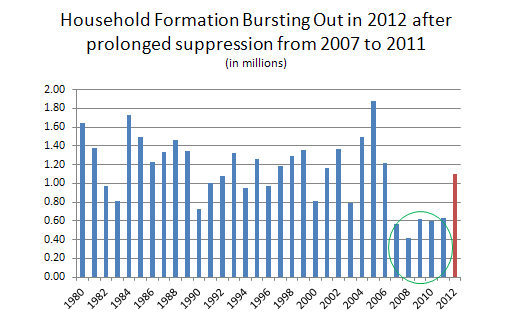
NAR has a good piece on the home ownership rate and household formation. The latest homeownership rate of 65.3% is the lowest since 1996.  Renters have been increasing.  They estimate that household formation broke out of its doldrums in 2012 and will be close to normalcy – around 1.1 million.  Note that this represents pent-up demand for housing as the Great Recession drove the low numbers, not demographics.  Of course some of these new households will go to rentals, but many will start purchasing starter homes, and they are the key to get transactions flowing again. This would also help ease the burden on the sandwich generation.

Chart:  Household Formation:

Looks like the sequester is going to happen, though the recent GDP report may give lawmakers a push to do something about it.  

When the FOMC statement is released, people will be focusing on the end of QE. Aside from the effect on interest rates, there is also the question about the size of the Fed’s balance sheet.  A recent paper projects the Fed’s balance sheet to start contracting in 2015, with a return to a more normal size in early 2018.  The Fed has been highly profitable during QE, since its own buying influences prices and makes its holdings of MBS and Treasuries more valuable. But what happens when they begin to sell?  The Fed may in fact lose money over the next few years, which will undoubtedly bring a political angle into the future role of the Fed.  Whoever succeeds Ben Bernake will, like Paul Volcker, preside over a Fed that will be unpopular, to say the least.