

 Brent Nyitray
 Fairlington Blade
 Let the mutherfuker burn!
 jnc4p
jnc4p Kevin S. Willis
 Michigoose
 lmsinca
 markinaustin
 Arcanaut
 novahockey
 quarterback
 ScottC
 yellojkt
Vital Statistics:
| Last | Change | Percent | |
| S&P Futures | 1492.9 | -4.2 | -0.28% |
| Eurostoxx Index | 2736.0 | -8.5 | -0.31% |
| Oil (WTI) | 96.55 | 0.1 | 0.11% |
| LIBOR | 0.301 | -0.001 | -0.33% |
| US Dollar Index (DXY) | 79.8 | 0.023 | 0.03% |
| 10 Year Govt Bond Yield | 1.96% | -0.01% | |
| RPX Composite Real Estate Index | 193.4 | 0.8 |
Stock index futures are weaker as the Fed kicks off its January FOMC meeting. The markets will be parsing the press release looking for clues regarding the end of QE, specifically the timing and the economic variables that influence the decision. Today is a very heavy earnings day, with Danaher, Ford, EMC, International Paper, and Pfizer reporting. Bonds and MBS are up a tick or two.
The S&P Case-Schiller index of home values rose 5.5% YOY and .6% MOM in the month of November. The hardest hit areas (Phoenix, Detroit, Las Vegas) showed the biggest YOY increases (Phoenix was up 23%!), while the New York declined 1.2%
DR Horton reported a 39% increase in revenues and a 26% jump in homes closed from a year ago. Orders were up 39% and backlog was up 62%. Like the other homebuilders, DHI is reporting general strength in their housing markets. There was a shift towards larger houses as well, as the dollar increase in the value of homes built increased 60%, while the number of units increased 39%. They are looking forward to the spring selling season with optimism. The stock is up about 4% pre-open.
Is the “risk on” trade we have been waiting for since 2007 finally on? Trim Tabs is reporting that last month was a record month for inflows for stock mutual funds and ETFs – the last time we had inflows of this magnitude was the winter of 2000, right as the tech bubble was bursting. Time to be cautious or time to break out the champagne? Reason for optimism: There are no, repeat no, signs of overheating in the economy. If anything there is a tremendous amount of pent-up demand. That is not recessionary, and should therefore be bullish for stocks. Reason for pessimism: Interest rates are going up. The great secular bull market in bonds that began with Paul Volcker’s tightening in 1981 is ending. The end of QE will mean long-term rates will rise, and short-term rates will soon follow. Also, we are in a secular bear market for stocks, and those rare animals typically last a lot longer than 12 years.
This secular bear market in stocks resembles the bear market of the 1970s. with stocks trading in a large range that oscillates over a period of years, while going nowhere. To put the 1970s in perspective, the Dow Jones Industrial Average was at roughly the same place when I graduated from high school as it was when I was born.
Chart: Dow Jones Industrial Average 1965 – 1983:

Compare to the S&P 500 since 2000:
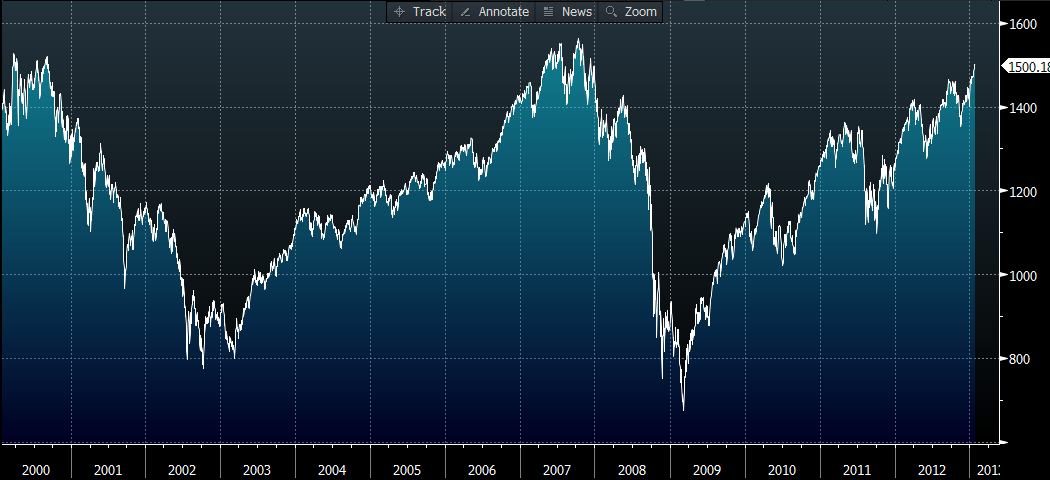
Similar oscillating pattern, with higher highs, and lower lows. If you believe in charts, they suggest a further run to eclipse the previous high and then a swoon lower. So, you might have another 8% – 10% left before the market heads back down again.
Of course we have one other secular bear market to look at: the granddaddy of them all:
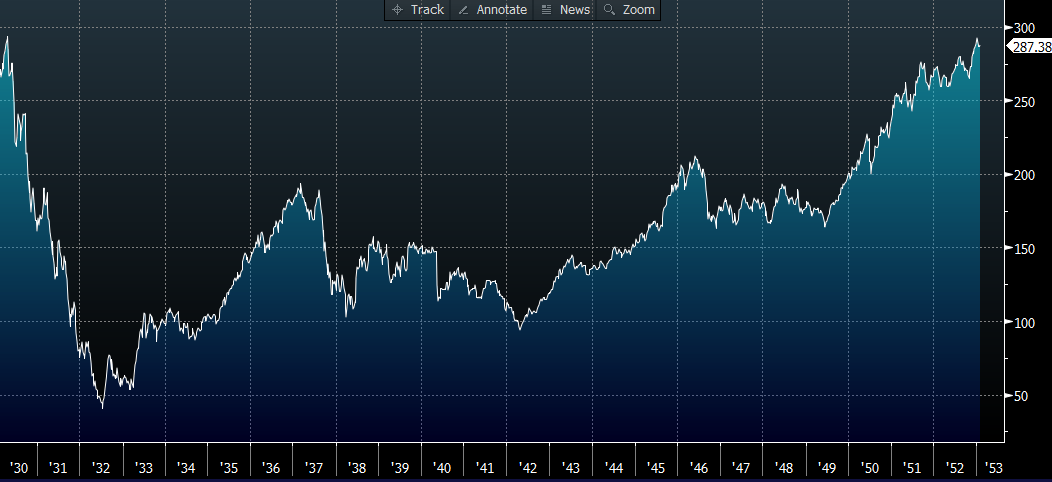
23 years of a secular bear – it took until 1953 to recover the losses from the 1929 crash. Some stock market darlings – Radio Corporation of America (aka RCA) never regained its peak from the 1920s. The economic backdrop of deleveraging has a lot more in common with the Depression bear than the 1970s bear which was driven by commodity price shocks and inflation.
Of course as Wall Street loves to say, past performance is not indicative of future performance, and charts are just that – representations of history that may or may not be relevant. The market may not follow either pattern. But, remember the great secular bull market in stocks from 1983 – 2000 was accompanied by a secular bull market in bonds that began at roughly the same time. That will not be the case this time around.
Filed under: Morning Report |
 All Things in Moderation
“with stocks trading in a large range that oscillates over a period of years, while going nowhere.”
This would seem to have strong implications for the old buy and hold arguments vs timing and also proposals to utilize equity investments as a retirement plan.
LikeLike
Thanks, Brent. Great description of the historical trends. Could you discuss the secular bear/bull markets in bonds at some point too? I think the overlap would be interesting to see.
LikeLike
Here you go Scott: Cass Sunstein makes the argument that Obama’s real goal is to enact FDR’s second bill of rights.
http://www.bloomberg.com/news/2013-01-28/obama-fdr-and-the-second-bill-of-rights.html
LikeLike
jnc:
My question: Is Cass Sunstein really this incapable of coherent thought, or does he simply assume his audience is?
LikeLike
The latter I suspect. And he has good evidence to back him up. See Greg Sargent on this piece:
What I find most annoying is his assertion that FDR’s second bill of rights is evidence that FDR believed in free markets and free enterprise and that the statement
“The right to a useful and remunerative job in the industries or shops or farms or mines of the nation.”
actually means:
“He did not mean that every American was necessarily entitled to a job”
You can see the intellectual roots of progressive/liberal constitutional interpretation theory here.
LikeLike
jnc:
You can see the intellectual roots of progressive/liberal constitutional interpretation theory here.
I see a complete absence of intellectual rigor. This is why it is so difficult to talk with progressives/liberals about rights issues…they have no coherent notion of what a right is or can be. They just use the term to mean “something I want people to have”.
LikeLike
FDR believed in free markets? Only if you completely ignore his policies….
LikeLike
it’s the positive vs. negative divide.
LikeLike
“This is why it is so difficult to talk with progressives/liberals about rights issues…they have no coherent notion of what a right is or can be. “
Yes they do. i don’t agree with it, but FDR’s notion is coherent and goes to the whole positive vs negative rights argument that Isaiah Berlin first articulated. FDR made his argument straight up based on this premise
“We have come to a clear realization of the fact that true individual freedom cannot exist without economic security and independence. “Necessitous men are not free men.” People who are hungry and out of a job are the stuff of which dictatorships are made.”
http://www.fdrlibrary.marist.edu/archives/address_text.html
It’s a serious argument and should be treated seriously. It goes all the way back to the Roman Republic.
My issue with Cass Sunstein is that he’s lying and saying up is down. It’s the same irritation when arguments are made that “the people” in the Second Amendment somehow refers only to the National Guard.
LikeLike
jnc:
Yes they do.
I very much disagree. The notion that so-called positive rights inhere in all men equally at the same time and in the same respect is an incoherent notion. It is logically impossible for it to be so.
It’s a serious argument and should be treated seriously.
It is not any kind of argument about rights at all, and it is based on an unstated premise about the meaning of freedom. The claim that “necessitous men are not free men” requires a definition of “free” to be understood and analyzed, and it is actually a false claim under an ordinary understanding of the term “free”, ie the absence of coercion. The argument may be a serious one about the advisability of what a democratic government should do in order to maintain its viability (that is in order to avoid becoming a dictatorship), but it is not a serious argument about the nature of rights or freedom.
LikeLike
jnc:
BTW, I am genuinely interested in whatever case you might make that the notion of so-called positive rights is a coherent one, understanding, of course, that you don’t actually accept the notion yourself. I think it would necessarily need to begin with a definition of the term “right”, which I would define as something to which one is morally entitled, but I am curious how you would define it.
LikeLike
I didn’t want to get down in the weeds when ScottC recently brought up negative freedom versus positive freedom but the couple of distinctions I read reminded me of FDR’s Four Freedoms:
Freedom of speech
Freedom of worship
Freedom from want
Freedom from fear
Two of these are negative and two are positive (although I’m still not sure how to tell which are which).
LikeLike
“Two of these are negative and two are positive (although I’m still not sure how to tell which are which)”
I’m assuming you are being facetious as it’s pretty obvious it’s the last two.
LikeLike
How do you even define what a universal Freedom from Want or Fear is? Seriously. I know that FDR pimped this but it just sounds crazy to me. It’s like extolling a Freedom to be Entertained, or a Freedom to be Cared For. Or Loved.
Course, I don’t think healthcare is a right, so…
LikeLike
It’s also interesting to read FDR’s commentary on the value of quashing dissent during wartime:
LikeLike
J,
Talk about your “cold wind.” I guess under Wilson and FDR, dissent wasn’t patriotic. Wonder if HRC thinks the same way now as she did then?
LikeLike
An argument against the sequester, by way of comparison to Japan.
LikeLike
The sequester is a cut of 22 basis points of GDP. Some austerity…
LikeLike
It’s in FDR’s premise that everyone is entitled to an equal starting place in the pursuit of happiness.
“As our Nation has grown in size and stature, however—as our industrial economy expanded—these political rights proved inadequate to assure us equality in the pursuit of happiness. ”
I assume you have read the Isaiah Berlin treatise?
http://en.wikipedia.org/wiki/Two_Concepts_of_Liberty
LikeLike
I think we may be having an argument over semantics. By “coherent”, I mean that the ideas that are being pro-offered can be understood in some sort of framework, even if I find the premise to be lacking due to logical fallacies, etc. This is distinct from Cass Sunstein’s BS that up is down, FDR didn’t really mean it, etc or a random statement of desires by individuals.
With regards to positive rights, the framework is pretty well defined:
http://en.wikipedia.org/wiki/Three_generations_of_human_rights
LikeLike
At the PL sinkhole, the liberals are both criticizing Rs for not wanting to allow more immigrants and taking umbrage to the notion that our immigration policy should be based on our needs not on family reunification. Can’t have it both ways.
This was quickly followed by gay bashing from a liberal, I assume, b/c it was aimed at Lindsey Graham. So far 3 have “liked” it.
LikeLike
jnc:
By “coherent”, I mean that the ideas that are being pro-offered can be understood in some sort of framework, even if I find the premise to be lacking due to logical fallacies, etc.
I dispute that they can be understood, even within the context of their own framework or premises. Consider FDR’s claim that, as you put it, “everyone is entitled to an equal starting place in the pursuit of happiness.” This actually contains two premises, first that everyone is entitled to the pursuit of happiness, and second that everyone is entitled to begin that pursuit from the same point. But these two premises are logically incompatible. If my pursuit of happiness includes a desire to provide advantages to my children that other children might not get from their parents (which is true for pretty much everyone) then my entitlement to the pursuit of happiness is in conflict with their entitlement to an “equal start”. The notion expressed is fundamentally self-contradictory.
This is what I mean when I say the progressive worldview is incoherent. It routinely posits the existence of “rights” that cannot logically co-exist, which contradicts the very nature of what a right is, specifically a moral entitlement.
LikeLike
This actually contains two premises, first that everyone is entitled to the pursuit of happiness, and second that everyone is entitled to begin that pursuit from the same point.
I really thought the latter was self-evident. Or so I had been told. What class or group of people are not deserving of happiness, let alone the ability to pursue it? And who determines and enforces this divide?
And what entitles one to a headstart in life other than advantageous selection of one’s parents? While I am eternally grateful to being born an American white male, but for the grace of God I could have been born into a Somalian refugee camp. Life is so tragically unfair in so many respects it seems callous to say that any effort to rectify disparities based on conditions completely outside of ones control to any degree is an unpardonable impingement upon the liberty of someone more fortunate solely through an accident of birth.
I built a really tall strawman there. Feel free to torch it.
LikeLike
yello:
I really thought the latter was self-evident. Or so I had been told. What class or group of people are not deserving of happiness, let alone the ability to pursue it?
You seem to be conflating the latter with the former. The latter premise was that everyone is entitled to begin the pursuit of happiness from the same point. I am not aware of anyone, except maybe FDR, who claimed this is self-evident, as it surely is not self-evident in the slightest. And I never said or implied that anyone was undeserving of the ability to pursue happiness. Quite the contrary, it is precisely because I think everyone is entitled to pursue happiness that I reject the notion that everyone is entitled to begin that pursuit from the same starting point. I’ve already explained the reasons for this, and have repeated it again below.
(BTW, while I firmly believe that everyone is entitled to pursue happiness, I’m not so sure that anyone who voted for Obama deserves to find it.)
And who determines and enforces this divide?
I don’t know what “divide” you are talking about.
And what entitles one to a headstart in life other than advantageous selection of one’s parents?
I never said or implied that anyone was entitled to a head start in life. What I think is that, as a function of their entitlement to pursue happiness, any given person is entitled to provide whatever head start they are able to provide to any other person of their choosing.
Life is so tragically unfair in so many respects
Although this is a common refrain, in fact the concept of “fairness” is not really applicable to the random happenstances of existence, unless you think that they are not so random but rather caused by some higher, sentient power, in which case that power could indeed be said to be fair or unfair.
…it seems callous to say that any effort to rectify disparities based on conditions completely outside of ones control to any degree is an unpardonable impingement upon the liberty of someone more fortunate solely through an accident of birth.
No one said any such efforts were unpardonable impingements upon the liberty of others. You are welcome to go to that Somolian refugee camp and do whatever is in your ability to rectify those disparities, and I won’t complain. But it is simply a fact that if you decide that, rather than you doing what you can to rectify them, you are going to use force in order to compel someone else to rectify them, you are indeed impinging on their liberty.
LikeLike
I’m fascinated by this story only because of this sentence: “He’s starting from the false premise that Medicaid doesn’t work, showing either a profound lack of understanding about health care systems or just his crass political ambition.”
If the current trajectory of Medicaid is financially unsustainable, and more and more doctors are dropping out, can it be said to be “working?”
The author goes on to say: “Insuring people through Medicaid, the CBO tells us, would cost 50 percent less per person for a state than subsidizing private insurance under state exchange. Medicaid has had the slowest rate of growth in costs compared to Medicare and private insurance. Medicaid patients are highly satisfied with the care they receive. Medicaid works.”
That is a lot of faith in CBO numbers, no? Does the CBO deserve such faith? I remember that during the HCR boondogle, er debate, the CBO scored in as deficit neutral even, because it excluded the so-called doc fix, while everybody knew that at some point in the near future, the doc fix would be implemented. I remember reading that as well at Kos. It just seems a little, you know, self-serving to quote the gospel of the CBO now since it may make Jindal look bad.
And how much concern should I put into the idea that Medicaid recipients like Medicaid? Wouldn’t it be better if they though it was a pain in the ass?
Anyhoo, a link to the Fightin’ Nutroots,
http://www.dailykos.com/story/2013/01/29/1183051/-Bobby-Jindal-stakes-out-far-right-health-reform-territory-with-Medicaid#comments
LikeLike
And how much concern should I put into the idea that Medicaid recipients like Medicaid? Wouldn’t it be better if they though it was a pain in the ass?
I have a bit of a problem with the idea that all government programs should be Kafkaesque nightmares designed solely to discourage and degrade the participants. If a person is entitled (in the broadest sense of the word) to a benefit either on the basis of income (or lack thereof) or in fulfillment of of previously promised benefits for service to our country, they should be treated with the same dignity and compassion as people using employer-based benefits.
Perhaps the fear is that if a government program were well-run and offered good value to the taxpayer, they would realize how arbitrary and needlessly expensive so-called ‘private’ health care is.
LikeLike
yello:
Perhaps the fear is that if a government program were well-run and offered good value to the taxpayer, they would realize how arbitrary and needlessly expensive so-called ‘private’ health care is.
Any health care program that is well run and offers good value to those who pay for it wouldn’t have to be run by the government, because people would voluntarily use it. The only reason for government involvement is so that unwilling users/payers can be forced to use/pay for it.
Indeed, the very purpose of government run health care is that the “good value” is offered to people other than those who are paying for it.
LikeLike
Brent – A Fourier transform would show you that there are different frequencies and amplitudes in those first two plots. From the perspective of someone who looks in the frequency domain, there’s little resemblance. Then again, you’ve put plots with different x-axes, making it next to impossible to compare them directly. It does give you the luxury of drawing whatever conclusions you would like without the bother of anyone being able to double check them.
BB
LikeLike
Well, what I think really undermines a charity program, and makes it susceptible to cuts, inadequate funding and potential dismantling is a perception that some percentage of recipients are taking advantage of those forced to pay for it. I would say it’s impossible to eliminate all “takers” from a given charity program, but making it inconvenient, vaguely humiliating and time consuming to use would cut down on it, in a relatively cheap way. Perhaps sacrificing some “dignity” and/or “compassion” to keeps a charity as free as possible from “moochers” is a price worth paying.
And I find the thought of “fear[ing]” a well run, cost efficient government program laughable. My world view is such that it is almost impossible for such a thing to exist. Have no fear my friend, I do not fear such a beast, I would welcome it.
LikeLike
And I find the thought of “fear[ing]” a well run, cost efficient government program laughable.
Just to plays Devil’s Advocate, I would propose the public school system to be one such program. Since it is available to all residents there is no competition based on price, only on quality. People migrate to school systems with the best education scores.
Competitors to the public schools market on perceived quality or exclusiveness, not cost. Even accounting for the taxpayer funding, private schools rarely have a lower per pupil cost.
An American version of the National Health Service could easily mimic this model. By providing a baseline coverage, out of network alternatives would have to provide a higher level of service which would also have a certain competitive inducement to the public sector to keep quality reasonable.
The advantage of universality, whether in education or in health care, is that there is no system to game and there is no distinction as a ‘taker’ since everyone is entitled to the service regardless of personal situation.
LikeLike
yello:
I would propose the public school system to be one such program. Since it is available to all residents there is no competition based on price, only on quality.
There is no single public school system. There are thousands of public school systems. And they do compete with each other both on price and quality, but since the product is made available via residency rather than via direct price, the price competition is manifested in house prices and tax rates.
The very worst thing that could ever be done to the public school system would be to nationalize it in an attempt to provide a “standard” product to all residents of the nation. It would destroy all of the best public schools.
An American version of the National Health Service could easily mimic this model.
If it did, it wouldn’t be a national health service. It would be thousands of mostly independent and locally run health services, funded locally in whatever way the locality wanted to fund the system. Pretty much exactly the opposite of the progressive wet dream of a single payer system.
LikeLike
I would say it’s impossible to eliminate all “takers” from a given charity program, but making it inconvenient, vaguely humiliating and time consuming to use would cut down on it, in a relatively cheap way.
I would argue the opposite. The more byzantine and capricious a program is,the more likely it is to be exploited by the ‘moochers’ determined to game the system than used by the people most in need of the service.
LikeLike
Going back to FDR’s Second Bill of Rights, I will paraphrase and abbreviate what I believe to be the more basic assertions:
Nobody should starve because they cannot afford food.
Nobody should die because they cannot afford health care.
Everybody should receive an education adequate to make them a literate and functioning member of society.
If core principles on liberty determine that any coercion required to adequately implement any of these goals through redistribution of income by any means other than completely charitable contributions is an unacceptable infringement upon someone’s freedom, there is really no point is discussing the best method of achieving them.
You seem to be saying that any government action which results in assistance to any individual other than those of your choosing (in your examples, most likely to be immediate family members) is an illegitimate infringement of your liberty. I hope I haven’t misinterpreted your philosophy.
LikeLike
yello:
You seem to be saying that any government action which results in assistance to any individual other than those of your choosing (in your examples, most likely to be immediate family members) is an illegitimate infringement of your liberty.
I am primarily saying that the progressive understanding of “rights” is contradictory and incoherent. It posits the existence of rights that are not compatible with each other, which negates the very nature of what a moral entitlement is.
Implicit in my criticism is that the initiation of coercion to compel a person to do something they wouldn’t otherwise do is a violation of their liberty. The source of the coercion, whether it is government or some other entity or individual, and the purpose of the coercion, whether it is to transfer funds to a poor person or a rich person, is irrelevant.
We can, I suppose, go on to have a discussion about whether a particular violation of liberty is “acceptable”, but we must begin by at least being honest about what it is, and not couch the discussion in language designed to make a rights violation appear to be the opposite of what it is.
LikeLike
Implicit in my criticism is that the initiation of coercion to compel a person to do something they wouldn’t otherwise do is a violation of their liberty.
Down this path is nothing but “All taxes are theft.” screeds ranting about jackbooted thugs. The entire basis of civilization is the surrendering of individual liberty for societal benefit to some degree. I appreciate the differentiation between negative and positive liberties and recognize that they are almost always in conflict in some way. The entire history of civilization is a negotiation between the two. But to a priori state that the former always trump the latter is just stubbornly absurd. No society can exist without some restraint on personal freedoms.
Denying all validity to any collective action which infringes on any individual liberty is meaningless. It’s a rabbit hole down which no productive dialog can occur.
LikeLike
Implicit in my criticism is that the initiation of coercion to compel a person to do something they wouldn’t otherwise do is a violation of their liberty.
Terribly overstated. Must agree with YJ. Down this road lies no ability to define harmful conduct as criminal. Down this road lies no ability to keep our air and water clean, or to assure the continuation of the competitive mechanism at the heart of capitalism.
All of the tensions between the liberties of one and of another require line drawing, by means of social control, as benign as agreed upon good manners or as forceful as the criminal law.
LikeLike
Very well stated, mark. A world without coercion of any kind is pure anarchy.
I like the ‘right’ to clean air and water. To put it in the obverse, nobody has the absolute ‘right’ to pollute the environment I share in common with them. I was going to formulate an example involving food safety where caveat emptor is really inadequate. I have a reasonable expectation to not fear that food I buy in a public market is going to kill me and I rely upon the government to allay that fear.
LikeLike
mark:
Down this road lies no ability to define harmful conduct as criminal.
Huh? Quite the contrary, it is precisely down this road that an objective definition of criminal conduct must lie. Why is rape criminal? Why is murder criminal? Why is theft criminal? Why is slavery criminal? Because they use coercion to force people to do something they don’t willingly do.
All of the tensions between the liberties of one and of another require line drawing,
There are no tensions between the liberties of one and another if one understands liberty to mean the absence of initiated coercion.
LikeLike
There are no tensions between the liberties of one and another if one understands liberty to mean the absence of initiated coercion.
You have written this before and I have written in response that I have no idea what you mean as it applies to the world, where liberties as we define them in the law are in conflict on a daily basis. Nothing in your broad statement of principle admits of the necessities of procedures for determining whose liberty or what liberty takes precedence in a given situation.
When you use murder and rape as examples of individuals taking the liberties of others I agree. The discussion, however, was about the limitation of the government’s role. Obviously, you think the government should define and punish murder. Do you think it should define and punish the emissions of CO2?
LikeLike
mark:
I have written in response that I have no idea what you mean as it applies to the world, where liberties as we define them in the law are in conflict on a daily basis.
And I pointed out to you then that your mistake is in holding liberties “as defined by law” to be primary to a non-legal understanding of liberty. A philosophical, moral understanding of liberty is necessary prior to the creation and application of legalities designed to protect it. When discussing how government should protect liberty, it makes no sense to look to current legal definitions of liberty as a guide. Otherwise one could never conclude that what the current government is doing is inadequate or, worse, a violation of liberty itself.
For example, one could not have advocated for the abolition of slavery in 1850 Mississippi with appeals to liberty “as defined by law”. Necessarily one had to appeal to a meaning of justice external to the justice system itself.
When discussing what the government should be doing, one must look to principles of justice outside of current law, not principles of justice as defined by current law.
The discussion, however, was about the limitation of the government’s role.
Yes. And I think that actions taken under the guise of government are subject to the same set of moral principles of justice that govern all other actions.
Obviously, you think the government should define and punish murder. Do you think it should define and punish the emissions of CO2?
With specific regard to CO2, no. But with regard to the more general issue you are getting at, yes the government has a role to play in protecting public goods (air is the quintessential public good) from the harmful actions of individuals.
LikeLike
yello:
Down this path is nothing but “All taxes are theft.” screeds ranting about jackbooted thugs.
And yet you have never heard such screeds from me, nor will you. I know you routinely try to dismiss my argument by raising this strawman, but it is a strawman.
Denying all validity to any collective action which infringes on any individual liberty is meaningless.
I never made such a denial. As I said, it is certainly possible to discuss which infringements might be acceptable and when they might be acceptable, but we must begin by acknowledging that they are indeed infringements, and dispense with the pretense that such infringements are actually protection of liberty. As jnc said the other day in a different context, if you want to restrict someone’s liberties, then own it, don’t pretend that up is down.
LikeLike
How do you even define what a universal Freedom from Want or Fear is?
Let’s approach it from this direction. In my ideal state, the need for personal protection beyond the most cursory security devices (door locks, well-lit entrances, etc.) is eliminated because a professional and well-trained police force following well-established rule-of-law procedures efficiently and effectively solves crimes that do occur. And a fair and equitable justice system meters out prompt and appropriate punishment.
In an anarcho-libertarian 2nd Amendment absolutist paradise, crime is low because each house is protected by a rabid gun-owner (or at least a large enough percentage to give the freeloaders herd immunity) willing to engage in lethal force to protect his or her property rights. However, in such an environment, the home owner must be always vigilant that he won’t be overpowered by an intruder with an even bigger arsenal.
In the former case, the citizenry is free from fear because the state has created a state of lawfulness. In the latter, security is specifically fear driven. Police powers are one role of government even the most ardent libertarian begrudgingly acknowledgement as a legitimate form of collective action and the taxes required to support the justice system a valid infringement on the ‘right’ to retain all your earnings.
LikeLike
yello:
In the former case, the citizenry is free from fear because the state has created a state of lawfulness.
That is not true. The only reason to have a police force is because of the knowledge that, even with the existence of formal law, some people will still try to behave unlawfully. And the only reason to have courts is because of the knowledge that those who try to behave unlawfully will often be successful. The existence of police and courts, ie a justice system, is somewhat of a deterrent to unlawful behavior but, manifestly, it is not a universal deterrent. It is impossible for the police to literally prevent all, and probably even most, criminal behavior. The primary function served by police and courts is to deal with criminal behavior after the fact. Hence, even with the existence of police and courts, the citizenry still has reason to fear criminal behavior.
The idea that “freedom from fear” is a moral right that people have, or a legal right that people “should” have, is meaningless treacle.
LikeLike
The idea that “freedom from fear” is a moral right that people have, or a legal right that people “should” have, is meaningless treacle.
I find the idea that I should have a reasonable expectation of safety to be one of the greatest advantages of Western civilization over say Colombia or Somalia. It may not be a Right in your neo-objectivist philosophy but I find it a great comfort and feature of our political system that I would not want to do without. If it isn’t a Right (however you are defining that), it’s definitely a Goal worth working to obtain even if some Rights have to be limited to obtain it.
LikeLike
I apologize Brent. The graphs did look different (the most recent one looks like a sawtooth with a period of about 7 years whereas the other looked like static noise with occasional spikes. The x-axis crack was unwarranted. TIme for me to take a little break, I think.
Paul
LikeLike
Let me try this. I believe there are inherent differences between people and one result of those differences quite naturally manifests itself in political philosophy. I think we’re blessed in this country by our defined freedoms to be able to both express and explore our differences in a manner that allows our people to vote according to their philosophical differences. In my lifetime I have seen the pendulum swing back and forth numerous times and I see that as a benefit not a curse. Therefore, while I am perplexed by our differences and fearful of some of the natural extensions in policy of my counterparts in the political arena, I still relish and actually cherish their participation and the dialogue. Thus, I keep coming back to our discussions here as a valuable endeavor.
I think my problem is that I am not well enough versed in political or philosophical history to be the one to hold the interest of my opponents here, or others of your persuasion, in the debate. And forgive me for saying this but I don’t think some of you value either my perspective or even others more versed in the art of debate as a counter to your definition of the parameters. I also believe this is a very common phenomenon in the political discussion blogs or even the floor of the House or Senate; we’re not listening to each other. Actually, most people only really want to listen to others who agree with them and feel free to disparage their “enemies”. I am trying to listen and learn and would love to live long enough to see a change in the embattled environment of our politics.
Let me just say that I read the words of the conservative/libertarians here and not only see them in black and white, I hear and feel them in the same stark reality of black vs white, right vs wrong, logic vs incoherence. What I don’t hear in general is any grey area of compromise or concession to the value of a differing philosophy. My political and social philosophy is not grounded in the same logical extension of what we can agree is a basic freedom. I believe in extenuating circumstances and need based or corrective based and community oriented prescriptions to correct the inequity of life while at the same time I actually do appreciate the brakes some of you put on my inclinations.
I can’t answer Scott’s or McWing’s or others’ questons the way you state them because they are completely logical and therefore, of course you are correct. Freedom from coercion by the government or others is as basic to humanity’s continued existence as just about anything. I can’t disagree with you because I don’t, but my inclinations do not stop there. Because I am completely willing to pool some of our resources (including my own), via the tax code, to rectify what I believe to be injustices created by birthright, individuals, corporations and even our own or another’s government, we will never be able to agree on the most basic necessities and responsibilities of said government.
I value the pooling of some of our individual resources, monetary and otherwise, in this endeavor especially when it improves the life of someone less fortunate (trite sounding but true). I can’t really state it more simply than that. I don’t however mean to intentionally harm another’s life in the process obviously, but I do understand how you could perceive my intentions otherwise. We have a long history in this country of this balancing act and I do believe if people like me go too far we will lose elections in the future and the pendulum will swing the other way again.
I don’t think I can come back but wanted some of you to know I have been reading and listening. It’s nearly impossible for me to explain my politics any further than this as I simply don’t have to words to do it justice.
LikeLike
lmsinca,
I value and appreciate your contributions. Part of the problem is that all the discussion occurs on the turf of the libertarians with their definitions and formulations. By accepting their definitions of rights there is no room for rebuttal or compromise.
I wish we had more discussion over practical policy actions rather than always devolving to philosophical meanderings disputing the very validity of government action in the first place. But if the philosophy is that government acting in a particular sphere is inherently invalid, trying to define what actions it should take is a moot point.
LikeLike
This is why I like ATiM so much. I’ll have to go back and read this back-and-forth when time permits.
LikeLike
Always good to hear from you, LMS, and you certainly don’t have to justify yourself in some broad philosophical context to me. We make decisions every hour of every day, and having some sense of how they affect those around us is not a shortcoming, but a necessity. So questing to find how your political decisions affect others, which is what you do, is a blessing.
LikeLike
I also believe this is a very common phenomenon in the political discussion blogs or even the floor of the House or Senate; we’re not listening to each other.
I think it is less that we are not listening to each other, although that certainly happens, than the fact that different people have different goals with respect to their participation in these sorts of conversations. As your post makes clear, you seem far more interested in hearing the various perspectives, considering them, and deciding whether and how to modify your beliefs accordingly. I think it is pretty clear that other people here, Scott in particular, are more interested in winning an argument and exposing the fallacies, erros and absurdities of their opponent. I am not arguing that one goal is superior to another. But these varying purposes inevitably lead to conflict. I also think that the varying purposes lead to the use of more or less stark rhetoric. I can certainly see how someone may interpret some of Scott’s posts to be inflammatory or, less frequently, dismissive. However, at least with respect to my interactions with Scott, or for that matter, everyone at this blog, I do believe that he listens to what liberals/progressives have to say and, on occasion, may modify his beliefs when confronted with a perspective he had not previously considered. I think his more confrontational style sometimes makes it hard to see this and his desire to win an argument and expose weak or illogical arguments leaves an impression that he is not listening.
This whole post is going to make me look like a giant Scott apologist, not that that’s a bad thing, but I have really been struggling lately with some of Scott’s posts and have thought about no longer participating. However, discussions like the one b/t Scott and Yello make that impossible.
LikeLike
“yellojkt, on January 30, 2013 at 7:00 am said:
Very well stated, mark. A world without coercion of any kind is pure anarchy.”
Which isn’t the argument that libertarians make. The argument is that coercion is only justified to prevent harm to others, but not to prevent someone from harming themselves. Under this logic, preventing pollution is justified, but not the drug laws, to use to simple examples.
LikeLike
JNC, I understand that to be a libertarian concept and I agree with it. YJ and I think Scott overstated the position as an absolute. If the understanding is that one’s liberty as a right is limited by another’s liberty as a right, if there is an understanding of line drawing and boundary setting, if there are procedures and mechanisms for adjudicating between persons each of whom claim the other is confounding liberty, we can have a system for the protection of liberty itself.
An example: the Colorado River of Texas is the longest river in the state. “The 862-mile (1,387 km) long river[4] flows generally southeast from Dawson County through Marble Falls, Austin, Bastrop, Smithville, La Grange, Columbus, Wharton, and Bay City before emptying into the Gulf of Mexico at Matagorda Bay.[3]” [wikipedia]
Unlike other states, TX water rights are a matter of state law. Every landowner along the Colorado claims a property right and the liberty to use the water.
It is a deep river, and until recently its water has been abundant. The drought has changed that, coupled with growth along the river. Until recently, there was enough water for the ranchers, for the City of Austin, for the rice farmers near Wharton who are major world suppliers of rice, and for cooling the Nuke at Bay City. Now there is not. Who gets the water? Property owners say “we have riparian rights”, an argument that favors the upstream ranchers on a first come first serve basis and which causes spread grief if it is apportioned.
So what if the rice farmers simply cannot get enough water? What if the nuke cannot be cooled? What if Austin cannot ration enough to keep growing? What if, what if. Lots of powerful interests. Nothing in Scott’s enunciation of liberty definitions and rights arguments is really helpful, here, as far as I can see. Rick Perry leads prayers for rain, of course.
LikeLike
mark:
I missed this comment from earlier:
Nothing in Scott’s enunciation of liberty definitions and rights arguments is really helpful, here, as far as I can see.
Perhaps, but that is no reason to dismiss them. It was not my purpose to propose a means of determining property rights over a river. I was proposing a framework in which any such rights could be coherently understood. If person A has a right to use the river, then it can’t also be said that person B has an equal right to use the river in a way that conflicts with person A’s use of the river. To do so renders meaningless the very concept of a right. That is not to say, however, that either A or B does (or does not) have such a right.
LikeLike
lmsinca, on January 30, 2013 at 7:10 am said:
…
“I think my problem is that I am not well enough versed in political or philosophical history to be the one to hold the interest of my opponents here, or others of your persuasion, in the debate. And forgive me for saying this but I don’t think some of you value either my perspective or even others more versed in the art of debate as a counter to your definition of the parameters.”
I for one value the contributions of the others (otherwise this place gets pretty boring, Brent’s morning report not withstanding) and I try to make an effort to do justice to the most effective version of the argument being presented, even if the post is a bit jumbled and the poster can’t reference Reinhold Niebuhr or Isaiah Berlin off the top of their head.
If you just want to post to win the arguments by default, one should go to Plum Line or better yet, just use Notepad. My purpose is always to attempt to persuade.
LikeLike
I value everyone’s contribution here which is why I urged Scott to return after his absence and continue reading. That doesn’t mean I personally can continue to debate him or others. Obviously, the purpose of debate is persuasion but when the battle is already lost at the outset what the hell is the point?
As one of those illogical lefties who’s trying to help Obama screw the rest of you what would be the point of me continuing? I don’t see one.
LikeLike
“yellojkt, on January 30, 2013 at 7:00 am said
Very well stated, mark. A world without coercion of any kind is pure anarchy.
I like the ‘right’ to clean air and water. To put it in the obverse, nobody has the absolute ‘right’ to pollute the environment I share in common with them. I was going to formulate an example involving food safety where caveat emptor is really inadequate. I have a reasonable expectation to not fear that food I buy in a public market is going to kill me and I rely upon the government to allay that fear.”
This gets into semantics again. Something can be a good idea and good public policy without being a constitutional right.
The rise of “rights” as a basis for taking action has been driven by the desire to interject the Federal court system into policy disputes to overrule the democratic process when it was perceived to be inadequate. As the Federal courts legitimate mandate has typically been to overrule legislation when it was found to violate constitutional rights, this has become the preferred framing to achieve the desired policy result.
LikeLike
This gets into semantics again.
We never leave semantics.
All arguments are won or lost with the definition of terms. Defining liberty as the absence of coercion is a start but then all sorts of assumptions get swept up into it. This obsession with coercion as being narrowly defined as explicit or implicit threats of violence is too limiting as it ignores far more subtle implications of unfettered action.
All these so-called ‘positive’ rights can be recast as negative rights with a reversal of actors. Any action you take limits my action in some way. If you extract ore from a mountain you have limited my ability to extract it in the future. If you want to chop down all the trees in a forest, that limits my right to use that forest for camping. If you don’t pay me a living wage because you have a monopoly on employment in a certain town, you are restricting my ability to feed my family. Without copyright or patent law, my right to sell my intellectual property is unrealized. It’s nice to think that all political decisions can be reduced to whether it restricts or enhances personal liberty, but that is a narrow blindered outlook.
LikeLike
Here’s a question for you lmsinca:
How different do you perceive Obama’s tone after the election than during it and during the first term? Do you find him to be dramatically more progressive in the second inaugural?
LikeLike
Yes his tone has changed and yes he appears to be more progressive.
LikeLike
I think the abortion issue is a good one if we’re going to discuss rights. If we define life as beginning at the minute of conception and that life is exactly as valuable and viable as the mother’s, or host’s if you will, as long as her life is also not in jeopardy, then I would have to agree that abortion is immoral and should be illegal. Logic would demand it. Logic would also demand that the host be punished for ending that life based upon our definition of murder. That’s the logical consequence.
If however, I place more value on the life, or perhaps I should say well being, of the host up to a certain point in development, then I can argue against your logic of life begins at conception by claiming extenuating circumstances.
Isn’t the art of politics defining those circumstances and the point of government? But if you insist that life begins at conception and all life is equal, there is no room for me to claim a disagreement.
LikeLike
Judging by recent Republican opinions, they seem to believe life begins when the roofie is slipped into the drink.
Cheap shot, I know, but it’s the logical extension of their statements.
LikeLike
FWIW, Lms, we use the word life too loosely. Bacteria have life. What we are dealing with is “personhood”. Persons, in our law, have a right to life that cannot be taken without due process. The State of Texas in R. v. W. wanted to define conception as the moment of personhood.
That is how the Court got into Solomon land by splitting the embryonic stages into not yet a person and could be a person.
The other view of life is that it begins when the last kid leaves home.
Obviously, I hope, I agree with the thrust of your comment. The adult woman is always a “person”. I am comfortable with the early-embryo being defined as “not yet a person”.
In traditional Jewish law, abortion is mandatory under some circumstances. I would not impose that view on anyone else, either.
LikeLike
The personhood laws they are attempting to pass are based on the “idea” that life begins at conception because all the potential of a human being are inherent in the fertilized egg.
I’m not trying to re-litigate the abortion issue here, that didn’t go very well the last two or three times. I’m simply trying to illustrate how logic and the logical conclusions we reach have conflicting outcomes some of which are intentional, others unintentional and the rest are a result of a value judgement.
Inherent in our differences politically is our individual value system.
LikeLike
I will leave the rest of you to it. I was compelled to express an opinion on this topic but am not very compelled all that often as I don’t see the point any more.
LikeLike
the government has a role to play in protecting public goods (air is the quintessential public good) from the harmful actions of individuals.
I’m not trying to be snarky or playing gotchya, but would that make clean air a fundamental positive freedom?
LikeLike
yello:
would that make clean air a fundamental positive freedom?
No. Maintaining clean air entails preventing action that harms others, not compelling action that helps others.
LikeLike
not compelling action that helps others.
Mandating installation of scrubbers in stacks at refineries.
LikeLike
mich:
Mandating installation of scrubbers in stacks at refineries.
No one is compelled to open a refinery and install scrubbers. They are prohibited from polluting. One of the ways they can demonstrate to the satisfaction of the government that they are not polluting is to install scrubbers. Another is to close down the refinery. There may be others that I am not aware of. But ultimately the regulations are designed to prohibit action (“don’t pollute”), not compel it.
edit: sorry, didn’t see jnc’s response.
LikeLike
Michi, that’s the same thing. It goes back to what the default situation is in the absence of action by the initial party. In this case, the air was free of pollution absent the action that cause the pollution in the first place, therefore the polluter caused the harm.
This is distinct from forcing me to pay for your health insurance/care. I didn’t cause your health problems, therefore I’m not responsible for them.
What you can make a good case for is that the libertarian concept of harm and actionable causes is incompatible with calls for tort reform. Inherent in the premise that private causes of action should be the primary means of redressing societal harms instead of regulation is the idea of a robust tort system.
LikeLike
That makes sense, jnc. Thanks!
LikeLike
Thanks for your explanation, too, Scott!
LikeLike
I’m looking for the link, but there was an essay/history that i was reading about how the courts during the industrial revolution basically shelved property rights and the related complains in favor of progress. meaning, hey, sorry poor people, but that factory is more important than the soot in your home. and instead of trying to put the genie back in the bottle, the response was regulating the polluter and the eventual creation of EPA.
LikeLike