

 Brent Nyitray
 Fairlington Blade
 Let the mutherfuker burn!
 jnc4p
jnc4p Kevin S. Willis
 Michigoose
 lmsinca
 markinaustin
 Arcanaut
 novahockey
 quarterback
 ScottC
 yellojkt
Vital Statistics:
|
Last |
Change |
Percent |
|
|
S&P Futures |
1487.3 |
-2.1 |
-0.14% |
|
Eurostoxx Index |
2711.0 |
-5.7 |
-0.21% |
|
Oil (WTI) |
96.78 |
0.1 |
0.10% |
|
LIBOR |
0.301 |
-0.001 |
-0.33% |
|
US Dollar Index (DXY) |
79.76 |
-0.117 |
-0.15% |
|
10 Year Govt Bond Yield |
1.83% |
-0.02% |
|
|
RPX Composite Real Estate Index |
192.2 |
-0.6 |
|
Markets are slightly lower this morning in spite of good earnings reports out of IBM and Google. After the close, we get Apple’s 4Q as well. Mortgage Applications were up last week. Later on we will get the IMF world economic outlook.
The House will vote today to suspend enforcement of the debt limit through mid-May, in order to put pressure on the Democratically controlled Senate to pass a budget and to relieve the pressure on the debt ceiling crisis. Obama says he will go along with it. Which means the next subject will be the sequestration cuts.
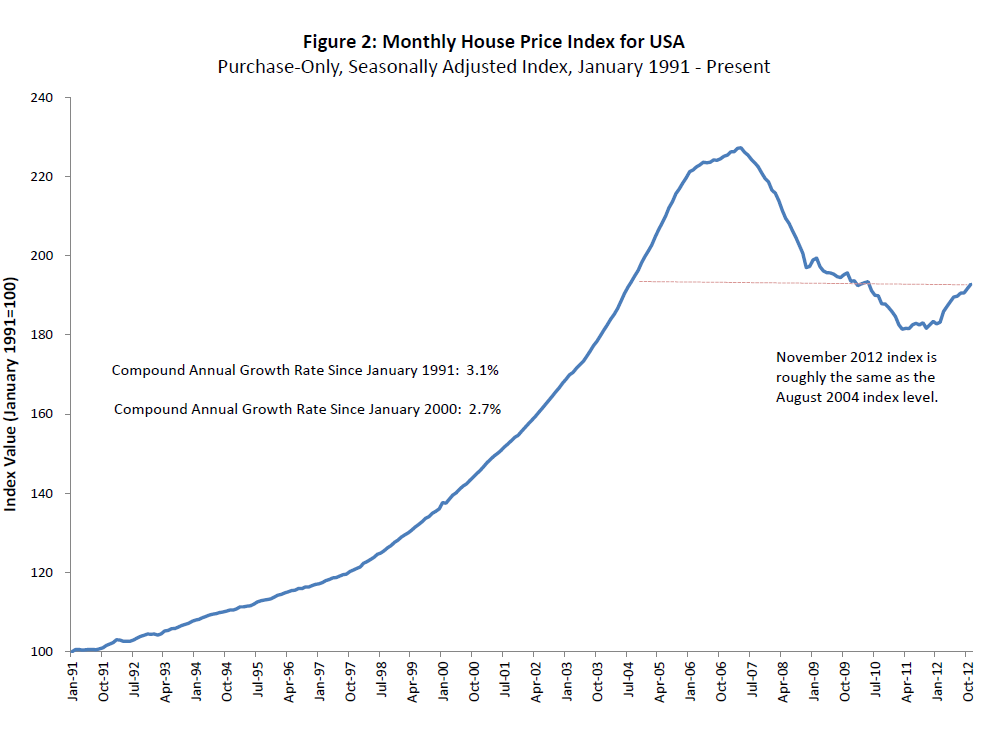
The FHFA House Price Index rose .6% in November. On a YOY basis, prices are up 5.6%. The FHFA index only looks at conforming mortgages, which is more stable than the broader indices. Prices are back to August of 2004 levels.
Is the roughly $1.7 trillion of foreign earnings stashed offshore by US companies something that is kept out of the US economy? Turns out that a lot of it is in offshore accounts, invested in US dollar assets like Treasuries and MBS, which undermines the argument that all of this foreign cash could be circulated in the US economy if we changed the tax laws. That said, this money is not available for expansion in the US or for distributions to shareholders.
The NAHB expects the housing upturn that started last year to pick up momentum, in spite of headwinds coming out of tight mortgage lending and potential tax changes. Using 2000-2003 as a baseline, the single-family market was running at 44% of normal production. The NAHB forecasts 949k total housing starts in 2013. From 1959 through 2002, 1.5 million units a year was considered “normal”
Jamie Dimon had some words for regulators at Davos. Suffice it to say that bankers loved it, and the chattering classes / political classes did not. If obama’s inauguration speech was a full-throated defense of activist government, Dimon’s speech was a defense of the private sector.
Filed under: Morning Report |
 All Things in Moderation
Just wondering — has the debt limit ever been delineated by a date rather than a number before?
LikeLike
One more thing about the debt limit bill:
LikeLike
Some CNN anchor/reporter has been writing a letter to Obama every single day for the last four years. Very weird.
LikeLike
We haven’t had a cult of personality president like this in a long time…
LikeLike
Brent:
We haven’t had a cult of personality president like this in a long time…
I can’t think of any in my lifetime that come even close.
LikeLike
Before my time, but what about JFK? My mother-in-law, bless her soul, would swoon when you mentioned him.
LikeLike
Probably JFK, I suppose.
LikeLike
Daily letter writing to the President by a member of the press is inappropriate, weird and a little creepy. Maybe I’m overreacting, but seems pretty inappropriate to me.
LikeLike
As if we needed any more proof that the press is head over heels in love with obama..
LikeLike
Regarding the Frontline piece from last night on the lack of bank prosecutions, perhaps the most memorable exchange was Senator Kaufmann’s reaction to the statement from Lanny Breuer that the economic impact of bringing a prosecution on the bank itself and it’s counterparties was considered prior to bringing a case. I also liked his comments on the value of oversight hearings. Pity he’s not there anymore.
It’s also interesting to watch it now after all the arguments about prosecutorial overreach in the Aaron Swartz case. One thing you can say about Breuer is he was certainly not trying to overreach on prosecuting Wall Street.
The other great irony of course is that the only major case that was even brought to trial was the one that the Bush DOJ started against Bear Sterns.
http://www.pbs.org/wgbh/pages/frontline/untouchables/
LikeLike
JNC:
I did not see it, but I should be able to get it on the PBS app on my ipad, which I will try to do later.
Did they name names? Who among the “leaders” on Wall Street, according to Frontline, should be facing criminal fraud charges?
LikeLike
Franklin Raines presided over an accounting fraud that rivaled Enron and the Administration didn’t even say “boo” to him.
The GSE’s owe the government, what, something like $180 billion? You would think that would matter
LikeLike
Scott:
The government is taking the civil suit route since the bar for establishing guilt is lower (“preponderance” vs. “beyond reasonable doubt”). From Frontline, a list of the top 10 civil cases:
http://www.pbs.org/wgbh/pages/frontline/business-economy-financial-crisis/untouchables/too-big-to-jail-the-top-10-civil-cases-against-the-banks/
LikeLike
Mike:
The government is taking the civil suit route since the bar for establishing guilt is lower
Yeah, I get it, and it makes perfect sense. But it also runs counter the populist narrative of a Wall Street double standard with regard to justice, or Wall Street as standing above the law, a narrative that Frontline itself seems to want to perpetuates with references like “Untouchables” and “Too Big to Jail”. I am curious if Frontline has made a reasonable case that certain identifiable individuals really have engaged in actual, criminal fraud and should be in jail, but have been spared simply because they are “Wall Street leaders”, or if, as I suspect is actually the case, the justice department has not pursued criminal action against certain individuals because their chances of success are in fact pretty low, and they are therefore better off taking a pound of flesh through civil suits and the subsequent settlements.
LikeLike
“The House will vote today to suspend enforcement of the debt limit through mid-May, in order to put pressure on the Democratically controlled Senate to pass a budget and to relieve the pressure on the debt ceiling crisis. Obama says he will go along with it. Which means the next subject will be the sequestration cuts.”
Mike beat me to it, but it really is a moment when they could get back to the “regular order”.
JNC and I think they have been ducking “regular order”, for ignoble reasons, as we stated in exchanged views, previously.
The importance of making the legislative process work, as a structural goal, cannot be overemphasized.
Further, It is the antithesis and antidote to “personality” politics, which have limited efficacy. I don’t know how you go about rating “personality cults”, but BHO, RWR, and JFK had more of a cult like following than the others, although WJC had as much “charisma” as any of them. I don’t think it made a difference for any of them except in their own electability. LBJ and RMN had huge landslide election victories with no charisma and no cult like appeal. So it is easy to overestimate the “noise” of personality stuff, IMHO.
LikeLike
mark:
I don’t know how you go about rating “personality cults”, but BHO, RWR, and JFK had more of a cult like following than the others,
I kind of doubt that either Reagan or JFK were ever characterized in a mainstream newspaper as “lightworkers” ushering in a “new way of being on the planet”.
Nor, I very much doubt, did any newscaster ever talk about his tingling legs in reaction to a Reagan or Kennedy speech.
I definitely think BHO wins this one by a wide margin.
LikeLike
I see what you are writing, Scott, and that is very amusing stuff, but I am counting also how quickly we got national stuff named after Kennedy and Reagan. I think we will get BHO bridges and tunnels, too, but few or no WJCs or Fords or Nixons.
That is another way of looking at personality cult. I’m too old to tingle, except in close proximity to my wife, but there was an Argentine female [IIRC] president who would have made me tingle at another time and place.
Didn’t “tingling”, as a speech description, originate with Pat Buchanan – RWR?
I’ll go Ashot one better and say I hope the Secret Service investigated the every day letter guy.
LikeLike
I don’t think there is any defending some of the coverage given to Obama, but in comparing him to the likes of RWR or JFK we are dealing with an entirely different media beast. To some extent the media’s adoration of Obama may be as much a reflection on the media and its size as it is Obama. I don’t think that undermines Scott’s point, but I wonder if others agree. I’d also wager that RWR and JFK probably didn’t have to deal with at least one large media outlet stumbling over itself to criticize them. One last thing: what if JFK was having an affair and the cult of JFK led to the media ignoring it? Omissions (like the media rarely talking about the legality and ethics of all the drone attacks) are tougher to capture and identify but could be an even better measure of a President’s cult than tingling leg comments.
LikeLike
There is no doubt in my mind that the press worshipped JFK, and that they loved RWR. So I think what makes it hard to compare is Ashot’s observation about how different the press is today. As Tim wrote, this does not detract from Scott’s point.
The suppression of JFK’s many problems – the women, the Addison’s, the steroid abuse [he had an almost Barry Bonds like morphing between 1956 and 1960], simply could not happen today. Was it kept silent out of respect for the office? In retrospect, I doubt it was entirely that, and that it was in part luv for JFK.
I don’t recall anyone in the press noticing the confusion RWR sometimes displayed in ’87-’88. It would have been all over the internet today. With videos of him asking Nancy for help. Some would pass it off as “hearing loss”, but some would suggest it was early stage Alzheimer’s. I don’t recall any of that, but I remember seeing the apparent confusion on two occasions. I think that was not speculated upon because times were different, and also because the MSM luvved RWR.
I heard Jim Lehrer give a college graduation address at OU in 1995 or ’96. He spoke in detail on the difference in reporting, pre-cable news and post. The race for immediacy at the expense of either reflection or investigation has only increased with the rise of the internet. You can read any sort of BS, fawning in the extreme or lying criticism in the extreme, over and over, now. So-called newscasters can say crap like they have tingling legs, but we can still make fun of them.
I wonder if WJC could have achieved that sort of personal acclaim in the pre-cable days. I know JFK could not have, today.
LikeLike
mark:
I don’t recall anyone in the press noticing the confusion RWR sometimes displayed in ’87-’88.
That’s probably because the press had already settled on the “amiable dunce” narrative long before ’87.
LikeLike
mark:
and also because the MSM luvved RWR.
The MSM in Texas must have been a much different one than the one I was seeing in the northeast.
LikeLike
ashot:
but in comparing him to the likes of RWR or JFK we are dealing with an entirely different media beast.
There is no doubt that this is a different media environment.
I’d also wager that RWR and JFK probably didn’t have to deal with at least one large media outlet stumbling over itself to criticize them.
I don’t know about JFK, but Reagan had multiple media outlets stumbling over themselves to criticize him. The NYT and WaPo, of course, were no more objective in 1984 than they are now (actually I’d say the WaPo was probably even worse then), along with ostensibly objective weekly news magazine outlets like Time and Newsweek (which back before the advent of the internet were much more significant and influential than they are now). And of course the only 3 TV networks back then were all arrayed against Reagan, albeit in a less overt and hence much more insidious manner than, say, the (almost) openly conservative FOX is today with regard to Obama. Don’t forget that FOX itself was born out of a conservative reaction against the monopoly of the big 3 that piped a soft-left version of reality into each household every night under the guise of “objectivity”. FOX is piping its version of reality into a significantly fewer number of households than the big 3 used to, and is competing against its mirror in CNN and MSNBC, which both work to prop Obama up as much as FOX works to tear him down.
One last thing: what if JFK was having an affair and the cult of JFK led to the media ignoring it?
I suspect JFK’s ability to get away with his many dalliances under the radar of public scrutiny had much more to do with the times he lived in than any cult of personality.
LikeLike
Scott:
as I suspect is actually the case
Probably. No laws against being stupid or being aggressive/taking risks. “Knowingly misled” is hard to prove. The government is likely also gun-shy from having lost the Bear Stearns criminal case.
Which reminds me that the Allen Stanford cases were granted cert by SCOTUS on Friday.
LikeLike
Re: charisma, I “met” Bush W once — very briefly in a handshake line. And all of these guys have a way of making you feel you’re the only one in the room. Mom had the same experience with Clinton at a reception. She had a longer interaction, but she said he was so smooth she forgot how much she hated him. picked her name of the name tag, and wove it into conversation like he’d know her for years.
LikeLike
“ScottC, on January 23, 2013 at 9:27 am said:
JNC:
I did not see it, but I should be able to get it on the PBS app on my ipad, which I will try to do later.
Did they name names? Who among the “leaders” on Wall Street, according to Frontline, should be facing criminal fraud charges?”
You can watch it on line without an iPad here:
http://www.pbs.org/wgbh/pages/frontline/untouchables/
The only real big name named from Wall Street was Robert Rubin of Citibank and they established that he was notified that mortgages were being securized by Citibank that violated their own internal risk management policies and then marketed to investors. It was really an indictment of the Obama DOJ for deciding not to investigate at all due to concerns about the economic impact of an actual prosecution on the bank and its counterparties.
LikeLike
Hey, NoVA–
So, what ideas do you have for me? 🙂
LikeLike
what type of position are you looking for? Brad traverse is great at finding what’s out there. but the name of the game, like anywhere else, is contacts and networking. All my DC jobs outside of my first, were based entirely on networking. I’m at my current position b/c I ran into a friend at a congressional hearing.
Unfortunately, my health care world doesn’t expand to what you’re dealing with.
That said —
1. NIH is huge. http://www.jobs.nih.gov/ and they’re well funded.
2. All these interest groups have fly-in days to lobby. If you can swing it, see what the story is for membership and attend the meetings, workshops, seminars. I’ve crashed the medical device trade industry annual meeting. Just a another guy in suit. “oh, my secretary probably forgot to register me.” same thing with congressional hearings — or better yet briefings that are all over town. example: http://www.allhealth.org/briefing_detail.asp?bi=268. i could probably make more than a few contacts there.
3. If there’s an agency you’re particular interested in, start monitoring the federal register for their meeting notices. maybe you can attend a public meeting and meet the director of the office of science stuff and hit it off. example — https://www.federalregister.gov/articles/2013/01/23/2013-01237/codex-alimentarius-commission-meeting-of-the-codex-committee-on-fats-and-oils. better yet, you’ll meet people who have business in front of this panel. then you can wow them with your skills and boots.
4. K-street loves them some experts. kind of. everyone talks about “we should totally hire an expert on X, Y, Z.” but it typically retired gov. that get hired that way.
5. DC is type A overload. there are a lot of very driven and busy people who think they’re very important. that can be hard if you’re not used to it.
LikeLike
Thanks, NoVA! I’ve already gotten a hold of a friend at NIH, and I just found out that someone else I worked with here is now there, so I’m going to get a hold of her, too.
Part of my problem is that I’m open to just about anything right now, so I don’t even really know how to narrow it down. I could see pitching myself as anything from an expert consultant to a trainer to a plain Jane bench scientist. I am going to go ahead and sign up on USAjobs (I’ve actually been meaning to do that for a couple of weeks, but I’d been told that it’s a painful process).
Feel free (any of you) to throw out more job ideas if you’ve got them.
LikeLike
the trick with usajobs is the KSA — knowledge, skills, and ability. each posting will have a series of questions that need to be answered. the computer will screen for key words. the trick is using strong, action verbs to get the computer’s attention. so when you write your response, go back and edit out the verb “to be”
“I was a bench scientist” — snooze.
“I applied my skills at the bench to analyze X and conclude Y.” applied, analyze, conclude. ping!
first crack, you’re writing to a machine that heavily screen resumes.
see also: http://www.fedshirevets.gov/. I’ve heard of this, but have no knowledge beyond that.
LikeLike
Good tips–thanks again!
LikeLike
Full Transcript of the Frontline piece from last night:
http://www.pbs.org/wgbh/pages/frontline/business-economy-financial-crisis/untouchables/transcript-37/
Looks like it has prompted the resignation of Lanny Breuer.
LikeLike
AAPL misses. Down >10% in after hours.
LikeLike
Michigoose, I have lots of ex-Navy buds in civilian service, doing military-type things. Don’t know if that is something you would be interested in. I can ask them how they did it.
LikeLike
Utah, Feds Face-Off Over Obamacare Exchange
http://reason.com/24-7/2013/01/11/utah-feds-face-off-over-obamacare-exchan
I find it amusing that so many proponents of state control are choosing not to build their own state exchanges, deferring instead to the federally created & run exchange. Utah is skating the line of maintaining their own exchange that does not comply with Fed requirements. The obama admin has conditionally approved the UT exchange, but requires some changes.
LikeLike
bsimon:
I find it amusing that so many proponents of state control are choosing not to build their own state exchanges, deferring instead to the federally created & run exchange.
I know what you mean. It’s so weird that proponents of state control would object to “state” exchanges that have to conform to federal requirements and be approved by the President. What’s wrong with these loons, huh?
LikeLike
“I find it amusing that so many proponents of state control are choosing not to build their own state exchanges, deferring instead to the federally created & run exchange.
From what I’ve read there is very little real state control. If that’s the case, why waste taxpayers money on it? Also, interesting how many states are refusing expanded Medicaid. That will be very problematic for implementation.
LikeLike
NoVA, Mike, and Ashot – I read Medicaid eligibility minimum standards as per the individual and federally defined, but states may provide higher income eligibility and more coverage.
So I think that states that refuse additional medicaid will leave a situation where income eligibles at or under 133% of the Fed poverty line will be directly eligible for the minimum possible Medicaid assistance directly from the Federal gummint.
I know the entire scheme is written as a federal-state partnership, but if one partner doesn’t show up the other is on the hook for the statutory minimum of coverage, right?
There is an argument that a state like mine, which will opt out of extended Medicaid, will not provide the extended benefits and there is no express authority for the Fed to step in.
Ashot, do you see that as a court enforced result? I lean toward thinking a court will let the Feds spend the Medicaid money directly in my state because of the painstaking care the statute goes to in order to define individuals as income eligible.
QB would probably have an educated guess on this.
LikeLike
Mark- I don’t deal a whole lot with Medicaid issues, but without researching the issue, I tend to agree with your statement, “thinking a court will let the Feds spend the Medicaid money directly in my state because of the painstaking care the statute goes to in order to define individuals as income eligible.” That was such an important aspect of the ACA that I have trouble seeing how the Feds and courts just end up letting states frustrate it. It seems like the Feds were pretty convinced State’s wouldn’t turn down “free money” or else I doubt they leave the states so much leeway to frustrate the expansion of health care coverage. Oops.
On the issue of the exchanges, I think the motivation behind the actions of the states vary more than people here seem to think. Michigan, which is entirely controlled by Republicans at this point, wants to set up their own exchange but has simply had trouble meeting the deadlines. There are a variety of reasons for that including tough deadlines set by the Feds, a slow moving state bureaucracy, concerns about meeting the fed standards, wanting to see what other states did and a few mother issues. I’m sure there are some states that have made the decision exclusively based on political considerations, but I think that’s probably less of a motivation than people think. The official story from Michigan Gov. Snyder is that he thought a state run exchange would best protect and benefit Michigan citizens.
LikeLike
I think Scott’s approach is great. R control of state politics is of concern to Ds, and this is now where many policies leftists dislike are originating. As part of upcoming fed spending cuts,I think the feds should start cutting back severely on support to states (recognizing that there are some fed mandates they still seem obligated to fund) because right now these conservative R pols controlling the states are getting lots of cred for reducing taxes, etc. Let’s see what those state constituencies really want when it’s the states that are responsible for meeting the safety net demands rather than the feds.
LikeLike
I think getting the Feds out of the business of redistributing wealth from one state to another is a wonderful idea.
LikeLike
See what I wrote about federal taxes and revenues vis-a-vis the states at 8:38PM CST.
LikeLike
Okie, I’m am in sincere and complete agreement! Common ground!
Mark, it’s going to be really fun to watch if the courts decide to follow the law as written and not allow federal subsidies to purchase insurance in states that do not set up there own exchanges.
LikeLike
Good. I’m sincere about it. But I predict that what happens in the states in a very short period of time will not be what you anticipate or like. If it is, then so be the choice.
LikeLike
Brent–I’d be interested in knowing what they’re doing and how they got into it. I’m open to about anything right now (as a friend told me, the world’s my oyster) since this will probably be my last chance to decide to try something drastically new and different. Thanks!
LikeLike
But I predict that what happens in the states in a very short period of time will not be what you anticipate or like.
Second.
LikeLike
Why would it be bad for citizens of a state to experience the true cost of the Federal government by having to either forgo something they are not paying for, or having to pay the full price, in new taxes imposed to cover the now withdrawn Federal support? Let’s face facts, we’re fundamentally under taxed for the kind of welfare state that is desired by the voters. Hell, we’re fundamentally under taxed for the welfare state we have now. Having us pay the piper, the full cost of what we already have, plus a portion of what we currently owe, should then allow us the opportunity, because we now have the experience of the true cost of what we currently have, to decide if it’s enough, to much or if we need more.
Right?
LikeLike
McWing:
The relationship between states and the federal government has basically become akin to that between a heroin addict and his drug dealer.
LikeLike
The relationship between states and the federal government has basically become akin to that between a heroin addict and his drug dealer.
Essentially, yes. And for those of us who live in red states, and know that we aren’t paying for things that the state government likes to take credit for providing (on the federal dime), I’d love for my fellow citizens to find out how subsidized we are. They think that we’re self-sufficient, because state taxes are so low, but we aren’t.
LikeLike
Mich:
And for those of us who live in red states, and know that we aren’t paying for things that the state government likes to take credit for providing (on the federal dime), I’d love for my fellow citizens to find out how subsidized we are.
Well, they say the first step to recovery is admitting you have a problem. Unfortunately you don’t seem to be willing to take that next step of actually trying to end the addiction. You just keep advocating for more drug dealers and new drugs. I guess you find being addicted to OPM appealing.
LikeLike
To clarify my comment at 7:27pm, I said the opposite of what I meant in one respect. I specifically do not trust the safety net of M/M or SS to the states. And I’m sure there are a few things I would add to that list if I thought more carefully about it. But I do include education, roads and other infrastructure, etc. There are reasons the fed got so involved in these areas: the states were doing a lousy job. But as michi stated so well, now many states are taking the credit for things they do not pay for, and I believe the typical uninformed voter would be in for some huge surprises they would find unpleasant and/or unacceptable. If not, we’ve saved some money.
Point of curiosity, does anybody happen to know how I-35 came to be a toll road in Kansas? I haven’t driven it north of Kansas — is it toll there as well? (I know it isn’t toll south of Kansas.) Edit: A quick google answered the question that the portion in KS that is toll is the only toll section of I-35. But I still don’t know how it came to be a toll road.
LikeLike
If a state government is doing a lousy job of something, one would imagine that the voters in that state would vote to change the government. If they don’t, it seems logical to assume that they have a different opinion of what makes something “lousy”. Why someone in, say, Oklahoma would insist that their opinion of the job that, say, the government of Montana is doing for its citizens ought to take precedence over the opinion of Montana voters themselves is beyond me.
The progressive impulse to impose their own preferences on everyone else is a real problem, both practically and morally.
LikeLike
If a state government is doing a lousy job of something, one would imagine that the voters in that state would vote to change the government.
Yes. My point, and I think michi’s as well. But there are some areas that impact the country as a whole. Roads (commercial transportation) comes to mind.
LikeLike
The relevant point was the sentence which followed: “If they don’t [vote to change the government], it seems logical to assume that they have a different opinion of what makes something “lousy”.”
Again, the progressive impulse to impose their own preferences on everyone else is a real problem, both practically and morally.
BTW, roads are not the “safety net of M/M or SS”.
LikeLike
Scott, it appears to me that you are trying to manufacture an argument where none exists and/or you just want to get on your soapbox about progressives.
And please do not insult me by insinuating that I don’t know that roads are not the “safety net of M/M or SS.” In spite of my belief that they are important to the country as a whole, I still specifically include roads in what I would devolve to the states.
I’m off to work. Have a good day, all.
LikeLike
I have no desire to argue with you, okie, mainly because you do not do so in good faith.
LikeLike
Mark,
The Medicaid question is a good one that should have been addressed during the drawing up of the PPACA. But, as ashot says, I don’t think there was even the thought that a state would not participate in the expansion because it would have lost all of its Medicaid funding. However, since the SCOTUS’ decision, there is no coercion, so states can opt out of the expansion without going bankrupt. I guess we’ll have to wait until next year to have someone with standing to challenge in court though.
LikeLike
okie,
Point of curiosity, does anybody happen to know how I-35 came to be a toll road in Kansas?
I don’t know about I-35 in KS, but the PA Turnpike (I-70/76) was originally a toll road that was incorporated into the interstate system. So, they just kept it as a toll road and were able to spend federal dollars elsewhere building the interstate.
The other option was to build a redundant highway that paralleled the turnpike, which, of course, would have been ridiculous.
LikeLike
I have no desire to argue with you, okie, mainly because you do not do so in good faith.
Coming from Scott, this is rich, indeed.
LikeLike
I am certainly interested in any examples you have of me acting in bad faith here, Mich.
LikeLike
Just throwing in my 2 cents, but a thread where we provide examples of each other’s bad faith or make accusations of bad faith seems like a really bad decision.
LikeLike
Agree, Ashot. The assumption must be of good faith, here.
I refer everyone to our rules of engagement.
LikeLike
Let me make it clear that I’m not siding with anyone in this argument. I think impugning people’s motives for making an argument is something we should avoid here at ATiM. I’m just trying to stop an argument before it starts.
LikeLike
Mark — i just got in and am crashing on something, but this is a pretty good 101 on the Medicaid expansion: http://www.kff.org/medicaid/upload/8391.pdf
more later.
LikeLike
NoVA – thanx – I will try to get this read before you come back.
LikeLike
Mark – see sessions 1 and 2 for how Medicaid and the exchanges are supposed to work: http://www.macpac.gov/home/meetings/2013-01
LikeLike
“I think getting the Feds out of the business of redistributing wealth from one state to another is a wonderful idea.”
Sounds like a proposal to dissolve the union.
LikeLike
bsimon:
Sounds like a proposal to dissolve the union.
It is good indication of how poor our education system is with regard to US history, and how ubiquitous collectivist ideology is, when a well educated person cannot conceive of any reason for the maintenance of the federal government outside of the redistribution of wealth from one state to another.
LikeLike
Scott, federal taxes are collected from individuals and entities, not from states. Federal expenditures go to federal programs, not to states.
Thus the federal bureaucracy’s location, itself, dictates that VA-DC-MD are all huge “donee” states.
Thus the prevalence of federal reservations, parks, and forests make AK and NM huge “donee” states.
Thus CA and TX are moderate donor states, but industrial states without huge Ag, DE and NJ, are big donor states.
It sounds as if you are saying the taxation and spending system is wrong because DE is a donor and neighboring MD is a donee. There are a lot of reasons our taxing and spending can be subjected to criticism, but the DE vs. MD result isn’t one of them. A tax-and-spend program based on the states would make even less sense and would be a devolution from the federal system – a step toward disintegration.
Addendum: Just read your “wealth redistribution” theory of state disparity. That is not actually how it works, because your wealth distribution theory does not break down in a widely differentiated manner between and among states. The state disparity of contribution is dependent on incomes, of course, but the disparity of federal expenditures is closely correlated to federal reservations and agriculture. These vary from state to state, quite widely, as I suggested above.
LikeLike
The phrase “tax expenditure” was used in the late 60s. I think it was a political and legal term, not a finance and economics term. We talked about it in terms of writing tax laws that changed existing tax law to give some group a relief from taxation that another group did not have. The oil depletion allowance was much bigger than the depletion allowance for other extraction industries. The home mortgage deduction was a relief from taxation written to encourage home buyers.
Understood narrowly as tax breaks for some and not for others, the phrase makes sense when a lobbyist or lawyer is trying to obtain a “tax expenditure” for her client. See, you can justify a tax expenditure for your constituent on policy grounds – helps the industry, creates jobs, sells homes – it’s a lawyer euphemism for tax break.
LikeLike
mark:
Scott, federal taxes are collected from individuals and entities, not from states. Federal expenditures go to federal programs, not to states.
I understand. Perhaps you should be directing this at okie, whose notions about federal spending subsidizing states are what generated this thread.
It sounds as if you are saying the taxation and spending system is wrong because DE is a donor and neighboring MD is a donee.
No, I think the taxation and spending system is wrong because it has become primarily an exercise in wealth redistribution. Whether you measure that redistribution by state or by individual doesn’t really matter to me, although you are certainly correct to point out that the money comes from individuals, not states.
Just read your “wealth redistribution” theory of state disparity.
It had nothing really to do with state disparities. It was a criticism of federal attempts to redistribute wealth, period. Again, the state disparity issue arose only because okie and mich made it one. So, again, your comments seem better directed at them than me.
LikeLike
Scott, so agreement with you on something is now used by you as an argument against that position? Sheesh.
LikeLike
okie:
Scott, so agreement with you on something is now used by you as an argument against that position?
I have no idea what it is you think we agree on, but you are almost certainly mistaken. I think the federal government should get out of the business of redistributing wealth and leave it to states to do so as they see fit. You quite specifically said that you do not “trust” states to manage wealth redistribution such as SS and medicaid. That is explicit disagreement, not agreement.
What I suspect you want is a temporary, alternate reality in which the federal government stops redistributing wealth to people in “red” states so that the rubes who think they are self-sufficient can be taught a lesson about all the grand and glorious things the Feds do for them that go unappreciated in the current, preferred reality. I actually want the Feds to stop redistributing wealth, for real, as a permanent fixture in our current reality. If you really do agree with me and are not simply using agreement as a rhetorical device to make a point, then please do set me straight.
LikeLike
And speaking of wealth redistribution, the WSj points out today that Obama was wrong (shocking, I know) in his inaugural. In fact the US is fast becoming a nation of takers.
• According to the BEA, America’s myriad social-welfare programs (the federal bureaucracy apparently cannot determine exactly how many of these there are) currently dispense entitlement benefits of more than $2.3 trillion annually. Since those entitlements must be paid for—either through taxes or borrowing—the burden of entitlement spending now amounts to over $7,400 per American man, woman and child.
• In 1960, according to the Office of Management and Budget, social-welfare programs accounted for less than a third of all federal spending. Today, entitlement programs account for nearly two-thirds of federal spending. In other words, welfare spending is nearly twice as much as defense, justice and everything else Washington does—combined. In effect, the federal government has become an entitlements machine.
• According to the latest data from the U.S. Census Bureau, nearly half (49%) of Americans today live in homes receiving one or more government transfer benefits. That percentage is up almost 20 points from the early 1980s. And contrary to what the Obama White House team suggested during the election campaign, this leap is not due to the aging of the population. In fact, only about one-tenth of the increase is due to upticks in old-age pensions and health-care programs for seniors.
Instead, the country has seen a long-term expansion in public reliance on “means-tested” programs—that is, benefits intended for the poor, such as Medicaid and food stamps. At this writing, about 35% of Americans (well over 100 million people) are accepting money, goods or services from “means-tested” government programs. This percentage is twice as high as in the early 1980s. Today, the overwhelming majority of Americans on entitlement programs are taking “means-tested” benefits. Only a third of all Americans receiving government entitlement transfers are seniors on Social Security and Medicare.
There’s more in the link.
LikeLike
“It is good indication of how poor our education system is with regard to US history, and how ubiquitous collectivist ideology is, when a well educated person cannot conceive of any reason for the maintenance of the federal government outside of the redistribution of wealth from one state to another.”
Please describe how the federal government can be maintained in a fashion where revenue collected from any given state is spent only on benefits accrued by that state.
LikeLike
bsimon:
Please describe how the federal government can be maintained in a fashion where revenue collected from any given state is spent only on benefits accrued by that state.
See how the federal government related to the states from 1789 thru, roughly, 1913. In brief, it could focus its resources and efforts mainly on national defense and other public goods rather than on, well, redistributing wealth. (And by public goods I mean in the economic sense, not the anything-that-might-be-said-to-benefit-“society”-in-some-way sense.)
One problem I sense here is that I use the term wealth redistribution to mean something more specific than simply spending government money on things that might provide ancillary benefits to some people but not others, which is probably how you are using the term. When the department of defense contracts to buy, say, a new plane from a plane manufacturer, obviously the owners and workers of the plane manufacturer benefit from from this spending in ways that others do not, as do, most likely, others in the community in which the manufacturer exists. But these are just ancillary benefits, they are not the point of the spending. Wealth redistribution is spending, like SS or medicaid or foodstamps for example, the specific purpose of which is to take wealth from one person or group in order to provide a specific benefit to another person or group.
LikeLike
Scott, thanks for the more thoughtful response. However, it does not adequately describe how revenue is balanced geographically against expenditures. For example, if the fed gov’t is responsible only for defense, how can residents of Kansas be equitably charged for their share of the defense budget vs, say New Yorkers? Charging a flat rate would be a transfer of wealth from the interior to the coasts. Yet it would also be easy to underallocate Kansas’s share. If there is a Federal government collecting revenue from all the states, how do you equitably balance – i.e. eliminate – any Federal transfer of wealth between states?
LikeLike
bsimon:
However, it does not adequately describe how revenue is balanced geographically against expenditures.
I wasn’t attempting to describe how to geographically balance revenue and expenditures, nor am I particulalrly concerned with doing so. I was attempting to demonstrate how the federal government could exist and serve a purpose outside of redistributing wealth.
I also attempted to explain what I meant by wealth redistribution, specifically distinguishing it from the more general government spending, an explanation that you seem intent on ignoring.
LikeLike
Scott, you have mischaracterized my position. It was not about being punitive or teaching anybody a lesson. I never thought we agreed about what we want from government, but I thought we agreed about the mechanism of devolving some functions to the states.
LikeLike
okie:
I thought we agreed about the mechanism of devolving some functions to the states.
I now see the source of our misunderstanding. Yesterday morning you switched from talking about wealth redistribution (so-called safety net programs) to talking about other government spending, whereas I have been talking about wealth redistribution all along. I am all for the the Feds devolving most responsibilities to the states, but as a matter of principle, not as a matter of picking and choosing which things I “trust” the states to manage without federal interference. So while we may agree that this or that federal responsibility should be left to states, we totally disagree on the underlying principle dictating why and to what extent it should be so, which to me is the relevant issue.
LikeLike
The theme of Radar Logic’s November 2012 monthly report is: It is still too early to call a housing recovery. Radar Logic has consistently been more bearish on the outlook for housing than Case-Schiller or the government. In their view, the strength in 2012 was due more to easy comparables from a lousy 2011 than any true organic growth. The typical seasonal drop in prices this year has been much lower than in the past. In addition, the increase in house prices has been driven more by a drop in distressed sales than an increase in the value of individual properties. Finally, they note that housing demand has been driven primarily by institutional investors, who’s demand may be temporary.
LikeLike