Morning Report 8/14/12

Vital Statistics:

Last Change Percent
S&P Futures 1408.3 5.7 0.41%
Eurostoxx Index 2423.9 7.9 0.33%
Oil (WTI) 93.39 0.7 0.71%
LIBOR 0.437 0.002 0.46%
US Dollar Index (DXY) 82.35 -0.088 -0.11%
10 Year Govt Bond Yield 1.71% 0.04%
RPX Composite Real Estate Index 190.1 0.4

Stocks are up this morning on good retail sales data. Retail Sales increased .8% last month vs an expected increase of .3%. The Despot also reported BTE earnings. The Producer Price Index increased .3%, higher than expectations. Inflation readings don’t matter these days – the only real economic numbers that matter are employment-related. Bonds are off a point and MBS are down about 1/4 of a point.

The National Federation of Independent Businesses reported another decrease in its Small Business Optimism Index, which has been in recession levels since late 2006. About the only positive takeaway from the report is that the credit crunch that started in 2007 is more or less over. 93% of all owners reported that all their credit needs were met or that they were not interested in borrowing. Overall, any growth experienced in the economy has been due to population growth, so the economy is more or less stagnant.

While the NFIB cites a relatively benign credit environment for small businesses, the NY Fed sees continued obstacles to obtaining credit, but notes that there are encouraging signs for the future.

Will Paul Ryan merely rubber-stamp whatever the Street wants? (as is alleged by the obama administration)Probably not. He won’t be as hostile to the Street as obama is, but he is in favor of some sort of Glass-Steagall type regulation. He also dislikes the Resolution Authority which allows the government to take control of failing institutions and wind them down, which he views as cementing TBTF.

Interesting article from the NY Times on the effect technology has had on trading costs and speed. Since 2000, the cost of trading a share in / out with commissions has fallen from 7.6 cents a share to 3.8.  The length of time it takes to execute a trade on the NYSE has dropped from 3.2 seconds to 48 milliseconds. Pretty amazing, really. The article goes on to say that we have probably reached the point of diminishing returns for investments in trading technologies.  I would point out that the bond market has a long way to go.

Morning Report 8/13/12

Vital Statistics:

Last Change Percent
S&P Futures 1400.9 -1.5 -0.11%
Eurostoxx Index 2435.3 12.1 0.50%
Oil (WTI) 93.51 0.6 0.69%
LIBOR 0.435 -0.003 -0.57%
US Dollar Index (DXY) 82.31 -0.244 -0.30%
10 Year Govt Bond Yield 1.66% 0.00%
RPX Composite Real Estate Index 189.6 0.5

The dog days of summer typically bring markets with no real news and no real motion. Today is one of those days. The equity futures are flat, and bonds / MBS are more or less flat as well.

The big news of the weekend was the choice of Ryan for VP.  Is this market-moving?  Not in the least.

Joseph Stiglitz and Mark Zandi are endorsing Senator Jeff Merkley’s plan to establish a trust to buy underwater, but performing, mortgages and refinance them. Of course there are large questions unanswered: At what price will these mortgages be bought?  And who will do the refinancing? If the plan envisions private lenders refinancing underwater mortgages, how does the government propose to deal with put-back risk?

Here is another idea:  Collateral Substitution. If you want to move, you can substitute a house of equal or higher value for the collateral. Suppose you live in a rust-belt city, with limited job prospects and you want to move to North Dakota, where the energy jobs are.  You would be able to sell your current home without having to repay the loan, and then use the proceeds to buy a new home in ND.

Of course, if housing has already bottomed, then perhaps the correct thing to do is absolutely nothing and let the market recover on its own.

We haven’t talked about Facebook for a while. Suffice it to say that the stock didn’t live up to the pre-IPO hype. Starting Thursday, the lockups start expiring, which means pre-IPO investors and employees who were restricted will now be able to sell.

John/BannedAgain’s Post on Paul Ryan

The Ryan you see today is not the man who for years has appeared as a guest on CNBC. That guy was a “moderate”, nuts and bolts on facts and figures, a charismatic wonk if you will. However not at all, ideologically speaking, on the side of the budget that now bears his name Here’s what I think happened.

The GOP in 2006-08 was an old party, especially in the national leadership, people in their 60s and older. It was full of politicians who had cut their teeth in the Reagan years. The back to back defeats damaged the brand so to speak and paved the way for the sea change that occurred in 2010. Suddenly, much more suddenly than men like Boehner were expecting I’m sure, the GOP was younger, angrier, more ideological and conservative.

As in any civil war, everybody has to choose sides. Ryan being a politician first and a wonk second, chose to run with the upcoming big dogs of his own generation as it were, rather than stay a moderate. He capped this off by putting his name on a budget that was a terrible mistake, because it was another one of those “symbolic” pieces of legislation that had no possibility of passage and which are by their very nature works of faith , not reason.

He’s stuck with the “Ryan budget” now in which the numbers don’t work, but which he’ll have to defend. It’s probably career suicide for him

Incidentally and hopefully the same sea change is about to occur for the Dems in 2014-16. They are an exceptionally old party at the leadership level, notwithstanding the president. Men and women who came to the fore in the Clinton years and who are now in their 60s and 70s. In the next two elections, all the Reids, Bidens, Clintons, Hoyers, Dingells Levins and Rangells will retire or be swept out by a younger generation of Dems, hungrier, more combative, more liberal in a watershed move.

May we all live in interesting times.

Posted on behalf of bannedagain because he doesn’t have the capability of creating a post himself, which is his own damn fault.

HAPPY BIRTHDAY

HAPPY BIRTHDAY TO MARK!

Hahahahaha, somebody older than me! Here are a few tidbits we’ve probably all seen before with a few variations.

How many do you remember?

Candy cigarettes with the “Red” tip.
Wax coke-shaped bottles with colored sugar water inside.
Soda pop machines that dispensed glass bottles.
Coffee shops and diners with tableside jukeboxes.
Blackjack, Clove and Teaberry chewing gum.
Home milk delivery in glass bottles, with cardboard stoppers.
Cream that separated, and rose up out of the milk bottle in the winter.
Telephone numbers with a word prefix, (WEbster 3-5803).
Rotary-dial telephones, and Party lines.
Newsreels before the movie.
Double-features at the neighborhood movie theater.
Walking to your neighborhood school.
Barber Shops with the red/white striped pole outside.
P. F. Flyers.
Butch wax.
Peashooters.
Hi-fi’s, 78, 33, and 45-RPM Records.
S&H Green Stamps.
Metal ice cube trays with levers.
Mimeograph paper.
“Blue” flash bulbs.
Beanie and Cecil.
Spin and Marty.
Howdy Doody.
Roller skate keys.
Cork pop guns.
Gum wrapper chains.
Drive-in movies.
Drive-in restaurants.
Car-hops, bell-hops, and sock-hops.
Outhouses.
Studebaker and Hudson automobiles.
Automobiles with Running-Boards.
Wash tub wringers.
Laundry that was hung outdoors to dry.
The Fuller Brush man.
Brylcreem.
Sitting around the radio, listening to your favorite program, like Sgt. Preston, or The Lone Ranger.
Princess Summer-Fall-Winter-Spring, Dilly-Dally, and Flub-a-Dub.
Paper “cut-out” dolls with paper clothes.
Reel-to-reel tape recorders.
Tinkertoys, and Lincoln Logs.
Fort Apache.
The Erector Set, and the individual who invented it.
The Marx “Super Circus” Playset.
15 cent McDonald’s hamburgers…. and no inside seating.
5 cent packs of baseball cards…with that awful pink slab of bubblegum.
“Push-Ups”, and Dreamsicles.
Penny candy, and penny loafer shoes.
The little wooden spoon that came with cups of ice cream.
29 cent-a-gallon gasoline.
Saddle Shoes, poodle skirts, and crinoline petticoats.
“Nellybelle”
Tom Corbitt – Space Cadet.
The “Cisco Kid” and “Have Gun, Will Travel”

And A Time When…

Decisions were made by going “eeny-meeny-miney-mo.”
Mistakes were corrected by simply exclaiming, “Do over!”
“Race issue” meant arguing about who ran the fastest.
Catching fireflies could happily occupy an entire summer evening.
Summer days were spent playing “Cowboys and Indians”.
It wasn’t odd to have two or three “best” friends.
The worst thing you could catch from the opposite sex was cooties.
Sex was a gender description, not a subject discussed in public.
Victoria’s secret had something to do with the Queen of England.
Having a weapon in school meant being caught with a slingshot.
A foot of snow was a dream come true.
Saturday morning cartoons weren’t 30-minute ads for action figures.
A Sunday drive in the country meant seeing lots of farms and animals.
“Oly-oly-oxen-free” made perfect sense.
Your friendly neighborhood policeman walked his beat.
It was perfectly safe to walk home alone at night.
Trick-or-Treat was in the evening, without your parents along.
Spinning around, getting dizzy, and falling down was cause for giggles.
The worst embarrassment was being picked last for a team.
War was a card game.
Space stations, laser guns and journeys to the moon were found only in comic books.
There were no HMO’s, and Doctors actually made house calls.
Color TV’s and Walkmans were non-existent.
“Pot” was a utensil used for cooking.
Water balloons were the ultimate weapon.
Baseball cards in the spokes transformed any bike into a motorcycle.
Taking drugs meant orange-flavored chewable aspirin.

And, Mark, I leave this with something for you to look forward to:

WHAT IS SUCCESS?

It Depends…

At age 4, success is not peeing in your pants
At age 16, success is “gettin’ a little”
At age 25, success is graduation and a wedding
At age 35, success is about career and family
At age 55, success is about graduations and weddings
At age 65, success is “gettin’ a little”
At age 90, success is not peeing in your pants


Mark, hope you’re having your best birthday yet with many more to come.

August 11, 1943

During early 1943, after he had negotiated the withdrawal of the Vichy French from north Africa, the American Fifth Army was formed under the command of Mark Clark.  He was one of Marshall’s “boys” – Ike, Patton, Bradley, and Clark.

Patton’s II Corps was attached to British First Army in north Africa and distinguished itself on the ground. Clark received much credit for strategic command. Clark was also in strategic command of the intended eventual American invasion of Italy. USA Fifth planned its crossing to Italy for September. Meanwhile, the British Eighth Army had crossed the Mediterranean, with the American Seventh Army attached, and under Patton’s command.

On August 3, 1943, Patton had his famous slapping incident, which would have got someone not one of Marshall’s boys cashiered.

On August 11, 1943, Patton took the first toehold in Sicily.

That news had not reached my dad, who decided his son would be named “Mark”.  Many boys were named “Mark” in 1943. It was probably the most popular name for boys that year, in the USA.

Domestic Terrorism

I was really busy with family matters from 2007 to early 2009 and then became consumed with the health care debate from 2009 to 2010 but I remember this story and thought it was fascinating at the time.  Remember that Homeland Security report that raised such a ruckus regarding domestic terrorism in 2009.  I think the report was probably badly worded in a few areas, such as referring to “right wing” extremists a little too frequently and it pissed a lot of conservatives off.  It also referred to environmental extremists but that was lost in the brouhaha I think.

Anyway the DHS nixed the report and actually eliminated the entire department except for one analyst.  The rest of the staff was shuffled around to other departments and according to the guy who was in charge pre shuffling, Daryl Johnson, basically given the big cold shoulder treatment or worse, and he at least left with a story to tell.

I love these kind of insider or whistle blower stories, and yes I know they’re not always completely believable, but this one sounds intriguing to me.

Spencer Ackerman tackles some of it here:

Johnson, who has written a forthcoming book about far-right extremist groups, concedes that the definition of “right-wing” in his product was imprecise. In retrospect, he says he should have clarified that his focus was on “violent” right-wing organizations, like white supremacists, neo-Nazis and so-called Sovereign Citizens who believe the U.S. government is an illegitimate, tyrannical enterprise. Much like mainstream Muslims denounce terrorism and object to over-broad analysis portraying Islam as an incubator of extremism, so too do mainstream conservatives denounce neo-Nazis and white supremacists and dispute that those groups are authentically right-wing.

Johnson left DHS in April 2010 after “they dissolved my team,” he says. Had he still been at DHS, he says he would have published an analysis calling attention to a growing number of attacks on mosques, which he thinks could serve as a “warning” to Sikh communities that are often mistaken for Muslim ones. But finding so-called “lone wolf” terrorists like Page is a challenge no matter their motivations, since they operate outside established extremist cells and often don’t have criminal records, making it difficult for law enforcement or homeland security officials to spot them.

Amy Goodman has an interesting interview with Johnson here:

(Scroll down the link for transcript)

AMY GOODMAN: What were the critical findings?

DARYL JOHNSON: Basically, that we were seeing a resurgence. We had experienced very early on, right after the election, we saw arson activity at black churches, we had a bombing out in the Pacific northwest where some police officers were killed that were carried out by anti-government extremists. We had a neo-Nazi up in Massachusetts that went on a shooting spree, and we saw a lot of extremist chatter talking about how they were fearful of an African-American president and possible gun confiscations, gun bans and the immigration issue was still being unresolved. So all these things kind of came together into the perfect storm which we saw very clearly and put out very clearly what our findings were.

AMY GOODMAN: Back in 2009 a handful of Republicans in the House called for Janet Napolitano to step down as head of the Department of Homeland Security in the wake of your memo that warned of right-wing political extremism in the United States. House Majority Leader, John Boehner, said the report focused on “[A]bout two-thirds of Americans who might go to church, who may have served in the military, who may be involved in community activities… I just don’t understand how our government can look at the American people and say, ‘You’re all potential terrorist threats.’” Those were Boehner’s comments. Daryl Johnson, your response.

DARYL JOHNSON: That is a gross misrepresentation of what was said in the report. Basically, I think what Boehner is alluding to is a very broad, vague definition that was in the footnote of one of the pages. Basically, the definition was written very broadly so it could encompass the wide range of extremist groups we were talking about which were primarily the white supremacist movement which has neo-Nazi groups, Ku Klux Klan groups, Christian Identity groups which is a racist religion that thinks whites are the true Israelites. We have skinhead groups. We have other types of white supremacists. It also was alluding to sovereign citizens, those that reject federal and state authority in favor of local authority. It was also talking about the militia extremists. So, basically, some of the conservative radio talk show hosts took this definition out of context, and without the scope of talking about violent extremism and terrorism which was stated upfront in the scope note, and took this definition out of context and applied it to a broad range of people. I think it was done deliberately as a political maneuver to use against the new administration.

Somewhat tangentially I read this in The Atlantic yesterday and it gave me the chills as it’s almost exactly what some of us here have been talking about for months.  The author here is referring to the attack last weekend at the Sikh temple.

Attacks like his are disconcerting to some white Americans for a seldom acknowledged reason. Since 9/11, many Americans have conflated terrorism with Muslims; and having done so, they’ve tolerated or supported counterterrorism policies safe in the presumption that people unlike them would bear their brunt. (If Mayor Bloomberg and the NYPD sent officers beyond the boundaries of New York City to secretly spy on evangelical Christian students or Israeli students or students who own handguns the national backlash would be swift, brutal, and decisive. The revelation of secret spying on Muslim American students was mostly defended or ignored.)     

In the name of counterterrorism, many Americans have given their assent to indefinite detention, the criminalization of gifts to certain charities, the extrajudicial assassination of American citizens, and a sprawling, opaque homeland security bureaucracy; many have also advocated policies like torture or racial profiling that are not presently part of official anti-terror policy.

Bundled Payments are Hard

One of the big issues in breaking down siloed care is how to “bundle” a payment. Providers balk unless you “risk adjust”: basically account for variations among patients. Without a risk-adjusted payment, a few high-cost patients are going to wipe out any savings. So, what to risk adjust? That’s the big question. In it’s simplest form, you either pay more to help adjust for provider risk or limit those involved in the demonstration. Exclude “risky” patients from bundling. I think that defeats the whole point.

Quoting from a behind the paywall trade pub:

Bundling is still experimental — and an accurate method is difficult to determine in the abstract — CMS may want to consider a combination of pre-payment risk adjustment that could be reconciled after the fact in order to account for high-cost patients, says Paul Van de Water of the Center on Budget and Policy Priorities. This would give doctors more security in participating in bundling, Van de Water said, as risk adjustment is never going to completely account for outliers.

Other options include flagging particular codes, such as for diabetes, so you know who is “riskier.” But that’s still pretty crude and it’s tough to get an accurate picture just on claims data.

Still others want “the medical, social, and personal patient factors that are beyond a provider’s control, such as poor nutrition, tobacco and alcohol use, and non-compliance with treatment recommendations ….
and geography, right down to neighborhoods people live in, also needs to be taken into account. This account for underserved areas. And they’re talking block-by-block.

This is hopelessly complex. But bundled payments are a big part of the “savings” in the ACA.

Wrong Door Raid: Cops Kill Dog, Search House Anyway

What do you do if you have a search warrant with the wrong address? Why kill the family pet, handcuff the kids next to the fluffy corpse and search the house anyway!

Even after learning that they were in the wrong house, the complaint states, the drug busters stayed in the Francos’ home and kept searching it.

But wait, there’s more! Why not double-down by by denying a diabetic child her medicine?

But its fine, after an hour search they turned up a .22 pistol.

More here

Morning Report 8/10/12

Vital Statistics:

Last Change Percent
S&P Futures 1394.3 -6.3 -0.45%
Eurostoxx Index 2418.2 -18.8 -0.77%
Oil (WTI) 91.79 -1.6 -1.68%
LIBOR 0.437 -0.001 -0.11%
US Dollar Index (DXY) 82.8 0.157 0.19%
10 Year Govt Bond Yield 1.63% -0.06%
RPX Composite Real Estate Index 189.1 0.1

Stocks are taking a breather this morning after a 6-day rally. Chinese and French economic data showed that their respective economies are slowing. Import prices fell 3.2%. Bonds are up 27 ticks and MBS are up about a quarter of a point.

The USDA cut its corn production forecast 17% due to the drought, while corn has  rallied 63% in the last two months. Since corn is also used for feed and is a big input into other foods, price increases will flow through to other foods as well. So if you were wondering why you are spending so much more on groceries (which is our 2nd biggest expenditure after shelter) now you know why. Gas isn’t the only commodity that can influence consumer behavior.

The debate going on regarding house prices centers on this:  Bull Case:  Housing has never been more affordable, prices appear to have bottomed and are increasing.  Bear Case:  Price Increases are due to constricted supply and once the shadow inventory hits the market back down we go.  Freddie Mac Chief Economist Frank Nothaft examines the issue in the latest Freddie Mac US Economic and Housing Market Outlook.  His conclusion is that the shadow inventory is still there, but it has been dramatically reduced. I tend to agree, although there isn’t really a standard definition of “shadow inventory.”  Certainly the red-hot rental market is attracting professional investors, while boomerang college grads are crimping supply. As a trader, my take is that after 6 years, whatever inventory is left is largely in strong hands. I don’t see a capitulation trade happening. I do find his economic forecasts to be way aggressive, though.  He is predicting 2.5% GDP growth through the end of the year, with 2.8% in Q113 and 3.2% in Q213 and mortgage rates gradually ticking up to 4.2% by the end of 2013.  Mortgage origination volumes are set to fall as the refinancing boom runs its course. You can click on the table below to increase the size.

Morning Report 8/9/12

Vital Statistics:


  Last Change Percent
S&P Futures  1400.5 2.3 0.16%
Eurostoxx Index 2427.8 -4.5 -0.19%
Oil (WTI) 93.89 0.5 0.58%
LIBOR 0.438 0.001 0.17%
US Dollar Index (DXY) 82.69 0.293 0.36%
10 Year Govt Bond Yield 1.72% 0.07%  
RPX Composite Real Estate Index 189.1 0.1  


Markets are grinding higher on no real news.  FWIW, the markets seem to be getting back into “risk-on” mode, with the latest rally in the stock market and the sell-off in the 10 year. After breaking 1.40, a few weeks ago, the 10-year is now over 7.2%.  MBS are down about 1/4 of a point. 

Mortgage delinquencies fell to 7.58%, slightly higher than the street 7.4% estimate. Foreclosures edged down to 4.27%.

The eminent domain issue is becoming bigger as FHFA weighs in. To recap, San Bernardino has proposed to use eminent domain to seize performing underwater mortgages from investors. They would pay the investors a “fair price” – presumably lower than the value of the property – and write down the principal of the mortgage to the market value of the house. SIFMA (who oversees a critical part of the securitization market) warned San Bernardino that if they followed this path that newly-mortgages originated in that area would be ineligible for inclusion into TBA pools, which would make it extremely difficult to get a mortgage there. California Lieutenant Governor Gavin Newsom fired back, telling the organization to “cease making threats to the local officials of San Bernardino County.”  Now FHFA has stepped in with a notice expressing “significant concerns” regarding the proposal, which is really more or less theft. Unless the county backs off, this could become to big to ignore, making it an explosive issue (for Democrats, at least) going into the election. 

Hey, Fannie made some money. They note that improving home prices, better efficiency in managing REO, and a continued decline in delinquency rates were able to overcome the drain from their legacy book of subprime mortgages bought during the bubble years.


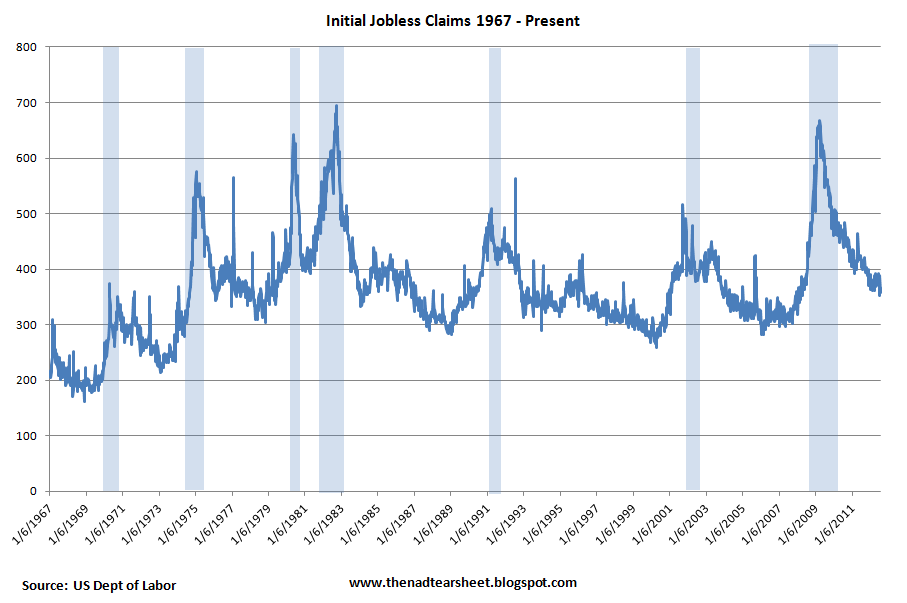
Initial Jobless claims came in at 361k, slightly lower than the 370k street estimate. Initial Jobless claims have fallen back to historical norms. Chart:  Initial Jobless Claims 1967-Present