

 Brent Nyitray
 Fairlington Blade
 Let the mutherfuker burn!
 jnc4p
jnc4p Kevin S. Willis
 Michigoose
 lmsinca
 markinaustin
 Arcanaut
 novahockey
 quarterback
 ScottC
 yellojkt
It’s not often I see an ATiM discussion echoed nearly word for word in the bigger blogosphere, but an item in Andrew Sullivan’s Dish gave me an odd sense of deja vu. He had reacted in horror to a Gallup poll which showed that 46% of Americans believe God created man as-is. Another 32% believe in what I call ‘guided evolution’ where there is divine influence. Only 15% believe that God had nothing to do with us looking as we do.
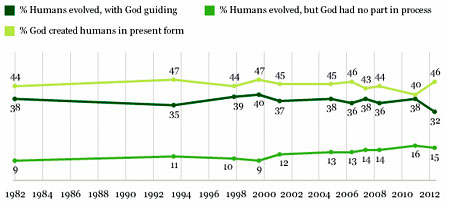
Sullivan’s alarm is stated thusly:
I’m not sure how many of the 46 percent actually believe the story of 10,000 years ago. Surely some of them know it’s less empirically supported than Bigfoot. {snip} I simply do not know how you construct a civil discourse indispensable to a functioning democracy with this vast a gulf between citizens in their basic understanding of the world.
Kevin Drum of Mother Jones rolled his eyes by noting that the 46% number is essentially unchanged since the question has been tracked and it is hardly a concern.
The fact is that belief in evolution has virtually no real-life impact on anything. That’s why 46% of the country can safely choose not to believe it: their lack of belief has precisely zero effect on their lives. Sure, it’s a handy way of saying that they’re God-fearing Christians — a “cultural signifier,” as Andrew puts it — but our lives are jam-packed with cultural signifiers.
Basically, Drum is saying that denying evolution is the price of admission to a not very exclusive club and most people are able to compartmentalize the cognitive dissonance it creates when relying on medicine or agriculture or anything that requires the actual mechanisms of evolution to work.
And lots of smart people don’t ‘believe’ in evolution (and I put ‘believe’ in air quotes because I personally ‘believe’ that is as silly as not believing in gravity) and still do quite well in their professional lives. I heard from colleagues of a prominent engineering professor who was a Young Earther, that is, he thought the Grand Canyon was created from backwash from Noah’s flood. I went to a public lecture of his and his thoughts on thermodynamics and the like were very mainstream and enlightening. Only at the end did he make a slightly veiled cryptic comment about having to conserve energy because we were stewards of the Earth.
Saying that God made Man in an afternoon and then used some spare parts to make Woman is a harmless fairy tale demonstrating a reliance on faith over a trust in reason. Evolution makes intellectual sense because it explains observable phenomena such as there being so many different types of plants and animals, far more than would fit on a raft 300 cubits long.
Not believing in evolution has very little effect on tax policy or road funding or the vast majority of governmental issues. It’s only when the theology drips into policy that I grow concerned. Jame Watt famously saw harvesting trees on a non-sustainable basis as no problem since he was imminently expecting The Rapture and then it wouldn’t matter any more. And we don’t want to even begin opening the can of worms of how religious dogma has affected the debate over reproductive rights.
So if someone wants to believe in folk tales on the origin of the world, I can only shake my head and shrug. To me these are people that in their devotion to their beliefs refuse to separate the moral and ethical authority that have been the traditional realm of religion from the mythmaking mumbo jumbo which science has supplanted. For some “God said it. I believe it. That settles it.” is all they need. For me, I expect a higher standard of intellectual rigor when deciding whose opinions I trust, I but don’t require it when selecting a plumber.
 All Things in Moderation
“And lots of smart people don’t ‘believe’ in evolution (and I put ‘believe’ in air quotes because I personally ‘believe’ that is as silly as not believing in gravity) ”
I’d rate evolution a few notches down from gravity. The existence of gravity can be proven in a controlled, reproducible manner.
Evolution is the best current theory to explain how life developed on Earth until we dig up evidence that the space aliens planted us here. However, we can’t reproduce it in the lab with a test planet.
LikeLike
However, we can’t reproduce it in the lab with a test planet.
However, as a hypothesis, it’s more falsifiable than some guy clapping his hands and saying “Let the water teem with living creatures, and let birds fly above the earth across the vault of the sky.”
LikeLike
I agree, I just don’t rate it at the same level of the law of gravity and any other natural phenomena subject to the scientific method.
LikeLike
Yello:
He had reacted in horror…
Heh. So pretty much as he always reacts to something he disagrees with. (Calm and understated Sully is not.).
Anyway, it’s certainly an odd thing to see Mother Jones channelling me. I wonder if anyone bothered to ask the uber-catholic (except, of course, for that one minor thing) Sully how the empirical data for transubstantiation compares to that for Bigfoot.
LikeLike
You might be surprised at Mother Jones. They were the only media outlet that I found that reported on the actual facts from the court proceedings on this sensational case:
“Why Jamie Leigh Jones Lost Her KBR Rape Case
Her story of a brutal attack in Iraq sparked a national outcry—but how much of it is true?
—By Stephanie Mencimer
| Thu Jul. 7, 2011 4:30 AM PDT”
…
“The media (me included) largely wrote this off as a sign that KBR was headed to the gutter to disparage a rape victim. But now that the case has gone to trial, it’s clear that KBR wasn’t just trying to scare Jones into settling. The court filings portray a very different version of the story. Here are some of the most sensational claims Jones has made, contrasted with the evidence that has emerged at trial:”
http://www.motherjones.com/politics/2011/07/kbr-could-win-jamie-leigh-jones-rape-trial
I’ve found that honesty is a more important consideration in reporting than political bias.
LikeLike
jnc:
I’ve found that honesty is a more important consideration in reporting than political bias.
Undoubtedly true. Unfortunately political bias can often make even one who is and is trying to be honest somewhat blinded to the truth.
LikeLike
Yello, do you think that a lack of belief in evolution is as damaging to the country as a lack of belief if vaccination?
LikeLike
From the post, I would guess obviously not, George…what caused you to ask that?
LikeLike
Mark, I just find it interesting that a segment of the population that believes in creationism is seemingly newsworthy, studied extensively and commented on ad naseum, but an issue that actually does and has resulted in the deaths of children gets little or no attention from the pundit class. I’m not accusing anybody of bad faith here, and immunization denial isn’t rigedly a left or right issue. I tend to see it more on the left (diaries at Kos and articles at HuffPo) while I see derision on the right towards those on the left who are deniers. Though Michelle Malkin is a bit of a denier herself, so it’s not rigid.
LikeLike
Thanks, George. I get that. A survey also shows that left leaners are more likely to believe in fortune tellers than right leaners. The crystal new age types are more likely to self identify as “liberal”.
However, when they start wanting to teach ESP and ouija boarding as “science” in the public schools I will first get exercised.
They probably do that in Sedona, AZ, now that I think about it.
I actually have a horseshoe to throw at this one: among those who most vehemently reject organized religion are both true believing atheists and true believing new agers. The new agers are thus true believers of a different stripe.
Or so I think.
LikeLike
Vaccination has a weird Prisoner’s Game behind it. If a population has achieved herd immunity some individuals can get away without it and still have a low risk while avoiding all potential vaccine side effects. But once you go beyond a certain percentage the disease has a chance to re-establish itself. For that reason I support mandatory vaccinations even if it is a clear violation of personal liberty.
If you are really asking if I think there are risks to vaccination, I will assume there must be, but that on a statistical basis the risk outweighs the downside. I don’t think the link between vaccination and autism has been epidemiologically confirmed or even hinted at. People who spread those sorts of theories are fear mongering and endangering lives.
LikeLike
Troll:
Luckily, most people agree that childhood vaccinations should be required. And vaccine denial looks to be pretty non-partisan.
Yello:
Interestingly enough, Yemen is doing a crash course measles and polio vaccine campaign. There was a big spike in cases last year because of all the upheaval.
LikeLike
The big problem for me, is not what an individual believes but what they expect society to sanction/promote. I have written here before that if you base your teaching on the theories that most closely match the observable evidence, then evolution will be taught similarly all over the world.
If on the other hand, you require a divine intervention of some sort, then there is no reason that the Judaeo Christian story has any superiority over the Indian, Chinese, Native American one etc. since they ALL lie outside the observable world and are based on oral pre-history.
LikeLike
banned:
The big problem for me, is not what an individual believes but what they expect society to sanction/promote.
The problem for me is not what an individual expects society to sanction/promote, but rather that an individual expects the government to force his own preferred views on every one else by law.
LikeLike
but rather that an individual expects the government to force his own preferred views on every one else by law.
Of course.
What examples come to mind for you?
LikeLike
Mark:
What examples come to mind for you?
Well, to keep things on topic, I imagine that people who have passionate beliefs in creationism don’t take any more kindly to having evolution forced on them or their kids in public schools than you would if it were the case that creationism and not evolution was the government preferred view.
LikeLike
Scott – is your response a function of your opposition to public education, per se?
LikeLike
Mark:
Scott – is your response a function of your opposition to public education, per se?
It would probably be more accurate to say that my opposition to public education is a function of the notion expressed in my response, rather than vice-versa.
Also, I’m not sure I would say I oppose public education or even public schools, at least not strongly. Rather, I would say that I support vouchers, giving parents the ability to purchase the education they want, rather than the one someone else wants them to get. I imagine that most of these battles over what will be taught in public schools would disappear rather quickly if dissenting parents were told. “Here’s the money we spend on educating your child. If you don’t like what we offer, go get something you do like.”
LikeLike
In order to explore that further, assume a voucher system is in place. I, too, find vouchers attractive, for the competitive pressure generated.
In that framework, what do you see as the role of accreditation and standards imposed by state educational authorities under state constitutions?
I could see levels of standards [e.g., these are the standard courses you will need for high school graduation at the GED level, at the premier college entry level, at the trade school level; and these are the minimum credentials for teachers] that would not limit additional material, say, theology, philosophy, or religion, or crystal new age ouija classes, that could be taught. In other words, biology would still be biology, and chemistry would still be chemistry, and geology would still be geology.
Without levels of standards I cannot see vouchers as anything but a waste of taxpayer money and an invitation to scam artists, not unlike the scandalous for-profit colleges that collect student loan money and give little or nothing in return.
Charter schools in TX and NC have had mixed results, but some have been quite good. And they have been a safety valve for smart/motivated poor kids in bad neighborhoods. When they have been bad it has usually been because they were a] undercapitalized, or b] dishonest. Here, in Austin, the YMCAs offer early morning PE for small charters and home schoolers, that is eagerly attended by hundreds. Don’t know the cost, but it is the kind of experience that a little charter cannot afford.
LikeLike
Mark:
In that framework, what do you see as the role of accreditation and standards imposed by state educational authorities under state constitutions?
I don’t see much of a role. It’s fine, I suppose, to provide a state “stamp of approval” of sorts which indicates which schools do and do not meet certain state-approved standards, so parents have some quick and easy way to judge a school without doing their own independent research. But if I decide I want to use my education $$ to send my kid to a school not on the approved list, I don’t see why I shouldn’t be able to.
BTW, I don’t find the notion that, without the state telling us what our kids should or shouldn’t learn, most of us, or even many of us, would be easy prey for hucksters looking to swindle us out of our education dollars, to be very persuasive. In fact I suspect that the public education system has taken more money from more people while leaving the kids under its charge insufficiently educated than any private school system, which ultimately has to actually earn its money, could ever hope to accomplish.
LikeLike
Interesting, Scott.
I disagree with you about standards and parental ability to discern – before the damage is done – the merits of a school. Most parents I have known did investigate the school before the child entered. Whether it was public, private, preschool, elementary, secondary, or beyond, most parents at least checked out the local reputation of the institution, and many went well beyond that. However, some parents in my experience simply did not or could not bother.
A story from the past. In the late 70s, central Austin, 22 mi N-S, 4 mi E-W, had thoroughly integrated schools. West Austin was Anglo. East Austin was brown-black. Our federal judge paired the east and west Austin elementary schools so that the kids from the paired west school were bused east for grades K-3 while the kids from the paired east school were bused west for grades 3-6. The east school in the pair became only a K-3 center and the west school only a 4-6 center. In the case of my oldest daughter, the directions were reversed: she went east 4-6. It was the first time some of the east schools had ever had a PTA. The idea of PTA became popular with the east Austin parents during the time the schools were paired. It turned out to be a revelation to most of them that they could have input into the process. The existing west Austin school’s PTA structure simply reached out to all the east Austin paired parents and I suspect more education of parents was done in the first year of pairing then had been accumulated in a lifetime, in terms of community involvement.
We don’t have busing any more, and Austin neighborhoods are far more multi-ethnic/racial than they ever were, east and west. But my experience then was that the poorest and least educated parents had the least ability to discern what was even going on in school. Standards are useful for the children, where “approvals” would only be useful for the parent, from my observations.
LikeLike
Mark:
The existing west Austin school’s PTA structure simply reached out to all the east Austin paired parents and I suspect more education of parents was done in the first year of pairing then had been accumulated in a lifetime, in terms of community involvement.
I think your story is a good example of why and how community standards/values differ from, and are a lot more important than, government values/standards.
Standards are useful for the children, where “approvals” would only be useful for the parent, from my observations.
I think the primary right and responsibility for determining what standards are most useful for kids belongs with parents themselves. It’s fine to offer guidance, but not fine to overrule the parents.
LikeLike
It’s fine to offer guidance, but not fine to overrule the parents.
I would brook more overruling than you, obviously. For example, I favor vaccination against communicable diseases for the children of parents who do not want their children inoculated. I favor compulsory education laws and child labor laws. I come from a legal tradition of “best interest of the child” [the Anglo-American standard], not the older tradition of parental ownership.
LikeLike
Mark:
I come from a legal tradition of “best interest of the child” [the Anglo-American standard], not the older tradition of parental ownership.
I assume you do not support a tradition of state ownership of children any more than I support a tradition of parental ownership. I suspect we simply give differing degrees of deference to parents’ views of what is in the best interest of the child.
Generally speaking, I think a parent has a much better idea of, and is much more likely to focus on, the best interest of a given child than the government or even the community at large. Certainly the state has an interest in protecting children from the acts of their parents at some point. I don’t think there is an obvious bright line, but the further we move from actual physical harm, my desire to impose my own view of “best interests” upon the parent and child decreases significantly and quickly.
LikeLike
John:
The big problem for me, is not what an individual believes but what they expect society to sanction/promote
Precisely. Excellent point.
BTW, what does your new handle on the PL refer to? I’ve been puzzling about it for weeks and haven’t figured it out. . .
George:
an issue that actually does and has resulted in the deaths of children gets little or no attention from the pundit class
Also an excellent point that I hadn’t thought about in that way (and I can see why, given your line of work, you would). One of the few things that I admired about Rick Perry was his mandating the HPV vaccine for girls before they (probably) reached an age when they became sexually active.
LikeLike
A Facebook friend of mine is a nurse in Australia and she has spent the last day or two tweeting pro-vaccination messages including pictures of her in pro-vaccination tee shirts. Like everything, education is needed to combat ignorance.
LikeLike
It seems to me the default position would be no religion in politics or the public sector.
LikeLike
michigoose:
I got bored of my old username and was reading The Ghosts of Cannae”, very good book.
scott:
“individual expects the government to force his own preferred views on every one else by law”
In my opinion and the opinon of many many others across all spectrums of nationality, religion and race, evolution is the closest explanation to the observable evidence. If we leave that, then it really IS forcing a preferred view, that of pre-historical, pre-literate man on everyone else.
LikeLike
banned:
In my opinion and the opinon of many many others across all spectrums of nationality, religion and race, evolution is the closest explanation to the observable evidence.
Agreed.
If we leave that, then it really IS forcing a preferred view, that of pre-historical, pre-literate man on everyone else.
Popular views can be forced on others just as easily as unpopular views. Whether or not a preferred view is being forced on someone is not at all a function of the popularity or, frankly, even the quality, of the view itself.
LikeLike
The failings and inflexibility of the public school system seems to be one of those ATiM evergreen topics. Parents have always had the choice to have their children taught as they see fit. The vouchers issue is whether taxpayers should subsidize that choice.
LikeLike
YJKT – could you support vouchers as I described them at 5:36 MDT?
Could you support public to public school vouchers [a Bush 41 idea]?
Would the accounting for the voucher funding matter – for example, if the voucher was pegged to marginal cost rather than capitalized average cost per student?
LikeLike
yello:
The vouchers issue is whether taxpayers should subsidize that choice.
By ignoring that parents are, generally speaking, taxpayers themselves, you manage to completely invert reality. The voucher issue is whether or not parents should have to subsidize an education that they don’t want.
LikeLike
As the spouse of a public school teacher, my opinions on the education system are biased, complicated and often contradictory. In general I find private school vouchers and to a lesser extent charter schools an end-run around the system. Contrariwise I am in favor of open enrollment within a district or even in some cases between districts as a way of keeping some modicum of competition available. But I find forced busing inconvenient and ineffectual.
I am all in favor of parent empowerment and involvement but not at the expense of distracting from the educational mission. I have a couple of guiding thoughts I don’t think most people pay enough attention to.
First, TANSTAAFL. Most people pay for better schools through home value and higher property taxes.
Standardized test scores are, in aggregate, proxies for average household income. Note the connection to my first point. It’s a positive feedback loop. People move to areas with good schools, raising the property values of those areas.
Most of a kid’s learning occurs outside the home. A household where education is valued, discipline is enforced, and standards are upheld is far more valuable than anything a school can do.
Every kid at a private or charter school is there because somebody wants them there. In conjunction with the item above, any school that underperforms its public counterpart is doing something very wrong.
Schools in impoverished urban areas are Dickensian hellholes and should be a source of profound civic embarrassment. If there were any easy way to fix them it would have been done already.
Most teachers are hardworking and dedicated and just as frustrated with bureaucracy and educational fads as anybody, if not more so.
I didn’t mean to tirade so much and I cut myself off. Needless to say I have plenty more opinions where those came from.
could you support vouchers as I described them at 5:36 MDT?
Could you support public to public school vouchers [a Bush 41 idea]?
Would the accounting for the voucher funding matter – for example, if the voucher was pegged to marginal cost rather than capitalized average cost per student?
To narrowly answer the exact questions:
Vouchers have some role, particularly is especially distressed areas but they invariably take away money for the kids that can’t use them unless the funding source is external to the traditional method.
Public school to public school vouchers are open enrollment with more complicated bookkeeping.
The only value of vouchers to impoverished parents is if the net cost is free or nearly free. How that accounting is done by the school district and the recipient school is a minefield.
LikeLike
The voucher issue is whether or not parents should have to subsidize an education that they don’t want.
Lots of people other than just the parents are taxpayers. Everybody in the community subsidizes the public schools. As a taxpayer I might object to my money paying for an education which I find objectionable (say a fundamentalist madrass) just because the parents don’t like what is being offered to everybody else.
Once you go down the road that the parents are the ultimate customer you start questioning the whole basis of free universal public education. Why then should anybody pay to educate someone else’s kids?
LikeLike
yello:
Once you go down the road that the parents are the ultimate customer you start questioning the whole basis of free universal public education.
Indeed. I see no reason to avoid that question.
Why then should anybody pay to educate someone else’s kids?
I can think of lots of reasons why someone might pay to educate someone else’s kids. The relevant question is why anybody should be forced to pay to educate someone else’s kids.
LikeLike
A better way to look at vouchers is that if somebody doesn’t like the public baseball field in his neighborhood he shouldn’t be entitled to demand his share of the parks and rec budget so he can put up a basketball court in his backyard. Nor are people who don’t ever go jogging entitled to a tax rebate because they never use the public running track.
LikeLike
Perhaps people who want creationism taught in schools should move to Korea, Heaven knows my school district has enough Koreans moving into it specifically for the quality public schools.
LikeLike
The relevant question is why anybody should be forced to pay to educate someone else’s kids.
And we have once again reached the fundamental core of the hyper-libertarian philosophy. Why should anybody be forced to pay for anything that is not for their immediate personal benefit?
LikeLike
yello:
Why should anybody be forced to pay for anything that is not for their immediate personal benefit?
I realize it is an inconvenient question, but avoiding it doesn’t make it go away. Is it your position that, as a matter of principle, any majority ought to be free to force a person to pay for anything that the majority desires?
LikeLike
it gets to the private vs. public good. education is a private good, albeit one with positive externalities.
LikeLike
“Nor are people who don’t ever go jogging entitled to a tax rebate because they never use the public running track.”
LikeLike
And then there’s this perspective:
“90 percent of Chicago teachers authorize strike
By TAMMY WEBBER
CHICAGO
Teachers in the nation’s third-largest school district voted overwhelmingly to authorize the first strike in 25 years if their union and the city cannot reach a deal on a contract this summer — signaling just how badly the relationship between teachers and Chicago school officials has deteriorated, union officials said Monday.
Chicago Teachers Union President Karen Lewis announced the result of last week’s balloting — nearly 90 percent of its 26,502 members voted to authorize a strike –and called it “an indictment of the state of the relationship between the management of CPS and its largest labor force members.” State law requires 75 percent approval.
Teachers are upset that Mayor Rahm Emanuel canceled last year’s raise and that they’re being asked to work longer days without what they consider to be an adequate pay increase. Lewis said other key issues include class size and resources.
A strike wouldn’t be called until the beginning of the next school year, but union leaders could do so without another vote. They say holding the vote now instead of later gives the union added leverage at the bargaining table. It also allowed 1,500 retiring teachers to vote.
“Our members … were loud, serious and clear,” Lewis said. “We want a contract that gives Chicago students the school they deserve. So we call on CPSs to take this process seriously and negotiate with us in good faith with an eye on the real prize, our children.”
Chicago Public Schools CEO Jean-Claude Brizard issued a statement saying it was “a shame” the union took the vote before an independent fact-finder presents recommendations on several contract issues next month and that he’s “disappointed that the union leadership would rush their members to vote for a strike before having the complete information on the table.”
Lewis said the fact-finder’s report will deal with only a handful of issues, and “we have an entire contract to negotiate.”
District spokeswoman Becky Carroll has said that once the report comes out, both sides will have 15 days to accept or reject it, and the union will have 30 days to decide whether or not to strike. The last Chicago teachers strike was in 1987, and lasted 19 days.
Much of the teachers’ frustration has centered on Emanuel, who rescinded a 4 percent raise last year and then tried to go around the union in his push for longer school days by asking teachers at individual schools to waive the union contract to work more hours. The Illinois Educational Labor Relations Board subsequently blocked Emanuel’s negotiations with schools.
He still was able to lengthen the school day for children to 7 hours, starting this fall, without the union’s approval.
Emanuel ignored reporters’ questions Monday about the strike authorization. Emanuel spokeswoman Sarah Hamilton said the public schools cannot afford a strike.
“At a time when our graduation rates and college enrollments are at record highs — two successes in which our teachers played an integral role — we cannot halt the momentum with a strike,” she said. “Our teachers deserve a raise, but our kids don’t deserve a strike and taxpayers cannot afford to pay for 30 percent raises.”
The district has proposed a five-year deal that guarantees teachers a 2 percent pay raise in the first year and lengthens by 10 percent the amount of time teachers must spend at school, from 7 hours to 7 hours and 40 minutes. The union wants a two-year deal that reduces class size and calls for teachers to receive a 24 percent pay raise in the first year and a 5 percent pay raise in the second year.
Chicago public school students have the shortest school day — 5 hours and 45 minutes — among the nation’s 50 largest districts, according to a 2007 report from the National Council on Teacher Quality — part of the reason Emanuel moved to lengthen it.
But the Chicago Teachers Union said that report did not track actual classroom time and insisted the amount of instruction time was on par with other districts.”
http://www.businessweek.com/ap/2012-06/D9VBKPU80.htm
LikeLike
Is it your position that, as a matter of principle, any majority ought to be free to force a person to pay for anything that the majority desires?
It’s kinda the whole basis of the Taxation Through Representation concept. Government by charity has never been tried on a large scale basis. Noblesse oblige as a funding mechanism has some serious flaws.
it gets to the private vs. public good. education is a private good, albeit one with positive externalities.
Indeed. It’s not even a private good to the people paying for the education. All parents should be able to put a lien on their children’s future earnings against the cost of education. If parents were given an equity stake, it could replace Social Security as a retirement system.
And thanks for the Park And Rec clip. Ron Swanson is a true conservative hero for all who find Stephen Colbert a little too pointy-headed.
LikeLike
yello:
It’s kinda the whole basis of the Taxation Through Representation concept.
So just to be clear, you think that if a majority wanted to collect taxes from a given demographic that will be distributed to, say, the Vatican, you believe that it should not be restricted from doing so?
LikeLike
Reminds me of a principal skinner quote: “I’ve always admired car owners and I hope to be one myself as soon as I finish paying off mother. She insists I pay her retroactively for the food I ate as a child.”
My objection to public education is that the funding is going to the wrong place. i’d much rather just cut a check to the family let them spend it as they see fit — public, private, parochial, tutors, or some combination. i think this would be especially beneficial for kids who need specialized care/instruction.
make schools more like community college. open enrollment and pick the classes you want.
LikeLike
it gets to the private vs. public good. education is a private good
I do not accept that, NoVAH.
Physical infrastructure may set a floor for a national economy, but the ceiling will be determined by the education of its citizens. Uneducated citizens crimp the economy. Discovery and entrepreneurship as well as mobility that allows literate and numerate workers to quickly retrain for new careers in industries that do not exist as we speak makes us nimble. It was what made America thrive, beyond its natural bounty. Adopt 19th century European class standards about education and in the 21st century America will fall by the wayside.
http://seattletimes.nwsource.com/html/opinion/2008080190_brooks30.html
David Brooks has been writing this for seven years and may have even written a book about it. It seems patently obvious to me.
LikeLike
Mark:
I do not accept that, NoVAH
How do you square this with your previous claim that you support compulsory education because it is in “the best interest of the child”? If it is in the best interest of the child, it is clearly a private good. It may have have positive externalities, as NoVA acknowledged, but if the “best interests of the child” is what drives you to support compulsory education, clearly you must recognize it primarily as a private, not a public, good.
LikeLike
Why doesn’t the serendipitous coincidence of the best interest of the child and best interest of the nation appeal to you? WRT education, and health, too, serving the best interest of the child creates the greatest natural resource we can have, the nation of healthy and educated adults.
———————————————————————
Yello, agree on vocational ed. There really are 750k unfilled decent paying jobs that voc ed would have prepped folks for, in small biz around the nation, according to the NFIB survey Brent posted. Community college is big bang for the buck, IMO. A public good.
LikeLike
mark:
Why doesn’t the serendipitous coincidence of the best interest of the child and best interest of the nation appeal to you?
I never said it didn’t appeal to me.
So you now seem to be saying that NoVA isn’t entirely wrong, ie you acknowledge that education is indeed a private good as NoVA claimed. But you also think that the positive externalities that he spoke of amount to a public good as well.
Do you think that an education is necessarily a public good? That is, the public gets a benefit out of educating someone no matter what that person does after receiving it?
LikeLike
So you now seem to be saying that NoVA isn’t entirely wrong, ie you acknowledge that education is indeed a private good as NoVA claimed. But you also think that the positive externalities that he spoke of amount to a public good as well.
NoVA has inverted the benefit analysis. Universal public education creates the strongest of public goods, human capital. The individuals who make the most of the opportunity are among those who receive individual or private benefit from the investment. The Houston Ship Channel is a public commercial good, but the petrochemical industry receives the most individual or private benefit from the investment. The example is not meant to be an exact parallel but only to show that the concept that YMMV can be applied.
Do you think that an education is necessarily a public good? I think universal education is necessarily a public good.
That is, the public gets a benefit out of educating someone no matter what that person does after receiving it?
The public does not benefit from individuals who completely waste their opportunities. This is irrelevant to the discussion. The public good is in the human capital created – the mass of persons trained and educated, from whom will spring countless ideas and lots of high quality work, great productivity, and even an Army that can think on its feet. This is analogous to every other public good in the sense that the investment is wasted on some individuals, singularly leads to the enrichment of some individuals, but nevertheless contributes to the general welfare in a cumulative sense. And nothing contributed more to the general welfare in the cumulative sense than universal education, in my reading of American history. The human capital created by universal education is our greatest national asset. It is the one without which we would be impoverished.
LikeLike
Mark:
NoVA has inverted the benefit analysis.
I disagree. Before an education can redound to the benefit of anyone else, it must first and foremost redound to the benefit of an individual.
This is irrelevant to the discussion.
No, it isn’t. I think you and NoVA are talking about two different things.
When NoVA says that an education is a private good, he is talking about the thing that the government actually provides, not the hoped-for cumulative effect of the thing provided across many people. The thing that the government provides, ie an education, is provided to individuals, and undoubtedly redounds to their benefit. That is, it is a private good. Whether or not it redounds to the benefit of others is dependent upon many things, not the least of which is, as you acknowledge, the subsequent choices made by that individual.
Subsidies to various industries – farming, oil, auto, banking – all are implemented with the expectation that they will redound to the benefit of “the public” at large, and they may well do that, but that doesn’t make them primarily public goods. They are, first and foremost, private goods that provide a benefit to specific individuals.
BTW, human capital is created by sex between a man and a woman, not universal education.
LikeLike
BTW, human capital is created by sex between a man and a woman, not universal education.
And on that note, we conclude.
I cannot resist this, however: When IH 10 was built between SA and Houston it enriched Gus Worthington, the highway contractor for a 30 mi. stretch near Seguin, before the public could use it. That is the nature of any investment for the public good; the cost of its construction causes a direct individual benefit to the individual during the building stage.
More: what the individual learns must enhance his/her general utility to society before it will redound to his/her benefit. Isn’t that obvious?
LikeLike
mark:
And on that note, we conclude.
It wasn’t intended to be snark for snark’s sake. It’s a legitimate point. Even humans without an education, which I would guess is most humans on the face of the earth, certainly most throughout history, have value. A formal education is certainly valuable, but it isn’t what gives humans worth.
LikeLike
Mark:
it enriched Gus Worthington, the highway contractor for a 30 mi. stretch near Seguin, before the public could use it.
Not a good analogy. The government did not enrich the contractor. The contractor enriched himself by providing a service. It was an exchange of value of value. The contractor provided a service to the government, and the government paid it for the services. This is not analogous to the provision of a “free” public education.
Isn’t that obvious?
Not to me. In fact, what is obvious to me is that an education redounds to the benefit of an individual simply by expanding the range of choices available to him even before he provides utility to anyone else. Further, it can redound to his benefit by enhancing his utility to a single other person. In fact, it can redound to his benefit simply by enhancing his utility to himself. There is no reason it needs to enhance his utility to society as a whole before it can redound to his benefit.
To reach back into a previous discussion, let’s assume you are correct that financial speculation provides no public utility whatsoever. Surely you recognize that a) speculators are generally well educated, b) that education has allowed them to become speculators, c) they are receiving a personal benefit from being speculators. Hence, their education has redounded to their benefit despite the fact that it is providing no (perhaps even negative?) utility to society at large.
LikeLike
Gus Worthington, a real person now deceased, is to be compared with the school system, not the children.
The children are human beings worthy of dignity and decency, but not contributory to the public good until they are educated; in this respect they are like materials.
I do not for a minute think of children as rocks and concrete. I am only talking in terms of economic utility here.
There is no static world. There are limited choices for the individual except in a world where there are a mass of individuals who can make educated decisions. Maintaining that critical mass of human capital – of creativity from the ridiculous to the sublime – is what makes for options for the succeeding individual. Speculators and gang bangers and other low lifes will be with us, absent the perfection of human nature.
I aam thinking we will continue to disagree. We can revisit at any time.
LikeLike
mark:
Gus Worthington, a real person now deceased, is to be compared with the school system, not the children.
I don’t understand. With regard to education, the individual benefit we were discussing accrued to the student. I said that this benefit accrued to the individual first and foremost, and only later might provide benefits to the public at large. You countered this by suggesting that such was the nature of all public goods, and your example was that the building of the highway enriched Gus Worthington first, before the public at large benefited. Thus I would thought you were drawing an analogue between Gus and the student.
If you are saying that the analogue is between Gus and the school system, I don’t understand the point of the analogy. Who is akin to the student getting an individual benefit before the public at large can achieve any benefit?
Speculators and gang bangers and other low lifes will be with us, absent the perfection of human nature.
The circumstances under which “low lifes” will be with us was never under question. What was under question was whether the individual benefit of an education was necessarily dependent upon one being useful to society at large. You said it was obviously the case. Not only do I think it isn’t obvious, I think it is obviously not the case.
I aam thinking we will continue to disagree.
Probably. But do you at least agree now that the benefit accrued by an individual as the result of being provided an education is not necessarily dependent upon his subsequently becoming a utility to society at large? If my speculator was not a good enough example to convince you, I’ll give you another: lawyers. 🙂
LikeLike
Yello:
It’s not even a private good to the people paying for the education.
Not only to the parents, but also to those who are required to pay the school tax and no longer have or have never had any children of school age.
LikeLike
Sam Harris on the whole “Does it matter to me what other people believe question”
http://www.tabletmag.com/jewish-life-and-religion/100757/qa-sam-harris?all=1
LikeLike
jnc,
Good quote from your article:
So just to be clear, you think that if a majority wanted to collect taxes from a given demographic that will be distributed to, say, the Vatican, you believe that it should not be restricted from doing so?
I’m not really sure what strawman you are trying to build here, but lots of taxpayer money goes to parochial schools under various programs. Not to mention social service programs run by churches. We do give lots of money to countries like Israel. A direct payment to the Vatican would probably be a violation of the Establishment Clause. I think you are asking me what should government not pay for since the right to tax is well established. But perhaps you are even disputing that. All taxes are theft after all.
Not only to the parents, but also to those who are required to pay the school tax and no longer have or have never had any children of school age.
Yes. This is part of the allure of retiring to Florida where there is no income tax and retirees vote down school bond initiatives with impunity.
LikeLike
yello:
I’m not really sure what strawman you are trying to build here
None.
A direct payment to the Vatican would probably be a violation of the Establishment Clause.
I’m not asking you what is. I am asking you what you think should be. There is a difference, even if it is all too often lost on you.
I think you are asking me what should government not pay for since the right to tax is well established.
No, I am testing to see if it is true, as you implied, that you have no guiding principles regarding what you think is a proper government expenditure. I doubt it is true.
LikeLike
I am testing to see if it is true, as you implied, that you have no guiding principles regarding what you think is a proper government expenditure.
A proper government expenditure is one which insures domestic Tranquility, provides for the common defence, promotes the general Welfare, or secures the Blessings of Liberty to ourselves and our Posterity. (I may have cribbed some of that.)
And there are lots and lots of things which promote the general Welfare including (but not limited to) health and safety regulations, interstate highways, public education, national parks, and perhaps even universal health care.
I doubt it is true.
I appreciate your faith in the existence of my moral convictions.
LikeLike
yello:
A proper government expenditure is one which insures domestic Tranquility…
So then, expenditures to provide a creationist education could be justified if doing so would help insure domestic tranquility?
A proper government expenditure is one which…secures the Blessings of Liberty to ourselves
Does that mean an expenditure that actually destroys the blessings of liberty would not be a proper government expenditure?
(I may have cribbed some of that.)
You cribbed the words, but you’ve applied them in an entirely new context. Originally the words were used as justification for the creation of the constitution, not the justification for tax and spend policies.
I appreciate your faith in the existence of my moral convictions.
All people are guided by some kind of ideology/philosophy, even if they routinely deny it and even if it is at root incoherent. Or both, as the case may be.
LikeLike
So then, expenditures to provide a creationist education could be justified if doing so would help insure domestic tranquility?
If there are rioting creationists, tough jail terms would be a better expenditure than mandating the dissemination of patently false information just to shut them up.
…justification for tax and spend policies.
Tax and not-spend policies are pretty ineffective. It doesn’t make sense to have a tax if you aren’t going to spend it on something. That’s just greedy and wasteful.
All people are guided by some kind of ideology/philosophy, even if they routinely deny it and even if it is at root incoherent.
“I mean, say what you want about the tenets of National Socialism, Dude, at least it’s an ethos.”
LikeLike
yello:
Tax and not-spend policies are pretty ineffective.
And we have once again reached the point of fundamental dishonesty.
LikeLike
“yellojkt, on June 13, 2012 at 11:51 am said:
Is it your position that, as a matter of principle, any majority ought to be free to force a person to pay for anything that the majority desires?
It’s kinda the whole basis of the Taxation Through Representation concept. Government by charity has never been tried on a large scale basis. Noblesse oblige as a funding mechanism has some serious flaws.”
I think you may have come full circle where if the basis for what is a legitimate government expense is what the majority supports, then if a majority were to support teaching creationism in schools (say in addition to as a competing theory, not in place of evolution) then it is hard to articulate a limiting principle where this is disallowed.
LikeLike
Once again words are cleverly placed in my mouth. Teaching a religious doctrine as a legitimate scientific theory to impressionable minds would hardly be promoting the general welfare if it led to confusion and ignorance no matter how great the outcry from the majority (or at least the 46%).
LikeLike
Yello:
Maybe you should consider the fact that both jnc and I interpreted your (non) answer to my question in the same way as possibly indicative of a failure on your part, not ours.
Perhaps if you weren’t so intent on avoiding simple questions with clever ripostes, and instead tried to give a straightforward answer, you wouldn’t be victimized so often.
LikeLike
“yellojkt, on June 13, 2012 at 2:52 pm said:
Once again words are cleverly placed in my mouth. Teaching a religious doctrine as a legitimate scientific theory to impressionable minds would hardly be promoting the general welfare if it led to confusion and ignorance no matter how great the outcry from the majority (or at least the 46%).”
It’s an argument on how (and who) to determine what the general welfare is. In a democracy, it’s usually the majority. The argument is over what constitutes a valid limiting principle on the will of the majority.
Mind you I’m an atheist so I don’t have much use for religion in general. But in a pluralistic democratic society, people who don’t agree with me get a vote too. My belief is that often the best way to reconcile these views is via an opt out mechanism like vouchers. You don’t have to have a 1:1 ratio for the tax money to the voucher. You could have a 2/3 or 3/4’s voucher so there’s still a subsidy for the public schools, but it’s financially viable for those who wish to send their kids elsewhere to do so.
LikeLike
Mark, I hadn’t read that Brooks piece before. This cracks me up.
Third, it’s worth noting that both sides of this debate exist within the Democratic Party. The GOP is largely irrelevant. If you look at Barack Obama’s education proposals — especially his emphasis on early childhood — you see they flow naturally and persuasively from this research. McCain’s policies seem largely oblivious to these findings. There’s some vague talk about school choice, but Republicans are inept when talking about human-capital policies.
I read this piece several weeks ago that you might be interested in. It’s actually a piece about what Bobby Jindal’s doing in LA.
As Dana Goldstein wrote in another profile of Ravitch last June in the Washington City Paper, “Once a vocal proponent of No Child Left Behind, charter schools, vouchers, and merit pay for teachers, Ravitch decided sometime around 2006 that there was actually no evidence that any of those policies improved American education. She now believes that the ‘corporatist agenda’ of school choice, teacher layoffs, and standardized testing has undermined public respect for one of the nation’s most vital institutions, the neighborhood school, and for one of society’s most crucial professions: teaching. The best way to improve American education, the post-epiphany Ravitch argues, is to fight child poverty with health care, jobs, child care, and affordable housing.”
LikeLike
And we have once again reached the point of fundamental dishonesty.
I’m sorry you feel that way but the ‘tax and spend’ slur is a completely meaningless buzz phrase. Of course you tax and spend. There are only three things government can do and that is tax, spend, and regulate. And if the government didn’t spend, it would have no need to tax. Now what level of taxation and spending is necessary for the desired function of the government is a valid conversation. But just to dismiss something as ‘tax and spend’ is glib.
LikeLike
yello:
But just to dismiss something as ‘tax and spend’ is glib.
I wasn’t dismissing anything. I was pointing out that the words you cribbed from the constitution to justify your taxation and spending preferences (or, in short, tax and spend policies) in fact justified no such thing within the context of their original use. You are too smart not to have grasped my point, but as is all too typical, you decided to ignore the point in order to engage in some snarky non-sequitur.
C’est la vie. I’m used to it by now.
LikeLike
mark,
It’s not just primary and secondary education which is becoming devalued. We are ignoring our most valuable resource. In order to maintain our standard of living we have to continue to maintain a value added differential over less labor costly countries and the only way to do that is with a highly educated work force. Vocational ed has been practically privatized to these vulture for-profit tech schools and it is serving their students and our society poorly.
LikeLike
Part of the other purpose for universal education is the unifying of the American concept by giving all children, particularly those of immigrants, a common educational reference point. Assimilation into American culture happens in less than a generation. The sort of ethnic strife which has paralyzed parts of the world becomes greatly muted in the melting pot/mixing bowl of the public school systems. Balkanizing it into separate vouchered enclaves is ultimately counter-productive.
LikeLike
I had not thought of that, YJKT. But universal public education to at least a local norm did have the effect you suggest – it made the melting pot actually work. Assimilation of the immigrants is through the public schools.
YJKT – do you know if that was by design in say, the NYC public schools in 1900? I think it is by design in Texas in 2012, but I will have to ask an expert to know with some assurance.
LikeLike
The modern public school system concept was pioneered by Horace Mann in Massachusetts in the mid-19th century. To quote the Wikipedia article on him:
He is a much ignored public figure except in the history of teaching. Lots of schools have been named after him.
LikeLike
human capital is created by sex between a man and a woman, not universal education.
Hence the need to ban all contraception so we can once again regain our status as the world’s greatest economic power. India and Africa are nipping at our heels.
LikeLike
yello:
Hence the need to ban all contraception…
If one views humans as capital to be put to use as a public good, then certainly such a ban wouldn’t be entirely irrational. It’s tough for a society to survive, much less thrive, if it has fertility below replacement levels.
LikeLike
All parents should be able to put a lien on their children’s future earnings against the cost of education.
Proving that there is no Proposal too Modest, LuIgi Zingales in the New York Times suggests that venture capitalists give college students loans in exchange for a percentage of future earnings (or earnings above that of an merely high school educated person).
In the tradition of PELL Grants and STAFFORD loans we could call these VASSAL contracts. And since this crop of bright minds would owe a share of all their future earnings to investors, we could call them sharecroppers.
LikeLike
“Balkanizing it into separate vouchered enclaves is ultimately counter-productive.”
But that’s not for government to determine (i need to flesh out my thought on that — clearly an underdeveloped thought).
And I wonder if TV — specifically only 3 or 4 channels — had more to do with it than the schools.
People can function perfectly in parts of NoVa and never speak a word of English or have any contact with the larger culture. I don’t think that’s a problem.
LikeLike
There was no TV in the late 19th/early 20th century. And Catholic immigrants kept up a parallel non-secular school system in many cities for decades with no public support.
LikeLike
D’oh! I was thinking a little later. but you’re right. but if the Catholics can do it, why can’t everyone else.
LikeLike
People can function perfectly in parts of NoVa and never speak a word of English or have any contact with the larger culture.
I go to Eden Center in Falls Church on a semi-frequent basis where not knowing Vietnamese is a distinct handicap. What is fascinating is to hang around the bubble tea places and watch the teenagers speak in Vietnamese to the shop keepers and then break into flawless English to each other. Their parents may be store clerks and nail techs but they are sending their kids to UVA and Virginia Tech to become engineers and doctors. It’s all part of the Immigrant Experience.
LikeLike
I wonder if the next generation will speak Vietnamese at all.
have a favorite in Eden Center? It’s a little further out but Bahn Mi DC Sandwich is great.
LikeLike
have a favorite in Eden Center?
We usually just go to Song Que Deli (which has taken over the old Huong Que location) for banh mi and bubble tea (Both the tamarind and the jackfruit are fantastic. Durian I can take or leave). If we want to have a sit-down meal we go next door to Viet Royal. The food is less pretentious and more authentic than Huong Que which has fled Eden Center for a new location.
Our telling incident was that one night both restaurants were completely full but Huong Que, because of its frequent good reviews in WaPo, was stuffed with people of European descent while Viet Royal was mostly serving Asians.
That is my one Tyler Cowen-ish type of rule: Eat at ethnic restaurants where there are a lot of native speakers.
Our newest discovery is Viet Pho on New Hampshire right off of the Beltway in Silver Springs because it is a lot closer to our house.
And you can never go wrong with any of the Pho 75s in town. I know someone who swears they put crack in the chili-garlic sauce.
LikeLike
Hence, their education has redounded to their benefit despite the fact that it is providing no (perhaps even negative?) utility to society at large.
Ezra Klein exhorts the four Dartmouth valedictorians (Four? Honor inflation, anyone?) to eschew the investment banking careers they have chosen and to become entrepreneurs instead.
LikeLike
I’ll skip past the educational aspects of the thread.
I did want to address what I consider to be a misconception regarding observational science. The general conception being that one makes a hypothesis and then devises and runs an experiment to test it. In many cases, that is either impossible or unethical.
Consider astrophysics. As far as we can possibly know, there was A big bang. We don’t get to run that experiment a second time. One can, however, compare the plethora of observations to theory. There’s something unusual in that the universe appears to be flat. Not enough mass to collapse on itself, but too much to fade away to nothing. Interesting, that.
Incidentally, modern science proved Newtonian physics to be wrong, including the law of gravity. It just happens to be at low velocity and low fields, that the actual laws of gravity (more accurately, the General Theory of Relativity) reduce to what had been observationally determined previously.
BB
LikeLike
“Jame Watt famously saw harvesting trees on a non-sustainable basis as no problem since he was imminently expecting The Rapture and then it wouldn’t matter any more.”
Watt never said this or in fact anything like it. It was a journalist’s fabrication.
LikeLike
“So if someone wants to believe in folk tales on the origin of the world, I can only shake my head and shrug. To me these are people that in their devotion to their beliefs refuse to separate the moral and ethical authority that have been the traditional realm of religion from the mythmaking mumbo jumbo which science has supplanted.”
If we are not created, how would you explain there being any more rational basis for that “moral and ethical authority” than for creationism itself?
And how is theistic evolution, which is the position of many “respected” scientists, any more defensible or acceptable than other forms of creationism?
LikeLike
qb:
If we are not created, how would you explain there being any more rational basis for that “moral and ethical authority” than for creationism itself?
I think this is an excellent question. In fact, what’s the rational basis for the very notion of morality?
And how is theistic evolution, which is the position of many “respected” scientists, any more defensible or acceptable than other forms of creationism?
Presumably any theistic theory that incorporates the evidence presented by the physical world will be more acceptable than those that reject or ignore such evidence. As an aside, it seems to me that anyone who believes if God must, of necessity, believe in some kind of theistic explanation on the origins of life.
LikeLike
Scott:
Presumably any theistic theory that incorporates the evidence presented by the physical world will be more acceptable than those that reject or ignore such evidence.
To me that is more a statement of what I am questioning than an explanation of it. As I understand theories of theistic evolution, they claim that evolution is guided in some way. As I understand evolutionary theory, that is a contradiction.
As an aside, it seems to me that anyone who believes if God must, of necessity, believe in some kind of theistic explanation on the origins of life.
That’s an interesting proposition. I’m not sure it is logically necessary, but theism without some form of creationism would be an odd construct.
LikeLike
qb:
To me that is more a statement of what I am questioning than an explanation of it.
I suppose. But I guess it seems logical to me that if one finds evidenced based explanations of a given phenomenon to be superior/preferable to faith based explanations, then it makes sense that, when comparing two faith based explanations, one would find the one that is at least consistent with available evidence to be relatively less objectionable than one which contradicts available evidence. That’s not to imply that the former is actually acceptable, just moreso than the latter.
As I understand evolutionary theory, that is a contradiction.
Perhaps. I am no expert on evolutionary theory, but I thought that evolutionists object to the notion of theistic guidance on the grounds that it is non-falsifiable, not that it contradicts available evidence.
LikeLike
Scott, I am no expert, either, but my understanding of evolutionary theory is that adaptation and speciation — evolution — occurs through natural selection of random variations. I cannot see how randomness does not exclude divine guidance, not just as a matter of falsifiability but as a contradiction of the theory of evolution itself. Indeed, this God would be no different from the “deceiver God” commonly posited by evolutionists as a characterization of creationism–a God who undetectably and deceitfully guides a process that he cleverly made to look unguided, materialistic, and natural.
LikeLike
qb:
Yes, I suppose that, to the extent that evolutionary theory posits a chain of events defined as necessarily random and unplanned, it would by definition exclude the possibility of any Godly participation.
LikeLike
BTW…isn’t the notion of survival of the fittest itself a tautology, the fittest, of course, being defined as those that survive?
LikeLike
The incorrect quote attributed to Watt is “After the last tree is felled, Christ will come back.” Glenn Scherer, writing for Grist Magazine, erroneously attributed this remark to 1981 testimony by Watt to Congress. The actual quote is: “I do not know how many future generations we can count on before the Lord returns, whatever it is we have to manage with a skill to leave the resources needed for future generations.” He obliquely referenced the Rapture, but did not suggest cutting everything down since it was coming soon. After it was discovered that the quote was mistaken, Grist corrected their article and Bill Moyers apologized.
[Note: I’ve adapted some Wikipedia information, but checked sources on this.]
It is perfectly acceptable to take much of Genesis as allegory. After all, much was adapted from Babylonian mythology. Ironically, being formed from the mud is much akin to hyperspeed evolution, given that the simple creatures were in the mud. What we know of the formation of the solar system contradicts the 6 days formation. The world and universe in which we live appear to be billions of years old. There is no way around that. So, if one accepts the literal interpretation of Genesis, you’re left with God deliberately trying to deceive us.
I’ve found that most scientists I know are agnostic, but those who are believers find inspiration in the natural world. One small tweak in a fundamental physical constant and life cannot happen. That’s not evidence for the fishes and loaves, but is inspiring.
BB
LikeLike