

 Brent Nyitray
 Fairlington Blade
 Let the mutherfuker burn!
 jnc4p
jnc4p Kevin S. Willis
 Michigoose
 lmsinca
 markinaustin
 Arcanaut
 novahockey
 quarterback
 ScottC
 yellojkt
Vital Statistics:
|
Last |
Change |
Percent |
|
|
S&P Futures |
1366.0 |
3.3 |
0.24% |
|
Eurostoxx Index |
2262.5 |
17.6 |
0.79% |
|
Oil (WTI) |
103.5 |
0.4 |
0.36% |
|
LIBOR |
0.466 |
0.000 |
0.04% |
|
US Dollar Index (DXY) |
79.32 |
-0.104 |
-0.13% |
|
10 Year Govt Bond Yield |
1.95% |
0.02% |
|
|
RPX Composite Real Estate Index |
173.8 |
0.4 |
World equity markets are recovering slightly after yesterday’s sell-off on the back of a couple of good bond sales out of Spain and the Netherlands. The Netherlands is another potential worry spot, as Prime Minister Rutte’s ruling coalition collapsed over austerity disagreements. Bonds and MBS are down slightly.
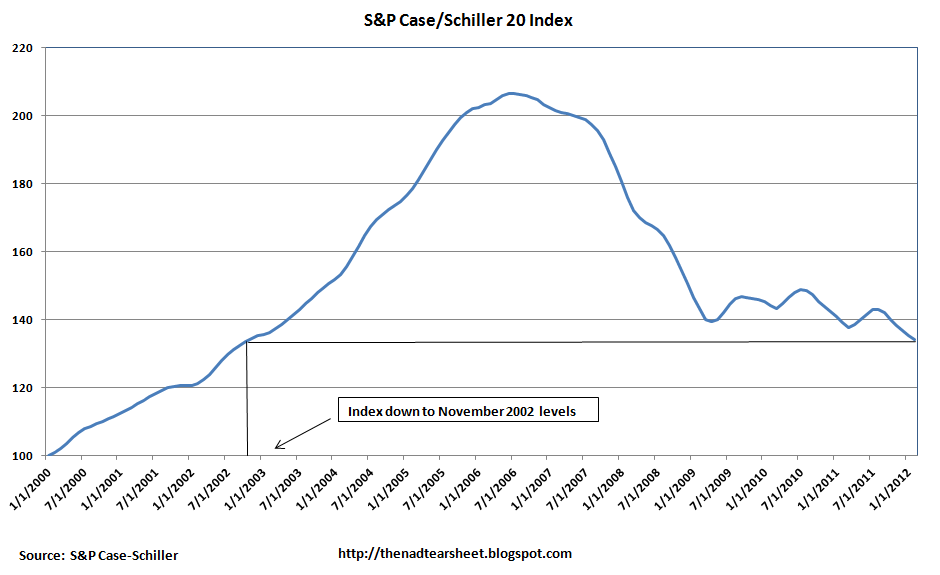
The S&P / Case-Schiller index fell to new post-bubble lows, with the index dropping 3.5% YOY. Five of the 20 MSAs showed increases – Detroit, Denver, Miami, Minneapolis, and Phoenix. Remember, Case-Schiller is a very lagged index, as the number reflects the market in December ’11 – February ’12. We are seeing the correlation between different MSAs break down, which should be good news for the homebuilders. Overall punch line of the report: Prices are still falling, albeit at a slower rate.
Shelia Bair warns of a bond bubble in the US. She raises an interesting question – Are we Europe? Or Japan? She thinks we are Europe. I think we are Japan, personally.
United Technologies, 3M, and AT&T all reported better than expected earnings. Former highflyer Netflix is down 15% on future growth worries despite a better than expected quarter. Apple reports after the close.
Lawrence Yun of the National Association of Realtors weighs in on the future of Fan and Fred. Punch line: Privatizing Fan and Fred in the 1970s created an untenable situation, where management took risks to maximize shareholder return with an implicit government backstop. This was an untenable situation, and almost guaranteed to end badly. It did. The question is what to do now. If you fully privatize Fan and Fred, you can expect volatility in mortgage rates and occasional market freezes. Say goodbye to the low-cost 30 year fixed rate mortgage, a uniquely American product that we almost consider our birthright. Pre-privatization, Fan and Fred performed a boring job very well. Perhaps it is time to make it official and fully nationalize them.
Chart: S&P / Case-Schiller 20-city index:
Filed under: Morning Report |
 All Things in Moderation
” Are we Europe? Or Japan? She thinks we are Europe. I think we are Japan, personally.”
Perhaps it is time to try door #3.
LikeLike
Say goodbye to the low-cost 30 year fixed rate mortgage, a uniquely American product that we almost consider our birthright. Pre-privatization, Fan and Fred performed a boring job very well. Perhaps it is time to make it official and fully nationalize them.
Color me shocked Brent. Maybe we could break up the big banks while we’re at it?
LikeLike
@lms. That was the author’s view, not necessarily mine.
That said, to fully privatize F&F would require something like half a trillion dollars to fill up the capital hole and provide a base. You aren’t going to find that kind of capital in the private markets.
The government has always subsidized the US residential real estate market, and IMO that causes distortions. So I don’t love this idea at all. But, I cannot envision the US voter standing for a purely private system of expensive 30 year fixed rate mortgages and primarily variable rate mortgages, so we might as well bring it all back in house. Or get rid of F&F and increase Ginnie’s role. But having Fannie Mae playing the role of the biggest mortgage arbitrage hedge fund on the Street was pretty much guaranteed to end badly.
Fun fact: LBJ’s privatization of Fannie Mae was a classic example of financial engineering – specifically off-balance sheet financing. This was similar to the special investment vehicles (SIVs) that all the big banks used. The borrower nominally “sells” the entity that issues debt – i.e. Fannie and Freddie bonds – and voila, that debt is no longer counted on their own balance sheet. Of course, the selling entity is still responsible for the payments so it isn’t really a “sale.” But the books look a lot better.
LikeLike
But the books look a lot better.
Funny, there’s a lot of that going around. I doubt Congress would ever Nationalize F & F at this point since most conservatives blame them and the government for the housing crash, well, and Barney.
LikeLike
For all intents and purposes, F&F are already nationalized.
LikeLike
That’s true temporarily at least, but isn’t the plan to dissolve them?
LikeLike
I guess you could dissolve them, but there is nothing to replace them.
LikeLike
Maybe I’m confusing Treasury’s 7 year plan to unwind them with “dissolution”.
LikeLike
Apple reports earnings of $12.30 per share. Back to $600!
LikeLike