Morning Report

Vital Statistics:

Last Change Percent
S&P Futures 1396.3 -2.2 -0.16%
Eurostoxx Index 2596.8 -11.5 -0.44%
Oil (WTI) 107.29 0.2 0.21%
LIBOR 0.4737 0.000 0.00%
US Dollar Index (DXY) 79.795 0.009 0.01%
10 Year Govt Bond Yield 2.26% -0.03%

Markets are quiet this morning after triple-witching last Friday. S&P futures are down a couple of points while bonds are up half a point. MBS are a up a tick.

Greek credit default swaps fixed at 21.75, which means sellers of protection owe 78.25%. So it appears that when all is said and done, that credit default swaps did in fact work as advertised.  Portugal, you’re up.

Merger Monday is back with a big deal in the logistics space – UPS is buying TNT for 6.8 billion, in a bid to create a Euro logistics company to rival DHL. UPS is paying a 54% premium to the undisturbed stock price, leaving some to question whether UPS is overpaying. But when companies are cash-rich and financing is cheap, you will see deal flow.

Speaking of cash-rich, supposedly Apple will disclose what they intend to do with their 100 billion in cash. Will Apple leave the trio of most-admired companies who don’t pay a dividend (Google, Berkshire Hathaway, and Apple)? The stock is currently halted.

The WSJ has an A1 article on the REO-to-Rental program. Ranieri is interested, as is Paulson.

Fair Warning! Rabbit Hole Argument. Should Woodward and Bernstein Have Mentioned Their Sources’ Motives for Leaking Information

I’m of the opinion that Watergate did a huge disservice to the American electorate in glorifying unnamed sourcing in stories without having to reveal possible motives for the source’s leaking. This review of a new book discusses Mark Felt’s rather Machiavellian actions in trying to secure the Directorship of the FBI. Did he do the country a service? I have to wonder.

Red Ink

Happy St. Patrick’s Day!

We’re down to 32 teams and a lot of brackets are awash in red ink.  Yesterday’s 16 games featured eight upsets, including two #2 seeds (Duke and Missouri) and a #4 (Michigan).

While no one in ATiM Rocks anticipated the Duke or Mizzou loses, the seed-differential bonus pixie was very busy bestowing gobs of points on the brackets of those willing to go with the likes of South Florida, Ohio, Xavier, NC State and Purdue.  Our leaderboard now looks like this:

USF Baby: 102; Moderately Yello: 98; DogJS: 89; MIA#4: 74; Michigoose#2 and ashot: 71; Blade Warriors: 65; Okiegirl: 62; MIA#2: 61; Okiegirldog: 49

Will VCU continue its post-season magic?  How’s the anticipated matchup between Marquette and Murray St. going to play out?  Is the Big Ten conference as strong as pundits like to claim?  (note to Yello: three) Madame Commish looks forward to more upsets and hopes you all have a great weekend.


Madame Commissioner wants to know…

Anyone pick St. B over FSU?  If so, close but no cigar.

For those who thought Belmont would beat the Hoyas, you have 3:10 1:06 0:00 to make up an 18-pt. a 15-pt. deficit.  Hey, it might didn’t happen 🙂

Why is the Norfolk St.-Mizzou game so close?  Mizzou’s down by 4 late in the 1st half.  Can you say bracket-wrecker?

Nice upset by NC State over SDSU, at least for those who picked it.

UPDATE  MIZZOU LOSES

Faux Health Care Update

Better publish this before I forget.

Bunch of links from the NEJM on Medicare reform.

On the whole, we do not believe that the recent slowdown in Medicare spending growth is a fluke. There has been a long-term trend toward tighter Medicare payment policy, and policy changes that began in the middle of the 2000s have continued that tightening (see graph).2 The Deficit Reduction Act of 2005 (DRA) reduced payment rates for imaging, home health services, and durable medical equipment, and the Medicare Improvements for Patients and Providers Act of 2008 (MIPPA) made substantial cuts to Medicare Advantage plans. Even though Congress has overridden payment cuts dictated by the sustainable growth rate formula (SGR) each year, the resulting physician-fee increases have fallen further and further below the relevant index of inflation. All these specific constraints on payment rates probably also slowed growth trends in the volume of services provided, leading to a larger slowdown in spending growth.3

Slower growth in Medicare Spending

On December 15, 2011, Senator Ron Wyden (D-OR) and Representative Paul Ryan (R-WI) released a Medicare reform proposal based on the concept of premium support.1 Under their proposal, Medicare would be converted from a defined-benefit to a defined-contribution program. Instead of guaranteeing to pay for services as they are rendered, as fee-for-service Medicare does, the program would give beneficiaries a subsidy (“premium support”) to purchase coverage from one of multiple competing health plans. The motivation behind the approach is to give plans a clear incentive to provide necessary services in a cost-effective manner, which can result in lower premiums or other beneficiary costs, attracting enrollees and increasing the plan’s share of the market.

Wyden-Ryan Proposal

These proposals would offer Medicare beneficiaries vouchers toward the purchase of private insurance or traditional Medicare. Private-plan offerings could vary, but the actuarial value of these alternatives would have to be at least equal to that of traditional Medicare. Increases in the amount of the voucher would be capped by an index that is expected to rise more slowly than health care costs. Advocates claim that cost-conscious enrollees and competition among profit-seeking insurers would hold down program costs. But if they didn’t, the growth cap would do so by shifting costs to the elderly and disabled.

Is premium support along the lines now being proposed a good idea? Is now the time to be making fundamental changes in Medicare? We believe that the answer to both questions is no.

Now is not the time for premium support

Before Senator Ron Wyden (D-OR) and Representative Paul Ryan (R-WI) introduced their “Bipartisan Options for the Future” on December 15, 2011, the notion that Democrats and Republicans agreed about certain aspects of Medicare might have seemed unthinkable.1 But the pairing of a liberal Democrat who has long worked on health care reforms and a fiscally conservative Republican primarily known for work on budget issues suggests that it might be possible for the parties to reach a compromise on Medicare reform. Of course, meaningful reform is not likely to occur in 2012: any significant reform probably won’t happen until the public sends a clearer signal about the kinds of change it will tolerate, which won’t be possible until after the fall elections. Yet some Republicans and Democrats appear to be in substantial agreement about some changes that might make Medicare more efficient, effective, and fiscally sustainable — even if none of these changes are universally accepted by either party as desirable or even tolerable.

Bipartisan Medicare Reform

A surgeon writes at Reason on medical ethics, cost controls and therapeutic guidelines.

Trends in US health care spending

Morning Report

Vital Statistics:

Last Change Percent
S&P Futures 1399.5 3.5 0.25%
Eurostoxx Index 2607.6 13.6 0.52%
Oil (WTI) 105.65 0.5 0.51%
LIBOR 0.4737 0.000 0.00%
US Dollar Index (DXY) 79.991 -0.159 -0.20%
10 Year Govt Bond Yield 2.32% 0.04%

Markets are slightly firmer after the consumer price index showed inflation is still behaving. The 10-year continues its slide and has backed up 40 basis points in the last two weeks. It feels like some major asset allocation trades are going on as investors sell bonds to buy stocks. For those keeping score, the 10 year yields 2.32%, versus a dividend yield of 2.27% on the S&P. So that move could have room to run.  Bloomberg is noting that the derivatives market is starting to price in Fed hikes in late 2013, nearly a year before the Fed’s current guidance of late 2014.

Industrial production was flat in Feb, below expectations, and capacity utilization was down slightly to 78.7% from 78.8%, also below expectations.

The NAHB Improving Markets Indicator predicts that 99 housing markets will improve in March, which is up from Feb.


Comics and Politics

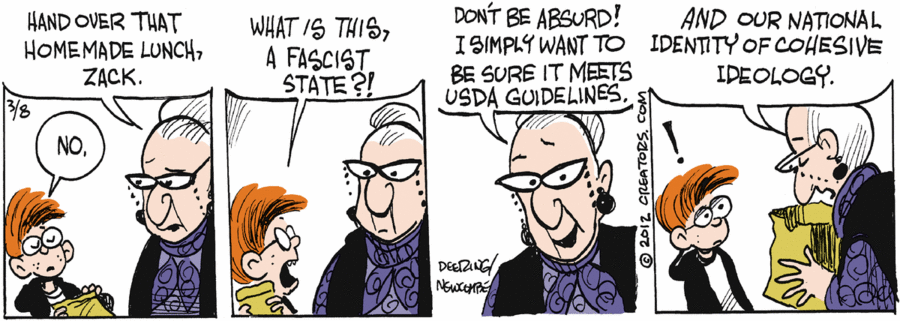
Recently a newspaper comic strip took on a hot button political issue in a provocative stand in a week-long series which ignited controversy and outrage:

I kid. Zack Hill is a minor comic and this series of strips went practically unnoticed. The story line for the comic seems to be based on this real news story about a preschooler who had her lunch confiscated because it was not well-balanced enough for the person checking lunches, whoever that may have been. For a week or so this became a cause celebre with all sorts of people decrying rampant Nanny State-ism. The primary complaint seemed to be over-reach into the personal decisions of a parent to determine what is an adequate meal.

This week the more high-profile comics and/or editorial page stalwart Doonesbury also took on a topical issue with this strip summing up the tone:

(click image for a more legible version)

This topic is very familiar to ATiM readers. It also tackles the issue as one of government over-reach and excessive Nanny State-ism. Feel free to draw your own additional parallels.

Retirement?

So I came across the article 6 reasons why you should not retire and, as someone that really looks forward to retiring,  it got me thinking.  Here are the 6 reasons:

1. There is no physical reason to retire.

2. Continued work can support healthy aging, including better physical and mental health.

3. Well-being and happiness are boosted when people are engaged in challenging and meaningful activities. Work is a major place to find such activities in our society.

4. Older people have rich experience and mentoring skills to help enrich the workplace experiences of younger colleagues.

5. Declining numbers of younger workers, courtesy of lower fertility rates, will raise the need to retain older employees in the workforce.

6. We need and like the money, and shorter retirements sharply cut the risk we will outlive our assets.

Well I read through these and…I still want to retire.  Quite badly.  Here is my response to these 6.

1)  So what…  Just because I am not forced into retirement by age or some other reason is not a good reason to keep working.  Just because I can?  I don’t think so. 
2)  If their idea of retirement is sitting out on the porch all day (with the exception of hitting the early bird specials), then yeah, I get it.  But I don’t plan to do that.  I plan to devote time to my hobbies, interests, family, friends and self…do the things I WANT to do, not NEED to do.  I think I am creative  enough to do things that will provide the same mental and physical benefits as what I do at work.
3)  Much the same as 2.  Work is A great place to find meaningful and challenging activities…it is by no means the ONLY place.
4)  Mentoring the younger…really?  Does anyone think that a 40 or 50 year old is going to be any less able to mentor a younger worker than a 70 or 80 year old?  There are plenty of people with the experience and maturity and age to be able to provide this great knowledge transfer.  Besides which, they say we are going to have a shortage of younger workers….meaning there should be a plethora of good mentors available.
5)  So this was the first that actually made me think…for a second.  First off, I will be off doing my own thing and, quite frankly, don’t care.  It will mean that salaries should rise for those workers and/or we will need to be that much more productive.  In any case, a higher salary could lure me back perhaps part time but I don’t think this in and of itself is a reason for me not to retire.
6)  With healthcare taken care of by Obama 🙂 what  is there to worry about if I have saved diligently during my working life?  Could I run out of money?  Certainly.  I can do that at any time during my life – there is always that risk.  I work hard to mitigate it and I will during retirement also. Quite frankly, that is a risk I am willing to accept.

So this article did not even begin to persuede me not to retire.  How about you? 


Morning Report

Vital Statistics:

Last Change Percent
S&P Futures 1392.5 3.8 0.27%
Eurostoxx Index 2581.0 6.2 0.24%
Oil (WTI) 105.51 0.1 0.08%
LIBOR 0.4737 0.000 0.00%
US Dollar Index (DXY) 80.436 -0.129 -0.16%
10 Year Govt Bond Yield 2.33% 0.06%

Equity markets continue to rally as bonds sell off. The 10-year now stands at 2.33% after yielding around 1.9% last week. MBS are lower as well, with some lenders now best-exing at 4-1/8%. That is a big move in a short period of time.

The producer price index (a measure of wholesale inflation) and initial jobless claims came in as expected. Empire Manufacturing (a New York – based measure of business sentiment put out by the New York Fed) showed general business conditions are expanding at a moderate pace. Prices paid jumped as did average workweek. Sentiment is optimistic.

ISDA is going to hold its auction to set the payouts on Greek CDS. The early indications seem to be that 23 is going to be the price on the roughly $2.6 billion in swaps. According to Bloomberg, The Austrian government is holding the old maid here, and will have to inject 1 billion euros into KA Finanz AG (the “bad bank” of nationalized Kommunalkredit Austria AG) to cover losses on Greek swap payouts.

Foreclosures are set to increase, according to RealtyTrac, as some of the barriers are removed (especially the State AG settlement) According to Bloomberg, the shadow inventory of homes in foreclosures or about to become foreclosures is around 4.5 million units. I wonder what the economic effect will be when those people who have been living for free suddenly have to pay rent.

On the other hand, the NAR shows list prices and demand up, with inventory down in its latest Real Estate Trends report.  Total inventory is down 22% YOY, with list prices up 6.82% and age down 9.8%.  The recovery seems to be concentrated in the hardest hit areas – Florida and Arizona. Phoenix inventories are down 48% and list prices are up 21%. I have been hearing anecdotal evidence of strong investor interest in Phoenix property, and these numbers do bear that out.

Something to Talk About

Posts have been a bit down over the last week (I’ve been sick and swamped at work), so here’s a bit of a random collection of stories.

“[F]our Republican senators will unveil a plan Thursday that would transition Medicare enrollees into the same health care program offered to federal employees while gradually increasing the eligibility age and requiring wealthier seniors to pay more.” The article notes that “the measure would phase out the existing Medicare program over an unspecified period of time.”

I can’t access the link that came with the above blurb, but maybe nova can help us out.

The CBO says the ACA will costs less but cover fewer people than first expected. Since the law’s primary goal is arguably to increase coverage, that seems like a bad thing.

It looks like the IPAB is going to be repealed as democrats run from the death panel as fast as they can. One of the criticisms offered up by at least one politician was that it takes these decisions away from Congress. Ummm…wasn’t that the point?

And just so it isn’t all health care, here is an amusing review of the movie version of Atlas Shrugged Part 1. The reviewer is assigned to watch random instantly available movies on Netflix and mostly he just makes fun of the movies.

And as we start the NCAA tournament….Go Green!!