

 Brent Nyitray
 Fairlington Blade
 Let the mutherfuker burn!
 jnc4p
jnc4p Kevin S. Willis
 Michigoose
 lmsinca
 markinaustin
 Arcanaut
 novahockey
 quarterback
 ScottC
 yellojkt
A few more political-tinged cartoons that struck my fancy over the past week.
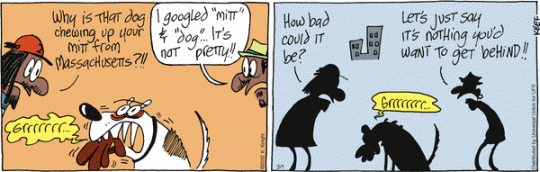
The first one seem particularly apropos for this week.

It seems Santorum isn’t the only one with a Google problem.
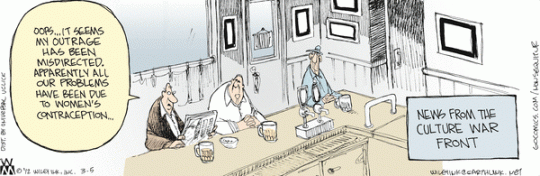
Finally, with the deadlines inherent in the comics business, I am amazed at how prescient this one is. It’s as if he knew Rush was going to keep fanning the flames of this issue.
Hope you enjoy.
Filed under: Uncategorized |
 All Things in Moderation
Was it Wolfe who said to take everything in moderation, including moderation?
LikeLike
It wasn’t Goodwin or Inspector Cramer.
LikeLike
According to the rules of the internet it was either Oscar Wilde, Winston Churchill or Mark Twain.
LikeLike
All our problems haven’t been due to women’s contraception, obviously, it’s the mandated purchasing of insurance that covers contraception (of any kind, presumably) by organizations with some religious affiliation.
LikeLike
Ah. Wilde, not Wolfe.
LikeLike
Wolfe said something like this: “A passion for honesty is admirable, but in that, as in everything, moderation is often best.”
I think he said it to a client in Archie’s presence.
LikeLike
I think my brain catalogued it under W names with a pretentious trailing ‘e’, then interpreted it as a lesson of the electric koolaid acid test.
LikeLike
Nero Wolfe was a fountain of pithy aphorisms compared with Tom Wolfe, or even Thomas Wolfe, who titled one of his novels with one. I never understood why he thought I could not go home again just because he had issues.
I really thought you meant Nero Wolfe for a moment. He drank beer to excess but made up for it by never moving from his chair, except to visit his orchids. Balancing priorities. He really did believe that honesty was to be practiced in moderation. My favorite detective, Holmes, either respected Watson for, or accused him of, moderation, depending on the circumstance.
LikeLike
One of the most amusing aspects of Rush’s monologue last week was the request for a video of Ms. Fluke given that her sex was being funded by others.
Contraception (via prescription) is one of the included benefits from my HMO (United Health Care). As this is being paid with mostly public funds, it leads to some interesting thoughts. First off, there are Catholics who are being forced to help fund the sinful (in the church’s eyes) activities of my wife and I. If there is an exception along the lines of the Blunt amendment, should not contraception be a disallowed benefit on the grounds that it violates the religious liberties of those who pay for it?
On the whimsical side, since my wife and I are being paid to have sex (Rush’s words), should we not be required to post videos of our activities? There could even be a whole new YouTube channel: YouWatch.gov! Mind you, it would be as pleasurable to view as the infamous Ross & Rachel sex tape.
BB
LikeLike
fb:
…should not contraception be a disallowed benefit on the grounds that it violates the religious liberties of those who pay for it?
No, it should be disallowed on the grounds that it is not an expense resulting from an insurable event.
LikeLike
I tried an experiment over at PL last night (slumming, yes). I posted a numbered list of propositions designed to demonstrate clearly and inexorably why the cost of contraception can’t properly be “insured,” and that the only possible purpose of compelling insurance coverage for it is to make people who don’t use it subsidize it for those who do. I asked whether anyone could poke any holes it it. All I got was a litany of evasions.
Insurance depends on the predictability of costs on an acturial basis that are unpredictable (and not within the insured’s control) on an individual basis. Since use of contraception is a matter of choice, if everyone was free to purchase contraception insurance or not, everyone who planned to use contraception would by the “insurance,” and those who did not plan to use contraception wouldn’t buy the “insurance.” That would mean that all insureds would incur the “insured” cost, and the premium would have to be more than the cost of contraception itself. The effect of compelling everyone to buy insurance with contraception coverage, therefore, is for those who don’t plan to use contraception to subsidize those who do.
It simply makes no sense as “insurance.”
LikeLike
Do we really need to have a discussion about why birth control benefits both genders? I think the fact that health “insurance” isn’t “insurance” in the normal use of the word has already been covered.
LikeLike
Mich:
Do we really need to have a discussion about why birth control benefits both genders?
I don’t think BC benefits genders. I think it benefits the individuals who use it, who could be either gender.
LikeLike
Do we really need to have a discussion about why birth control benefits both genders?
Birth control is often a non-contraceptive medical treatment for women (especially as regards difficult periods), not unlike testosterone therapy for men. Certainly that use of bc should be covered, if treatments such as testosterone therapy are covered for men.
LikeLike
The better term is health care coverage, in which the protection from unforeseen events is just one aspect. A far more important role is the preventive and routine care which heads off the catastrophic events.
Fee for service is the least effective way to maximize healthfulness because there is a disincentive for early diagnosis. That is also why annual check-ups, routine exams, and immunizations are often done at low or no co-pays, to encourage that behavior.
By separating health care into a separate benefit bundle which is untaxed and is in effect a non-cash form of minimum wage (since health care costs are rarely proportional to income and inversely proportional to the manual labor fraction of the work involved) it encourages people to take advantage of it to their benefit.
This is a bit paternalistic and anathema to all the rugged individualists, but it plays into the irrational economic choices people make as part of their psychology.
And I agree with Michigoose that men enjoy the benefits of women having access to contraception even if the burden is on women to implement it.
As for women who want contraception being bandied as sluts, it is important to remember that hormonal birth control offers no protection against disease so it is a poor choice for truly promiscuous women who must also rely on barrier methods.
Most (many? Ladies, help me out here) women don’t go onto BCP until they are sexually active in at least a semi-monogamous relationship. By making the barrier lower in cost, it would encourage women to begin earlier which I see as a good thing.
Effective oral contraception requires a rigorous dedicated routine which is easier to instill before the onset of sexual activity. I get pilloried when I (as a man with no daughters) suggest that all women go on birth control (either BCP or Norplant) at the age of fifteen just as a backstop against poor decision making or unforeseen sexual assault, but the downsides to such a policy (with a liberal opt-out option) seem minimal.
LikeLike
yello:
Fee for service is the least effective way to maximize healthfulness…
So is allowing people to exercise (or not) as they see fit. Perhaps you also think we should have federal mandates for insurance to pay for health club memberships.
I think maximizing freedom should be a higher priority for government than maximizing healthfulness.
LikeLike
Fee for service is the least effective way to maximize healthfulness…
This is asserted but it’s just presumed, not established. There is no fee-for-service market for healthcare per se (outside of cosmetic surgery), and certainly not every alternative method of delivery has been tried. Also, there’s plenty of evidence that both broad private and insurance and governmental single payer systems can be hugely inefficient. I think this is an assertion that might require closer examination.
LikeLike
Perhaps you also think we should have federal mandates for insurance to pay for health club memberships.
Many insurance plans do offer subsidies to health clubs. That benefit is very good for post-cardiac event patients who need a regular exercise program that is less supervised than prescribed physical therapy. Most large corporations have in-house fitness centers as an employee benefit so adding it to mandatory coverage would give small businesses who can’t afford their own facilities a level field.
While it would be a good feature to have, let’s work on getting basic health care such as contraceptive services in the mix before we expand it further.
LikeLike
yello:
While it would be a good feature to have, let’s work on getting basic health care such as contraceptive services in the mix before we expand it further.
Yet another reason to fight the current expansion tooth and nail.
LikeLike
I think it benefits the individuals who use it, who could be either gender.
Same sex couples have very little use for contraceptive services. I can explain that in further detail if you need me to.
LikeLike
yello:
I can explain that in further detail if you need me to.
It might be useful if you explained what relevance it has to my point.
LikeLike
It might be useful if you explained what relevance it has to my point.
For contraception to be necessary, let alone effective, a member of each gender has to be involved, both of whom avoid the consequences of an unplanned pregnancy. There are lots of good books and websites on this topic.
LikeLike
For contraception to be necessary, let alone effective, a member of each gender has to be involved, both of whom avoid the consequences of an unplanned pregnancy. There are lots of good books and websites on this topic.
I may be wrong, but I don’t think that did anything to explain the relevance.
LikeLike
yello:
There are lots of good books and websites on this topic.
Perhaps, but there are there any good books on the bizarre thought process that leads one to think this has anything to do with the point I made, namely that it is individuals, not genders, that benefit from the use of BC?
LikeLike
This is asserted but it’s just presumed, not established.
The uninsured are in the fee for service market and they largely tend to avoid health care until it reaches the level that requires expensive treatment at emergency rooms and the like. While I am not an epidemiologist, I will hypothesize the even after adjustment for other factors, people with insurance are healthier than people without.
The inefficiency of the for-profit health insurance system is a process I have been quite critical of in the past. It can be made better but it is still a rather poorly stitched sow’s ear masquerading as a purse.
LikeLike
I may be wrong, but I don’t think that did anything to explain the relevance.
One individual of each gender benefits, so both genders benefit. In situations where the individuals are of the same gender, the need is irrelevant. Please don’t make me draw a diagram.
LikeLike
I thought nova had posted statistics indicating covering birth control actually decreases insurance premiums. If that’s the case, then the subsidy is arguably the opposite of what QB posits. It isn’t quite that cut and dry but if covering bc would reduce premiums, how is it a subsidy?
Birth control is often a non-contraceptive medical treatment for women (especially as regards difficult periods), not unlike testosterone therapy for men.
I really don’t think anyone, other than perhaps Santorum, opposes coverage under these circumstances.
Perhaps you also think we should have federal mandates for insurance to pay for health club memberships.
I doubt that is particularly effective in promoting healthfullness, it certainly would be an inefficient means of doing so. As nova has frequently pointed out, not all preventative care is created equal and some is a big waste of money.
Although not germane to the issue of a federal mandate, every thing I hear from insurers and providers alike is that there is going to be a huge push for community health and wellness programs. Lots of money is going to be invested to keep populations healthy, particularly at risk populations. Obviously this has nothing to do with a federal mandate, but it will be interesting to see how these programs develop.
LikeLike
ashot:
I thought nova had posted statistics indicating covering birth control actually decreases insurance premiums.
I’d like to see those stats, as intuitively it seems very unlikely to be the case.
LikeLike
I’d like to see those stats, as intuitively it seems very unlikely to be the case.
This seems to be a relatively neutral take on topic. Their conclusion is it isn’t particularly clear one way or the other. In the 10 seconds I spent on that google search, I saw a couple mentions of how birth control does more than just prevent pregnancies. Time had a err…less neutral take on the issue.
*EDIT- That 10 seconds comment was not meant to be some sarcastic barb at you, Scott. It was only meant as a disclaimer that I did not conduct a thorough search.*
LikeLike
ashot:
That 10 seconds comment was not meant to be some sarcastic barb at you, Scott.
No worries.
LikeLike
Your link to the Time article seems to be broken.
LikeLike
Thanks yello. I noticed that and did eventually fix it. The whole comment was a bit of a fiasco.
LikeLike
Heh. United Health Care evidently has a different definition of insurance as there are multiple items they define as insurable that do not meet the Scott/QB test. Or we can simply go with health coverage that includes but is not limited to insurable events. In the case of contraception, it apparently behooves UHC to provide coverage as it prevents a much more expensive insurable event.
Autism was certainly an unexpected event in my family. Quasi-monthly appointments with our family’s psychiatrist are routine by now. It would be a bit weird to have the diagnosis of a chronic disease be insurable, but once medication is routine, it’s not an insurable “event” and thus not subject to coverage.
With regards to both sexes benefiting from contraception, I’d happily direct questions to a friend of mine who is currently paying child support to his ex or another friends with an unexpected addition to the family (a loved child, to be sure) that meant several years of lost income and a very expensive house upgrade. He got the snip shortly thereafter. That suggests to me that he thought he benefited from effective contraception.
BB
LikeLike
The late Charles William Bailey was my doc until he retired. He was LBJ’s family doc, a combat surgeon in WW2, and he went through UT Law from ’61 to ’66, at a leisurely pace, while maintaining his full time medical practice across the street from the Law School. So 100s of lawyers called him their doctor; many of us met him in law school. As he was performing a vasectomy on me in ’78, he casually mentioned, while waving his scalpel, that he had been sued for the first time in his life. I asked if I should rethink the surgery and he said “no” and he told me the story of the suit while he cut on me, with a flair for the dramatic. I do believe my vasectomy is completely irreversible.
LikeLike
FB,
Insurance companies choose to structure policies to pay for a lot of things that aren’t really insurance. That’s one way to look at my point.
A simple way to think of it is, what would happen if insurance for X were sold as stand-alone insurance. What if someone offered birth control “insurance” policies, and people were free to buy them or not (obviously, Obamacare makes this illegal)?
It wouldn’t work, of course. Not as insurance. People who did not plan to use contraception would not buy the “insurance.” Everyone who planned to use it would buy the insurance, or, at a minimum, everyone who purchased the insurance would do so planning to use contraception.
All “insureds” would therefore incur the cost of using contraception. To pay them all, the “insurer” would simply have to charge a premium higher than the cost of contraception itself (in order to cover transaction costs and make some profit). We can easily see from this that it isn’t insurance. It is simply a payment conduit.
From this perspective, it can also be seen that the only effect and purpose of forcing everyone to buy such insurance is for those who won’t use it subsidize those who do. One can make arguments that this is all a good idea anyway, but those arguments really have nothing to do with a need for “insurance” for contraception, because there is no such thing.
LikeLike
fb:
United Health Care evidently has a different definition of insurance as there are multiple items they define as insurable that do not meet the Scott/QB test.
Of course they do. In order for their customers to pay for standard medical treatment and products with pre-tax rather than after-tax dollars, they “insure” all kinds of things that are not insurable events. It’s a tax dodge, and is one of the reasons health care inflation is so high.
it apparently behooves UHC to provide coverage as it prevents a much more expensive insurable event.
Or it behooves them to provide their customers with the benefit of paying for their contraception with pre-tax instead of after-tax dollars.
It would be a bit weird to have the diagnosis of a chronic disease be insurable, but once medication is routine, it’s not an insurable “event” and thus not subject to coverage.
Agreed. It seems to me that the costs associated with an autistic child are precisely the kinds of individually unpredictable but actuarially knowable costs for which insurance, properly understood, is ideal. Did someone suggest otherwise?
LikeLike
mark, good story. LMAO. Although not in the same rung on the hierarchy, I had a similar experience. While I was having surgery on my face (fyi, not cosmetic surgery) with only local anesthetic, I was chitchatting with the doc. I realize this would have been a classic calm-the-patient technique, but at the time I could not help but ruminate on the fact that I was chitchatting with someone who was cutting my face with a sharp instrument.
LikeLike
qb, to me the point is, what you advocate is not the current reality. Insurance plans for the most part already cover contraceptives within limits. (My “should”
thought is: cover it the same as any other prescription currently is covered.)
So your argument is irrelevant. IMHO, you are tilting at windmills and in the minority on this one. Regardless of estoeric arguments about definition of insurance, definition of rights, etc.
Prove it at the polls.
LikeLike
Prove what at the polls, okie?
What isn’t current reality is irrelevant? Obama campaigned on fundamental change. Was his whole campaign irrelevant? Was advocacy of ACA irrelevant before it was passed? What political or policy change to people advocate that is already the current reality?
We shouldn’t argue if we are in the minority?
This argument isn’t esoteric. It is fairly simple and is fundamental to the argument being made for mandated coverage and ACA generally.
Something I find astonishingly ironic about this is that the analysis exposes that advocates of coverage are advocating precisely what they always contend is most wrong with our system: profiteering insurance companies that don’t contribute anything of value. Their profits don’t go to providing health care, the argument goes. What this argument overlooks, of course, is that what insurance provides is protection against a risk. When “insurance” is used simply as a conduit for payment, the insurer truly is contributing nothing of value. They are just a pass-through, taking a cut of the customr’s payments as profit.
LikeLike
okie:
qb, to me the point is, what you advocate is not the current reality.
Doesn’t seem to me to be much of a point. No policy is the current reality until it is. Obamacare wasn’t the current reality until it was. Nor was civil rights. Nor was the vote for women. If arguments for any given policy were “irrelevant” and “tilting at windmills” simply because it wasn’t “current reality”, reality would never change. Yet it changes all the time.
LikeLike
“what you advocate is not the current reality.”
Often a desire to change reality is what drives advocacy.
Having said that, I am with you, okie – prescriptions should be covered in a health care plan, whether for viagra or birth control pills.
LikeLike
“costs associated with an autistic child are precisely the kinds of individually unpredictable but actuarially knowable costs for which insurance, properly understood, is ideal. ”
Offering birth control coverage is precisely the kind of actuarially knowable cost you describe.
LikeLike
bsimon:
Offering birth control coverage is precisely the kind of actuarially knowable cost you describe.
No, it isn’t. The costs associated with contraception are a choice, not the result of an individually unpredictable event.
LikeLike
“The costs associated with contraception are a choice, not the result of an individually unpredictable event.”
1) you’re assuming birth control pills are only prescribed as contraception, which is inaccurate. So far as I know we’re only talking about birth control pills, not the sponge, or the dam, or condoms or spermicides. 2) The costs of pregnancy are individually unpredictable, but over a large population are predictable, as is the influence of making birth control available to that population.
LikeLike
bsimon:
you’re assuming birth control pills are only prescribed as contraception, which is inaccurate.
True. I remember back in my college days, at a catholic university, the truly astonishing number of women who found themselves with medical problems that required the use of the pill, prescribed by the university infirmary. Never for contraception, of course, which would have been against both catholic doctrine and school policy. Must have been something about the school food that resulted in so many erratic menstrual cycles, necessitating the pill.
The costs of pregnancy are individually unpredictable, but over a large population are predictable…
That is an argument for the costs of pregnancy, not the costs of contraception, being insurable. But even at that, it isn’t a very good one since a) many (most?) pregnancies are actually planned and are not unpredictable and b) pregnancy is a choice (as we are routinely informed by the likes of, say, Planned Parenthood).
LikeLike
qb,” prove it at the polls”” = let’s see how many candidates advocating your positions actually get elected. Yes, they will be elected in OK, but nation-wide ? Countdown is on! Yum yum. But still not quite as good as an NCAA bracket.
I’m tired and might respond to other substantive points you raise. You have not alienated me from considering them.
LikeLike
One can make arguments that this is all a good idea anyway, but those arguments really have nothing to do with a need for “insurance” for contraception, because there is no such thing.
I can’t disagree with qb here, at least in the stricter sense of the term insurance. However, given that the same argument applies to any number of other things insurance covers, I don’t find the argument all that compelling. To me the only justifications for opposing the BC mandate is because you oppose such government intrusions in general or you oppose the use of BC on religious grounds.
LikeLike
ashot:
To me the only justifications for opposing the BC mandate is because you oppose such government intrusions in general…
That is, of course, why the mandate (indeed any mandate) is objectionable. But when advocates attempt to justify the mandate on dubious economic grounds (such as that it will reduce costs), it is necessary and sensible to counter that justification on its own terms.
LikeLike
But when advocates attempt to justify the mandate on dubious economic grounds (such as that it will reduce costs), it is necessary and sensible to counter that justification on its own terms.
I’m not saying people shouldn’t try to oppose it on economic grounds, but I dont’ find such an argument particularly compelling given that such an argument applies to countless medicines and lifestyle choices that I am subsidizing with my insurace premiums. Not to mention that it isn’t at all clear that coverage will in fact increase premiums.
LikeLike
“given that such an argument applies to countless medicines and lifestyle choices that I am subsidizing with my insurace premiums”
I make this argument against all sorts of stuff. allergy meds, physicals, Viagra, cholesterol meds. basically, if it’s not going to be catastrophic cost (a level that should be set between insurer and customer and contracted for accordingly) it should be paid out of pocket. that’s the only way we’re going to control costs — but pushing it onto the end user*. And if it’s a chronic disease. sucks for you, it’s now part of your life and your monthly budget. plan accordingly.
If I get seasonal allergies every year, I should know to budget for the damn pills. Same with BC. and if I can’t budget for them, we’re essentially moving into a charity care issue.
This whole debate makes me crazy. We’ve politicized health care — stuff like it is not only inevitable, it’s part of the process.
LikeLike
Scott – Interesting points. I’ll set the linkage of pre-tax benefits with inflation as interesting, but unproven. It’d be interesting to delink the tax code with medical costs, including general medical expenditures, flexible spending accounts, as well as the deduction for health care expenses exceeding a certain percentage (2?).
There was an interesting article in the Post about cost of health care expenses here vs. abroad. I’ll try to put together a separate post on that one as it intersects with a conversation I had with a friend in the UK. I’ve taken advantage of lower dental care expenses in Costa Rica vs. the U.S. One can cover the cost of the flight with the cost difference of a dental implant. A co-worker and I had pretty much the same thing happen, a chunk of a tooth broke off, and the cost difference was about $800.
Thanks for clarifying on chronic health care costs. A health care event (diagnosis of a chronic disease, whether HIV or autism) has an associated cost of care and is thus insurable.
BB
LikeLike
fb:
I’ll set the linkage of pre-tax benefits with inflation as interesting, but unproven.
The linkage isn’t really related to the pre-tax aspect in particular, but rather the 3rd party payer aspect, which itself is a function of the pre-tax benefit.
In order to reap the pre-tax benefit, a person needs to funnel the expense through his employer, via insurance, thus introducing a third-party payer. Once a third-party payer is introduced, any individual incentive to limit expenses is diminished.
It’d be interesting to delink the tax code with medical costs, including general medical expenditures, flexible spending accounts, as well as the deduction for health care expenses exceeding a certain percentage (2?).
I think it would be a great idea. And I’d make the deduction percentage 0%.
LikeLike