Things that make you go "hmmmmm".I'm guessing the Chinese population in Peru has something to do with mining. But why the Indian population in South Africa? Anybody know??
That population is historic and related to the Commonwealth status enjoyed by the U of SA at the beginning of the century. Ghandi practiced law in South Africa for many years.
I didn't know that about Ghandi, Mark, thanks!I'm guessing HK counts as diaspora because it wasn't "China" (again) until what, a decade ago? And Taiwan probably doesn't count because China considers it merely a breakaway state.
yello:How does Hong Kong count as a diaspora destination?I lived in HK when it was returned to Chinese control in 1997. At the time, there was no change in the restrictions on movement between Hong Kong and China. That is to say, one still had to go through the same immigration controls and visa restrictions after the handover as before. I don't know if that remains the case, but if so, it might explain why HK is counted as a destination.No idea why Taiwan wouldn't be counted as well.BTW, as an aside, the language of Hong Kong is different to the language of the rest of China, ie Cantonese vs Mandarin on the mainland. Not sure that is relevant for these purposes, but it does represent a distinguishing feature.
Another explanation might be that the source is The Economist, a British publication, and they still haven't quite come to grips with the fact that HK is no longer British. 😉
But these aren't the case of a diaspora. These are areas traditionally inhabited by Chinese people. Nobody moved in Hong Kong, just the political borders changed. If anything there is a stronger case for Taiwan since there are the native Taiwanese and the mainlanders who followed with the fall of the Nationalist government.These numbers also look big because they are tracking the patterns of the two most populous nations on Earth. Other countries such as Ireland and Vietnam have probably had bigger diasporas as a percentage of their base population.
yello:These are areas traditionally inhabited by Chinese people. Nobody moved in Hong Kong, just the political borders changed.I understand your point, but I think Hong Kong (along with Macau) is rather a special circumstance. Although it is true that Hong Kong was historically, albeit very sparsely, inhabited by Chinese people, it is also true that, under British rule and while it was not in fact part of China, huge numbers of Chinese did move there. Their citizenshipo status was very complicated and changing over the years, but anyone born in HK after it was ceded to Britian in 1842 was considered to be a British subject. In other words, Hong Kong was, relative to China, very much a different country just like, say, Vietnam or Singapore or any other place that Chinese people emigrated to. And so I dont' think it is necessarily wrong to include Hong Kong as part of the Chinese diaspora.


 Brent Nyitray
 Fairlington Blade
 Let the mutherfuker burn!
 jnc4p
jnc4p Kevin S. Willis
 Michigoose
 lmsinca
 markinaustin
 Arcanaut
 novahockey
 quarterback
 ScottC
 yellojkt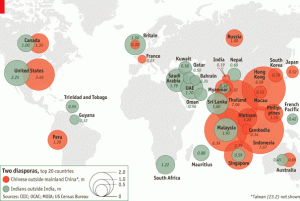


 All Things in Moderation
Things that make you go "hmmmmm".I'm guessing the Chinese population in Peru has something to do with mining. But why the Indian population in South Africa? Anybody know??
LikeLike
That population is historic and related to the Commonwealth status enjoyed by the U of SA at the beginning of the century. Ghandi practiced law in South Africa for many years.
LikeLike
…20th century…
LikeLike
How does Hong Kong count as a diaspora destination?
LikeLike
Good point, YJ. And if HK, why not Taiwan?Both are not "mainland China".
LikeLike
I didn't know that about Ghandi, Mark, thanks!I'm guessing HK counts as diaspora because it wasn't "China" (again) until what, a decade ago? And Taiwan probably doesn't count because China considers it merely a breakaway state.
LikeLike
yello:How does Hong Kong count as a diaspora destination?I lived in HK when it was returned to Chinese control in 1997. At the time, there was no change in the restrictions on movement between Hong Kong and China. That is to say, one still had to go through the same immigration controls and visa restrictions after the handover as before. I don't know if that remains the case, but if so, it might explain why HK is counted as a destination.No idea why Taiwan wouldn't be counted as well.BTW, as an aside, the language of Hong Kong is different to the language of the rest of China, ie Cantonese vs Mandarin on the mainland. Not sure that is relevant for these purposes, but it does represent a distinguishing feature.
LikeLike
Another explanation might be that the source is The Economist, a British publication, and they still haven't quite come to grips with the fact that HK is no longer British. 😉
LikeLike
Also, throw Macau in there with HK and Taiwan as well. It was a Portuguese colony much like Hong Kong that was returned to China in, I believe, 1998.
LikeLike
But these aren't the case of a diaspora. These are areas traditionally inhabited by Chinese people. Nobody moved in Hong Kong, just the political borders changed. If anything there is a stronger case for Taiwan since there are the native Taiwanese and the mainlanders who followed with the fall of the Nationalist government.These numbers also look big because they are tracking the patterns of the two most populous nations on Earth. Other countries such as Ireland and Vietnam have probably had bigger diasporas as a percentage of their base population.
LikeLike
yello:These are areas traditionally inhabited by Chinese people. Nobody moved in Hong Kong, just the political borders changed.I understand your point, but I think Hong Kong (along with Macau) is rather a special circumstance. Although it is true that Hong Kong was historically, albeit very sparsely, inhabited by Chinese people, it is also true that, under British rule and while it was not in fact part of China, huge numbers of Chinese did move there. Their citizenshipo status was very complicated and changing over the years, but anyone born in HK after it was ceded to Britian in 1842 was considered to be a British subject. In other words, Hong Kong was, relative to China, very much a different country just like, say, Vietnam or Singapore or any other place that Chinese people emigrated to. And so I dont' think it is necessarily wrong to include Hong Kong as part of the Chinese diaspora.
LikeLike