

 Brent Nyitray
 Fairlington Blade
 Let the mutherfuker burn!
 jnc4p
jnc4p Kevin S. Willis
 Michigoose
 lmsinca
 markinaustin
 Arcanaut
 novahockey
 quarterback
 ScottC
 yellojkt
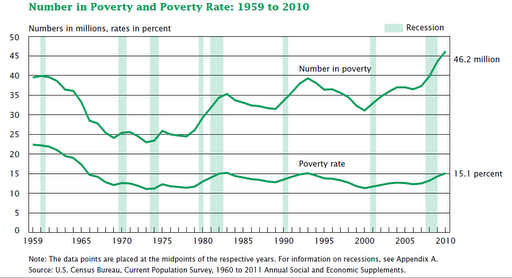
There were some interesting discussions of poverty in the US over the weekend and for some reason I thought it might be helpful to see the trajectory of poverty rates over the last 50 years. The chart also overlays the statistics over past recessions which I think is helpful. Content below is from EconMatters. (lmsinca)
By EconMatters
In yet another sign that the Great Recession cuts deep and long–the number of Americans living below the official poverty line reached 46.2 million, the highest in 52 years since the Census Bureau started tracking the figures in 1959.
The overall poverty rate also climbed to a 17-year high at 15.1%, which means 1 in 6 Americans are living below poverty line largely due to the high unemployment and underemployment rate. The official poverty line for 2010 is defined as an annual income of $22,314 for a family of four, and $11,139 for an individual.
 |
| Chart Source: The Census Bureau |
The Census Bureau’s annual report released on Tuesday, Sept. 13 gives a very grim snapshot of American households in 2010. As the U.S. economy expanded 3% in 2010, and corporations reported good profits, the gains are not trickling down to workers. The median household income in 2010 dropped to $49,445, which is virtually unchanged from the level in 1997. Overall, household income has fallen by 6.4% since the recession began in December 2007. (Ok, who was the one declared that the recession “officially” ended in June 2009?)
Note from lmsinca
So we’re one week in and it has been interesting to say the least. The site is both stable and usable as a forum for discussions. We’ve attracted a great group of commenters and authors so far but I would suggest we need to at least double our list over the next couple of weeks to keep things interesting. There were some great posts with both controversial and non-controversial comments and even a few heated arguments……………welcome to blogging. We’ve already seen a few people leave or decide not to participate for various reasons, which I don’t find unusual in the least. We keep working, discussing and improving, building on success and learning from our mistakes. The more people take ownership of this space the more successful it will be. Are we having fun yet?
Welcome to week two.
(Posted Sunday night from the West Coast for East Coast early birds)

Filed under: Uncategorized |
 All Things in Moderation
Good morning, all from the CDT Zone. I have pointed to the 29% school dropout rate since 1970 as a critical mass. The only cure I know of is in the education system, and the biggest bang for the buck I know of is the community college system, followed by Head Start.Poverty may persist, but for those who will take a hand up rather than a hand out both they, personally, and the society, generally, will be more productive.More, later!
LikeLike
Good morning. I guess those of us in CDT are the only ones up yet? Actually, it's a bit early for me to be in think mode on this as my mind is on my work day, but I'll check back on it later in the day.A good day to all!
LikeLike
Those poverty rates don't include any form of government assistance, do they? Because if that's what it is, even given food stamps and WIC and other forms of poverty assistance, that's really bad. I had meant to get back to education in my previous post on "taxing the rich" to end poverty–that the point I found interesting is how the employment rate for college graduates was statistical full employment. Again, those jobs may be lesser jobs, but even that indicates folks with a college education have enough skill-flexibility to work effectively in either kind of job. It just seems to best jobs program might be getting people at least a basic college education. Of course, that may be a symptom more than a cause–the same factors that lead to a person getting a complete college education also put them in a better position to find employment, even in hard times.
LikeLike
Good morning all. I don't believe this is just a criticism of the "War on Poverty" or the symptom of a disease. There are numerous factors obviously which have created this huge class of poor or working poor including the out-sourcing of jobs, the Great Recession, growing wealth discrepancy, education reforms gone awry, etc. etc. etc. Everyone here could probably point to a different villain, assuming we all recognize this as a problem waiting for a solution.I don't believe adhering to our standard notions of economic or political ideology will solve it, do you?"The Working PoorThe number of low income jobs is rising while the number of high income jobs is falling. This has created a situation where the number of "the working poor" in America is absolutely skyrocketing. Millions of Americans are working as hard as they can and yet they still cannot afford to lead a middle class lifestyle.*Since the year 2000, we have lost approximately 10% of our middle class jobs. In the year 2000 there were about 72 million middle class jobs in the United States but today there are only about 65 million middle class jobs.*Back in 1980, less than 30% of all jobs in the United States were low income jobs. Today, more than 40% of all jobs in the United States are low income jobs.*Between 1969 and 2009, the median wages earned by American men between the ages of 30 and 50 dropped by 27 percent after you account for inflation.*According to a report released in February from the National Employment Law Project, higher wage industries are accounting for 40 percent of the job losses in America but only 14 percent of the job growth. Lower wage industries are accounting for just 23 percent of the job losses but 49 percent of the job growth.*Half of all American workers now earn $505 or less per week.*Last year, 19.7% of all U.S. working adults had jobs that would not have been enough to push a family of four over the poverty line even if they had worked full-time hours for the entire year.*The number of Americans that are going to food pantries and soup kitchens has increased by 46% since 2006."Note: I'm posting without a link to this piece as I'm having trouble with the html on it…………..I'll keep working and post the link when I get it right. Is anyone else having trouble with html, because none of mine is working this morning?
LikeLike
Here's that link for the piece above. Everything seems to be working now.
LikeLike
Yee haw, I can comment again! And no clickcliclclickclickclick
LikeLike
Hi, taroya! Did you see the kitties on the "Testing, Testing" thread? :-)And for anyone who drops in, please go to the FAQ sheet to take a look at it and edit if you'd like. Please leave a comment (or an update at the bottom of the post) so that I know you've seen it–thanks!
LikeLike
I did, I saw kitty! Love kitty!And will go to FAQ sheet as well.heh hee, cats are supposed to be graceful and all that…when I first got my Angora, he was maybe 2-3 months old. He was looking at me as he ambled across the desk…and walked right off of the end!WHERE was that video cam when I needed it?
LikeLike
Great one-week note, lms. Agree.On the income and poverty issues, whenever I see figures like these, one of my thoughts, right or wrong, is that as technology and economic complexity increase, the opportunities for achieving greater wealth increase, but so does the challenge of capitalizing on them. That is, the more technology and complexity, as well as market expansion and integration, increase, the more wealth can be accumulated by someone who knows how to do it. Or perhaps the more diverse the opportunities there are. The flip side is that people who do not improve their ability to participate and be personally productive seem bound to far farther behind those who do. This is more of a hypothesis than a strong belief, but I do believe it. Recession and stagnation certainly amplify our problems, but I think that there are just more ways for Steve Jobs and a thousand mini-Jobses to make money, and more money, as technology and economic complexity advance. Those who take advantage will continue to increase their lot faster than those who don't.
LikeLike
Note: some gadgets–recent comments and followers, to name two–seem to be browser dependent. They work in Safari, and probably Chrome, but may not work in the browser you are using. They don't work for me in Firefox on the Mac, for example.
LikeLike
They're working in Chrome, Kevin.
LikeLike
Recent comments, if you do see it, updates from the RSS feed, so may be 10-20 minutes behind. But it's in chronological order, which is nice.
LikeLike
I don't think that there are more opportunities for achieving greater wealth due to technology and economic complexity.I think that technology has provided a more DIRECT ACCESS to economic complexity; but the raw base hasn't changed. For example, farmers could drop-ship (perhaps profitably) to direct buyers, since that opportunity now exists (and didn't just 20 years ago). OR, they can pack up and go to the farmer's market.More people can put up websites, but WHAT are they selling and from WHERE did it come? I can design simple affiliate sales websites all day long, but you likely only make 3 or 4 hundred bucks over the course of a year. 3 to 5% commission doesn't cut it.You could sell something that you make (what do you mean, the Arts aren't important??) and have a good profit margin, depending on what you make, and how much it takes (and how long) to make it.What other opportunities are there? QB, you need to define " improve their ability to participate and be personally productive".Participate in WHAT, exactly?
LikeLike
I agree that opportunity is out there still and those who explore and become proficient in new technology certainly have the chance to become successful. It seems we (in general terms) always fall back on education then. Mark said earlier he was a big fan of community colleges and Head Start, as am I, I'm just not sure we're utilizing the potential in these programs to the best advantage for the population.I think the problem I have right now with the deficit mania, if I can call it that, is that one of the largest cut backs at the state level, because of reduced revenue, is in education. The growth in poverty seems to be a direct result of the recession but I'm wondering if the cuts we're making across the board will simply prolong, for another decade, the misery, and actually create a "living in poverty generation".Also, in many ways it is specifically technological advances that have created the deterioration of the job market, along with other factors of course. And the competition for jobs has created an employers market which is adding to the decline of the middle class IMO.
LikeLike
What I am saying is this (I want to say that it is not all that well thought out but more of an inchoate idea):If you look back 100-200 years ago, what ways were there for people to be part of a middle class or wealthy class? Agriculture and land remained major sources of wealth and opportunities that were readily understood by many people. The economy was constituted much more along agrarian and small merchant and business lines. Family stores, feed businesses, blacksmiths … you name it. Most people did not work for large organizations. (Sounding liberal yet?) If an enterprising person could identify an opportunity and put together enough resources to acquire a little piece of land or a store selling every day goods or groceries, he could make a go of it. To be sure, the Industrial Revolution also made a few people truly rich based on new technologies and innovative business organizations and operations. Steel, railroads, oil, etc. But most people did not need to understand advanced technologies or even economic factors or markets beyond their locality to succeed. A "middle class" life could be built through means more readily accessible and understood in the everyday life of ordinary people. Moreover, there was not the same proliferation of technologies and economic complexity then that there is now in the wake of the high-tech revolution. Electronics and other advanced technologies hold opportunities limited only by imagination, which is quite a different proposition than, say, steel and railroads. You don't have to figure out how to beat Andrew Carnegie at his game; you just have to think of the next Facebook or iPod. Even for average people who will never do those things but are capable of, and prepared to, have good jobs with Apple or another company, the opportunities are more diverse. I may not be able to conceive the iPod or cell phone, mobilize capital and organize a company capable of bringing it to the market, but if I am a darned good programmer I might make good money there. On the other hand, if you are going to start a family store, beware that Walmart is out there.The difference, in simplistic terms, seems to me to be that someone 150 years ago could start a family store or farm and maintain a middle class life based on knowledge and know how accessible to all and widely shared. Today, to be a crack programmer or other tech savvy employee, you need education. You need to understand economic horizons beyond the town where you grew up and what everyone there does for a living. You need to have the vision to move to Silicon Valley if that is your dream — if you even have a dream. You have to see farther out, in time and geography. There is a much larger world of opportunities like this, but they are harder to take, or at least they take more preparation and education (and perhaps talent) than it took 150 years ago. You might grow up using an iPod, but it doesn't mean you know how one works without studying electronics. But anyone who grew up on a farm or in a family store 150 years ago knew how to make that business work. Modern life and economics presents more opportunities for more wealth to more people, but at the same time presents daunting complexity and demands for knowledge and education. It seems to me to lead inherently to a growing "gap" between those who make the most of it and those who don't. People who are content to do a job that is not much unlike one done 150 years ago are not going to keep up with people exploiting the opportunities of the 21st century. That's at least part of what I am postulating.
LikeLike
QB, good stuff. In regards to current innovation, we need to (I think) re-examine patent law. Patent trolling is non-beneficial, and patents in technology are often granted on very broad concepts. I'm thinking that if you hold a patent and you're not applying it in a marketable product, your patent expires. Or something. As it stands, you have to be an Apple to produce an iPod (or whatever the next iPod is going to be) to sustain the onslaught of patent trolls who own patents on vague descriptions of what you, in your genius, figured out how to actually do.
LikeLike
Okay, I get what you are saying.A couple of things come to mind. The first one is that most people are not ambitious enough to go to 4 years of college to learn programming, or electronics, etc. Has nothing to do with the cash, although that certainly comes into play today.And there shouldn't be anything wrong with being unambitious. Janitor should pay a living wage. All of those traditional jobs not displaced by technology should pay a living wage.And yes, 150 years ago, anyone could have a small business. Not so much today, again, due to a lack of knowledge. It isn't regulation, which is what I suspect you are really after :)Technology has fundamentally changed our society. 150 years ago, you didn't have electricity, tv, computers, phones, refrigerators. Today, we do have those things, and they cost money, and our society won't do without them.That means that 150 years ago, you worked for food, clothing, and shelter. All done.Today, we work for food, clothing, shelter, transportation, electricity, and all the things that come with that same electricity.Education is indeed the key if you want something better than what you have. BUT, at the moment, you also must have money to start with in order to pay for that education so that you can avail yourself of more money-making opportunities.Those that have money, make money. Those that don't have money, make it for those that do.
LikeLike
Another fantastic post qb. One of the results from this downturn I think will be the lesson to families and educators to stress the importance, at a much earlier age, of education or professional training. The old factory jobs of the past are for the most part gone, and so an uneducated young man or woman has a much more difficult time breaking into the workforce. We have friends with two sons and neither one was encouraged to attend college. One joined the Air Force and became a helicopter mechanic and then decided not to re-enlist. Unfortunately, he has now discovered he still can't land a job, even with his training, without attending at least a technical program or college. The other, who is quite bright but lazy at school, is growing medical marijuana. Their parents never pushed a college education and they weren't interested in it, so now they are discovering the folly of their ways.I think we'll see a greater emphasis going forward on education than ever before, so much so that the demand may outstrip the availability. This is why what I see happening to the college system, out here anyway, is so discouraging. Now that we need it the most, the cutbacks are preventing interested people from attending.
LikeLike
And Taroya, I agree that whatever blue collar jobs are still out there deserve a living wage. Some people only require and are only interested in having enough to provide for their families and enjoy a weekend off to spend with them. We have a lot of friends in that category and they're quite content.
LikeLike
Kevin, I agree, the patent troll problem is a problem.But I don't think you necessarily need to be Apple to produce an iPod. There are people with capital out there looking for the next iPod to invest in. (If our government will just stop calling them unpatriotic pigs and threatening to tax them harder.)Yes, lms, I think you said much more simply something like what I said. An answer to this from people who don't think like me could be that someone working in a relatively menial position "should" still be paid X because all the tech advancement on which his or her employer is built and on which it thrives makes him or her more productive as well. I don't see this as a normatively sound claim, or an economically sound one. People can negotiate whatever arrangements they will, but the hard fact is that the check-out clerk today is doing the same job as a check-out clerk 100 years ago, albeit with a much fancier register that makes him or her a little more productive but requires even less skill.
LikeLike
Let me clarify that if I can. Someone doing a simple job that is more productive than it was years ago, because of technology that leverages the work, might indeed be more productive in that sense, and and it could fairly be argued "should" make more as a result (but I'm not sure what that means). But what this does not change is that the people who develop the technology and processes and systems that make him or her more productive are going to advance faster. Why? Because they can. It is just the nature of reality.
LikeLike
We may be talking around in circles.I think that the basics that we need (janitor, trash collection, check-out clerk) should be paid a minimum wage, but it HAS to cover living expenses in today's world for one person. Today's minimum wage doesn't do that.After that, anything and everything that takes a little more skill or education can get paid a little more. That is called 'incentive'.As for the rich, that only live off of investments…don't care. I don't see much extra opportunities, so much as different opportunities. And then, those don't exist for you unless you already have the technology and capability to access it.
LikeLike
qb, I wasn't claiming that argument re technology etc. What I'm saying is that the job market now belongs to employers and they are the ones setting the wages because they can. When you have in some cases upwards of 50 applicants for a job, you know going in that you can tweak the wages to your advantage. I'm not necessarily saying it's right or wrong, just that it's contributed to the decline of the middle class. The pressure of global wages has had an impact as well. While we are lowering our average income is the cost of living going down also? It doesn't feel like it, especially when you add health care expenses to the formula.I don't have any answers, we're in a terrible recession after all, but I don't think we can just say people need to try harder and leave it at that. Maybe the answer is in our trade laws or even in patent issues such as you and Kevin have discussed. I'm doubtful it's in taxation or regulation although I do believe in a more progressive tax system and or closing loopholes, I'd be surprised if there was much affect on unemployment. I think the answer lies in education and investment, whether it's research and development or infrastructure, or all of the above.
LikeLike