Morning Report: Morning Report: Fed officials open to slowing the pace of rate reductions

Vital Statistics:

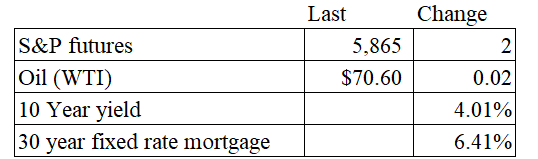
Stocks are flattish this morning as earnings continue to come in. Bonds and MBS are up.

San Francisco Fed Chair Mary Daly is open to skipping a rate cut at one of the two remaining Fed meetings this year. “It’s clear that the direction of change is down,” but added “one or two cuts was a reasonable thing” provided that the economic data continues as expected. Atlanta Fed Head Raphael Bostic is also open to skipping a meeting.

The December Fed Funds futures still overwhelmingly see two more cuts this year:

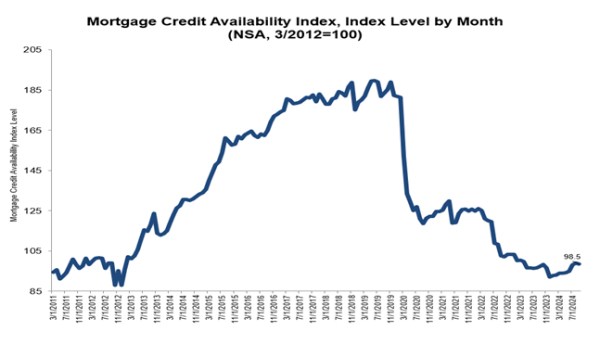
Mortgage credit availability decreased in September, according to the MBA. “Mortgage credit availability tightened slightly in September as lenders remained cautious in this uncertain economic environment,” said Joel Kan, MBA’s Vice President and Deputy Chief Economist. “There was a decline in loan programs for cash-out refinances, jumbo and non-QM loans, including loans that require less than full documentation. Most component indexes decreased over the month, but the government index increased, driven by more offerings of VA streamline refinances.”   
Mortgage applications fell 17% last week as purchases fell 7.2% and refis fell 17%. “ Mortgage rates moved higher for the third consecutive week, with the 30-year fixed rate increasing to 6.52 percent, its highest level since August,” said Joel Kan, MBA’s Vice President and Deputy Chief Economist. “The recent uptick in rates has put a damper on applications. Refinance applications fell 26 percent to their lowest level since August, with comparable drops in both conventional and government refinances. This pushed the refinance share of applications back below 50 percent for the first time in over a month. Furthermore, purchase applications also decreased but notably remain 7 percent higher than a year ago.”

US Bank reported better than expected earnings, although revenues missed. Mortgage origination volume improved markedly, rising 16.7% YOY to $11 billion. They are marking their $215 billion MSR portfolio at 4.9x. Provisions for credit losses increased 8% YOY.

Morning Report: Strong jobs report

Vital Statistics:

Stocks are higher this morning after a strong jobs report. Bonds and MBS are getting slammed.

The port strike has been suspended as the ports and Longshoreman’s union extended their contract through to Jan 15. The issue was almost certainly unhelpful to the Democrats for the upcoming election, so the fight has been tabled until it is over.

The economy added 254,000 jobs in September, according to the Employment Situation Report. This was well above the Street expectations of 132,000. The unemployment rate ticked down to 4.1%. The employment-population ratio ticked up, while the labor force participation rate was flat.

Average hourly earnings rose 4%, which was well above the 3.7% expectation. Overall, it was a strong report.

The early reaction in the bond market was negative, as it gives the Fed more leeway to move cautiously with rate cuts. The 10 year spiked to 3.99% before falling back.

The Fed Funds futures currently see 25 basis points in November and another in December.

The services economy expanded in September, according to the ISM Services Report. “The increase in the Services PMI® in September was driven by boosts of more than 6 percentage points for both the Business Activity and New Orders indexes. The Employment and Supplier Deliveries indexes had mixed results, with a 2.1-percent decrease and 2.5-percent increase, respectively. The Supplier Deliveries Index returned to expansion in September, indicating slower delivery performance. The stronger growth indicated by the index data was generally supported by panelists’ comments; however, concerns over political uncertainty are more prevalent than last month. Pricing of supplies remains an issue with supply chains continuing to stabilize; one respondent voiced concern over potential port labor issues. The interest-rate cut was welcomed; however, labor costs and availability continue to be a concern across most industries.”

Morning Report: Consumer confidence falls on weakening labor outlook

Vital Statistics:

Stocks are flat this morning on no real news. Bonds and MBS are flat as well.

Home prices hit a new record, according to the Case-Shiller Home Price Index. Prices rose 5.0% year-over-year in July, a deceleration from the 5.5% recorded in June. New York City led the charge, followed by Las Vegas and Los Angeles. “We continue to observe outperformance in most low-price tiers in the market on a three- and five-year horizon,” Luke continued. “The low-price tier of Tampa was the best performing market nationally with five-year performance of 88%. The New York market was the best market annually, posting a gain of 8.9%. New York’s low-tier index, which include home values up to $533,000, helped drive that growth with 10.8% annual gains. Over five years, markets such as New York and Atlanta saw low-price-tiered indices outperforming their market by as much as 20% and 18%, respectively. The relative outperformance of low-price-tiered indices has both benefited first-time homebuyers as well as made it more difficult for those looking for a starter home. The opposite is happening in California, which has the most expensive high-price tiers in the nation, all well over $1 million. The rich are getting richer in San Diego, Los Angeles, and San Francisco where their high-price-tiered indices outperformed on a one- and three-year basis.”

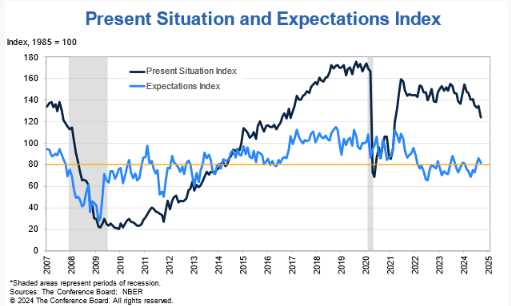
Consumer confidence declined in September, according to the Conference Board. “Consumer confidence dropped in September to near the bottom of the narrow range that has prevailed over the past two years,” said Dana M. Peterson, Chief Economist at The Conference Board. “September’s decline was the largest since August 2021 and all five components of the Index deteriorated. Consumers’ assessments of current business conditions turned negative while views of the current labor market situation softened further. Consumers were also more pessimistic about future labor market conditions and less positive about future business conditions and future income.

The Present Situation Index has moved down markedly over the summer and continues to fall. Inflationary expectations remained elevated at 5.2%.

Mortgage applications rose 11% last week as purchases rose 1.4% and refis rose 20%. “Mortgage applications increased to their highest level since July 2022, boosted by a 20 percent increase in refinance applications after a large increase the prior week. The 30-year fixed rate decreased for the eighth straight week to 6.13 percent, while the FHA rate decreased to 5.99 percent, breaking the psychologically important 6 percent level,” Joel Kan, MBA’s Vice President and Deputy Chief Economist. “As a result of lower rates, week-over-week gains for both conventional and government refinance applications increased sharply. The refinance share of applications is now at 55.7 percent, and while the level of refinance activity is still modest compared to prior refi waves, they now account for the majority of applications, given the seasonal slowdown in purchase activity.”

Morning Report: The Fed meets

Vital Statistics:


Last Change
S&P futures 322 -10.6
Oil (WTI) 41.45 -0.12
10 year government bond yield 0.6%
30 year fixed rate mortgage 2.98%


Stocks are lower this morning as the FOMC meeting begins. Bonds and MBS are flat.


The FOMC meeting begins today, and we will get the announcement tomorrow. The Fed is considering the idea of basically controlling the entire yield curve, which means it essentially sets interest rates by diktat. The Fed is reaching into its historical toolbox and returning to the Truman Administration, where the Fed pushed down rates to limit the government’s borrowing costs. Japan has experimented with the same policy. Note that the rest of the world more or less relies on the 10 year US bond yield to determine the correct price of risk, and taking that number out of the hands of the market is playing with fire. IMO, we have a sovereign debt bubble of epic proportions, with negative yields all over the globe. Like all bubbles, this one will probably blow up too, once inflation returns. I have no idea what it will look like, but I can almost assure you that politicians, the media, and academia will blame the free market and not a bunch of academics sitting in a room trying to manipulate the price of money the way the Soviets manipulated the price of corn, tractors or gasoline.


Durable Goods orders rose 7.3% last month, which was higher than expectations. Core Capital Goods orders (kind of a proxy for business capital expenditures) rose 3.3%.


The MBA reported that the share of loans in forbearance fell for the 6th straight week. Reported loans in forbearance decreased by 6 basis points to 7.74%, or about 3.9 million homeowners. Ginnie loans ticked up, while Fannie / Freddie loans fell.


The Senate GOP has released their $1 trillion coronavirus relief proposal, which will include another $1,200 payment to individuals, more payroll protection money, but a reduction in the additional unemployment benefits from $600 a week to $200 a week. Democrats are complaining about the drop in unemployment benefits. The increased benefits will probably get get reinstated to get enough support to get it through the House. Both parties realize that as we approach the election, it will get harder to pass anything.


New COVID cases are slowing in Arizona, Texas and Florida.


Homebuilder D.R. Horton reported a 10% increase in revenues for the quarter ended June 30. Net orders were up 38% in units. Orders were up 50% year-over-year in May and June. Note D.R. Horton has a lot of Texas exposure, which is seeing an increase in COVID cases.

The Company believes the increase in demand since May has been fueled by increased buyer urgency due to lower interest rates on mortgage loans, the limited supply of homes at affordable price points across most of the Company’s markets, and to some extent the lower levels of home sales from mid-March through early April which caused some pent-up demand.

D.R. Horton stock is up 4% pre-open


We saw similar order growth for MDC Holdings as well. Orders increased 5% in the June quarter and were up 53% in the month of June.

Our results this quarter reflect the favorable industry dynamics in place today, including a low interest rate environment, a lack of available supply and a highly motivated buyer. They also reflect our continued shift in focus to the more affordable segments of the market and the benefits of our build-to-order strategy, which caters to the wants and needs of a large segment of the buying population. We believe that providing homebuyers with flexibility and choice at an affordable price is a winning strategy for our company. Given the favorable market conditions we are experiencing, we now believe that we may achieve as many as 8,000 home deliveries for the 2020 full year, which would be a 15% increase from the prior year.

MDC stock is trading up 6% pre-open.