Morning Report: Morning Report: Fed officials open to slowing the pace of rate reductions

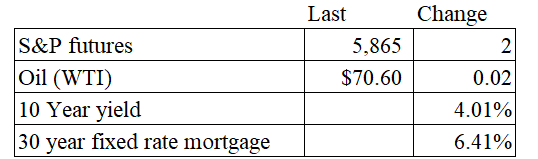
Vital Statistics:

Stocks are flattish this morning as earnings continue to come in. Bonds and MBS are up.

San Francisco Fed Chair Mary Daly is open to skipping a rate cut at one of the two remaining Fed meetings this year. “It’s clear that the direction of change is down,” but added “one or two cuts was a reasonable thing” provided that the economic data continues as expected. Atlanta Fed Head Raphael Bostic is also open to skipping a meeting.

The December Fed Funds futures still overwhelmingly see two more cuts this year:

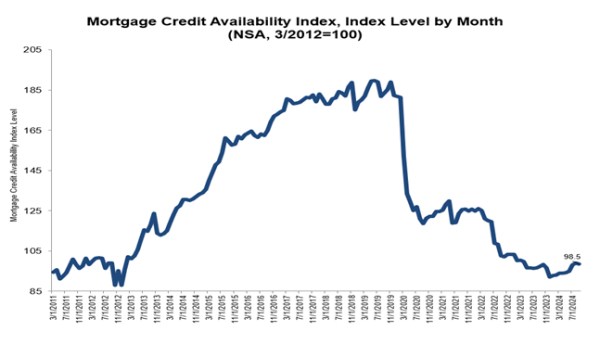
Mortgage credit availability decreased in September, according to the MBA. “Mortgage credit availability tightened slightly in September as lenders remained cautious in this uncertain economic environment,” said Joel Kan, MBA’s Vice President and Deputy Chief Economist. “There was a decline in loan programs for cash-out refinances, jumbo and non-QM loans, including loans that require less than full documentation. Most component indexes decreased over the month, but the government index increased, driven by more offerings of VA streamline refinances.”   
Mortgage applications fell 17% last week as purchases fell 7.2% and refis fell 17%. “ Mortgage rates moved higher for the third consecutive week, with the 30-year fixed rate increasing to 6.52 percent, its highest level since August,” said Joel Kan, MBA’s Vice President and Deputy Chief Economist. “The recent uptick in rates has put a damper on applications. Refinance applications fell 26 percent to their lowest level since August, with comparable drops in both conventional and government refinances. This pushed the refinance share of applications back below 50 percent for the first time in over a month. Furthermore, purchase applications also decreased but notably remain 7 percent higher than a year ago.”

US Bank reported better than expected earnings, although revenues missed. Mortgage origination volume improved markedly, rising 16.7% YOY to $11 billion. They are marking their $215 billion MSR portfolio at 4.9x. Provisions for credit losses increased 8% YOY.

Morning Report: Strong jobs report

Vital Statistics:

Stocks are higher this morning after a strong jobs report. Bonds and MBS are getting slammed.

The port strike has been suspended as the ports and Longshoreman’s union extended their contract through to Jan 15. The issue was almost certainly unhelpful to the Democrats for the upcoming election, so the fight has been tabled until it is over.

The economy added 254,000 jobs in September, according to the Employment Situation Report. This was well above the Street expectations of 132,000. The unemployment rate ticked down to 4.1%. The employment-population ratio ticked up, while the labor force participation rate was flat.

Average hourly earnings rose 4%, which was well above the 3.7% expectation. Overall, it was a strong report.

The early reaction in the bond market was negative, as it gives the Fed more leeway to move cautiously with rate cuts. The 10 year spiked to 3.99% before falling back.

The Fed Funds futures currently see 25 basis points in November and another in December.

The services economy expanded in September, according to the ISM Services Report. “The increase in the Services PMI® in September was driven by boosts of more than 6 percentage points for both the Business Activity and New Orders indexes. The Employment and Supplier Deliveries indexes had mixed results, with a 2.1-percent decrease and 2.5-percent increase, respectively. The Supplier Deliveries Index returned to expansion in September, indicating slower delivery performance. The stronger growth indicated by the index data was generally supported by panelists’ comments; however, concerns over political uncertainty are more prevalent than last month. Pricing of supplies remains an issue with supply chains continuing to stabilize; one respondent voiced concern over potential port labor issues. The interest-rate cut was welcomed; however, labor costs and availability continue to be a concern across most industries.”

Morning Report – Hotel California Monetary Policy 12/14/12

Vital Statistics:

  Last Change Percent
S&P Futures  1412.1 0.1 0.01%
Eurostoxx Index 2628.7 1.1 0.04%
Oil (WTI) 86.4 0.5 0.59%
LIBOR 0.308 0.000 0.00%
US Dollar Index (DXY) 79.91 -0.023 -0.03%
10 Year Govt Bond Yield 1.71% -0.02%  
RPX Composite Real Estate Index 191.6 0.4  

Stock index futures are flat after a benign CPI report.  Of course the Fed explicitly told us that until unemployment drops below 6.5%, they do not care what inflation does. Industrial Production rebounded in November, and Capacity Utilization rose. Bonds and MBS are up small.

Markit’s flash Purchasing Manager’s Index is generally upbeat and shows US manufacturing rebounding in December after reaching post-crisis lows in Aug and Sep. There has been some concern that Q4’s GDP numbers have been goosed by an inventory build, which means we are borrowing growth from next quarter.  FWIW, the report does not bear that out as it shows inventories are falling. The report notes employment is picking up in the manufacturing sector as well.  

CoreLogic’s December Market Pulse is reasonably optimistic on housing.  Punch Line:  Residential Real Estate is finally contributing to economic growth instead of being a drag. While residential real estate is not a massive driver of the economy, it usually is the first to recover after a recession and makes its largest contributions early in the economic cycle. It is the piece of the puzzle that allows us to shift from first to second gear.  

The Man With The Tan – Angelo Mozilo has no regrets about how he ran Countrywide and only agreed to a $67.5 million settlement to protect his children.  (BTW, it looks like Bank of America paid the lion’s share of that) You can read his entire deposition here

Great perspective on the history of banking from my favorite financial author, Jim Grant. “You can have the fear of God or the socialization of risk, but you cannot have both.”

Interview with Dallas Fed President Richard Fisher on the Fed’s “Hotel California” monetary policy.  He lays out the argument that the problem with the economy is not monetary policy, it is regulatory uncertainty out of Washington. He also notes that we are reaching the point of diminishing returns. 

FOMC Minutes

Statement

Economic Projections

Longer Run Policy Considerations

Big Picture:  The Fed is on hold until late 2014. Previously they anticipated low interest rates through mid-2013.   Inflation target is 2%.  The Fed will continue to re-roll its investments into mortgage backed debt.  Operation Twist will continue.

In this new age of transparency, the Fed is giving investors more of a look at their thinking.

More granular stuff:  The Fed has taken down its forecast for GDP growth in 2012 and 2013.  In November, they projected 2.5% – 2.9% GDP growth for 2012 and 3.0% to 3.5% for 2013.  They now expect 2.2% to 2.7% growth for 2012 and 2.8% to 3.2% for 2013.  So, while the general tenor of most observers seems to be more optimistic, the Fed is going in the opposite direction.

However, they took down their unemployment estimates from November, so that is a positive.  What is interesting is that they stated the “normal rate of unemployment” range was 5.2% to 6.0%.  Which means that once unemployment gets in the mid 5-s, the Fed will start tightening. At least that is how I interpret it.  Don’t expect to see long-term unemployment rates similar to the ones Clinton (5.19%) and Bush (5.27%) enjoyed.  6 is the new 5. The Fed is at least paying lip service to the idea of preventing future bubbles.

The Fed introduced an inflation target of 2%.  Note the 10 year is yielding 2%.  Get the message?  Nope, the 10 year rallied hard on the announcement.  Stocks also rallied.