Morning Report: Dovish comments out of Jerome Powell

Vital Statistics:

 LastChange
S&P futures3921-9.4
Oil (WTI)59.02-2.42
10 year government bond yield 1.65%
30 year fixed rate mortgage 3.34%

Stocks are lower this morning as Jerome Powell heads to the Hill for two days of testimony. Bonds and MBS are up.

Bond yields are falling a little on Jerome Powell’s prepared remarks. While he talked about the recovery, he did mention the further work to be done.

Indicators of economic activity and employment have turned up recently. Household spending on goods has risen notably so far this year, although spending on services remains low, especially in sectors that typically require in-person gatherings. The housing sector has more than fully recovered from the downturn, while business investment and manufacturing production have also picked up. As with overall economic activity, conditions in the labor market have recently improved. Employment rose by 379,000 in February, as the leisure and hospitality sector recouped about two-thirds of the jobs it lost in December and January. The recovery has progressed more quickly than generally expected and looks to be strengthening. This is due in significant part to the unprecedented fiscal and monetary policy actions I mentioned, which provided essential support to households, businesses, and communities. However, the sectors of the economy most adversely affected by the resurgence of the virus, and by greater social distancing, remain weak, and the unemployment rate—still elevated at 6.2 percent—underestimates the shortfall, particularly as labor market participation remains notably below pre-pandemic levels. We welcome this progress, but will not lose sight of the millions of Americans who are still hurting, including lower-wage workers in the services sector, African Americans, Hispanics, and other minority groups that have been especially hard hit.

The Biden Administration is working on a $3 trillion infrastructure plan which will include roads and bridges, updating the electrical grid, universal broadband, and tax increases. I don’t think any Republican has voted for a tax increase since the George HW Bush “Read My Lips” moment, so hopes of bipartisanship are probably not going to happen. Regardless, Biden is going to try.

The number of loans in forbearance fell to 5.05%, according to the MBA. “New forbearance requests decreased to their lowest level since last March. Combined with a steady pace of exits, this drop in new requests resulted in a larger decline in the share of loans in forbearance across all investor categories,” said Mike Fratantoni, MBA’s Senior Vice President and Chief Economist. “More than 11 percent of borrowers in forbearance have now exceeded the 12-month mark. We anticipate that servicers will be busy over the next month, with many homeowners opting for the extension for up to 18 months recently made available for federally-backed loans.”  

Speaking of the MBA, it had issued a letter that urged the government to reconsider the investment caps for Fannie and Freddie. That letter is no longer on the MBA’s website. Could be wishful thinking on my part, but maybe the government is re-thinking this directive? Janet Yellen could write a letter to FHFA rescinding the last letter, and it would be business as usual. I think the last thing the government wants to see is credit get restricted.

New Home Sales fell 18% to a seasonally-adjusted annual rate of 775,000. This is 18.2% below January, but 8% above last February. I suspect this is weather-driven, but higher input prices are having an effect as well.

Dallas Fed Head Robert Kaplan said he was one of the members who would vote for a rate hike in 2022.

The forecast has improved, my forecast has improved meaningfully,” said Kaplan, adding that he is expecting 6.5% growth in gross domestic product in 2021, in line with the median committee estimate. Having said that, we’re still in the middle of the pandemic, and I want to see more than a forecast. I want to see actual evidence that that forecast is going to unfold. As we do, and as we make substantial further progress in meeting our dual mandate goals, I for one am going to be an advocate of beginning the process of moving some of these extraordinary monetary measures and doing it sooner rather than later,” he said. “But I need to see outcomes, not just a strong forecast.

Posted on

Morning Report: The economy slips in February

Vital Statistics:

 LastChange
S&P futures39088.4
Oil (WTI)61.22-0.72
10 year government bond yield 1.69%
30 year fixed rate mortgage 3.35%

Stocks are flattish this morning on no real news. Bonds and MBS are up small.

The upcoming week will have a lot of Fed-speak, but should be relatively non-eventful for economic data. We will get personal incomes and spending on Friday, along with the third revision of Q4 GDP.

Congress has allocated money to help struggling landlords who aren’t receiving rent from the their tenants. That said, many landlords are turning down this aid because of the strings attached. “If you have someone who wasn’t upholding their end of the contract…you’re asking the housing provider to sign up for essentially another year of this person being in this unit unable to pay,” said Amanda Gill, government affairs director for the Florida Apartment Association, a landlord trade group.

The Chicago Fed National Activity Index slipped in February, as production and consumption fell. Bad weather was a factor in the production numbers, but shouldn’t have played a part in the consumption area. The idea that we are going to start a rip-roaring recovery in the back half of the year is predicated on spending, particularly stimulus funds. If people use that money to pay bills or reduce debt, the effect will be much smaller.

Existing Home Sales fell 6.6% in February, according to NAR. That said, they still were up 9% on a YOY basis. The median home price came in at $313,000, which was up 16% from a year ago. Inventory stood at just over 1 million homes, which is a 2 month supply.

“Despite the drop in home sales for February – which I would attribute to historically-low inventory – the market is still outperforming pre-pandemic levels,” said Lawrence Yun, NAR’s chief economist.

“I still expect this year’s sales to be ahead of last year’s, and with more COVID-19 vaccinations being distributed and available to larger shares of the population, the nation is on the cusp of returning to a sense of normalcy,” Yun said. “Many Americans have been saving money and there’s a strong possibility that once the country fully reopens, those reserves will be unleashed on the economy.”

Morning Report: The changes to SLR will expire at the end of the month.

Vital Statistics:

 LastChange
S&P futures39082.4
Oil (WTI)59.22-0.72
10 year government bond yield 1.72%
30 year fixed rate mortgage 3.33%

Stocks are flattish this morning on no real news. Bonds and MBS are flat as well.

The Fed is allowing the temporary change to the Supplemental Liquidity Ratio to expire at the end of the month. Part of what has been driving rates higher has been banks getting ahead of this expected change. The punch line is that banks were holding a lot more Treasuries and mortgage backed securities than normal and now that will reverse. I am not sure where we are in this unwinding process, but it sounds like it has to end by the March 31.

So far we haven’t seen more guidance out of the GSEs regarding the investment property cap. Aggregators have been adding big hits to second and investment properties to discourage sellers. The most likely result of this will probably encourage the re-launch of the private label securitization market, particularly in non-guaranteed QM loans, which are loans that conform with QM, but are not guaranteed by the government. Re-launching this market will probably be an easier lift than the standard non-QM loans simply because there is a lot of data regarding prepays and defaults.

wrote about this issue a few years ago, and as far as I can tell, not much has changed since then. The big thing people don’t realize is that there are a lot of issues the buy-side needs resolved in order to bid this paper. It isn’t as simple as the mortgage industry thinks it is. A lot of stuff needs to be ironed out at the SIFMA level regarding the behavior of issuers and servicers. Given there is a need, we will probably see it happen, but this market isn’t about re-materialize overnight.

Morning Report: Bonds down as Fed sees uptick in growth and inflation.

Vital Statistics:

 LastChange
S&P futures3935-28.4
Oil (WTI)63.33-1.32
10 year government bond yield 1.75%
30 year fixed rate mortgage 3.30%

Stocks are lower this morning as rates head higher. Bonds and MBS are down.

The Fed maintained the Fed Funds rate at 0%, however the dot plot showed more voting members seeing rate hikes in 2022. You can see the change between December 2020 and March 2021 below:

The economic projections also changed a touch, with the 2021 GDP estimate increasing pretty markedly from 4.2% to 6.5%. They also see the unemployment rate falling to 4.5%, however inflation is expected to be above the Fed’s target by the end of the year. The forecast for headline PCE inflation is 2.4% and the forecast for core PCE is 2.2%. In December, they saw both inflation numbers at 1.8%, so the minutes will be an interesting read to see what has changed in their thinking.

Bonds initially rallied, sold off, and then rallied again after the meeting, however they are well lower this morning. European and Asian bond yields are up this morning, so perhaps the inflation numbers has investors spooked.

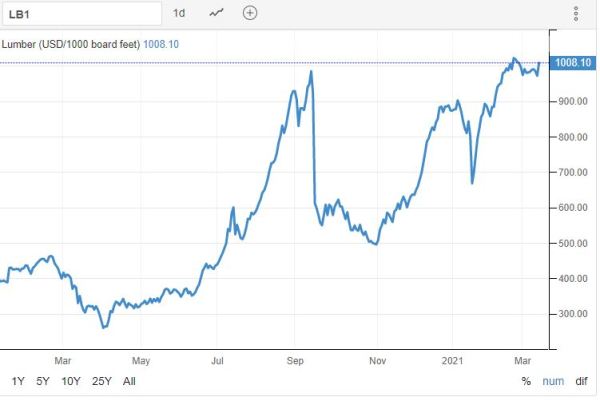
Lumber prices have tripled since last year, which is adding about $24,000 to the price of a house, according to the NAHB. COVID-19 related shutdowns in lumber mills drove the increase. “The elevated price of lumber is adding approximately $24,000 to the price of a new home,” Fowke said. “Though builders continue to see strong buyer traffic, recent increases for material costs and delivery times, particularly for softwood lumber, have depressed builder sentiment this month. Policymakers must address building material supply chain issues to help the economy sustain solid growth in 2021.” Not sure how policymakers i.e. government can address the issue aside from price controls and jawboning companies like Weyerhauser about “price gouging,” neither of which will do much.

I do wonder if the drop in February housing starts was driven by commodity / labor shortages or weather. Regardless, the price of new homes is rising, along with the cost of financing them. This is not going to help matters with the supply / demand imbalance.

Speaking of the supply / demand imbalance, 36% of home sales in February were above list, a record. “This is the strongest seller’s market since at least 2006,” said Redfin Chief Economist Daryl Fairweather. “Buyers outnumber sellers by such a huge margin that many homeowners are staying put because they know how hard it would be to find a place to move to. It seems like the only move-up buyers who are confident enough to list their homes are those who are relocating to a more affordable area where they’ll have an edge on the local competition.” Biden’s proposed $15,000 first time homebuyer tax credit will help but not much.

Initial Jobless Claims rose to 770,000 last week. In order to really see a meaningful recovery, these numbers have to get back to normalcy, which is in the 200,000 – 300,000 range. That said, the unemployment rate can fall despite this since anyone who has been unemployed for 6 or more months doesn’t count in the BLS unemployment numbers. The stat to watch for improvement is the employment-population ratio.Posted onCategories

Morning Report: Housing starts disappoint

Vital Statistics:

 LastChange
S&P futures3938-13.4
Oil (WTI)63.88-0.46
10 year government bond yield 1.66%
30 year fixed rate mortgage 3.27%

Stocks are lower this morning as we await the FOMC decision at 2:00 pm. Bonds and MBS are down again.

The FOMC decision at 2:00 will be potentially market moving based on any changes in the dot plot and economic projections. Jerome Powell will have a press conference afterward.

Housing starts came in much lower than expected in February, according to Census. The seasonally-adjusted annual number was 1.42 million, which was down 10% compared to January, and down 9% year-over-year. Building permits also came in low at 1.68 million, which was down 11% MOM but up 17% YOY. This is another disappointing economic number.

The 10 year bond yield continues to rise due to the Supplemental Liquidity Ratio issue, which is set to expire at the end of the month. While these rules are somewhat arcane, they have become a political football in DC. The main point is that eliminating the SLR relief will force the big banks to reduce the size of their balance sheets, which means they will reduce deposits and sell Treasuries. I am wondering if this will come up in the FOMC release or the press conference.

Mortgage applications fell 2.2% last week as purchases increased 2% while refis fell 4%. “Mortgage application activity was mixed last week, as the run-up in rates continues to reduce incentives for potential refinance borrowers,” said Joel Kan, MBA Associate Vice President of Economic and Industry Forecasting. “The 30-year fixed rate increased to its highest level since June 2020, and all other surveyed rates were either flat or increased.”

Morning Report: Disappointing economic data

Vital Statistics:


  Last Change
S&P futures 3962 6.4
Oil (WTI) 63.88 -1.56
10 year government bond yield   1.60%
30 year fixed rate mortgage   3.26%

Stocks are flattish this morning as we begin the March FOMC meeting. Bonds and MBS are up small.


Retail Sales fell 3% in February after a strong January. The retail sales control group, which excludes volatile items like autos, gas and building products fell 3.5%. While these numbers were a disappointment, January’s numbers were revised upward, which takes out some of the sting.


Another disappointing economic report. Industrial Production fell 2.2% in February, while the Street was looking for a 0.5% gain. Manufacturing Production fell 2.2% and capacity utilization slipped from 75.5% to 73.8%.


New home applications fell 9% in January, however they were up 9.2% from a year ago. “The economy and job market continue to improve, but new home sales activity slowed in February. Builders continue to be confronted with rising input costs and a lack of available lots, causing them to slow production,” said Joel Kan, MBA Associate Vice President of Economic and Industry Forecasting. “Applications for new home purchase mortgages decreased last month but remained over 9 percent higher than a year ago, and MBA’s estimate of new home sales, at 748,000 units, was at its slowest annual pace since May 2020. After seven consecutive months of a strong 800,000-unit sales pace, supply and demand imbalances are likely creating bottlenecks.”


5.8% of all mortgages were at least 30 days delinquent in December, according to data from CoreLogic. This is up 2.2 percentage points from a year ago. The worst states for delinquencies are the Deep South and the Mid-Atlantic. Louisiana, Mississippi, NY, NJ, and Maryland were the top 5 states. Below is a chart of delinquencies. Foreclosures are being held down due to government actions, so those numbers will definitely be going up once the restrictions are lifted.


The number of loans in forbearance fell to 5.14% from 5.2% a week ago. “One year after the onset of the pandemic, many homeowners are approaching 12 months in their forbearance plan,” said MBA Chief Economist Mike Fratantoni. “That is likely why call volume to servicers picked up in the prior week to the highest level since last April, and forbearance exits increased to their highest level since January. With new forbearance requests unchanged, the share of loans in forbearance decreased again. Homeowners with federally backed loans have access to up to 18 months of forbearance, but they need to contact their servicer to receive this additional relief.”

Morning Report: FOMC week

Vital Statistics:


  Last Change
S&P futures 3937 -1.4
Oil (WTI) 64.88 -0.76
10 year government bond yield   1.62%
30 year fixed rate mortgage   3.27%

Stocks are flattish this morning on no real news. Bonds and MBS are flat.


The big event this week will be the FOMC meeting on Tuesday and Wednesday. While no one expects to see any change in policy, a lot of attention will be drawn to the dot plot and whether we see an increase in the number of members seeing rate increases in 2023. We will also get a fresh set of economic forecasts, and economists are taking up their numbers for this year. While I won’t be surprised to see the Fed take up GDP estimates, I am more interested to see whether they take up inflation estimates.

Jerome Powell will hold another press conference, and I am curious as to whether he will discuss the effect that the supplemental liquidity ratio is having on longer-term rates, or whether the business press asks about it.


Tappable equity, or the amount of home equity that could be converted into a cash-out refinance, reached a record of $7.3 trillion at the end of 2020. This works out to be about $158,000 per homeowner. “This past year has been one of significant home price growth, to say the least,” Walden said. “But it has also occurred in a market in which the word ‘unprecedented’ has likely been used more over that same period than perhaps ever in history. Nevertheless, that growth has brought the levels of equity available to American homeowners with mortgages to…well, unprecedented levels.”

This stat is important, because it illustrates how cash-out refinances, particularly debt consolidation refis, will increase in importance as rates rise. Even if the new rate is more or less the same, if the borrower can repay credit card debt that costs in the teens with a 30 year fixed rate mortgage at 3.5%, it still makes sense to do. Don’t forget that 30 year to 15 year refis will also be popular with rates down here. There will still be plenty of business to be done.

Given the supply / demand imbalance for available homes, expect to see home prices continue to rise. I do wonder however if the new Fannie restrictions on investment and second homes affects pricing in certain areas.


Higher input prices will be driving up the price of new homes. Lumber prices are trading around $1,000, and skilled labor wages are on the rise as well. This will affect affordability issues.


Morning Report: Yields rise on hot inflation numbers

Vital Statistics:


  Last Change
S&P futures 3913 -14.4
Oil (WTI) 65.82 -0.036
10 year government bond yield   1.60%
30 year fixed rate mortgage   3.2%

Stocks are lower this morning on no real news. Bonds and MBS are down.


The stimulus bill is signed and checks could start hitting bank accounts as early as this weekend.


Still nothing as far as guidance out of Fannie and Freddie regarding exactly how the investment limits are going to work. The MBA is supposedly aware and concerned, but that is about it. Note that the last time Fannie and Fred introduced a massive policy change (the adverse market fee), they ended up delaying it a few months so lenders could clear out their pipelines.


Unfortunately, Fan and Fred interpret the directive differently, and I am hearing that even different reps in the same company are giving different advice.


The Producer Price Index rose 0.5% MOM and 2.8% YOY, which is much higher than the Fed’s 2% inflation target. Ex-food, energy and trade services, it rose 0.2% MOM and 2.2% YOY. While one print of the PPI doesn’t mean inflation is back, bonds don’t like it and yields are up accordingly.


Foreclosure filings rose 16% MOM, but are down 77% from a year ago. This is a completely artificial number however due to foreclosure moratoriums. “Extensions to the federal government’s foreclosure moratorium and CARES Act mortgage forbearance program continue to keep foreclosure activity historically low,” said Rick Sharga, executive vice president of RealtyTrac, an ATTOM Data Solutions company. “These government actions, and the efforts of lenders and mortgage servicing companies, have helped millions of homeowners avoid foreclosure during a year-long global pandemic and a recession that resulted in 22 million lost jobs.”


Nearly half of all Americans missed a mortgage or rent payment during the pandemic.


The labor market is on the mend, with job openings rising to 6.9 million at the end of January. The quits rate, which tends to lead wage increases was stable at 2.3%.

Morning Report: Fannie limits investment / second home purchases

Vital Statistics:


  Last Change
S&P futures 3921 24.4
Oil (WTI) 65.52 1.06
10 year government bond yield   1.51%
30 year fixed rate mortgage   3.19%

Stocks are higher this morning as bonds continue to rally.


Fannie Mae sent out a letter yesterday announcing they will restrict non owner occupied guarantees to 7%. This applies to cash window sales and MBS as of April 1. I am not sure how Fannie plans to enforce this, but it will be something to watch.

This rule change stems from an order to FHFA in the waning days of the Trump Administration, which intended to limit Fannie Mae’s risk. In addition to the 7% NOO cap, it directs Fannie to limit cash window purchases to $1.5 billion per year per lender, and also to limit its high risk loans (generally LTV > 90 / FICO < 680 / DTI > 45). The latter requirement seems to be a direct shot at the HomeReady program.

The original letter gave a Jan 1 2022 date for implementation, however Fannie is interpreting the investment / second home cap as being binding now, hence the short fuse (March 10 announcement, April 1 start). The MBA is gathering input from lenders regarding the changes, and it appears that Fannie is as well. Note the Urban Institute has already issued a white paper that lists the problems with the FHFA directive.

While Urban Institute is mainly concerned with the high risk loan issue since it disproportionately affects minority borrowers, it does also push back against the investment limit. Why does Urban Institute care about landlords? It doesn’t. But, investment property loans are highly profitable for Fan and Fred, and these loans subsidize those higher risk loans that Urban wants to see made.

So, what does this mean for originators? First understand that these edicts stem from a different Administration. The Biden Admin is more sympathetic to Urban Institute’s worldview than the Trump Admin is. Janet Yellen could write a letter to FHFA rescinding the January guidance. FHFA would then tell Fannie and Fred that the limits no longer apply, and it will be business as usual.

Second, given that investment property loans are highly profitable, at least according to Urban’s numbers, someone is going to do them. The most likely outlet is probably non-QM. Interestingly this could alleviate a big issue with non-QM, which was the track record problem. The buy-side has been leery of non-QM securities because they don’t have a history of prepay speeds and delinquencies, which makes valuing them difficult. Introducing garden-variety investment properties into the mix would fix that because there is a ton of data on these loans. That said, the buy-side was not avoiding this paper for that reason only; there are other issues that need to get ironed out at the SIFMA level.

The other likely outcome is that this could jump start the private label securitization market again, and we could see banks begin to bid this paper given its profitability characteristics. On the high-risk loan issue, I imagine FHA will pick up the slack.

My guess is that the Biden Admin will not want to upset the apple cart with the economy in a precarious position and the US suffering a housing shortage. Limiting investment loans will only exacerbate that problem. The issue near-term is that COVID and the stimulus bill are front and center for DC’s attention. That said, since it doesn’t require legislation it does make things easier. Plus nobody in Blue Check Mark Twitter or the New York Times is going to get too bent out of shape if Biden reverses some Trump directive. That makes it easier.


Yesterday’s 10 year bond auction went off without a hitch, which was pretty impressive given that bonds were already up pretty big on the day. The bid-to-cover ratio was up a hair. We have a 30 year bond auction today at 1:00 pm, which will be watched closely.


Initial Jobless Claims fell to 712,000 which is still a dismal number. While everyone loves to focus on the 379,000 print in February, the constant drip of 700,000 + initial jobless claims is a big issue. We used to be around 200,000 pre-COVID, which puts that number into perspective.

Morning Report: JP Morgan calls for 7.3% growth this year

Vital Statistics:


  Last Change
S&P futures 3892 18.4
Oil (WTI) 64.42 0.46
10 year government bond yield   1.55%
30 year fixed rate mortgage   3.19%

Stocks are higher this morning after yesterday’s bond rally. Bonds and MBS are down a touch.


The big event today will be the 10-year bond auction at 1:00 PM. Yesterday’s 3 year auction went well, and stock investors will be focused keenly on the bid-to-cover ratio for today. With tech stock valuations stretched, a rise in rates can pull down valuations quite a bit.


Inflation remains largely unchanged, with the Consumer Price Index rising 0.4% MOM and 1.7% YOY. Ex-food and energy, inflation rose 0.1% MOM and 1.3% YOY. The Fed prefers to focus on the PCE inflation index, but suffice it to say the inflation scare has yet to be included in the numbers.


Mortgage Applications fell 1.3% last week as purchases increased 7% and refis fell 5%. The 30-year fixed mortgage rate climbed to 3.26 percent last week, which is the highest since last July and up 40 basis points since the start of 2021,” said Joel Kan, MBA Associate Vice President of Economic and Industry Forecasting. “Signs of faster economic growth, an improving job market  and increased vaccine distribution are pushing rates higher.”


JP Morgan was out with a note yesterday predicting that the US economy would grow 7.3% this year. That would be the fastest rate of growth since the end of the Korean War. As of the December FOMC meeting, the Fed was predicting 4.2% GDP growth. 7.3% seems quite aggressive to me, but maybe it happens. We will need to see massive job creation for this to play out, and with something like 1/3 of small businesses failing over the last year, this seems like a heavy lift. I suspect the big banks feel pressure to cheerlead the economy, and that is part of the equation as well.


The mortgage credit availability index remained depressed in February. “Credit availability in February was unchanged from January, remaining close to its lowest level since 2014,” said Joel Kan, MBA’s Associate Vice President of Economic and Industry Forecasting. “The housing market is in strong shape heading into the spring, with robust growth in purchase applications, home sales, and new residential construction. Government credit supply has increased in five of the past six months, albeit in small increments, but remains tight by historical standards. This adds another obstacle for many aspiring first-time buyers who are already navigating supply and affordability constraints.”  


Fannie Mae’s Home Purchase Sentiment Index fell 16% YOY despite the improving economy. “As we expected, the HPSI remained relatively flat in February, but underlying data indicate growing job-related optimism among consumers, especially among lower-income and renter groups,” said Doug Duncan, Fannie Mae Senior Vice President and Chief Economist. “With the growing likelihood that lockdown restrictions will continue easing as vaccination efforts ramp up, and with warmer weather on the horizon and another round of fiscal stimulus pending, these two segments of consumers may have good reason to feel more positive about the labor market. This optimism appears to be well-placed, too, given Friday’s jobs report from the Bureau of Labor Statistics, which showed the strongest net gain in payroll employment since October, although the unemployment rate remains quite high by historical standards. However, other components of the index remain well below pre-pandemic levels, so we believe there may still be room for improvement in housing and economic attitudes in the coming months, depending in part on the future path of mortgage rates.”


The National Multifamily Housing Council reported that 80.4% of apartment renters paid rent as of March 6, which is a 4.1% decrease from February. While Texas wasn’t mentioned, I wonder if the ice storm is playing a part here. While Washington is focused squarely on the side of renters, landlords are struggling.