Morning Report: Mark Calabria addresses Fan and Fred changes

Vital Statistics:

 LastChange
S&P futures4,120-6.8
Oil (WTI)61.25-1.37
10 year government bond yield 1.57%
30 year fixed rate mortgage 3.18%

Stocks are lower this morning as overseas cases of COVID-19 increase. Bonds and MBS are up small.

Mortgage applications finally snapped out of their slump and increased for the first time in 6 weeks. Overall applications increased 6.8%, while purchases increased 6% and refis rose 10%.

FHFA Chairman Mark Calabria spoke at the MBA Spring Conference and said that the Preferred Stock Purchase Agreement (the basic governing doc between the GSEs and the government) will need to be amended again.

“I said in January when the PSPA were signed — there needs to be another set of amendments. January really is a bridge,” he told Wells Fargo‘s Kristy Fercho, chair-elect of the Mortgage Bankers Association, at the trade group’s spring conference. “We knew when the January memo was being signed that Fannie would hit the retained earning caps and the sweep would go into place. And so it was absolutely critical that we ended this sweep so we can continue to build capital. Because again, just as it is at Wells or any other financial institution, with Fannie and Freddie, capital really is the binding constraint on the risk and footprint and activities they can take.”

Calabria was asked about the 7% investment cap as well. Here is what he said:

“I obviously wish that we were in a better capital position and had a stronger Fannie and Freddie that could support more of the market, and that’s our objective” Calabria replied. “The reality is there will be some short-run pinch, if you will, on the market, while we try to build a stronger Fannie and Freddie that can support the market. I do want to clarify because I think there’s often some misperceptions out there, and to say, the PSPA are lines of credit, Fannie and Freddie cannot legally knowingly take risk against PSPAs. That would be like if Wells said, ‘Well, we’ve got deposit insurance so who cares.’”

I found this statement surprising since the NOO loans are highly profitable for Fannie Mae and Freddie Mac, so limiting them does nothing to improve their capital position. As Calabria mentioned, the PSPA is a line of credit, and this would be the first time I have seen a creditor unilaterally change a debt covenant in a way that is adverse to the creditor. It is possible he is referring strictly to the high risk stuff (i.e. high LTV / low FICO / >43 DTI) and not the investment properties, but the question was specifically about the 7% cap. But certainly, if the overarching goal here is to get Fannie Mae and Freddie Mac better capitalized, limiting investment property loans goes against that goal.

Morning Report: Lumber prices continue their upward trajectory

Vital Statistics:

 LastChange
S&P futures4,145-10.8
Oil (WTI)63.750.37
10 year government bond yield 1.6%
30 year fixed rate mortgage 3.18%

Stocks are down this morning on overnight weakness in equity markets. Bonds and MBS are down small.

The number of loans in forbearance fell another 16 basis points last week to 4.5% of servicers’ portfolios. Fannie Mae and Freddie Mac loans fell to 2.44% while FHA fell to 6.16%.

Given the investment limits on non-owner occupied loans, non-QM lenders are stepping in to fill the void. It is important to understand that the GSE’s issue with these loans is philosophical, not risk-related. In other words, these investor loans are profitable – that isn’t the issue. This restriction was put in place by Mark Calabria, the current director of FHFA. This is driven by a belief that the government should be supporting first time homebuyers, and helping people get on the first rung of homeownership. It shouldn’t be in the business of helping professional real estate investors.

That said, the limits on high-risk loans (high LTV / low FICO) are being driven by risk concerns. FWIW, if these limits stay in place, I think the high risk stuff is going to go to FHA, while the investor stuff will go to non-QM.

Western Alliance reported strong first quarter numbers, with EPS up 130% YOY to $1.90 per share. The acquisition of Amerihome closed and the bank intends to portfolio a bunch of Amerihome (and presumably Galton) non-QM loans on its balance sheet. The stock has been on a tear, more than tripling over the past year.

Interesting study results out of Fannie Mae regarding remote work. Respondents reported that remote work improved productivity and reduced operating costs. That said, collaboration did seem to suffer. 79% of lenders prefer a hybrid model, where some employees work remotely and some work on-site.

I think the big takeaway from COVID and remote work is that a big source of friction in the economy – the need for workers to be located near their place of work – is disappearing. This should help drive productivity increases in the economy, which is what drives improving standards of living. If you look at the latest NFIB Small Business Sentiment Survey, finding qualified workers remains the biggest concern for small business. The ability to source workers from all over the country will help alleviate that issue.

Note that productivity has always been notoriously hard to measure, and in these days of “free” internet applications it is 10x worse. How do you put a price on your personal data? It isn’t monetary, but it isn’t worthless either. Since productivity and inflation are intertwined, this will become a more important issue going forward.

Speaking of inflation, consumer products giant Proctor and Gamble announced that it will increase prices in September. It appears that prices of paper products is driving the increases. Kimberly-Clark also announced it will increase prices in June.

Speaking of inflation, lumber continues to spike. It is trading now at $1,347. Users of lumber had delayed orders in hopes that prices would fall, and that didn’t happen. Now everyone is competing for supply.

Morning Report: Apartment financing conditions weaken

Vital Statistics:

 LastChange
S&P futures4,167-8.4
Oil (WTI)63.18-0.04
10 year government bond yield 1.6%
30 year fixed rate mortgage 3.17%

Stocks are flattish this morning as earnings season begins. Bonds and MBS are flat.

We should have a quiet week data-wise, with existing home sales and new home sales the only really important data. We won’t have any Fed speakers since we have a meeting next week.

According to the CDC, at least half of all adults have received at least one COVID-19 shot. Despite this good news, it looks like overseas countries are battling with a resurgence of cases.

The CFPB is taking aim at servicers. “We are very concerned and we’re watching closely…Our supervision team is robustly asking for more data than ever from servicers….We remain very concerned about a potential wave of borrowers seeking assistance after the emergency protections expire later this year, and we will use our regulatory, enforcement, and supervisory authorities to prevent avoidable foreclosures” said the CFPB spokeswoman.

Apartment market conditions appear to be tightening for the first time in a year and a half, according to the National Multifamily Housing Council. Interestingly, the debt financing conditions continued to weaken. I think this refers more to CMBS transactions, not 1-4 unit residential financing which is facing new caps from Fannie Mae. The CMBS market took some lumps last year as COVID-19 negatively affected many commercial real estate tenants. That might explain why Annaly jettisoned its CMBS portfolio recently.

Morning Report: Housing starts jump

Vital Statistics:

 LastChange
S&P futures4,1697.4
Oil (WTI)63.52-0.04
10 year government bond yield 1.58%
30 year fixed rate mortgage 3.16%

Stocks are higher this morning on strong economic numbers out of China. Bonds and MBS are up.

Housing starts jumped 19% MOM and 34% YOY to a seasonally-adjusted annual rate of 1.74 million units. This is certainly a good number, however remember the base case issue – in March of 2020, the economy was shut down, and in February we had a lot of bad weather. Still, it is an encouraging number. In the grand scheme of things, 1.7 million is not that huge of a number; in fact it is just about average.

Note that chart goes back to the 1950s, and the US population has increased substantially since then. If you take the series and divide it by the US population, you get a sense of how much the US has underbuilt over the past decade.

Building Permits rose 30% YOY to 1.72 million. On a month-over-month basis, they rose 2.7%.

As the starts divided by population chart shows, the US needs a lot of housing immediately. Existing home sales data shows a dearth of inventory, and home price appreciation is soaring. In the fourth quarter, just about every homebuilder was reporting fat gross margins, so the builders have every incentive to build, especially since work-from-home has made the exurbs more attractive. The exurbs, with cheaper land will attack some of the affordability issue. Housing will finally do some of the heavy lifting for US economic growth.

Congress is also introducing a bill to encourage more building near transit stops. My guess is this is primarily a messaging bill since local communities really call the shots with zoning and environmental statements, etc. With all of the headaches of building in the cities, with workers heading outwards, along with eviction moratoriums, I can’t see developers getting too excited about this, but you never know.

The Biden Admin is planning a first-time homebuyer bill. It would provide $25,000 cash, usable at closing, for certain first-time homebuyers. It would be available only to first-generation and economically disadvantaged homebuyers. It will be means-tested and will be available only to people who make less than 120% of area median income, and their parents could not have owned a home in the past 3 years (although if the parents lost their home in a foreclosure or short sale, it won’t apply). The base-case grant is $20k, but if you are part of a group that has been “subjected to racial or ethnic prejudice” you get an extra $5k. It sounds like there will be a lot of moving parts here, so it will be interesting to see how much of an impact it really makes.

Consumer Sentiment improved in April, according to the University of Michigan Consumer Sentiment Survey. The improvement was driven more by current economic conditions than it was by future expectations, which is also encouraging.

Morning Report: Freddie Mac introduces new forecasts

Vital Statistics:

 LastChange
S&P futures4,14224.4
Oil (WTI)62.74-0.44
10 year government bond yield 1.60%
30 year fixed rate mortgage 3.20%

Stocks are higher this morning after a strong retail sales number. Bonds and MBS are up.

Freddie Mac released its quarterly forecast yesterday. Freddie sees the 30 year fixed rate will average 3.2% in 2021, while rising throughout the year. It sees a 3.4% fixed rate in the fourth quarter of 2021, and it hitting 3.8% in the fourth quarter of 2022. This will drive refi volumes to $1.8 trillion in 2021 and $800 billion in 2022.

Freddie sees home price appreciation to decrease in 2021, falling to 6.6% from 11% in 2020.

March was the hottest month in housing history, according to Redfin. The median house price rose 17% YOY to $353,000. Housing inventory fell 29% and homes sold in 25 days, with 42% trading above list. I suspect all of the housing data for the next few months should have an asterisk next to it since we are comparing to lockdown months. Still, the rise in prices is undeniable.

Retail Sales rose 9.8% in March, driven by stimulus payments and an easy comparison to February which had a lot of bad weather.

Initial Jobless Claims fell to 576k last week. Nice to see a drop, but we need to get back below 300k to have some semblance of normalcy.

Wells reported first quarter earnings yesterday. Mortgage originations were $51.8 billion, which was up 8% YOY and down about 4% compared to the fourth quarter. Retail originations were 65% of total volumes as Wells seemed to be pulling back from correspondent. That said, revenues did increase on a MOM and YOY basis, driven by higher gain on sale margins and a heavier retail mix.

New Home purchase applications rose 7% MOM and 12% YOY, according to the MBA. That said, new home sales are estimated to fall in March, driven by exceptionally low inventory and higher price / borrowing costs.

Industrial Production rose 1.4% in March, while manufacturing production rose 2.7%. Capacity Utilization increased to 74.4%. These numbers were all below expectations.

Morning Report: 2020 was a record year for mortgage originators

Vital Statistics:

 LastChange
S&P futures4,131-1.4
Oil (WTI)60.940.84
10 year government bond yield 1.63%
30 year fixed rate mortgage 3.22%

Stocks are flat this morning as we kick off earnings season. Bonds and MBS are up.

JP Morgan reported strong earnings this morning which included $5.2 billion in credit reserve releases. These are reserves the bank took for potential losses related to COVID which now look unlikely to materialize. Consumer lending has returned to pre-pandemic levels, and mortgage origination was up 40% YOY. Return on equity was an eye-popping 24%. JPM CEO Jamie Dimon is pretty bullish on the economy.

New Residential is buying Caliber for $1.675 billion in cash. That must explain why Caliber recently increased its investment property LLPAs to 7-9 points. Caliber earned $891 million in pre-tax income in 2020, so New Rez is paying 1.9 times pretax earnings for the company, which originated $80 billion last year. It also gets a $153 billion MSR portfolio.

Caliber is owned by Lone Star Funds, and this sale (along with Amerihome) shows that private equity is ringing the register on mortgage originators. I suspect these funds are going to re-deploy that cash into single-family rental strategies.

The MBA estimates that the industry did $3.8 trillion in mortgage originations last year, which would be the best year ever recorded.

“2020 was a banner year for the mortgage industry, despite the COVID-19 global health crisis essentially shutting down the U.S. economy in March and forcing personnel into remote work environments,” said Marina Walsh, CMB, MBA Vice President of Industry Analysis. “A surge in housing and mortgage demand, record-low mortgage rates and widening credit spreads translated into soaring net production profits that reached their highest levels since the inception of MBA’s annual report in 2008.”

Average production volume was $4.5 billion per originator, up from $2.7 billion in 2019. Average production profit rose to 157 basis points from 58 in 2019. Total production revenues rose to 434 basis points, up from 356 in 2019. Surprisingly, loan production expenses, were more or less flat at $7,578. Productivity might have been the driver, which rose from 2.3 loans per employee to 3.3 loans per employee.

Mortgage applications fell 3.7% last week as purchases fell 1% and refis fell 5%. The 10 year reached 1.7% last week, and now seems to be heading lower, at least for the time being.

The MBA is urging Washington to allow some additional flexibility on the GSE caps for investment properties and high risk loans. MBA Senior Vice President of Legislative and Political Affairs Bill Killmer said a more flexible approach and timeline would allow the GSEs to come into compliance by making necessary adjustments to their automated underwriting systems on a prospective basis. “This solution would alleviate concerns about existing loan pipelines and make lender-specific caps unnecessary,” he said. “Gradual changes also would provide time for private capital alternatives to develop the operational capacity to better serve these market segments.”

Import prices rose 1.2% MOM and 6.9% YOY, while export prices rose 2.1% MOM and 9.1% YOY. The import number was driven by energy, while the export number was driven by agricultural. Take these numbers with a grain of salt; COVID-19 related shutdowns (especially during the heavy lockdown days) are going to produce some strange year-over-year comparisons.

Morning Report: Small Business Optimism Improves

Vital Statistics:

 LastChange
S&P futures4,118-1.4
Oil (WTI)60.140.44
10 year government bond yield 1.66%
30 year fixed rate mortgage 3.27%

Stocks are flattish this morning after good economic news out of China. Bonds and MBS are up small.

The consumer price index rose 0.6% MOM and 2.6% YOY, which was a touch above expectations. Ex-food and energy, it rose 0.3% MOM and 1.6% YOY, which is more or less in line with where it has been the past several years. This reading was a relief to the bond market given that the producer price index was super-hot. Remember, the Fed is targeting an average rate for inflation, so it needs to see inflation above its 2% target for a long time to get the average up. Given that we have seen persistently low inflation since 2008, even with unemployment rates below 4%, the Fed is going to be less trigger-happy raising rates. We have roughly 10 million jobs to get back, and that is the top priority for the Fed.

Small Business Optimism rose 2.4 points to 98.2, according to the NFIB. The most interesting stat from the report is that 42% of business owners reported being unable to find qualified workers to fill open positions, which is a record. From the report:

Thirty four percent have openings for skilled workers (up 1 point) and 19 percent have openings for unskilled labor (up 3 points). Owners are frustrated with mounting unfilled job openings as qualified and willing candidates are scarce. Fifty percent of the job openings in construction are for skilled workers, down 1 point. Fifty-five percent of construction firms reported few or no qualified applicants (down 6 points) and 38 percent cited the shortage of qualified labor as their top business problem (up 3 points).

On the inflation front, 26% of respondents reported increasing average selling prices. Price hikes were most prevalent in wholesale and retail. Overall, improvement in business conditions will be highly dependent on the course of the virus. If we see no more flare-ups and most of the population gets vaccinated over the summer, then we should see a pretty hefty recovery going into the back half of the year.

Loans in forbearance fell again last week, according to the MBA. Total forbearances fell 24 basis points to 4.66% of servicers’ portfolio, or about 2.3 million homeowners. This drop was one of the largest decreases in the survey’s history. The biggest drop was in Ginnie Mae loans, which fell from 6.78% to 6.33%.

Loan delinquencies fell to a 10 month low, according to CoreLogic. 5.6% of loans were at least 30 days down in January 2021, an increase of about 210 basis points from a year ago. 3.1% of mortgages are 120 days plus, but the number in foreclosure is only 0.3%. The low foreclosure number is artificially low due to the foreclosure moratorium, and we will see those numbers jump when it is lifted, probably some time in 2022.

Morning Report: Jerome Powell appears on 60 Minutes

Vital Statistics:

 LastChange
S&P futures4,115-5.4
Oil (WTI)60.471.15
10 year government bond yield 1.67%
30 year fixed rate mortgage 3.27%

Stocks are flattish this morning on no major news. Bonds and MBS are flat.

We kick off earnings season this week, with the big banks starting the show. We will get some important economic data with the Consumer Price Index on Tuesday, Industrial Production on Thursday and Housing starts on Friday.

Fannie Mae and Freddie Mac will stop purchasing loans under the GSE patch starting on July 1. This means they will no longer accept loans with debt-to-income ratios above 43%. This is interesting given that the CFPB has proposed extending the patch to October 2022.

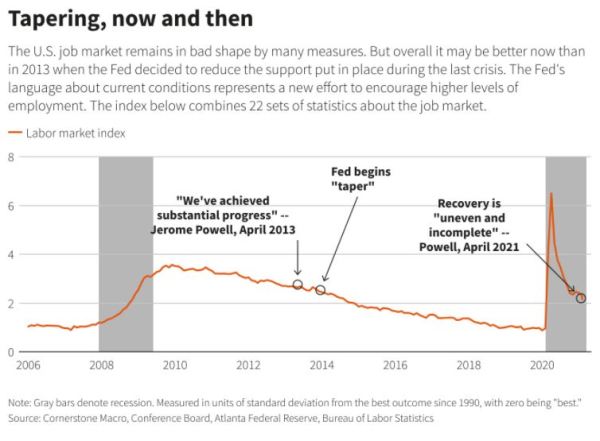
Fed Chairman Jerome Powell went on 60 Minutes yesterday and talked about the state of the economy. Here is the transcript. Nothing was said that could be considered market-moving, although he did discuss the Fed’s thinking regarding inflation as the economy improves:

SCOTT PELLEY: What the Fed has done traditionally is use economic models to predict inflation and then raise interest rates, tap the brake if you will, before inflation happens. Is that what you’re planning on doing?

JEROME POWELL: No, it’s not. And really, what we’ve done is we’ve updated our understanding of the economy and therefore, our policy framework to the way the economy has evolved. The economy has changed. And what we saw in the last couple of cycles is that inflation never really moved up as unemployment went down.

We had 3.5% unemployment, which is a 50-year low for much of the last two years before the pandemic. And inflation didn’t really react much. That’s not the economy we had 30 years ago. That’s the economy we have now. That means that we can afford to wait to see actual inflation appear before we raise interest rates. Now, we don’t want inflation to go up materially above 2% and go back to, you know, the bad, old inflation days that we had when you and I were in college back a long time ago. But at the same time, we do have the ability to wait to see real inflation. And that’s what we plan on doing.

Overall, the Fed is sticking with its base case scenario that the second half of 2021 will be exceptionally strong, perhaps the strongest in 30 years. That said, there are still about 9 million fewer people working than there were pre-pandemic and a lot of small businesses have closed. It will take time for those people to find jobs and new businesses to emerge to replace the closed ones.

Powell has changed his thinking even over the course of his term regarding tapering and getting off the zero bound. The labor market index is roughly at the same place today as it was in 2013 when Powell began urging the Fed to reduce purchases of Treasuries and MBS. As the article notes, we are going to see a spike in inflation simply because prices during the lockdown days of 2020 were artificially low. Of course that doesn’t tell the whole story; supply chain bottlenecks are driving prices higher as well, although those should be temporary. Ultimately people’s perception of inflation is largely driven by prices at the gas pump, and the summer driving season begins soon.

Morning Report: Inflation spikes

Vital Statistics:

 LastChange
S&P futures4,084-4.4
Oil (WTI)59.43-0.45
10 year government bond yield 1.68%
30 year fixed rate mortgage 3.26%

Stocks are flattish this morning after a dull overnight session. Bonds and MBS are down.

Inflation at the wholesale level jumped last month, according to the Producer Price Index. The headline number rose 1% month-over-month and 4.2% year-over-year. Ex-food and energy, it rose 0.7% MOM and 3.1% YOY.

The FOMC minutes from Wednesday mentioned that the early days of COVID presented some unusually weak price readings, which will create exaggerated year-over-year comparisons this year. While the Fed focuses on the Personal Consumption Expenditures index instead of CPI / PPI it appears we are seeing this effect here as well. Regardless, bonds don’t like the number and the 10 year tacked on about 5 basis points of yield this morning.

Fannie Mae sent out a letter yesterday regarding non-owner occupied properties. It said:

Effective June 1, all whole loans secured by investment properties must be purchased against the Investment Property commitments in Pricing & Execution-Whole Loan® (PE-Whole Loan). Loan Delivery will allow whole loans for investment properties to only be delivered against a 30yr or 15yr investment property PE-Whole Loan commitment. If an investment property loan is delivered against another commitment type (e.g. 30-Year Fixed Rate, 30-Year Fixed Rate – 110k Max Loan Amount, etc.) a fatal edit will occur.

Essentially, Fannie will limit its purchases of investment properties (and presumably second homes) by rationing its commitments to people. No idea what pricing will look like or anything like that, but that is the latest out of Fannie. I have heard that Freddie is telling lenders they may have to repurchase excess NOO loans if they over-deliver.

Higher borrowing costs are not deterring demand for second / vacation homes, according to Redfin. “The Palm Springs housing market is incredibly busy, with an influx of vacation-home buyers from Los Angeles and San Francisco,” said local Redfin agent Nisa Sheikh. “Many of them are tech workers who can do their jobs remotely, and they enjoy the weather and lifestyle here in the desert. People don’t want to vacation in a hotel room right now, and many of my buyers are planning to turn their second homes into Airbnb rentals and earn some extra income when they’re not in town.”

Redfin noted that home price appreciation was higher in seasonal towns versus non-seasonal towns. Redfin noted that second-home mortgage locks were up 128% in March, which I think was driven by people trying to get in loans before Fan and Fred impose their NOO limits. Look at the price appreciation: 19%.

Morning Report: Dovish FOMC minutes

Vital Statistics:

 LastChange
S&P futures4,08010.4
Oil (WTI)59.17-0.65
10 year government bond yield 1.66%
30 year fixed rate mortgage 3.28%

Stocks are higher this morning despite another disappointing unemployment filing number. Bonds and MBS are up.

Initial Jobless Claims increased to 744,000 last week. Despite the improvement in the BLS Employment Situation report, this drip, drip, drip of initial claims is worrisome.

The FOMC minutes were pretty dovish. I was interested in what drove the significant upward revision in GDP forecasts, and they primarily based it on vaccination progress, in addition to some economic reports. The stimulus measures were mentioned as well, but essentially the optimism in the economy is based on the progress made in battling COVID.

“Participants observed that the pace of the economic recovery had picked up recently and that the economy continued to show resilience in the face of the pandemic. They noted encouraging developments regarding the pandemic, including significant declines in the number of new cases, hospitalizations, and deaths over the intermeeting period as well as a pickup in the pace of vaccinations. In light of these developments as well as the extent of the recent fiscal policy support, participants significantly revised up their projections for real GDP growth this year compared with the projections they submitted last December. They noted, however, that economic activity and employment were currently well below levels consistent with maximum employment.”

In terms of consumer spending, the Fed noted that consumption had risen this year, however spending on services has been weak. They mentioned the high consumer savings rate and expect that this represents pent-up demand that will be released later in the year as social distancing restrictions are removed.

They noted that the labor market improved recently, however there is a lot of work to do in order to get back to normalcy.

“Participants observed that labor market conditions had improved recently, as payroll employment registered strong gains in February and the unemployment rate fell to 6.2 percent. Even so, payroll employment was about 9.5 million jobs below its pre-pandemic level, and labor market conditions for those in the most disadvantaged communities were viewed as lagging behind those of other households. Moreover, participants noted that employment in the leisure and hospitality sector was still down substantially from its pre-pandemic level despite a sharp rebound in February. Participants generally expected strong job gains to continue over coming months and into the medium term, supported by accommodative fiscal and monetary policies as well as by continued progress on vaccinations, further reopening of sectors most affected by the pandemic, and the associated recovery in economic activity. However, participants noted that the economy was far from achieving the Committee’s broad-based and inclusive goal of maximum employment.”

Finally, they discussed the increased inflation numbers. It turns out that the 2%+ PCE inflation forecast for the rest of the year is being driven primarily by exceptionally weak inflation numbers in the spring and summer of 2020. As things return to normalcy, the year-over-year comparisons will be exaggerated. In other words, a 2.3% or 2.4% PCE reading should be nothing for the bond market to freak out over.

Overall, the minutes were interpreted as dovish, particularly the sentence that the economy was “far from” achieving the goal of maximum employment.

The MBA’s Mortgage Credit Availability Index improved last month, driven by improvement in low FICO and high LTV products. I wonder if this was driven by the announcement by the GSEs that they will begin limiting these products and bankers are trying to get these loans done before the window closes. We are still way below where we were pre-COVID, however.

The Biden Administration is planning to help ease the housing shortage by providing incentives to local governments to permit apartment buildings in areas zoned for single-family residences only. Essentially, if local governments ease zoning restrictions, they will get grants from the Federal government for building schools, etc. This is being trumpeted by the Administration as “all carrot, no stick” however that doesn’t mean that HUD won’t be back suing local governments under the AFFH argument. Ultimately this comes down to how much the local governments need the money.

Speaking of the Biden Admin, he is “willing to negotiate” on the higher corporate tax rate. It sounds like he is getting some push-back from people in his own party on this.