

 Brent Nyitray
 Fairlington Blade
 Let the mutherfuker burn!
 jnc4p
 Kevin S. Willis
 Michigoose
 lmsinca
 markinaustin
 Arcanaut
 novahockey
 quarterback
 ScottC
 yellojkt

Filed under: food | 7 Comments »
Filed under: food | 7 Comments »
Well, it looks like “Occupy Wall Street” is finally getting some media attention. I’ve been following the story a little and I’ve read commentary that they need both a defined message and a goal to get anywhere with their protest, and I’ve also read others stating their lack of those is part of the message itself. I do know it’s spreading to other cities and the number of protesters seems to be growing. Yesterday more than 700 were arrested after a confrontation with police on the Brooklyn Bridge. Protesters are using social media to attract people to the ill defined cause. That sounds familiar.
NEW YORK (AP) — More than 700 protesters demonstrating against corporate greed, global warming and social inequality, among other grievances, were arrested Saturday after they swarmed the Brooklyn Bridge and shut down a lane of traffic for several hours in a tense confrontation with police.
“I don’t think we’re asking for much, just to wake up every morning not worrying whether we can pay the rent, or whether our next meal will be rice and beans again,” Larkins wrote in an email to The Associated Press. “No one is expecting immediate change. I think everyone is just hopeful that people will wake up a bit and realize that the more we speak up, the more the people that do have the authority to make changes in this world listen.”
Nicholas Kristof had a few suggestions for them in the way of demands. It’s doubtful any of this will ever come to fruition or if it does, I’m sure the financial wizards will figure out a way around it. These ideas, while reasonable in my view, seem a little naive coming from someone like Kristof.
*Impose a financial transactions tax. This would be a modest tax on financial trades, modeled on the suggestions of James Tobin, an American economist who won a Nobel Prize. The aim is in part to dampen speculative trading that creates dangerous volatility. Europe is moving toward a financial transactions tax, but the Obama administration is resisting — a reflection of its deference to Wall Street.
*Close the “carried interest” and “founders’ stock” loopholes, which may be the most unconscionable tax breaks in America. They allow our wealthiest citizens to pay very low tax rates by pretending that their labor compensation is a capital gain.
*Protect big banks from themselves. This means moving ahead with Basel III capital requirements and adopting the Volcker Rule to limit banks’ ability to engage in risky and speculative investments. Another sensible proposal, embraced by President Obama and a number of international experts, is the bank tax. This could be based on an institution’s size and leverage, so that bankers could pay for their cleanups — the finance equivalent of a pollution tax.
Much of the sloganeering at “Occupy Wall Street” is pretty silly — but so is the self-righteous sloganeering of Wall Street itself. And if a ragtag band of youthful protesters can help bring a dose of accountability and equity to our financial system, more power to them.
And then there’s this, two of my favorite lefties, David Dayen and Kevin Drum think BofA’s announcement to charge a $5 fee on debit cards is actually a good move for consumers. At least now we see the fees up front, they’re no longer just added into other banking fees or services, and we can choose to not pay it by taking our business elsewhere.
All along, banks have had the option of reforming overdraft fees to make them fairer and more transparent. They had the option of allowing merchants to charge customers for swipe fees or not as they preferred. But they didn’t. That’s because hidden fees, on average, are more lucrative. But hidden or not, we’re all still paying them.
The new fees are annoying, but that’s a feature, not a bug: they’re right up front in black and white, which means that consumers will see them and can be properly outraged (or not) by them. This in turn means that the free market has a chance to actually work: consumers will abandon Bank of America if their fees are too high and force them to charge less. Likewise, other banks will compete openly on the size of their fees. In the end, this competition will force fees down to the lowest possible profitable level, which is exactly what competition is supposed to.

Filed under: Occupy Wall Street | Tagged: BofA, debit card fees, Kristof | 43 Comments »
Just kidding
I mentioned my garden this morning. One of my fall vegetables coming along quite nicely is acorn squash. Maybe you have them in your garden also. Here’s a great recipe.
Roasted Corn Pudding in Acorn Squash
1 small acorn squash (2lb.) cut in half lengthwise and seeded
1 TBS clarified butter or olive oil
1 cup milk (you can substitute coconut milk if you want)
1 egg plus 2 egg whites
1/2 cup fresh corn kernels
1/4 tsp anise seed, chopped (or curry paste if using coconut milk)
1/2 cup chopped scallions
1 pinch of freshly grated nutmeg
1/4 tsp of fine grain sea salt
1/2 cup grated white cheddar cheese
Preheat oven to 375
Rub orange flesh of each half squash with butter/oil. Place cut side up on a baking sheet. You may have to trim the bottom (green side) a little to get the squash to sit flat. Cover with foil and bake for about 40 minutes.
Combine the milk, eggs, corn, anise (or curry paste), 1/2 of the scallions, nutmeg and salt. Fill each squash with filling. There may be some left over so pour into ramekin and bake with squash. Continue baking squash, uncovered, for another 30 to 50 minutes or until tender. Remove from oven and set oven to broil. Sprinkle cheddar cheese on top of squash and broil until cheese is brown and bubbly. Add remaining scallions and serve.
Be creative and mix up the spices, parsley and cilantro both go well with the corn instead of the anise or curry. (lmsinca)
It looks like FairlingtonBlade and I are both obsessed with food today. I promise I’ll get back to politics manana. I have an interesting link that might surprise some of you regarding the move by BofA to charge monthly debit card fees. (lmsinca)
Hope you’re all enjoying your weekend.

Filed under: recipes | Tagged: acorn squash, corn pudding | 12 Comments »
Hi all,
I’m going to try to make a weekly food post to the group. This one involves, well, raw fish. I remember my first experience with sushi. The only thing that I really liked was the shrimp. I later learned that’s because it was cooked. The first time I really enjoyed sushi was my third crack at it, when I got together with a grad student from an old group and we were at a sushi place in San Francisco. It’s slowly grown on me, but came on with a vengeance.
My first experience with raw oysters was during the week that I interviewed for a job in Boston. The interview had gone well and I was out with my best friend from college. I tried the oysters on a whim and loved them. This is odd as my previous experience with oysters had been negative (oyster stew). As Men on Film would say, Hated It.
Many years later, I was down in Costa Rica at a pricey Italian restaurant. I ordered fish carpaccio and loved it. In essence, very thinly sliced raw fish that is marinated in olive oil and citrus. Add in some capers, parsley, pepper and such. I loved it on its own, but it was a bit much for my wife. Then inspiration hit.
One can order Chirashi at a sushi place. Literally, it means scattered rice. The dish consists of a bed of sushi rice with pieces of sashimi placed on top. It’s a household staple as one need not do any complicated rolling. In this case, I prepare the carpaccio and then serve it over a bed of rice. The sauce from the carpaccio (olive oil, citrus, and a few flavors) seeps into the rice. The starch of the rice balances out the fish. Japan meets Italy. It’s a good combination.

Filed under: Uncategorized | 4 Comments »

There are hobbies and then there are pastimes. To me a hobby is when you create something useful or artistic, such as a garden, rebuilding an engine, writing a short story (for fun), knitting, quilting, etc. (you get the idea). A pastime is more along the lines of doing something you enjoy, hiking, reading, watching football, camping and what not.
I work pretty hard all week, as many of us here do, and while I always have chores, grocery shopping or getting together with friends and family, I still try to work on one of my hobbies every weekend. Here in CA we have a long growing season so I’m able to have a garden in the spring, summer and fall. We usually get frost sometime in Jan. or Feb. so whatever’s still out there is generally a goner by then. By March though I’m off and running again.
My husband built me a raised bed garden a few years ago, he’s awesome, and it’s so much easier gardening now because my back kills me if I’m bent over for too long. This year I found one zucchini that got a little too large hiding along the edge of one of the railroad ties.
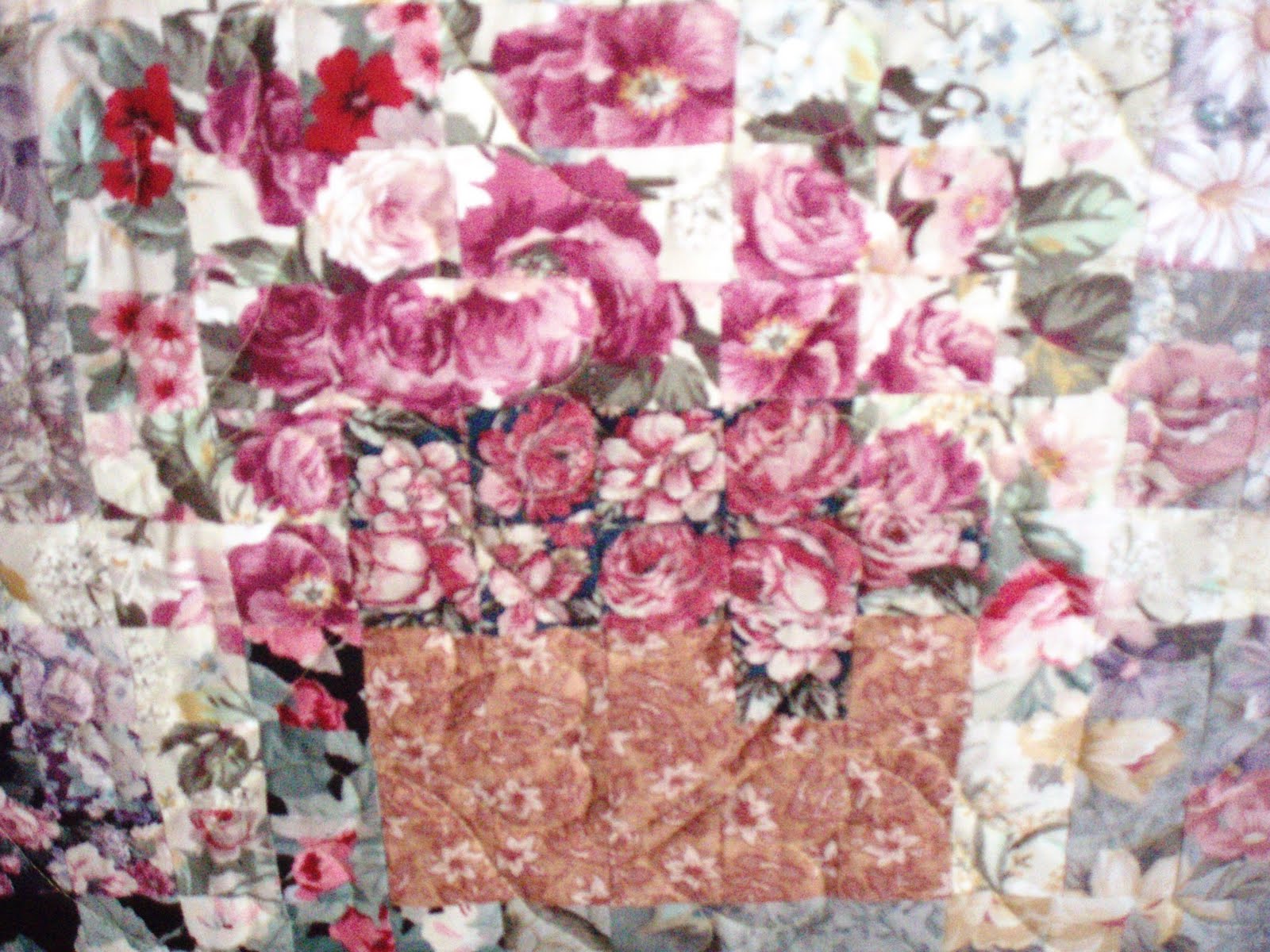
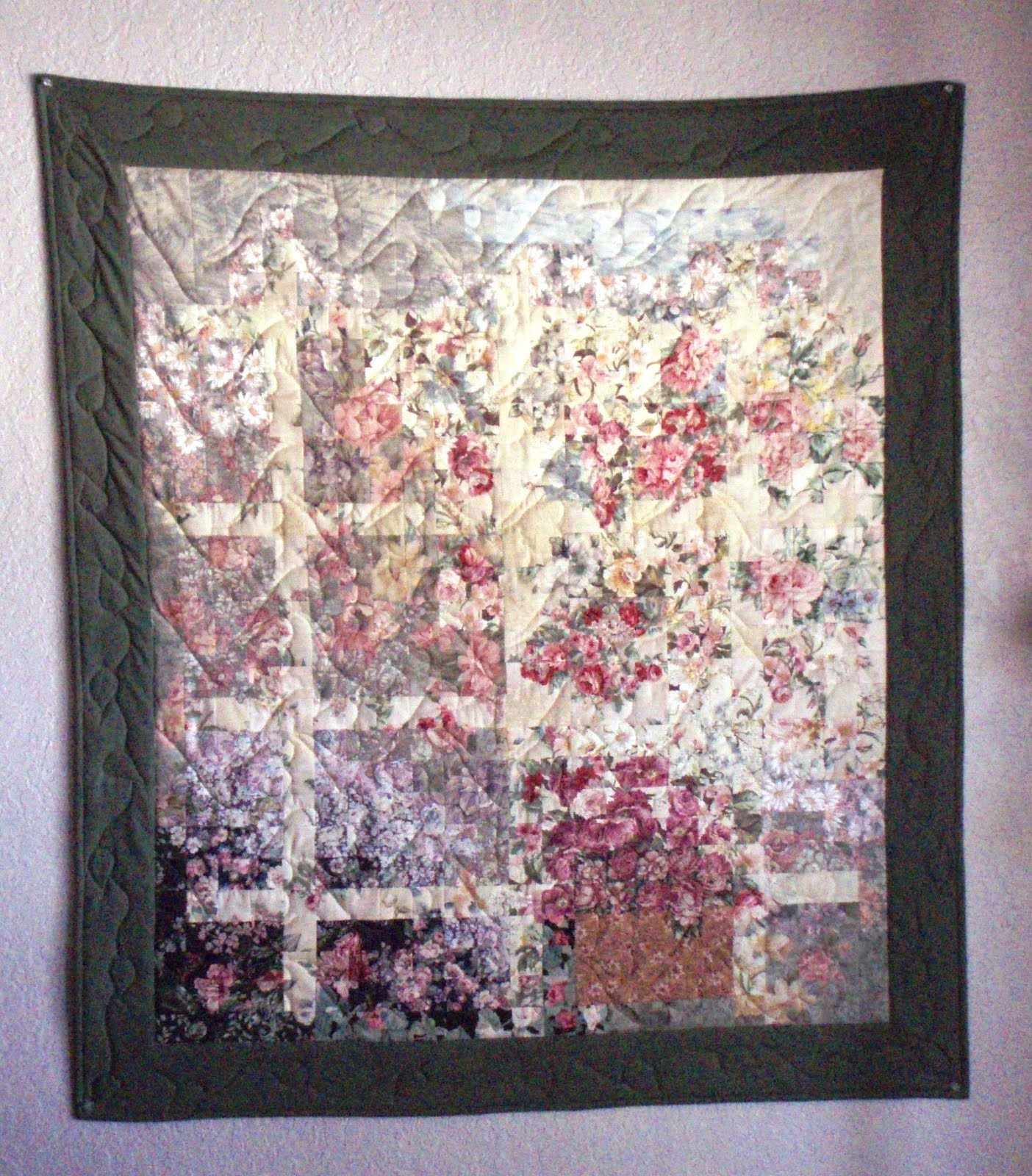 I also create watercolor quilts when I have time. Luckily, we have a room where I can spread out fabrics and such and make a big mess, then just shut the door and ignore it for a week or two. This quilt is made from two inch squares I cut and then pinned to a large piece of batting on the wall. I kept moving the pieces around until I got what I hope is an impressionistic image of a lattice fence, with a flowering vine, and clay pot in the bottom right corner. This one took about six months to complete. As you can see from the pic of the flower pot, it looks better from a distance.
What are your hobbies?

Filed under: Uncategorized | Tagged: gardens, hobbies, quilts | 5 Comments »
Apologies for making this a full blown post. I wanted to comment on shrink’s “Peace be upon you” post, but my iPad will not allow me to post comments for some reason. Anyway…
For the record, and for those of you who might be wondering just what it is shrink (or “-“, as he is now apparently known) is talking about, this thread and this comment in particular is what apparently “wrecks it for everybody” and “drives away the people worth having” (ie shrink himself, or Teilhard de Chardin as he was called before he became “-“).
I leave it to you to decide just what or who “the problem” really is.

Filed under: Uncategorized | 28 Comments »
The problem is: people who need to get after other people, one way or another. They wreck it for everybody. The people they run off are easy to run off and those are almost always the people worth having.

Filed under: Uncategorized | 8 Comments »
You know what’s cool? Not MySpace, which, frankly, I thought sucked way before Facebook opened up a can of whoopass on ’em. I’m glad to see that my earlier judgement of them has proved to be correct. And ugly, impenetrable, non-functional interface and poor design will not succeed indefinitely, just because people can use the site to be “social”.
You know what actually is cool? The Amazon Kindle Fire.
If you’ve never seen Lonely Island’s Like a Boss, you should. Rated R for “Adult Situations”.
Speaking of Lonely Island (I’m sure someone said something about them), I love the SNL skit with Rhianna: Ronnie and Clyde. Don’t ask my why.
Abba interlude: The Dancing Queen Bridal March from Muriel’s Wedding.
For our Muppet fans, Miss Piggy meets Big Bird on the Muppet Show.
I’m outta here! Happy weekend, everybody — KW

Filed under: muppets | Tagged: kindle fire, lonely island, muppets, myspace | 6 Comments »
Nigel Farage (UKIP Leader) doesn’t like the Eurozone. And he doesn’t want a United States of Europe. And he blames the Euro and the whole Eurozone concept for the coming Greek default.
I picked one. I suggest you go to the website and check out on multiple Nigel Farage videos available on YouTube. The Worm as Turned, for example. He’s a bare-knuckles critic of the whole Euro project.

Filed under: euro, eurozone | Tagged: nigel farage | 6 Comments »
I’ve been promising lmsinca a post on MedPAC for quite some time. They’re meeting again next week and will have a session (benefit redesign) that I think will be of more interest. So I’m going to combine the two meetings into one post.
Until then, a little nugget:
Just like the rest of the program, a small percentage of Part D (the drug benefit) beneficiaries account for the majority of program spending. For Part D, 8 percent account for 40 percent of total spending and 20 percent of the total prescriptions. In 2009, on average the “high-cost” beneficiary filled 111 prescriptions over the year. Each prescription cost an average cost of $110. The lower-cost beneficiaries, by comparison, filled 41 prescriptions at a cost of $42 each during the same time period. “High cost” tended to use more brand-name drugs (as opposed to generics).
It’s the same story over and over. There’s a small percentage of beneficiaries who are the cost drivers. Until we figure out how to control costs in this area the rest is rearranging the deck chairs.
Also, Medicare is estimated to reach six percent of GDP by 2040, and the Hospital Insurance Trust Fund will be unable to pay full benefits after 2024. That’s 13 years from now. The growth in expenses means that a beneficiary’s average out-of-pocket costs will increase faster than Social Security benefits.
Update: Slight edit to answer lms’ clarifying question.
Update II: A lot of criticism regarding Part D is directed at the non-interference clause, which prohibits the government from direct negotiation. Repealing this would have a negligible effect, according to CBO. Part of the reason is that it would not be a true negotiation, because the biggest tool the government could use, a restrictive formulary, is left off the table because it’s a political nonstarter. Also, before the MMA was enacted various prescription drug bills were kicking around congress for many years. The vast majority of them — republican and democratic — included this provision. As it stands, drug manufacturer negotiate with the prescription drug plans, who have every incentive to get a good deal. But again, they’re hamstrung by the requirement to have very inclusive formularies. In some class of drugs they’re required by law to include the vast majority of the available prescriptions — in every therapeutic category its at least 2 drugs.
Regarding re-importation, the law gives HHS the authority to do it, provided that the department can certify it can be done safely. FDA is worried about counterfeit drugs, tampered drugs, etc. There’s also the R&D argument. Haven’t spent too much time on this issue, but the NIH looked at it a few years back. Personally, I think it’s a band-aid approach to more systemic problems in the overall health care system.

Filed under: Uncategorized | 7 Comments »

