Got a pumpkin? Stuff it!

Fall is my favorite time of year. Don’t get me wrong. Lazy summer evenings are nice, but DC is too warm for my taste. Fresh tomatoes almost make it worthwhile. Wintertime has its own pleasures, particularly snuggling under the comforter. Spring is a wonderful awakening and I love the arrival of fresh greens and strawberries.

Ah, but fall. It’s relief from that long, hot summer. I can enjoy the clear warm days and love the cool rainy ones. And comfort food comes back on the menu along with those fruits and vegetables that have been growing all year, just waiting for me to happen by.

We went apple picking out in Front Royal last year. It’s a long trip, so we’ll see if we can find something closer this year. One of my favorites is homemade apple sauce. It’s so easy. Good apples, a bit of sugar and spice, heat and plenty of time. This stuff is to the jarred as a summer tomato is to the ones you see in the supermarket. I bought a food mill specifically for the aim of making apple sauce. I used a potato ricer last year. It works, but it’s messy.

I’m looking forward to our annual Thanksgiving bash. That’s a post in and of itself. I tried my first organic turkey last year. It was pretty good, though I think my favorite of the meal was the beets I picked up a MoM’s (My Organic Market) in Del Ray.

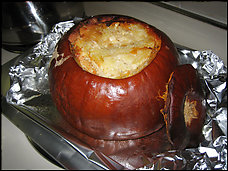
Perhaps the purest fall food for me is the pumpkin. I remember that I used to make an occasional pumpkin pie and have it for breakfast for the better part of a weak. There are other things you can do with it, though. My favorite of these is to stuff it. Here is an absurdly simple recipe a former Post food writer (Kim O’Donnell) clued me into three years ago.

The first time I ever made this, Primo and Secondo were sick and so I had to leave the pumpkin in a warm oven. An interesting thing happened. The skin began to fall away from the pumpkin, so I peeled it and served it all mixed. It’s cheesy, pumpkin goodness. Here are a few of source links:

http://voices.washingtonpost.com/mighty-appetite/2008/11/the_great_sugar_pumpkin.html

http://www.thekitchn.com/thekitchn/fall/autumn-supper-savory-stuffed-pumpkin-099843

http://www.doriegreenspan.com/dorie_greenspan/2008/09/pumpkin-packed-with-bread-and-cheese-a-recipe-in-progress.html

http://blog.streaminggourmet.com/2009/10/25/ruth-reichls-cheesy-bread-in-a-pumpkin/

BB

Stuffed Pumpkin

Ingredients
1 sugar pumpkin, 2 – 3 pounds
4 – 6 oz. of stale bread, cut into ½” chunks
4 – 6 oz. of cheese, cut into chunks
Several cloves of garlic, chopped
½ – 1 cup whole milk
Seasoning (nutmeg or herbs)
Method
Cut a cap off the top of the pumpkin. Cut off any seeds and strings off the cap and scoop out everything from the pumpkin. Give the inside of the pumpkin a good rinse.
Combine the stuffing and, well, stuff that pumpkin. Put the pumpkin in a baking pan (or oven save pot) and place into an oven at 375 degrees. Bake for about an hour or so.
Notes
The seeds are a great snack if you wash them off and roast them.
Go with whatever you like for the cheese. Gruyere works well. I love a good blue cheese in this recipe. I’m guessing that some cooked bacon, broken into pieces, would add additional yumminess.
The recipes that I’ve seen call for using half and half, but I think it works fine with milk. You can also mix the dairy with chicken stock.
I’ve seen nutmeg used for the seasoning, but I prefer to use a dry herb mix such as Herbs de Provence.
I’ve seen different cooking methods to be used. One can go with a higher temperature oven and that’ll add a nice char to the pumpkin. Just keep an eye on it and reduce the temperature as needed.

Sunday Funnies and Liz Warren


Maybe I’m wrong, it sure wouldn’t be the first time, but I think the middle class has finally woken up to the fact that the deck is stacked against them. I hope we’ve realized we don’t need a savior, we’re on our own, that much is clear. But people are finally expressing their anger and frustration outside of the voting booth so maybe someone will get the hint. I’m a little cynical, they just passed another free trade deal that most Americans didn’t want, so who knows what’s really going on. A Liz Warren in the Senate may be able to level the playing field a little, that’s the hope anyway.

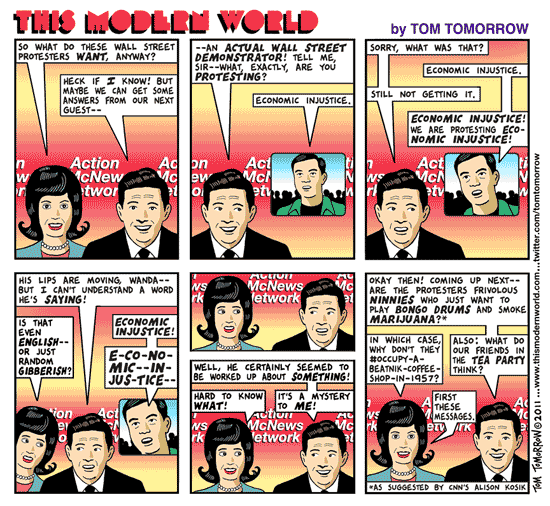
People are frustrated with Washington, Republicans and Democrats alike. Congressional approval hovers below 15% and Obama’s not faring all that well in the polls himself. Whether, as some claim, we believe the so-called liberal media blitz blaming “Wall Street” for our woes or you believe the conservative claim that “government” was largely to blame, it’s tough to deny that we’re having trouble climbing out of this recession. While the economy would undoubtedly have been worse without TARP, “Main Street” isn’t in recovery yet. The Tea Party and the OWS protesters aren’t characters in a children’s book, an Ayn Rand novel or science fiction, they’re real people with real concerns for their future. It’s pretty obvious conservatives are worried about Liz Warren. Scott Brown’s campaign coffers have grown substantially since she announced her Senate run.

She had gained millions of supporters. With her passionate defense of America’s beleaguered middle class, under assault today from seemingly every direction, she had become like a modern-day Mr. Smith, giving voice to regular citizens astonished at the failure of Washington to protect Main Street—and what increasingly appeared to be its abandonment of middle-class America.

If you read this piece in Vanity Fair you’ll discover why she appeals to many of us, and also why she might just be a little different from the usual beltway corporate sponsored politician. I know, I know, corporations are people too, but oddly enough, so are people.

Arrayed against Warren, and today against the very existence of the C.F.P.B., was the full force of what many, most notably Simon Johnson, the M.I.T. professor and former International Monetary Fund chief economist, have called the American financial oligarchy: Wall Street firms and banks supported mainly by Republican members of Congress, but also politicians on the other side of the aisle, along with members of Obama’s own inner circle.

She has enemies in the White House and particularly at Treasury. There’s no love lost between Warren and Geithner, especially after her questions during heated oversight hearings. Chris Dodd wasn’t particularly thrilled having her in charge of setting up the CFPB, he wasn’t all that enthusiastic about bringing transparency or consumer protections to the banking industry in the first place. Does anyone miss Chris Dodd?

Reid asked Warren to head the congressional panel overseeing the $700 billion bailout. The job was vague, with no clear goals, but Warren would turn it into a tough, prosecutorial committee. She did real investigations, grilled government officials, and issued blunt monthly reports demanding more accountability from banks and better returns for the taxpayer. She held public hearings that were televised, asking the questions that many taxpayers wanted asked—and questions that bankers and Treasury officials did not want to answer. Perhaps the most widely watched hearing is the one that took place in September 2009. A video of part of that hearing can still be found on YouTube, under the title “Elizabeth Warren Makes Timmy Geithner Squirm.” It opens with Warren asking the question that was on the minds of many taxpayers: “A.I.G. has received about $70 billion in TARP money, about $100 billion in loans from the Fed. Do you know where the money went?” What followed during the rest of the hearing was the spectacle of the Treasury secretary tripping over his words, his eyes darting around the room as Warren, calm and prosecutorial, kept hammering him with questions.

She wasn’t always a Democrat. Her first big foray into bankruptcy, via a study she conducted to uncover fraud, had a much different result than she expected.

In 1978, Congress had passed a law that made it easier for companies and individuals to declare bankruptcy. Warren decided to investigate the reasons why Americans were ending up in bankruptcy court. “I set out to prove they were all a bunch of cheaters,” she said in a 2007 interview. “I was going to expose these people who were taking advantage of the rest of us.” What she found, after conducting with two colleagues one of the most rigorous bankruptcy studies ever, shook her deeply. The vast majority of those in bankruptcy courts, she discovered, were from hardworking middle-class families, people who lost jobs or had “family breakups” or illnesses that wiped out their savings. “It changed my vision,” she said.

And of course the vigor with which the banking sector and Republicans continue to vilify, demean, and label her will only increase the support and campaign donations she receives in response.

In those speeches, sometimes using slides filled with numbers and graphs, she would, as she did at a speech in Manhattan in early June, outline the impact on middle-class Americans of rising health-care costs, burgeoning debt, and the depletion of not only their savings but also, with the rise in joblessness, their confidence. She spoke of “the Wild West” conditions deregulation had created, where banks could sell virtually any product they wanted, on any terms: mortgages they knew consumers could not pay off, credit cards whose rates they could raise at whim, products that came with a mind-boggling array of penalty fees, many of them not fully disclosed. But it was her final remarks that brought down the standing-room-only house in June. “We cannot run our country without a strong middle class. We cannot run a democracy without a strong middle class,” she said, her voice quavering slightly. “If we hollow out the middle class,” she said, “then the country we know is gone.”

But while audiences applauded her, Warren’s opponents lacerated her. She was called incompetent, power-hungry, ignorant, a media whore, and, in a widely televised moment, a liar, by a Republican congressman during a hearing in May. “It was like she was the Antichrist,” says Roger Beverage, the president of the Oklahoma Bankers Association and one of the few bankers who publicly supported her. She had become the lightning rod for the opposition to the C.F.P.B.

Her critics characterize her as an elitist or a shark in school marms clothing, but while she speaks the language of the middle class, she also knows the secret handshakes and tricks of the trade of the financial elite. It’s no wonder they’ve spent so much money trying to keep her away from the levers of power.

That bluntness was evident in an interview even in late May, when Warren, who learned only in July that she wouldn’t get the job, still believed that Obama might ask her to run the C.F.P.B. “It’s money and power, the only two things we are talking about here,” she said, speaking of the people who were trying to kill the C.F.P.B. “in the back alleys,” as she put it. “There are many who are rich and powerful who say the system works fine as it is,” she continued. “America had been a boom-and-bust economy going into the Great Depression—just over and over and over, fortunes were wiped out, ordinary families were crushed under it. Coming out of the Great Depression we said, We can build a structure that makes us all safer. And notice, it’s from the end of the Great Depression to the 1980s that we built America’s middle class. That’s when we got stronger as a country. That’s when that big, solid, boring, hardworking, play-by-the-rules group in the middle emerged and defined what America was. You still had the ability to become a billionaire, but the center stayed strong and, notice, provided opportunity for growth, opportunity for getting ahead, opportunity that your kids were going to do better than you did. That was what defined America. And then we started, inch by inch, pulling the threads out of that regulatory fabric, starting in the 1980s.”

We’ll see how tough she is, she’ll need it, but I believe she’s got what it takes to both win and make a difference. There will be a lot of eyes on the Senate race in Massachusetts.

Marketing OWS (Sat. Open Thread) unless someone comes up with something better

We could have some fun with this today. Oct. 15th. is the day OWS, or versions of it, goes global so it’s high time we advertise and capitalize it. I love the stock quotes in there.

A few comments from “hedge fund” and “bankster” types:

Citi’s CEO Vikram Pandit said at a breakfast meeting on Wednesday that he’d be happy to meet with protesters, and he added that their sentiments were “completely understandable,” according to reports by Bloomberg and Fortune magazine.

“Trust has been broken between financial institutions and the citizens of the U.S., and that is Wall Street’s job to reach out to Main Street and rebuild that trust,” Pandit said.

What better way to do it than a corporate sponsorship? Doesn’t “Occupy Wall Street By Citigroup” sound more friendly? And wouldn’t America make a faster comeback if corporations would simply pay people to protest against them?

Bill Gross, co-founder of PIMCO, one of the world’s largest investment firms, put his jingle on Twitter on Tuesday: “Class warfare by the 99%? Of course, they’re fighting back after 30 years of being shot at.”

Bank of America /quotes/zigman/190927/quotes/nls/bac BAC -0.48% : “If you like anarchy and chaos, you’ll love the court filings in our foreclosure cases.”

Samuel Adams /quotes/zigman/131652/quotes/nls/sam SAM +2.02% : “Boston beer: Never as harsh as Boston police.”

Netflix /quotes/zigman/87598/quotes/nls/nflx NFLX -0.83% : “We stopped saying ‘Qwikster.’ You stop should stop staying ‘Bankster.’”

United Airlines /quotes/zigman/617037/quotes/nls/ual UAL -0.72% : “We love people with too much baggage.”

General Electric /quotes/zigman/227468/quotes/nls/ge GE +2.34% : “Thanks for paying your taxes so we don’t have to.”

BP /quotes/zigman/247026/quotes/nls/bp BP +2.92% : “Why does there always have to be this Gulf between us?”

Dr. Pepper /quotes/zigman/507521/quotes/nls/dps DPS +0.25% : “Be a Pepper. Don’t be pepper sprayed.”

Blackberry /quotes/zigman/18534/quotes/nls/rimm RIMM +1.52% : “Could you please try texting whatever it is that you’re so mad about, again.”

Sotheby’s /quotes/zigman/241211/quotes/nls/bid BID +0.70% : “Next time you unwashed hippie activists go barging into to one of our fine auctions, buy something.”

Bits & Pieces (Friday Night Buckingham Edition)

Anybody here still watch SNL? I enjoy Kenan Thompson’s bizarre and meta-meta “What’s Up With That” . . . the sketch that always features an unspeaking Bill Hader as Lindsey Buckingham, who never gets to perform. But keeps coming on the show. And eventually, the real Lindsey Buckingham makes an appearance (follow link, I can’t, so it may well be the whole show), but I’m embedding the one where Al Gore shows up as a guest.
Is that enough Lindsey Buckingham? No, it’s not. A very solid live performance of one of my favorite Lindsey Buckingham songs, Street of Dreams:
 

I recommend “D.W. Suite” from Go Insane, though I cannot, myself, verify it (net nanny). Hopefully, it’s the right thing. Here’s a dance rehearsal from a Singapore American School, done to “D.W. Suite”. 
Finally, a link to the actual real stereo track of Mick Fleetwood’s “I Want You Back”, a tune that seems clearly written and mostly sung by Lindsey Buckingham. 
I used to buy a lot of 12″ singles, back in the day. I didn’t get this one, but that’s probably just because I didn’t see it at Peaches Records and Tapes. It’s the 12″ single to “Go Insane”.
I was a fan of the entire Go Insane album. It was Buckingham’s most produced/over-synthesized album, and I loved him for it. 
Finally, the one song of Lindsey Buckingham’s that pretty much everybody on earth has heard, “Holiday Road” from National Lampoon’s Vacation. 
Laters, My Babies — KW

Lee Stranahan on Pigford

If you’ve followed Pigford at all, you might want to read this article by Lee Stranahan reiterating his belief that the Pgiford settlement was mostly a fraud and black farmers with legitimate claims pretty much got screwed by folks exploiting the controversy for their own gain.

Of course, Lee Stranahan works with Andrew Breitbart, so if you may draw whatever conclusions, based on context, that you please.

On BigGovernment.com (linked above), Lee asserts that there is video of the Pigford Attorney publically revealing conspiracy to defraud the federal government. Watch it, and decide for yourself (if you’re interested in this kind of thing). 

Job Creation Ideas

I’m late on a bunch of stuff, but wanted to post this for the good of the order.

“‘Jobs’ are deals between workers and employers, and so ‘creating’ them out of unwilling parties is impossible. The state, though, can outlaw deals, and has,” Deirdre McCloskey is a professor of economics, history, English, and communication at the University of Illinois at Chicago

This, and other job improvement suggestions, available here for your review and discussion.

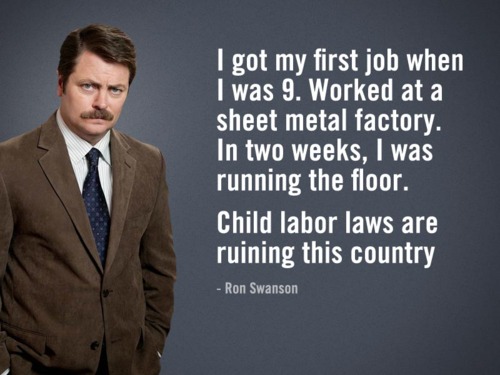
And for a little Friday fun, everyone’s favorite sit-com libertarian Ron Swanson:

Morning Report

Vital Statistics:

Last Change Percent
S&P Futures 1210.4 12.5 1.04%
Eurostoxx Index 2352.5 20.01 0.86%
Oil (WTI) 85.83 1.6 1.90%
US Dollar Index (DXY) 76.869 -0.18901 -0.25%
10 Year Govt Bond Yield 2.24% 0.05%

Economic data this morning: Import Price Index up 13.4% YOY. Advance retail sales up 1.1% for the month of September. August sales were revised higher from flat to +.3%. September’s numbers have generally been much stronger than August. The WSJ has a story this morning discussing economic volatility, and shows that economic volatility has indeed been higher than historical averages. Certainly the stock market has been more volatile, with the VIX index over 30 (even after a gigantic rally). Link: Economy in Full Swing (Watch Your Head) – WSJ

Google reported last night better than expected numbers. The stock is up over 8% premarket. So far, Alcoa and JP Morgan have sold off after their numbers (in spite of “beating” the “analyst estimate”). The initial take from JPM and AA is that Europe is going to be a problem. Last quarter, CEOs were generally constructive on 2H; it will be interesting to hear their views going forward this time around.

Today’s Washington Post discusses the prospect of a double dip recession, (link) and makes the point that the typical drivers of a recession – construction and auto inventories – are already flat on their back, so there isn’t any excess to work off. That is a fair-enough observation, although I would point out that this isn’t the typical inventory-driven recession. This is a recession in the aftermath of an asset bubble, and those recoveries are slower, more fickle, and a lot of the levers that government has to fix things (monetary and fiscal policy) don’t work very well. To give you an idea of how depressed housing is (and why this recession is different), look at the chart below regarding housing starts.

Housing and construction typically leads the economy out of a recession. This time, it is not because there is a massive inventory of unsold homes. In addition, household formation has been depressed as a) immigration has been slowing, and b) unemployed college graduates move back in with their parents. A bottom in housing is a necessary, but not sufficient, condition for an economic rebound.

The WSJ has a depressing piece on how median incomes have fallen during the 2000s. Again, this is typical post-bubble behavior. The equity bubble burst in 2000, and the only thing that provided the economy any real energy was the housing bubble. Although people have the perception that the housing bubble inflated in 05-06, if you look at housing’s historical relationship with incomes, the bubble actually started in 2000, when the equity bubble burst. Guys like Krugman have been advocating inflation as a way out of this mess; so far, the Fed has only succeeded in commodity price inflation. If the “wage” side of the wage / price spiral don’t cooperate, the Fed only succeeds in crimping disposable incomes further, which is a recipe for the dreaded misery index.

Bits & Pieces (Thursday Night Open Mic)

Real-life superhero Phoenix Jones arrested for being over-enthusiastic with pepper spray.

In the mid-80s, Mick Fleetwood of Fleetwood Mac came up with a solo album. I loved the one video released from it, and the song, but it’s almost impossible to find. But, here it is.

For the video shoot, Mick Fleetwood shaved his beard. Probably shouldn’t have done that. Fans of Lindsey Buckingham will note that the video sounds very much like Lindsey Buckingham, both in terms of the singing and the writing.

I had a friend who was a musician during the 80s (he’s still a musician, but the story is from the 80s). He wrote a song called “Wrestling with Girls” that got picked up by local wrestler, Jerry “The King” Lawler. Amazingly, I was able to find it (or a segment featuring it, done on Jerry “The King” Lawler’s 80s talkshow) on YouTube. YouTube, is there anything you can’t do? The song starts at 5:56 . . .

What does this have to do with Mick Fleetwood’s “I Want You Back” sounding more like Lindsey Buckingham than Mick Fleetwood? Well, I had a copy of this song before Lawler decided he wanted to release it as a single. With the exception of the announcer segment, which is clearly Jerry Lawler, the song sounds identical. So imagine my youthful surprise when I heard the version with Jerry Lawler . . . and it was still Steve Cox. I think Jerry Lawler can be heard, off-tune, far in the background, if you listen closely.

A wrestler faking singing a song. Can you imagine it?

If you watch any of the leading in video (I did, for the first time since 1986), you’ll notice Steve was a uber-geek. I don’t remember him being such a big geek. Interesting how our perspectives change over time.

Anyway, for evidence that folks move in different directions as time passes, take a look at some of the traditional native American flute playing Steve was doing about 7 years ago as Voice of Golden Eagle. Same guy, extremely different vibe.

It’s really solid. “That was sunset song.”

— KW

The Cowled One Percent

Tort Reform Shmort Reform

One of the problems in discussing tort reform is that there seems to be a lack of agreement on what we are trying to accomplish. Evaluating the success, or lack thereof, of tort reform varies depending on whether you think the goal is to lower malpractice premiums for physicians (not very good at it), stop frivolous lawsuits (OK at it), lower the cost of health care (not very good at it), prevent outrageous verdicts (good at it but other reform could do this too), line the pockets of insurance companies (pretty good at it), promote justice (bad at it) or all of the above. The evaluation process is further complicated by the many variables that cause health care costs and insurance rates to increase and the near impossibility of isolating the role tort reform and law suits play in such trends. Overall, I think tort reform is red herring…well, unless you’re a medical practice attorney (plaintiff or defendant) then it’s a big deal.

For clarification, I am simply going to discuss tort reform as it applies to medical malpractice claims. There are two reasons for that, one is because I can speak knowledgeably about the topic and the second is that it is the sort of tort reform that is discussed when addressing health care reform. Maybe we can goad Quarterback into posting on class action reform at some point in the future (I think that would be worthwhile). I am also going to focus mostly on Michigan because I have personal experience with tort reform in Michigan and because they actually have adopted pretty comprehensive tort reform measures that have been in place since 1986.

Frivolous Lawsuits

Most attorneys can tell a story or two about dealing with a frivolous case and preventing or deterring them is something that should be pursued. Even if the case is quickly dismissed it will cost a party a couple grand in attorney fees (wait, why am I complaining about this?). In Michigan, one of the ways frivolous medical malpractice suits are deterred is through the requirement that plaintiffs file an Affidavit of Merit (“AOM”) signed by a qualified physician with their complaint. The AOM must contain specific things, but basically it’s a physician saying the claim is not frivolous. I’m not sure this is quite the deterrent tort reform proponents think it is. I knew of at least two law firms that had physicians who actually had offices at law firms. That isn’t to say it doesn’t work at all. Statistics show the number of medical malpractice claims filed have declined over the last 10-20 years. I just think the drop in malpractice suits is due to damage caps, which I’ll get into later, rather than fewer frivolous claims.

Another measure aimed at deterring frivolous claims is a loser pays system. I’m dubious of such a system since I think it promotes settlement more than anything and therefore does not particularly promote justice, a criticism that can be aimed at most tort reform measures. Michigan has a tame version of the loser pays system enforced through a requirement that all cases go to “Case Evaluation”, a form of mediation. Case Evaluation involves each party writing a summary of their case and making a presentation to a 3 member panel of attorneys. The panel values the case and each party can accept or reject the panel’s recommendation. Basically, if you reject the recommendation and it ends up a better deal than an eventual jury verdict, you are on the hook for the other side’s legal fees (possibly in addition to whatever the verdict is). Again, I think this mostly promotes settlement which isn’t inherently bad, but isn’t inherently good either.

Damage Caps

While ostensibly aimed at preventing runaway jury verdicts like the infamous $2.7 million verdict (later reduced to $480,000) in the McDonalds coffee case, damage caps are probably best at reducing the number of lawsuits in general. The reason for this is simple; lawyers, unlike more altruistic professional like doctors (I kid), like to make money. In Michigan, punitive damages are not allowed (goodbye $2.7 million) and non-economic (read pain and suffering) damages are limited at two different levels. The first level is currently $411,300 and the second is $734,500. Basically the first level applies unless you have a brain or spinal injury or lose a limb. To show how this deters filing a case, take a 70 year-old retiree who was relatively healthy, goes to the hospital and dies during surgery. Since she wasn’t working, her damages are basically limited to the lower cap amount plus medical bills. So the most an attorney could get is one-third of $411,300 minus expenses. However, most cases aren’t open and shut so the settlement is likely to be much lower. Add the expenses of an expert witness, depositions etc and that cases take 2 years or so to get to trial and it’s easy to see why an attorney would turn down a perfectly legitimate case (this is where a loser pays system may actually increase litigation expenses since an attorney may take on that case if the other side is scared of having to pay attorney fees). Perversely, the 70 year-old’s case is worth a lot more if she ends up alive and brain damaged, paralyzed or missing a limb. It’s pretty easy to see that while this saves money it doesn’t promote justice which is why some states have found caps to be unconstitutional (see Georgia and Illinois).

Health Care Costs

Most recently, tort reform has been talked about in the context of reducing health care costs. The CBO said the money saved would be a drop in the bucket and I tend to think that is true, particularly with respect to decreasing malpractice premiums and the amount paid out in settlements and verdicts. However, that doesn’t really address the cost of defensive medicine which is nearly impossible to measure. To be blunt, I think defensive medicine is largely nonsense. First, the cost of defensive medicine is almost always derived from polls or surveys of physicians who would most benefit from tort reform so color me skeptical. Second, when a doctor submits a bill for a service to Medicare, Medicaid or a private payer they essentially swear the services were medically necessary. So if a test was performed simply to avoid a lawsuit and it was not medically indicated they are committing fraud. Lastly, I think the motivation of being paid for the test is stronger motivation than the less likely scenario of being sued as a result of not performing a particular test.

Are You Done Yet?

This is already too long so a few more thoughts. First, after Texas passed tort reform, doctors rushed to practice there (wait, I thought they were altruistic) which led to more money being spent on health care, not less. Second, there are Constitutional concerns with Congress telling juries all over the country how much cases are worth. Since, tort reform is generally supported by Republicans and opposed by trial lawyer loving Democrats you get a lovely situation where small government conservatives support this big government intrusion and big government liberals (like me) get to point that fact out (yes, I realize this makes me a hypocrite, too). Lastly, there are other measure out there like joint and several liability and the collateral source rule among others, but they involve more legalese and would make this post even longer. I am happy to discuss those in another post or in the comments.