Morning Report: Homebuilder Confidence Declines

Vital Statistics:

 LastChange
S&P futures3,878-0.25
Oil (WTI)75.74 1.54
10 year government bond yield 3.57%
30 year fixed rate mortgage 6.26%

Stocks are flattish as we head into a week of light trading. Bonds and MBS are down.

The week should be quiet ahead of the holidays, however we will get a lot of housing data with existing home sales, housing starts, and new home sales. We will also get the third revision to last quarter’s GDP and personal incomes / spending.

Speaking of GDP, this is interesting. The Philadelphia Fed took a look at the jobs created in the second quarter of 2022. According to government estimates, the economy added over a million jobs in the April, May and June of this year. Using more comprehensive data, the Philly Fed found that job growth was barely positive – only about 10,000 jobs were added.

This highlights how difficult the Fed’s job is. While the inflation numbers are the motivating factor for Fed policy, the strength of the labor market has been the justification for its hyper-aggressive policy of sequential 75 basis point increases. If the labor market isn’t as tight as the Fed thinks, then it has probably overshot at this point.

That said, when you look at the preponderance of the labor data out there, this Philly estimate looks like the outlier. The labor market is indeed tight when you look at job openings, the unemployment rate and wage increases.

The Freddie Mac Multifamily Apartment Investment Market Index declined 5.4% in the third quarter. “Rising mortgage rates continue to fuel a decline in the Apartment Investment Market Index,” said Steve Guggenmos, vice president of Research & Modeling at Freddie Mac Multifamily. “Property prices and net operating incomes, although positive, are now decelerating, further fueling the decline. Multifamily fundamentals remain consistent and strong, but there’s no question that higher rates are having an effect.”

Homebuilder confidence fell ever single month in 2022, according to the NAHB / Wells Fargo Housing Market Index. In December, the index fell 2 points to 31, which is the lowest since 2012 if you exclude the pandemic-related decline in mid-2020.

“In this high inflation, high mortgage rate environment, builders are struggling to keep housing affordable for home buyers,” said NAHB Chairman Jerry Konter, a home builder and developer from Savannah, Ga. “Our latest survey shows 62% of builders are using incentives to bolster sales, including providing mortgage rate buy-downs, paying points for buyers and offering price reductions. But with construction costs up more than 30% since inflation began to take off at the beginning of the year, there is little room for builders to cut prices. Only 35% of builders reduced homes prices in December, edging down from 36% in November. The average price reduction was 8%, up from 5% or 6% earlier in the year.”

Morning Report: Homeowners feel stuck

Vital Statistics:

 LastChange
S&P futures3,882-40.25
Oil (WTI)73.64-2.54
10 year government bond yield 3.54%
30 year fixed rate mortgage 6.24%


Stocks are lower as they continue their post-Fed sell-off. Bonds and MBS are down.


Retail sales fell 0.6% in November, which was lower than expectations. On a year-over-year basis they rose 6.5%. These numbers are not adjusted for inflation, so if you take into account the 7.1% CPI print from Tuesday, retail sales are more or less down on a year-over-year basis in real terms. Ex-vehicles and gasoline they fell 0.2%. Note October’s numbers were revised downward. This doesn’t bode well for this year’s holiday shopping season.


Industrial Production fell 0.2% in November, according to the Federal Reserve. Manufacturing output fell 0.6% and is up 1.2% compared to a year ago. Capacity Utilization ticked down 0.1% to 79.7%.


These two reports show the economy slowing. The Atlanta Fed’s GDP Now estimate now sees 2.8% growth in the fourth quarter, but that seems high given the other data out there.

This image has an empty alt attribute; its file name is image-15.png


A lot of attention has been placed on the issue of home affordability and how it is impacting potential buyers. This is a fair point, but affordability is also an issue for sellers too, and this helps explain the dearth of home sales. According to one study, many people who would like to move consider themselves stuck.

High home prices are one issue – the home seller would presumably be looking in the same picked-over market that everyone else is in for a new home. Second higher mortgage rates are a problem. So many homeowners who would like to move will probably hunker down with their 3.5% mortgage and wait it out while homebuilding squares the circle.

I imagine this problem is most acute for downsizers – people who’s kids are grown and no longer need a 3,000 square foot house. The other side of the trade – the move up homebuyer – isn’t really there. The move-up homebuyer is a smaller group (less people are having families) and affordability constraints have been a double-whammy.

That said, I think the respondents are too pessimistic, at least on rates. When the study was conducted, the mortgage rate was between 7% and 7.5%. Over 2/3 of respondents though rates would be higher in 12 months. Since then, we have seen mortgage rates fall about a percentage point. As MBS spreads revert to the mean and the Fed wraps up its tightening cycle rates should stay the same or move lower.


Morning Report: The Fed disappoints

Vital Statistics:

 LastChange
S&P futures3,972-60.25
Oil (WTI)76.52-0.84
10 year government bond yield 3.47%
30 year fixed rate mortgage 6.31%

Stocks are lower this morning after the Fed poured cold water on a dovish shift in policy. Bonds and MBS are up.

The Fed raised interest rates 50 basis points as expected, however it increased its forecast for the Fed Funds rate in 2023 by 50 basis points. So instead of the markets seeing another 25 basis points of tightening in 2023, it looks like we will get another 75. The dot plot comparison is below:

The Fed revised downward their estimate for 2023 GDP from 1.2% to 0.5%, and increased its unemployment projection from 4.4% to 4.6%. The core PCE inflation forecast was increased as well, from 3.1% to 3.5%. The bottom line is that in spite of a couple good prints on the consumer price index the Fed became more hawkish, not less.

The press conference was basically non-eventful with Powell going back to his 3 components of inflation explanation: goods, housing and services wages. The goods issue was a function of supply chain bottlenecks from the pandemic, and this appears to be more or less over. The housing issue (which is really rental inflation) will probably begin to fade as we head into mid-2023. The wages part is the driver for the Fed’s decision-making.

The Fed is looking at a historically tight labor market, and is trying to avoid the 1970s wage-price spiral. FWIW, I personally don’t think that is as applicable today, mainly because we don’t have as many workers covered under collective bargaining agreements, which is where those wage increases got cemented in the past. Regardless, this is the driver of the Fed’s thinking.

The reaction in the markets was muted. Stocks sold off, while bonds tried to sell off and failed. The yield curve continues to invert, and is now fully negative across the board with the overnight rate at 3.81% and the 30 year rate at 3.49%. This is even more interesting in the context of quantitative tightening. Lower long term rates made sense when the Fed was building its balance sheet, but it is odd when you consider they are letting it run off. The inversion of the yield curve is back towards where it was in the early 1980s during the deep and painful recessions of 1980-1982.

Now check this out: It is still early, but look at the December 2023 Fed Funds futures implied probabilities: They aren’t buying the Fed’s narrative.

The futures may in fact adjust over the coming days, but at least as of this morning, they see the Fed funds rate at 4.25% – 4.5%, exactly where it is today. Really strange.

The press conference was pretty much uneventful, though you are seeing a narrative being formed politically: “The Fed wants you out of work.” Of course that is a simplistic and unfair framing (most narratives are) but watch this germ begin to manifest itself more clearly in the coming weeks. I wouldn’t be surprised to see more and more pointed rhetoric out of Washington over monetary policy as politicians hammer on the idea that workers, who’s wages have not kept up with inflation for decades are finally getting a raise and the Fed is looking to sacrifice them at the altar of 2% inflation. Incidentally one reported asked if the Fed might reconsider its 2% target and Powell basically said it wouldn’t. Personally, I don’t see the magic in 2%, but it they do.

So, bottom line, people who were hoping for the all-clear signal didn’t get it. That said, with MBS spreads still wide and the 10 year kind of solidly stuck where it is, we should see mortgage rates work lower despite all of this.

Morning Report: Markets await the Fed

Vital Statistics:

 LastChangeS&P futures4,025 -2.25Oil (WTI)76.521.3410 year government bond yield 3.52%30 year fixed rate mortgage 6.45%

Stocks are flat as we await the Fed decision at 2:00 PM. Bonds and MBS are flat.

Today’s Fed decision is one of the biggest ones in the past few years. The inflation numbers are falling, and the yield curve is inverted. The actual decision (50 basis points versus 75) is really not going to be the important part. The dot plot will be the focus, as the Fed Funds are predicting a more dovish path than the Fed was forecasting at the September meeting. Below is the September dot plot, and I put some lines next to the year-end 2023 forecast to give you what the Fed funds futures are currently predicting. The wider the line, the higher the probability, if that makes sense.

IMO, if the Fed’s dot plot confirms the Fed Funds futures, then it will be a signal to the markets that the Fed is more or less done with this tightening cycle (the steepest since the early 80s), and that will be a weight off the shoulders of the stock market and the bond market.

The economic projections will matter less, although the forecast for inflation will carry some weight. We are seeing increased financial stress in the markets, so at some point that will begin to drive the Fed’s thinking, especially if inflation continues to moderate. If the financial stress begins to accelerate, the Fed will probably cut rates since illiquidity is a front-burner issue.

Mortgage applications rose 3.2% last week as purchases increased 4% and refis increased 3%. “Mortgage rates increased slightly after a month of declines, as financial markets reacted to mixed signals regarding inflation and the Federal Reserve’s next policy moves,” said Joel Kan, MBA Vice President and Deputy Chief Economist. “The 30-year fixed rate inched to 6.42 percent, which is still close to the lowest rate in a month. Overall applications increased, driven by increases in purchase and refinance activity. However, with rates more than three percentage points higher than a year ago, both purchase and refinance applications are still well behind last year’s pace.”

Wells Fargo investment raised its weighting on PennyMac to overweight based on falling rates. “We are not expecting a return to the 2020/2021 boom period, but we believe the worst is behind the industry,” he said. “The risk is that we are early and that the interest rate drop reverses or remains stubbornly high.”

Chase has apparently raised its net worth requirement for correspondents from $2.5 million to $10 million.

Morning Report: Green on the screen as the CPI comes in better than expected

Vital Statistics:

 LastChange
S&P futures4,237112.25
Oil (WTI)74.521.34
10 year government bond yield 3.46%
30 year fixed rate mortgage 6.44%

Stocks are rocketing after the consumer price index came in below expectations. Bonds and MBS are up.

Consumer prices rose 0.1% MOM in November, according to the BLS. The Street was looking for a 0.3% increase, so this is very good news. On a YOY basis, prices are up 7.1%. The core rate (which excludes food and energy) rose 0.2% MOM and 6.0% YOY.

Shelter was the big contributor to inflation, while energy was a drag. Here is a chart of the MOM changes for the past year. It definitely looks like inflation is beginning to return to normalcy on a MOM basis

The December Fed meeting begins today, and I have to imagine this will weigh heavily in the discussion. The December 2022 Fed Funds futures reaction so far is somewhat muted with the probability of a 50 basis point hike rising to 79% from 75%.

The December 2023 Fed Funds futures now look like this:

According to this, the most likely scenario is that the Fed raises rates 50 basis points in December and is then done. The next most likely scenario is another 50 tomorrow and another 25 sometime next year and then it is done. We are seeing some handicapping of a rate cut next year.

This may be too optimistic, but what this graph is telling us is that as of tomorrow, the fed is out of the way. Which should be good news for housing and the mortgage market in general.

Don’t take this as a sure thing. The next shoe to drop is the dot plot which will be released tomorrow. If the Fed still sees 5% in the fed funds rate next year, this rally will probably unwind.

Small business optimism improved in November, but remains below its 48 year average. “Going into the holiday season, small business owners are seeing a slight ease in inflation pressures, but prices remain high,” said NFIB Chief Economist Bill Dunkelberg. “The small business economy is recovering as owners manage an ongoing labor shortage, supply chain disruptions, and historic inflation.”

Future business expectations remain recessionary, although they are improving. Sales are down, and price increases are abating. Supply chain issues seem to be improving as well.

Morning Report: Purchase locks fall, but maybe buyers are beginning to come back

Vital Statistics:

 LastChange
S&P futures3,980 11.25
Oil (WTI)71.930.89
10 year government bond yield 3.53%
30 year fixed rate mortgage 6.35%

Stocks are higher this morning as we head into Fed Week. Bonds and MBS are flat.

The week ahead will have two major reports, with the Consumer Price Index tomorrow, and the FOMC meeting on Wednesday.

The Fed funds futures see a 77% chance of a 50 basis point hike and a 23% chance of a 75 basis point hike. Given some of the language from different Fed speakers, we could see a pretty wide range for the 2023 Fed Funds forecast in the dot plot.

Purchase locks fell 22% in November, according to Black Knight. Overall lock volumes fell 21.5% and are down 68.5% compared to a year ago. A combination of the normal seasonal slowdown and affordability issues are making a perfect storm for mortgage bankers. “Mortgage rates pulled back slightly in November based on what the market perceived as good inflation news,” said Scott Happ, president of Optimal Blue, a division of Black Knight. “The spread between mortgage rates and the 10-year Treasury yield narrowed by 13 basis points during the month to 283 basis points in a sign that investors and lenders may be seeking to accelerate the impact of falling rates. But, despite the improvement in rates, lock activity remained subdued.”

Homebuyer demand ticked up slightly as lower rates are beginning to get some potential buyers interested. “This week has been relatively calm and quiet as we approach the end of one of the most volatile years in housing history,” said Redfin Deputy Chief Economist Taylor Marr. “But it’s not over yet. Next Tuesday’s inflation report is the 500-pound gorilla in the room, and the Fed’s press conference the next day will bring us much more clarity on how soon and how quickly we can expect mortgage rates to come down in the new year. Since we expect only a small decline in prices next year, mortgage rates will dictate housing affordability, and as a result, demand and sales, in 2023. If rates continue declining, more buyers may wade back into the market, as they’ll have lower monthly payments.” 

Good read from CNBC reporter Ron Insana on what ails the economy. In his opinion, the US economy suffers from a shortages all over the place, particularly in the labor market. The Fed’s prescription is to increase the unemployment rate to 5% in order to bring the supply and demand imbalance more in line. Will that make the economy stronger? The answer is probably no. He recommends that we ease immigration rules to let in more people to fill the supply gap in the labor market.

It is an interesting prescription. The US has encouraged college at the expense of skilled labor for the past few decades, and now it seems we have a glut of over-educated and indebted people with few tangible skills, and a deficit of people who can weld, wire an electrical panel or swing a hammer. Increasing immigration will do wonders for the latter, but I don’t know what it will do for the former.

Morning Report: Mixed bag of inflation data

Vital Statistics:

 LastChange
S&P futures3,948-15.25
Oil (WTI)71.93 0.43
10 year government bond yield 3.53%
30 year fixed rate mortgage 6.35%

Stocks are lower after the Producer Price Index came in hotter than expected. Bonds and MBS are down.

Inflation at the wholesale level picked up in November, according to the BLS. The Producer Price index rose 0.3% MOM and 7.3% YOY, which was driven primarily by final demand servicers, which is basically wages. The PPI ex-food and energy rose 0.3% MOM and 6.2% YOY. This report is one of the last pieces of data before the Fed meets next week.

Consumer sentiment improved in the early part of December, according to the University of Michigan Consumer Sentiment Index. All three components improved on a MOM basis, but are still lower than a year ago. This probably reflects falling gasoline prices – these consumer confidence indices generally correlate negatively with gas prices.

Inflationary expectations eased again, which is good news for the Fed. Inflation expectations hit a 15 month low, but are still higher than a couple of years ago.

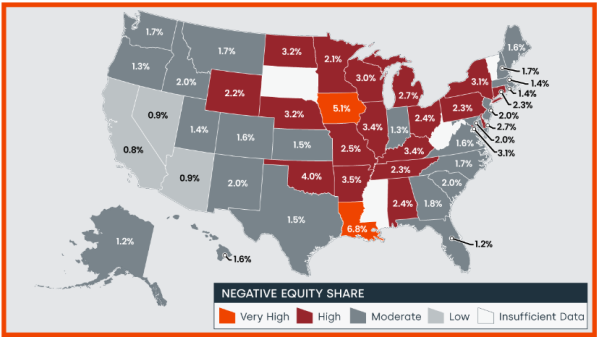
Home equity increased 15.8% YOY in the third quarter, according to data from CoreLogic. This works out to be about a $34,300 gain on the average mortgaged home. Negative equity is still an issue in the Midwest and Northeast.

“At 43.6%, the average U.S. loan-to-value (LTV) ratio is only slightly higher than in the past two quarters and still significantly lower than the 71.3% LTV seen moving into the Great Recession in the first quarter of 2010. Therefore, today’s homeowners are in a much better position to weather the current housing slowdown and a potential recession than they were 12 years ago. Weakening housing demand and the resulting decline in home prices since the spring’s peak reduced annual home equity gains and pushed an additional number of properties underwater in the third quarter. Nevertheless, while these negative impacts are concentrated in Western states such as California, homeowners with a mortgage there still average more than $580,000 in home equity.”

Morning Report: Mortgage credit expands

Vital Statistics:

 LastChange
S&P futures3,95520.25
Oil (WTI)74.001.99
10 year government bond yield 3.50%
30 year fixed rate mortgage 6.33%

Stocks are higher this morning on no real news. Bonds and MBS are down.

Mortgage credit expanded in November, according to the MBA.

“Credit availability increased slightly in November, the first increase in nine months, as lenders continued to navigate a challenging environment brought on by higher rates and a much slower housing market,” said Joel Kan, MBA Vice President and Deputy Chief Economist. “Jumbo credit availability saw a 4 percent increase, as jumbo rates remained more competitive than rates on conforming loans. Lenders are seeking to capture more volume in this space. Most of last month’s increase came from more ARM loan programs being offered.”

Homebuyer sentiment improved in November, according to the Fannie Mae Home Purchase Sentiment Index. “Both consumer homebuying and home-selling sentiment are significantly lower than they were last year, which, in our view, is unsurprising considering mortgage rates have more than doubled and home prices remain elevated,” said Doug Duncan, Fannie Mae Senior Vice President and Chief Economist. “Following eight months of consecutive declines, the HPSI did tick up slightly in November but is essentially unchanged since hitting its all-time low last month. Consumers continue to expect mortgage rates to rise but home prices to decline, a situation that we believe will contribute to a further slowing of home sales in the coming months, as both homebuyers and home-sellers have reason for apprehension. We expect mortgage demand to continue to be curtailed by affordability constraints, while homeowners with significantly lower-than-current mortgage rates may be discouraged from listing their property and potentially taking on a new, much higher mortgage rate.”

Foreclosure activity increased 57% YOY, according to data from Attom. “Foreclosure starts in November nearly doubled from last year’s numbers, but are still just above 80 percent of pre-pandemic levels,” Sharga added. “We may continue to see below-normal foreclosure activity, since unemployment rates are still very low, and mortgage delinquency rates are lower than historical averages.”

Morning Report: Productivity revised upwards

Vital Statistics:

 LastChange
S&P futures3,924-20.25
Oil (WTI)74.87-0.69
10 year government bond yield 3.53%
30 year fixed rate mortgage 6.43%

Stocks are lower this morning on no real news. Bonds and MBS are flat

Third quarter productivity was revised upward from 0.3% to 0.8%, according to the BLS. This was due to a revised 0.5% increase in output and a 0.1% increase in hours worked. Unit labor costs were revised downward from 3.5% to 2.4%. They are up 5.3% over the past four quarters.

Mortgage applications fell 2% last week as purchases fell 3% and refis rose 5%. Refis are still 86% lower than they were last year at this time. “Mortgage applications decreased 2 percent compared to the Thanksgiving holiday-adjusted results from the previous week, even as mortgage rates continued to trend lower,” said Joel Kan, MBA Vice President and Deputy Chief Economist. “Rates decreased for most loan products, with the 30-year fixed declining 8 basis points to 6.41 percent after reaching 7.16 percent in October. The 30-year fixed rate was 73 basis points lower than a month ago – but was still more than three percentage points higher than in December 2021. Additionally, the pace of refinancing remained around 80 percent lower than a year ago.”

Home prices rose 10% in October, according to CoreLogic. This is half the pace of late spring / early summer.

“Following the recent mortgage rate surge above 7%, real estate activity and consumer sentiment regarding the housing market took a nosedive,” said Selma Hepp, interim lead of the Office of the Chief Economist at CoreLogic. “Home price growth continued to approach single digits in October, and it will move in that direction for the rest of the year and into 2023. However,” Hepp continued, “while some housing markets have seen significant recalibration since the spring price peak and are likely to post losses in 2023, further deteriorating for-sale inventory, some relief in mortgage rate increases and relatively positive economic news may help eventually stabilize home prices.” CoreLogic sees home prices rising about 4% next year, although some of the hottest MSAs during COVID will probably see significant declines.

The decline in home prices will take some of the pressure off the inflation numbers, since housing is a key component to the inflation numbers. Rental inflation is coming down, and is probably past the peak, at least according to some market observers.

Morning Report: Home prices continue to decline

Vital Statistics:

 LastChange
S&P futures4,003-0.25
Oil (WTI)76.42-0.43
10 year government bond yield 3.57%
30 year fixed rate mortgage 6.37%

Stocks are flattish this morning on no real news. Bonds and MBS are flat as well.

Home prices fell 2.4% QOQ in November, according to the Clear Capital Home Data Index. It is interesting to see places like the Midwest and Northeast lead while the hottest markets on the West Coast are taking a beating. Take a look at some of the declines below:

You might see YOY declines in places like San Francisco soon. Affordability constraints actually do matter at some point.

Falling home prices have exhumed a demon from the past – negative equity. According to Black Knight, 8% of mortgaged home purchases from 2022 are now underwater. Overall negative equity numbers remain low, however.

Among FHA mortgages originated this year, over 25% are underwater, and 75% have less than 10% equity. According to Black Knight, we are seeing an increase in FHA early payment defaults. A combination of falling home prices and a possible 2023 recession will make servicing GNMA loans a nightmare.

Given affordability problems, home prices should be falling pretty dramatically, but they haven’t at least so far. Blame low inventory for that.

“We’ve now seen four consecutive months of home price pullbacks at the national level,” said Graboske. “But after a couple of significant drops earlier in the summer, the pace of cooling has slowed considerably, with October’s non-seasonally adjusted drop of just 0.43% the smallest decline yet. Though seemingly counterintuitive, the much higher rate environment may be limiting the pace of price corrections due to its dampening effect on inventory inflow and subsequent gridlock in home sale activity. While the median home price is now 3.2% off its June peak – down 1.5% on a seasonally adjusted basis – in a world of interest rates 6.5% and higher, affordability remains perilously close to a 35-year low. Add in the effects of typical seasonality and one might expect a far steeper correction in prices than we have endured so far, but the never-ending inventory shortage has served to counterbalance these other factors. Indeed, the volume of new for-sale listings in October was 19% below the 2017-2019 pre-pandemic average. This marks the largest deficit in six years outside of March and April 2020 when much of the country was in lockdown – with the overall market still more than half a million listings short of what we’d consider ‘normal’ by historical measures.

Falling home prices are affecting builders as well. In November, 36% of builders cut prices to move inventory, and 56% were offering some sort of incentive.

We are also seeing other promotional activity, including offers to pay closing costs, rate buydowns, or free upgrades.

A Reuters poll shows analysts expect home prices to fall about 12% peak-to-trough. Prices peaked in June, and have already fallen about 4% so far this year. The MSAs that had the fastest growth will probably experience the biggest declines, as we are seeing in the Clear Capital data above.