Coding a Better Government

It seems to me what she’s talking about is, though, crowd-sourced infrastructure that dynamically accomplishes many of the goals of government (especially at the local level) with the easier distribution of information and the encouragement of involved citizenship.

Sort of a bottom-up socialism. One that completely decentralizes the entire process of “getting things done” in the community.

Morning Report

Vital Statistics:

  Last Change Percent
S&P Futures  1378.8 8.7 0.63%
Eurostoxx Index 2319.8 35.8 1.57%
Oil (WTI) 104.4 0.8 0.77%
LIBOR 0.466 0.000 0.00%
US Dollar Index (DXY) 79.16 -0.068 -0.09%
10 Year Govt Bond Yield 1.99% 0.01%  
RPX Composite Real Estate Index 173.5 -0.3  


Markets are higher this morning on Apple’s earnings. Hard to believe a half-a-trillion dollar company could move up 10% in a day, but there you go. Bonds and MBS are lower as we await the FOMC decision this afternoon. No one anticipates a change in policy, but the market will focus on clues about QEIII. 


Speaking of the Fed, Krugman has some advice for Ben Bernake. Hint:  He’s not doing enough.


Durable Goods orders fell 4.2% YOY in March, the biggest drop in 3 years. Ex transportation, they fell 1.1%. This was far below expectations. There was also a marked buildup in inventories in the last 6 months, which portends a manufacturing slowdown. There has been nothing in the economic data in the last couple of months that indicates the economy is accelerating – everything points to a deceleration. This is mainly due to overseas weakness. The UK is officially in recession, while Europe and China are slowing.


Mortgage applications fell last week after a huge jump the week before. The 10-year spent all of last week below 2%, so maybe the refi activity is starting to dry up – meaning everyone who can refi at 3.75% has already done so.


Lender Processing Services has released its first look for March foreclosures and delinquencies. The total US loan delinquency rate is just over 7%, which is down almost 9% YOY. The number of properties in foreclosure totaled 2.06MM, the number 90D+ was 1.6MM and 30D+ was 3.5MM, for a total of 5.6MM delinquent. The full report will be released on May 1.


FWIW, Mark Zandi thinks the bottom in real estate is in. Bob Schiller isn’t so sure.

Morning Report

Vital Statistics:


Last

Change

Percent

S&P Futures 

1366.0

3.3

0.24%

Eurostoxx Index

2262.5

17.6

0.79%

Oil (WTI)

103.5

0.4

0.36%

LIBOR

0.466

0.000

0.04%

US Dollar Index (DXY)

79.32

-0.104

-0.13%

10 Year Govt Bond Yield

1.95%

0.02%


RPX Composite Real Estate Index

173.8

0.4


World equity markets are recovering slightly after yesterday’s sell-off on the back of a couple of good bond sales out of Spain and the Netherlands. The Netherlands is another potential worry spot, as Prime Minister Rutte’s ruling coalition collapsed over austerity disagreements. Bonds and MBS are down slightly.


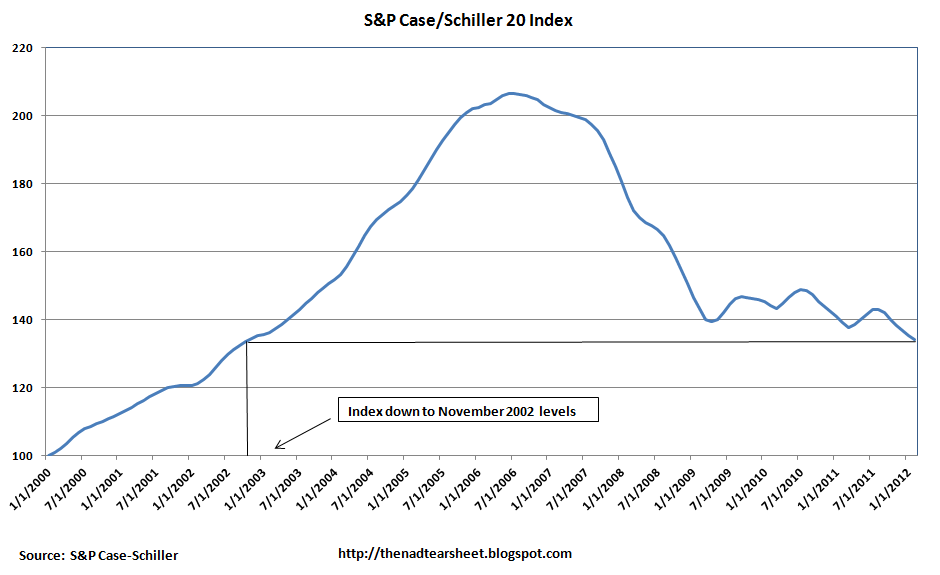
The S&P / Case-Schiller index fell to new post-bubble lows, with the index dropping 3.5% YOY. Five of the 20 MSAs showed increases – Detroit, Denver, Miami, Minneapolis, and Phoenix. Remember, Case-Schiller is a very lagged index, as the number reflects the market in December ’11 – February ’12. We are seeing the correlation between different MSAs break down, which should be good news for the homebuilders. Overall punch line of the report: Prices are still falling, albeit at a slower rate.


Shelia Bair warns of a bond bubble in the US. She raises an interesting question – Are we Europe?  Or Japan? She thinks we are Europe. I think we are Japan, personally.


United Technologies, 3M, and AT&T all reported better than expected earnings. Former highflyer Netflix is down 15% on future growth worries despite a better than expected quarter. Apple reports after the close.


Lawrence Yun of the National Association of Realtors weighs in on the future of Fan and Fred. Punch line:  Privatizing Fan and Fred in the 1970s created an untenable situation, where management took risks to maximize shareholder return with an implicit government backstop. This was an untenable situation, and almost guaranteed to end badly. It did. The question is what to do now. If you fully privatize Fan and Fred, you can expect volatility in mortgage rates and occasional market freezes. Say goodbye to the low-cost 30 year fixed rate mortgage, a uniquely American product that we almost consider our birthright. Pre-privatization, Fan and Fred performed a boring job very well. Perhaps it is time to make it official and fully nationalize them.


Chart:  S&P / Case-Schiller 20-city index:


Morning links

A few links that may be of interest…

Climate alarmist James Lovelock admits to being, well, a bit alarmist.

Voter ID laws? We don’t need no stinkin’ voter ID laws.

A Chinese company markets a new pair of sunglasses by naming them after Helen Keller.

The Obama admin embraces the implied racism of disparate impact laws.

Cool time lapse video of girl growing up, from infant to 12 years old.

Medicare Trustees Report

Here’s all you need to know about the 2012 Medicare Trustees Report, which was “released” in the sense that press releases have been issued and talking points have been distributed. Have not seen the actual report language, but will post a link when I do.

The spin is that the ACA is working and will save money. And then CMS Richard Foster will speak.

Somewhere in the back of the report, Foster will write something to the effect of “these projections are based on current law and will not be viable” long term. He’ll reference the doc fix.

Count on it. So, are those pointing to the savings “wrong”? No. Are they lying bastards? Yes.

Update: Here’s the actual report.

Yep. Foster writes:

“Further, while the Affordable Care Act makes important changes to the Medicare program and substantially improves its financial outlook, there is a strong likelihood that certain of these changes will not be viable in the long range. Specifically, the annual price updates for most categories of non-physician health services will be adjusted downward each year by the growth in economy-wide productivity. The best available evidence indicates that most health care providers cannot improve their productivity to this degree—or even approach such a level—as a result of the labor-intensive nature of these services.
Without unprecedented changes in health care delivery systems and payment mechanisms, the prices paid by Medicare for health services are very likely to fall increasingly short of the costs of providing these services. By the end of the long-range projection period, Medicare prices for hospital, skilled nursing facility, home health, hospice, ambulatory surgical center, diagnostic laboratory, and many other services would be less than half of their level under the prior law.”

He goes on:

For these reasons, the financial projections shown in this report for Medicare do not represent a reasonable expectation for actual program operations in either the short range (as a result of the unsustainable reductions in physician payment rates) or the long range (because of the strong likelihood that the statutory reductions in price updates for most categories of Medicare provider services will not be viable).

Morning Report

Vital Statistics:

Last Change Percent
S&P Futures 1360.7 -14.5 -1.05%
Eurostoxx Index 2254.9 -56.4 -2.44%
Oil (WTI) 102.8 -1.1 -1.07%
LIBOR 0.466 0.000 0.00%
US Dollar Index (DXY) 79.52 0.321 0.41%
10 Year Govt Bond Yield 1.92% -0.04%
RPX Composite Real Estate Index 173.4 0.5

Kind of a soggy tape this morning to go along with our soggy weekend in the Northeast. Political woes in Europe seem to be the main culprit. A split in the Netherlands over austerity measures is causing Dutch credit default swaps to richen. Purchasing Manager Indices in France, Germany, and the Netherlands all came in below expectations. While there have been some worries over Spanish banks, EURIBOR / OIS (a measure of stress in the banking system) is still falling after peaking in early December. So at least one indicator is telling us these fears are overblown.

In the US, stock index futures are down about a percent and bonds are stronger. Bonds have had a remarkable turnaround in the last month, as the 10-year bond futures broke down and fell out of their range in mid-March, only to rally again on euro fears. The contract is now challenging resistance at 144. Incredible turnaround. MBS are up small.

In US earnings, Chevron and Kellogg both disappointed. So far, earnings have been strong overall. Homebuilder DR Horton reported better than expected sales, the question will be whether this was weather-related.

Merger Monday is back, with a couple big deals in the pharma space and a couple of old British titans – Vodafone and Cable and Wireless – are partying like it is 1999.

Speaking of Prince’s apocalyptic party song, a venerable investment bank from that era is re-launching. Smith Barney manager Frank Campanale is bringing back E.F. Hutton. Given that E.F. Hutton is a recognizable name and was not involved in the financial crisis, it makes some sense to resurrect it. One possible way to break up the big banks would be to have them spin out their non-commercial banking units – Citi could spin Smith Barney and Travelers, Chase and JP Morgan could split again, and you would basically re-establish the money center bank. Maybe the foreign banks could get involved, with Credit Suisse spinning out First Boston and DLJ, UBS spinning out PaineWebber, and Deutsche Bank spinning Bankers Trust.

I Recommend WaPo’s ‘Spring Cleaning’ – 10 articles for conversation starters

http://www.washingtonpost.com/opinions/its-time-to-toss-the-all-volunteer-military/2012/04/19/gIQAwFV3TT_story.html?sub=AR

I liked Milbanks’ take on the Cabinet –  except for the Big Four, they don’t do anything.  The Departments may be important, but the Cabinet members are mere figureheads, he claims.  He may have exaggerated (what else is new?), but I got the thrust of it.

Bites & Pieces (Appetizers)

We’re having a small party next Saturday and so I’ve been thinking about the menu and what kind of appetizers to serve.  I’ve asked a few family members for suggestions and all of them requested this one.  It’s not the healthiest dish on the planet but since it’s one of those things I only make on rare occasions it falls into the eat in “Moderation” category.  Below I’ll jot down another recipe for an eggplant dip that’s quite a bit more nutritious although Michi may have already given us a similar one.

When I was growing up the popular appetizer at cocktail parties was Rumaki (chicken liver, water chestnut, bacon) so I guess mine isn’t any worse than that.  My father was the Rumaki King and so my sister and I helped make and serve a lot of it…………………………….yuck.

Fried Artichoke Hearts (serves 4 to 6)

Ingredients:

1 can artichoke hearts, not the marinated variety, you can buy them whole or quartered.  Quartered are more work but go further with a crowd.

3/4 cup flour

salt and garlic powder added to flour (dash of salt, 1 tsp garlic powder)

2 eggs lightly beaten

3/4 to 1 cup panko bread crumbs

oil for frying

2 to 3 tablespoons butter

juice of 1/4 lemon

Parmesan, freshly grated or Kraft

Directions:

Drain artichoke hearts.  Measure the seasoned flour and bread crumbs into individual bowls and likewise the eggs.  First coat the hearts with flour, then dip into the eggs coating thoroughly and last, roll in bread crumbs.  I generally do three or four at a time and use a separate fork for each bowl to keep my fingers from building up with all the sticky ingredients.  Place in a single layer on a plate and cover.  Refrigerate for several hours as they are best fried when really cold.

I generally fry them in a hot pan with just a 1/4″ layer of oil on the bottom and flip them several times until they turn a golden brown, but you can deep fry them it you want.  Drain on paper towels for a few minutes and while they’re draining melt the butter and add lemon juice.  Place the hearts into a serving dish and drizzle with lemon butter and sprinkle the top with Parmesan cheese………………Voila!!!!!

Eggplant Dip (Serves 4 to 6)

Ingredients:

5 large eggplants

5 cloves garlic

Juice of 1 large lemon

1 to 2 tablespoons tahini

5 green onions, chopped

salt and black pepper

Directions:

Heat the oven or grill to 400.  Roast whole eggplants on a baking sheet in the oven or directly on the grill for 40 to 50 minutes until soft and let cool.  Scoop out the insides of the eggplants and put them into a bowl, discard the peels.  Mash the eggplant and then let stand for about 30 minutes.  Discard any accumulated juices.

Add the garlic, lemon juice, tahini and green onions to the eggplant and mix together.  Add salt and pepper.  Keep refrigerated until serving.  Serve with crackers, cut vegetable or bread cubes.

And lastly, this piece from the Nation might clarify a few things for the girls here, or at least the ones who used to be here.  I’m not trying to start another fight please, just thought the girls might find something useful from this perspective.

TRES FAUX MORNING REPORT

Vital Statistics:
Last Change Percent
S&P Futures 1381.3 8.8 0.65%
Eurostoxx Index 2311.0 26 1.1%
Oil (WTI) 103.58 1.31 1.3%
LIBOR 0.466 0.000 0.00%
US Dollar Index (DXY) 79.55 .01 0.00%
10 Year Govt Bond Yield 1.977% .0277%
Odds Texas will sign Pollard unknown
Bloomberg offers that there is a jump in German confidence, US Airways and AMR are closer to merger, and that Microsoft and GE posted good profits.
FT reports that Wall Street has enjoyed its best quarter for bond trading in two years, rounded off with a surge in revenues at Morgan Stanley and Bank of America, in spite of a steep decline in risk-taking and the introduction of new regulations.
The new Economist leads with the digitalisation [their word] of manufacturing.

Revisiting the American Dream, or Dusk in America

A little uplifting reading for you.
National Journal: In Nothing we Trust

It’s long but covers Americans’ increasing indifference to our institutions — government, churches, corporations, etc.