Elinor Ostrom, RIP

Somewhat related to both the discussions of economics and evolution is the work of Elinor Ostrom, who passed away yesterday. Ostrom was awarded the Nobel Prize in Economics in 2009. She was a political scientist who worked on the “tragedy of the commons” and collective action.

The WSJ announcement.

Ostrom’s Nobel page.

Commentary by Ilya Somin at VC.

A post by the evolutionary biologist David Sloan Wilson, whose work I think I’ve referenced here before.

Morning Report 6/13/12

Vital Statistics:

  Last Change Percent
S&P Futures  1314.8 -5.3 -0.40%
Eurostoxx Index 2142.0 -1.4 -0.07%
Oil (WTI) 82.79 -0.5 -0.64%
LIBOR 0.468 0.000 0.00%
US Dollar Index (DXY) 82.31 -0.115 -0.14%
10 Year Govt Bond Yield 1.68% 0.01%  
RPX Composite Real Estate Index 179.1 0.2  

Markets are lower this morning on disappointing retail sales data. April numbers were also revised downward. The Producer Price Index showed inflation at the wholesale level remains under control. Bonds and MBS are lower in spite of the soggy tape. Jamie Dimon gets his close-up today in front of the Senate Banking Committee.

The Lender Processing Services Home Price Index rose .9% in March.  This was the second consecutive monthly increase in the seasonally-adjusted index since 2006. The increase was broad-based geographically, with increases in almost every MSA. That said, March sales volume was extremely low – like mid-90s low – as inventory dried up.  I mentioned a WSJ article yesterday that attempted to address the question why volumes are so low if shadow inventory is so high. Negative Equity is largely the culprit. Also in the report, distressed sales (short sales / foreclosures) made up 40% of the transactions. CNBC notes that new laws like Nevada’s foreclosure-reform law are having the unintended (maybe not) consequence of delaying foreclosures and delaying the market-clearing process. California is debating a “Homeowner Bill of Rights” as well. The net result is that the supply of foreclosed properties will continue to be artificially held back and helps explain the low volume of transactions.

In a story that is guaranteed to hit a lot of ideological nerves, the Washington Post profiles a loan officer who claims Wells Fargo steered minority borrowers into no-doc subprime loans. Needless to say, Wells disagrees claiming they never did no-docs in the first place and that the borrowers wouldn’t have qualified for prime loans anyway. Ironically, she is now in the mortgage-relief business, which has come under scrutiny by the FTC for charging up-front fees and not delivering anything. Needless to say, this article will produce a lot of heated CRA vs bankster debate.

Does It Matter If You Don’t Believe In Evolution?

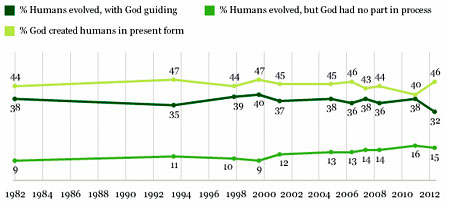
It’s not often I see an ATiM discussion echoed nearly word for word in the bigger blogosphere, but an item in Andrew Sullivan’s Dish gave me an odd sense of deja vu. He had reacted in horror to a Gallup poll which showed that 46% of Americans believe God created man as-is. Another 32% believe in what I call ‘guided evolution’ where there is divine influence. Only 15% believe that God had nothing to do with us looking as we do.

Sullivan’s alarm is stated thusly:

I’m not sure how many of the 46 percent actually believe the story of 10,000 years ago. Surely some of them know it’s less empirically supported than Bigfoot. {snip} I simply do not know how you construct a civil discourse indispensable to a functioning democracy with this vast a gulf between citizens in their basic understanding of the world.

Kevin Drum of Mother Jones rolled his eyes by noting that the 46% number is essentially unchanged since the question has been tracked and it is hardly a concern.

The fact is that belief in evolution has virtually no real-life impact on anything. That’s why 46% of the country can safely choose not to believe it: their lack of belief has precisely zero effect on their lives. Sure, it’s a handy way of saying that they’re God-fearing Christians — a “cultural signifier,” as Andrew puts it — but our lives are jam-packed with cultural signifiers.

Basically, Drum is saying that denying evolution is the price of admission to a not very exclusive club and most people are able to compartmentalize the cognitive dissonance it creates when relying on medicine or agriculture or anything that requires the actual mechanisms of evolution to work.

And lots of smart people don’t ‘believe’ in evolution (and I put ‘believe’ in air quotes because I personally ‘believe’ that is as silly as not believing in gravity) and still do quite well in their professional lives. I heard from colleagues of a prominent engineering professor who was a Young Earther, that is, he thought the Grand Canyon was created from backwash from Noah’s flood. I went to a public lecture of his and his thoughts on thermodynamics and the like were very mainstream and enlightening. Only at the end did he make a slightly veiled cryptic comment about having to conserve energy because we were stewards of the Earth.

Saying that God made Man in an afternoon and then used some spare parts to make Woman is a harmless fairy tale demonstrating a reliance on faith over a trust in reason. Evolution makes intellectual sense because it explains observable phenomena such as there being so many different types of plants and animals, far more than would fit on a raft 300 cubits long.

Not believing in evolution has very little effect on tax policy or road funding or the vast majority of governmental issues. It’s only when the theology drips into policy that I grow concerned. Jame Watt famously saw harvesting trees on a non-sustainable basis as no problem since he was imminently expecting The Rapture and then it wouldn’t matter any more. And we don’t want to even begin opening the can of worms of how religious dogma has affected the debate over reproductive rights.

So if someone wants to believe in folk tales on the origin of the world, I can only shake my head and shrug. To me these are people that in their devotion to their beliefs refuse to separate the moral and ethical authority that have been the traditional realm of religion from the mythmaking mumbo jumbo which science has supplanted. For some “God said it. I believe it. That settles it.” is all they need. For me, I expect a higher standard of intellectual rigor when deciding whose opinions I trust, I but don’t require it when selecting a plumber.

Morning Report 6/12/12

Vital Statistics:


Last

Change

Percent

S&P Futures 

1303.7

3.4

0.26%

Eurostoxx Index

2145.2

7.5

0.35%

Oil (WTI)

82.29

-0.4

-0.50%

LIBOR

0.468

0.000

0.00%

US Dollar Index (DXY)

82.53

0.013

0.02%

10 Year Govt Bond Yield

1.61%

0.02%


RPX Composite Real Estate Index

178.9

0.2


Markets are a touch higher this morning after yesterday’s sell-off. Federal Reserve Bank of Chicago President Charles Evans (who Jim Bianco called an uber-dove) said he supports more stimulus. The 10-year yield is back up to 1.61% and MBS are down about 1/4 of a point.

The National Federation of Independent Business Optimism Index ticked down in May. It came in at 94.4, vs 94.5 in the previous month, which is a historically low level. 51% of owners hired or tried to hire in the last three months and nearly 3/4 of those reported few or no qualified applicants for positions. The report has a pretty scathing indictment of Washington, with 22% of the respondents indicating taxes as the single most important problem. 20% reported poor sales, and 19% reported government red tape.

Excerpt from the report: “The Index did not go down by much, that’s the good news. The May reading is still at recession levels from an historical perspective, consistent with very anemic Gross Domestic Product (GDP) and employment growth. The calculus of spending decisions requires an estimate of future sales, tax rates, interest rates and credit availability, labor costs, health care costs, regulatory compliance costs, all of which are very uncertain, meaning that owners cannot make reliable estimates of what will happen to these factors. Most of this uncertainty is coming out of Washington, D.C. Owners can’t attach probabilities to outcomes or even decide which outcomes to consider.

The amount of political manipulation and evasion to guide the spending of billions of taxpayer dollars is disturbing to owners. Sixty (60) percent of those surveyed said now is a bad time to expand their businesses; one-in four of those owners cited political uncertainty as the main reason, second only to concerns about a weak economy. Investing in jobs or plant and equipment will remain at “maintenance” level until this is resolved.”


I would be surprised if this doesn’t become campaign fodder.

study from the Federal Reserve regarding changes in US family finances has been getting a lot of discussion – the median net worth of families has dropped nearly 40% from 2007 to 2010, putting them back where they were in 1992. Most of this is housing-driven, though stocks, student loans, and a drop in incomes are playing a part too.  A generation’s worth of wealth creation has been destroyed in 3 years. Of course much of that wealth was illusory, but it does speak to why confidence has been so lousy – the reverse wealth effect. Hopefully housing is in fact bottoming, which will reverse this effect. 

The WSJ addresses in interesting question:  if the shadow inventory is so high, why is the inventory of homes actually for sale at normal levels?  It turns out (unsurprisingly) that negative equity is the reason, but also the influx of professional investors scooping up inventory in the hardest-hit areas.  It also explains why prices are rising the most at the bottom end of the market – they have the most negative equity, so supply is the most constrained.

Chart:  NFIB Small Business Optimism Index:


Fool’s Errand?

http://dealbook.nytimes.com/2012/06/11/why-the-bailout-in-spain-wont-work/?nl=business&emc=edit_dlbkam_20120612

Morning Report 6/11/12

Vital Statistics:

  Last Change Percent
S&P Futures  1328.3 6.3 0.48%
Eurostoxx Index 2169.7 25.8 1.20%
Oil (WTI) 85.09 1.0 1.18%
LIBOR 0.468 0.000 0.00%
US Dollar Index (DXY) 82.28 -0.229 -0.28%
10 Year Govt Bond Yield 1.63% 0.00%  
RPX Composite Real Estate Index 178.7 0.0  

Markets are up this morning on a potential bail out for the Spanish banks, although the initial euphoria is wearing off. When I checked in last night, the S&P futures were up 16 points.  Now they are up 6. During the US financial crisis, the one sure-fire trade was to fade any rally brought on by some sort of government rescue. The S&P futures would spike up on news that the government was intervening somewhere, and then would sell off as people realize the intervention is no panacea. US bonds clearly aren’t buying it, with the 10 year unch’d. MBS are flat as well.

While equity markets have rallied on the Spanish bailout, Spanish bond yields have not. After trading up to 6%, Spanish government yields are now over 6.4%. As Bill Gross has noted, the Spanish bond market is rigged, as the Spanish banks are encouraged to buy up debt auctions to make the demand for Spanish debt look better than it really is. 

Are we there yet? That is the title of CoreLogic’s June MarketPulse report on housing. While noting that previous seasonal strength in 2010 and 2011 ended up fading into year-end, CoreLogic postulates that the green shoots we are seeing indicate the market has turned for good. The caveat:  housing won’t really turn until the job market is fixed. 

Bits and Pieces (Lulu’s Garden)

We’ve had one of those years at our house.  You know, one of the memorable ones for crappiness.  Things are looking up however, for the most part.  We even received rent money and the security deposit this week on our rental property, and the new family begins moving in today.  They don’t appear to be hoarders, and yes we did have the house fumigated.  Last weekend my husband and I painted all four bedrooms and this week I cleaned all the floors (again), the bathrooms (again), windows and the broiler.  He cleaned the windows on the enclosed patio, put in a new toilet and cleaned the fireplaces etc.  That’s over finally.  We’ve had a few health issues, some accidental, some related to being over 60 I guess, but so far we’re carrying on pretty well.

One thing that has always kept me from panicking when the worry sets in is working in my garden.  That’s right, the garden comes in ahead of ATiM.  I will try to participate a little more going forward however, as I have missed our discussions.

Anyway, I’ve been growing veggies since I rented my first house at age 20.  When the kids were little we had a fruit orchard and really large garden in the back part of our property (we have a half acre).  That’s all been replaced with a rather large warehouse for the business.  We did manage to find a nice growing spot on the side of the house, outside the bedroom window, for a small garden.  Since it’s just the two of us now it’s perfect and I can look out the window and see our handiwork.

This year I planted a couple of things I’ve never had in my garden before, bok choi and Japanese cucumbers.  In the photo below the bok choi is in the center bottom of the picture between the beets, on the left, and the Japanese cucumber.  At the back of the photo is swiss chard, which we have in our garden nearly year round.   I saute the chard in safflower oil and then add tamari and a little sesame oil and add it to brown rice after the rice is cooked……………………..yummy.

In the photos below are three kinds of summer squash, a few remaining green beans (the dogs dug up most of them), three kinds of lettuce, more swiss chard, and I just planted pumpkins and acorn squash last weekend.  These new veggies took the place of the snow peas, which we already ate, also yummy.

We’re taking a couple of days off this weekend and heading to the beach tomorrow, my favorite destination, so have a great weekend everyone.

Green Jobs

Oil lobbyist friend sent this to me.  Don’t act so shocked, I have friends

Video at: http://dailycaller.com/2012/06/08/labor-dept-counts-oil-lobbyists-garbage-men-bus-drivers-as-green-jobs-video/#ixzz1xD7qDCZn

Here’s the transcript.

REP. DARRELL ISSA: Well, let me — let me run you through some questions here because you’re here because we’re having a green jobs counting discussion.
Does someone who assembles turbines — is that a green job?
MS. JANE OATES: Wind turbines?
REP. ISSA: Yeah. Wind turbines.
MS. OATES: I think we would call any kind of sustainable manufacturing –
REP. ISSA: OK.
MS. OATES: — fitting the definition that was –
REP. ISSA: Does someone who sweeps — does someone who sweeps the floor in a facility that makes solar panels, is that a green job?
MS. OATES: Solar? I’ll give that to –
REP. ISSA: To Galvin?
MS. OATES: — if you don’t mind.
MR. JOHN GALVIN: We define — we have a two-part definition –
REP. ISSA: We already had the briefing on that. So just answer the question. If you’re sweeping the floor in a solar panel production facility, is that a green job?
MR. GALVIN: If you ask me for the number of health care jobs in the United States, I’ll give you the employment from the health care industry.
REP. ISSA: Look, Mr. Galvin –
MR. GALVIN: — nurses and doctors –
REP. ISSA: You did not want to come here as a witness. You are not a delighted witness. So let’s go through this.
I asked you a question. You know the answer. Would you please answer it.
If you sweep the floor in a solar panel facility, is that a green job?
MR. GALVIN: Yes.
REP. ISSA: Thank you. If you drive a hybrid bus — public transportation — is that a green job?
MR. GALVIN: According to our definition, yes.
REP. ISSA: Thank you. What if you’re a college professor teaching classes about environmental studies?
MR. GALVIN: Yes.
REP. ISSA: What about just any school bus driver?
MR. GALVIN: Yes.
REP. ISSA: What about the guy who puts gas in the school bus?
MR. GALVIN: Yes.
REP. ISSA: How about employees at a bicycle shop?
MR. GALVIN: I guess I’m not sure about that.
REP. ISSA: The answer is yes, according to your definition. And you’ve got a lot of them.
What about a clerk at the bicycle repair shop?
MR. GALVIN: Yes.
REP. ISSA: What about someone who works in an antique dealer?
MR. GALVIN: I’m not sure about that either.
REP. ISSA: The answer is yes. Those are — those are recycled goods. They’re antiques; they’re used.
What about someone who works at the Salvation Army in their clothing recycling and furniture?
MR. GALVIN: Right. Because they’re selling recycled goods.
REP. ISSA: OK. What about somebody who opened a store to sell rare manuscripts?
MR. GALVIN: What industry is that?
REP. ISSA: People sell rare books and manuscripts — but they’re rare because they’re old so they’re used.
MR. GALVIN: OK.
REP. ISSA: What about workers at a consignment shop?
MR. GALVIN: That’s a green job.
REP. ISSA: Does the teenage kid who works full time at a used record shop count?
MR. GALVIN: Yes.
REP. ISSA: How about somebody who manufacturers railroads rolling stock — basically, train cars?
MR. GALVIN: I don’t think we classified the manufacture of rail cars as –
REP. ISSA: 48.8 percent of jobs in manufacturing, rail cars counted, according to your statistics. About half of the jobs that are being used to build trains.
OK. How about — just one more here. What about people who work in a trash disposal yard? Do garbage men have green jobs?
MR. GALVIN: Yes.
REP. ISSA: OK. I apologize. The real last last is, how about an oil lobbyist? Wouldn’t an oil lobbyist count as having a green job if they are engaged in advocacy related to environmental issues?
MR. GALVIN: Yes.

Morning Report 6/8/12

Vital Statistics:


Last

Change

Percent

S&P Futures 

1302.7

-7.3

-0.56%

Eurostoxx Index

2143.7

0.6

0.03%

Oil (WTI)

82.22

-2.6

-3.07%

LIBOR

0.468

0.000

0.00%

US Dollar Index (DXY)

82.72

0.666

0.81%

10 Year Govt Bond Yield

1.56%

-0.08%


RPX Composite Real Estate Index

178.7

0.4


Markets are weaker this morning after some disappointing economic data out of Europe. I guess people were hoping for a little bit more out of the Bernank regarding further stimulus when he testified in front of Congress yesterday. The trade deficit narrowed as imports and exports fell by 1.7% and .8% respectively. Bonds and MBS are both up a little. Overall, it feels like a typical Summer Friday and I would expect most of the Street to be on the L.I.E. by noon.

The Fed voted yesterday to accept the Basel III framework. Rob Chrisman has a good piece on how Basel III will impact mortgage pricing. Essentially the new treatment of mortgage servicing rights will force big lenders like Wells to lower the price they are willing to pay for servicing released premiums. In plain English, this means that Basel III has imposed a higher cost on the banks that will be passed on to borrowers. The Fed estimates that the 19 largest US banks are about $50 billion short of meeting new capital requirements, but they also note that these rules will become fully implemented by 2019 and that most banks should be able to meet the new capital requirements through retained earnings and won’t need to raise more capital.

Fannie Mae notes in its National Housing Survey that consumer sentiment seems to be plateauing as we head into the summer selling season. Roughly 1/3 of the respondents expect home prices to rise in the next 12 months and 72% believe now is a good time to buy.

The FHA is planning to announce a bulk sale program today. However, they want to deter “vulture investors” by requiring that the loan buyer to wait 6 months to foreclose and to agree to keep at least half the REO for 3 years.

Health Care Link Dump

Just wanted to post some of the recent health care news.  There’s also been an uptick in the number of SCOTUS ruling previews, but none of them are really all that insightful.  Just parlor game speculation.

Also, the White House has issued a veto threat on the medical device tax repeal bill.  [Edit:  Link to Statement of Administration Policy]

AHIP released a survey that found the number of people enrolled in health savings accounts and high deductible health plans has tripled over the last five years.  Survey is available here.  The Washington Post and Kaiser Health News recently profiled employers’ increasing use of high deductible health plans.  Most of these plans already covered a lot of the essential benefits stuff for free, even before the ACA, which I probably should have known.  The article is available here.

Medical costs are expected to rise by 7.5 percent in 2013, the fourth consecutive year of modest increases, according to a study released by PricewaterhouseCoopers LLP’s Health Research Institute.   Four factors that will continue to slow the rise in medical costs in 2013: medical supply and equipment costs are moderating under market pressure; growth in physician services is expected to be one of the slowest areas of cost growth as consumers choose alternatives to traditional office visits; accessibility to information on prices is exerting downward pressure as consumers in high-deductible plans seek cost information and pricing information becomes more readily available; and pharmaceutical patents are expiring.  The study is available here.

The Washington Post and GAO on a ACA tax credit in that small businesses aren’t using due to the complexity of taking it.  article is available here.  The GAO report, “Small Employer Health Tax Credit – Factors Contributing to Low Use and Complexity” (GAO-12-549) is available here.

Video:  Former CMS Administrator says that premium support (aka vouchers) is going to happen.