Drones and an Open Thread

One of the features I love most about the internet is following links that are embedded in links……………………….you never know what you’ll find.  Generally it’s either a virus or a piece that agrees with the original you’ve just read but with either a twist or a few added details.  Occasionally you find an unexpected source of information or amusement.

I woke up way too early this morning, for someone who was out until midnight, and spent the wee hours of the morning following links and came across this guy.  It’s too early to tell if he’ll be a valuable source of information or just another quack hiding behind some interesting ideas, but the piece I read this morning might interest some of you.

It’s been suggested by more than one wit that life imitates art far more often than art imitates life. The United States military these days seems intent on becoming a poster child for that proposal. Industrial design classes at MIT used to hand out copies of “Superiority” as required reading; unfortunately that useful habit has not been copied by the Pentagon, and as a result, the US armed forces are bristling with brilliantly innovative wonder weapons that don’t do what they’re supposed to do.

You’ll notice that this has done little to stabilize the puppet governments we’ve got in the Middle East these days, and even less to decrease the rate at which American soldiers are getting shot and blown up in Afghanistan.  There’s a reason for that.  The targets for drone attacks have to be selected by ordinary intelligence methods—terrorists don’t go around with little homing beacons on them, you know—and ordinary intelligence methods have a relatively low signal-to-noise ratio.  As a result, a lot of wedding parties and ordinary households get vaporized on the suspicion that there might be a terrorist hiding in there somewhere.  Since tribal custom in large parts of the Middle East makes blood vengeance on the murderers of one’s family members an imperative duty, and there are all these American soldiers conveniently stationed in Afghanistan—well, you can do the math for yourself.

He goes on to talk about torture being another ineffective use of the military and then explains a theory based on chaos, discord and confusion.  I especially like this explanation of chaos and discord comparing a tropical storm (chaos) to antibiotic resistant bacteria (discord).

If we shift attention from Tropical Storm Isaac to the latest recall of bacteria-tainted produce, we move from chaos to discord.  Individually, bacteria are nearly as dumb as storms, but a species of bacteria taken as a whole has a curious analogue to intelligence.  All living systems are value-oriented—that is, they value some states (such as staying alive) more than other states (such as becoming dead) and take actions to bring about the states they value.  That makes them considerably more challenging to deal with than storms, because they take active steps to counter any change that threatens their survival.

If X occurs, then Y must occur………………………………………..

This bit of systems theory is relevant here because American culture has a very hard time dealing with any kind of uncertainty at all. That’s partly the legacy of Newtonian science, which saw itself—or at least liked to portray itself in public—as the quest for absolutely invariant laws of nature.  If X occurs, then Y must occur:  that sort of statement is the paradigmatic form of knowledge in industrial societies.

It also explains a good bit of why the United States has stumbled from one failed counterinsurgency after another since the Second World War.

You can’t treat a hostile country like a passive object that will respond predictably to your actions.  You can’t even treat it as a chaotic system that can more or less be known statistically. At the very least, you have to recognize that it will behave as a discordant system, and react to your actions in ways that support its values, not yours: for example, by shooting or blowing up randomly chosen American soldiers to avenge family members killed by a Predator drone.

There’s more and he gets into the confusion aspect of his theory…………I just thought it was an interesting exercise in expanding the way we think.

MiA – I am pulling a Kevin and adding a Ted Talk here. Liberals, conservatives, and the Moral Mind

Haidt is a liberal.  After the first few minutes that include bashing conservatives for the amusement of liberals, he presents what he says are the pre-wired pathways that lead to developing an adult sense of morality.  He claims five from neuroscience, and liberals will be inclined to criticize him when he says conservatives use all five while liberals rely on two.  I will shorthand the five neural presets as: nurturing-hurting, fairness-cheating, group loyalty or betrayal, authority-rebellion, and purity-disgust.  I would criticize him just as I would Kant for the categorical imperative:  we do not I think, have the tools to make this a simple matter.  But what Haidt says in this Ted talk is interesting [after the cheap shots in the beginning], and I think worth attending.  If the neurosci is accurate, then it has more weight than most offerings on “morality”.

Morning Report 8/24/12

Vital Statistics:

Last Change Percent
S&P Futures 1395.9 -4.1 -0.29%
Eurostoxx Index 2417.7 -11.4 -0.47%
Oil (WTI) 95.89 -0.4 -0.39%
LIBOR 0.425 -0.002 -0.47%
US Dollar Index (DXY) 81.56 0.205 0.25%
10 Year Govt Bond Yield 1.63% -0.04%
RPX Composite Real Estate Index 192.1 0.1

Markets are off after a disappointing durable goods report. Between the durable goods report and the cap good report, it showed companies pulled back from making capital investment in July. This put a bid under bonds and the 10 year is now pushing 1.6% after topping 1.8% earlier this week.  MBS are up 1/4 of a point as well.

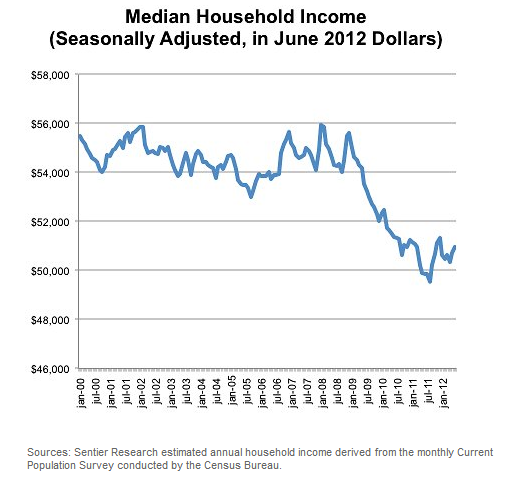
Why does the economic recover not feel like a recovery? One big reason is that incomes are still falling – in fact they have fallen more since the recovery began than they did during the recession. Given the move in the median house price, the median house price to median income ratio has spiked to 3.7x, implying housing is overvalued. FWIW, I am skeptical of NAR’s median house price numbers, which supposedly rose 22% to 189.6 from 154.6 in Jan. Perhaps the lack of distressed sales has caused the median price to shoot up.

Bill Gross said this morning that QEIII is “almost a done deal.” No update on the status of the cult of equities’ demise, though.

Republicans want to study the implications of returning to the gold standard. This is undoubtedly aimed at libertarians who like Ron Paul and may vote for Gary Johnson.  Needless to say, the Nobel Krug Man does not approve.

Chart:  Median income:

Morning Report 8/23/12

Vital Statistics:

  Last Change Percent
S&P Futures  1409.8 -2.5 -0.18%
Eurostoxx Index 2436.2 -16.6 -0.68%
Oil (WTI) 97.49 0.2 0.24%
LIBOR 0.427 -0.004 -0.91%
US Dollar Index (DXY) 81.34 -0.143 -0.18%
10 Year Govt Bond Yield 1.70% 0.00%  
RPX Composite Real Estate Index 192 0.0  

Initial Jobless Claims came in at 372k, a little higher than expected and pretty much in line with the latest trend of 375k / week.  New Home Sales increased to 372k in July

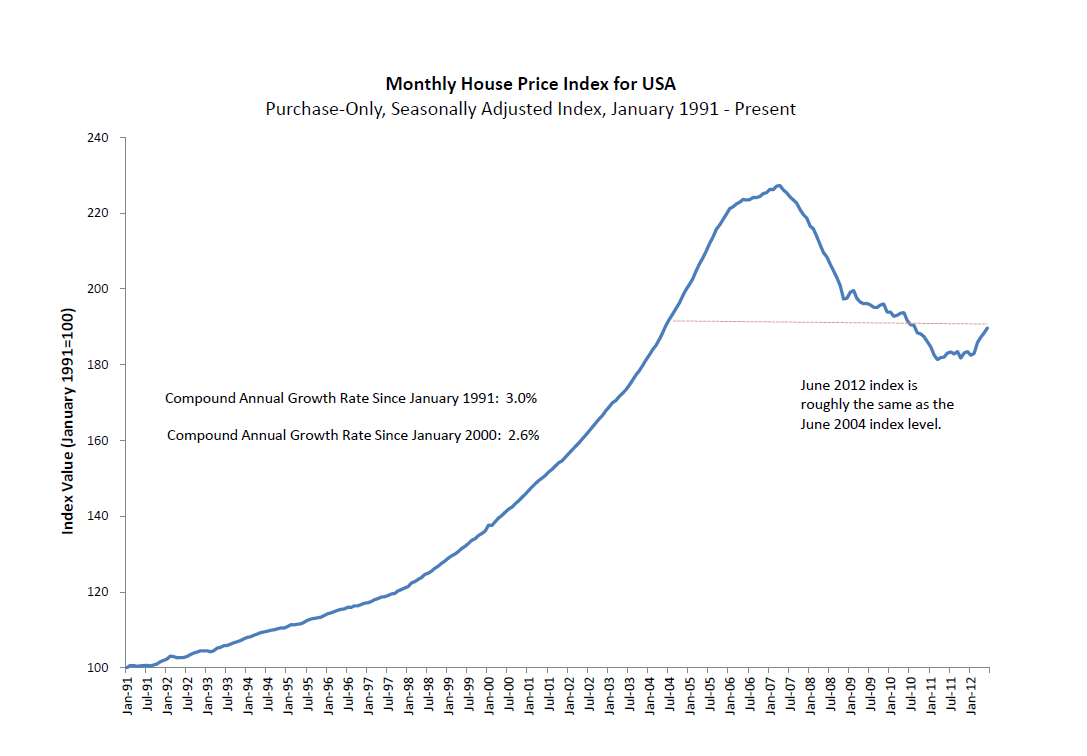
The FHFA Home Price Index increased 3% YOY and .7% MOM. This report only focuses on conforming mortgages, which makes it a more stable index than Case-Schiller or RPX.

The FOMC minutes noted that economic conditions have decelerated from earlier this year and discussed the possibility of another round of quantitative easing.  This drove the 10 year yield from 1.8% to 1.7%. MBS rallied as well.  My view has been that we are getting too close to the election – the Fed wants to appear non-political and definitely does not want to influence elections.  However this morning, St Louis Fed President James Bullard characterized the minutes as “stale,” noting that some of the data lately indicates the economy is getting stronger again.

CBO is forecasting 2.25% economic growth for the rest of the year and unemployment above 8%.  If Taxmageddon is not averted, CBO projects a recession with real GDP declining .5% from Q412 to Q413 and unemployment rising to 9%. If all the tax hikes and spending cuts are held off indefinitely, their projection is pretty much where the economy is now – 1.7% GDP growth with 8% unemployment. So the goalposts are (a) very modest recession vs (b) very modest recovery. Which means interest rates aren’t going anywhere. 

Chart:  FHFA House Price Index

Morning Report 8/22/12

Vital Statistics:

Last Change Percent
S&P Futures 1409.1 -3.4 -0.24%
Eurostoxx Index 2469.1 -21.2 -0.85%
Oil (WTI) 96.73 -0.1 -0.11%
LIBOR 0.431 -0.003 -0.63%
US Dollar Index (DXY) 82.02 0.108 0.13%
10 Year Govt Bond Yield 1.77% -0.02%
RPX Composite Real Estate Index 192 0.2

Stocks are lower this morning on no real news. Dell missed.  Existing Home Sales are scheduled to be released at 10:00 am EST. The minutes of the last FOMC meeting are scheduled for 2:00pm EST. Bonds are up a half a point and MBS are flat.

Mortgage Applications fell 7.4% last week as refis slowed.

Greece needs some breathing room to pay its debts.

FHFA has revised their short sale guidelines to allow homeowners who are current on their mortgage (and have an eligible hardship) to sell their home in a short sale. Importantly, job relocation qualifies, which should help people who are stuck with underwater homes in places with no jobs to leave. Second Lien holders will be given $6,000 to expedite a short sale.

Toll Brothers reported better than expected earnings, with a 41% increase in revenues, 59% increase in backlog, and 66% increase in contract signings.  Toll is in the McMansion business, so it isn’t necessarily representative of the whole market, but it is another positive data point, especially for the jumbo part of the space.  The stock is up a few percent pre-open.

Fannie Mae’s economic outlook for the rest of the year is generally gloomy, although it does predict that housing activity will be a net positive to GDP for the first time since 2005.

Morning Report 8/21/12

Vital Statistics:

Last Change Percent
S&P Futures 1419.6 4.9 0.35%
Eurostoxx Index 2477.1 10.8 0.44%
Oil (WTI) 97.13 1.2 1.21%
LIBOR 0.434 0.000 0.00%
US Dollar Index (DXY) 82.03 -0.422 -0.51%
10 Year Govt Bond Yield 1.84% 0.03%
RPX Composite Real Estate Index 191.8 0.4

Markets are stronger this morning on no real news. There are very no meaningful economic releases this week, except for perhaps the FOMC minutes which come out tomorrow.  The lack of news out of Europe has led to a benign environment for equities, which means that the 10-year continues its sell-off.  MBS are down 6 ticks as well.

HUD is doing another auction of distressed single family loans – $1.7 billion. These are loans primarily in Phoenix, Chicago, Tampa, and Newark. Given the amount of money that’s being raised for distressed real estate, HUD should be shoveling this stuff out the door.  When the ducks are quacking, you gotta feed ’em.

Dick Bove of Rochdale Securities points out that the government’s regulation of the banks is creating an opportunity for the shadow banking system – the firms who operate outside of the banking system (that would be us, for example). While he does worry about this laying the groundwork for the next crisis, in the meantime winners will emerge in the disarray. Take a look at the charts of Nationstar Mortgage (NSM), Impac (IMH), and Redwood Trust (RWT).  These stocks have been screaming. This is actually a very bullish sign for real estate – since the crisis began, the market has been dominated by Ginnie / Fannie loans. A bottom in real estate is the single most important factor to turn things around. The private label securitization market is the second.

The era of frothiness is over (at least according to the Economist).  What is interesting is that real estate is the cheapest relative to incomes in Japan, followed by Germany and the US.  The Canadian real estate bubble still has yet to burst. It will be interesting to see how their banking system handles it.

Morning Report 8/20/12

Vital Statistics:

Last Change Percent
S&P Futures 1412.7 -2.5 -0.18%
Eurostoxx Index 2468.5 -3.1 -0.12%
Oil (WTI) 95.73 -0.3 -0.29%
LIBOR 0.434 -0.001 -0.23%
US Dollar Index (DXY) 82.64 0.040 0.05%
10 Year Govt Bond Yield 1.82% 0.01%
RPX Composite Real Estate Index 191.8 0.4

Markets are weaker this morning on no real news.  The next two weeks should be pretty quiet as August winds down. There are no real market-moving economic releases this week, except possibly the FOMC minutes, which will be released Wednesday afternoon. Bonds and MBS are flat.

The Chicago Fed National Activity index improved slightly in July to -.13, but is still below zero, meaning the economy is growing below trend. June was revised downward. The plus is that the index is still above -.7, the level that starts indicating a recession.

Has Mario Draghi picked up Hank Paulson’s bazooka?  The Bundesbank and the ECB are reacting to a Der Spiegel story which says the ECB is looking to “cap” sovereign interest rates.  Which means they have to be willing to buy any and all government bonds at a set price. The ECB has characterized the article as “misleading.” Paging Mr. Soros…

The latest in the San Bernardino Eminent Domain saga.

The Generation Game-Sunday Open Thread

I’ve been looking around all afternoon for something to begin a new thread with and found this piece from Crooked Timber fairly interesting.  We keep hearing a lot about Baby Boomers and Gen X and Y or whatnot and so I thought this might be a conversation starter.  While I was reading the comments I came across one guy who was insistent that the boomers were the worst generation ever and a bunch of narcissistic destructive dolts or something along those lines.

One of the standard ploys in journalism, marketing and political commentary is the generation game. The basic idea is to label a generation ‘X’ or ‘Y’, then dissect its attitudes, culture, and relationship with other generations. The most famous generation, of course, is that of the Baby Boomers, born between the end of World War II and the early 1960s, and their most enduring contribution to the generation gap is the ‘Generation Gap’ between children and their parents.

The generation game is played with particular vigour in cultural commentary, but its reach seems to be extending all the time. No US Presidential election would now be complete without voluminous commentary on the generational backgrounds of the contenders. There is even a branch of economics called generational accounting, which is supposed to show whether one generation is subsidising another through the tax and welfare system.

Once we strip out the more-or-less constant social distinctions associated with membership of a given age-group, the idea that we can say much about any particular cohort becomes far more dubious. In fact, cohort effects are only of much importance between the ages of 16 and about 25. The experience of childhood is dominated by family and school, and, while both families and schools have changed since the 1950s, the rate of change from one decade to the next has been quite slow.

On the other hand, by the time the members of a given cohort reach their late twenties, their live courses have diverged so much that they cease to form a well-defined group with common experiences. The differences between men and women, rich and poor, workers and bosses, married and single, parents and nonparents count for much more than the commonality that comes from sharing a date on a birth certificate.

For the crucial decade from 16 to 25, however, common experiences related to growing up at a particular time can be very important. Whether the labour market is in a boom or a slump when you finish school can make a big difference to your subsequent career. For males, an even more important question is whether the years of military age coincide with a major war. Peacetime and wartime generations, or boom and slump generations, can be very different.

This is a re-publication of a piece written prior to this recession but I thought this was interesting and I think we all know how both the 16-25 and the over 50 crowds are suffering this time.

It was not until the recession we had to have, from 1989 to 1992, and the waves of downsizing in the 1990s, that the end of postwar prosperity really hit the Vietnam generation and the baby bust cohort. Although the focus of policy attention remained firmly on youth unemployment, the real story of the 1990s was the disappearance of jobs for workers over 50, and particularly for men over 50. The employment rate for this group has fallen from nearly 100 per cent during the postwar boom to around 50 per cent today.

I, Judas – A Book Review

James Reich is both novelist and poet.  If you accept that he has the soul of a poet, then I, Judas is one of the most difficult and lengthy poems you’ll ever read.  I say difficult not in an “oh my God, what lousy poetry” way, but in the sense of being “uncomfortable while reading” way.  I felt, while I was reading, as if I were a child being allowed to sit at the adult’s dinner table for the first time and discovering that it was much more fun at the children’s table.

Perhaps you disagree that he is a poet, then I offer this passage about that fateful morning in Dallas in November of 1963:

“jackals careened about the passenger door. Scarlet broth ran down her sunglasses. His back brace held him corseted to his cross, and the shot pealed again.”

Judas pops up in numerous momentous, and not so momentous, occasions like a modern day Lucifer peddling his influence as he skips around the globe and history.

I was raised by atheists to be a Christian.  As such I’ve always had great difficulty accepting Jesus as the Son of God but even I, perhaps because I still attend church for inspiration and solace, was shocked to contemplate biblical characters in such brazen terms.  For example, Mary Magdalene as the reckless whore and Joseph crafting the rude cross of his own son’s crucifixion, in the hopes that his wife’s lover will one day hang from one.

Recently, I was discussing the Lochness Monster with my six year old grandson as he has been doing research on Nessy lately.  I asked him if he believed the Lochness Monster was real or not and he said “I believe in all the legends Grandma”.  Reading I, Judas would cure him of that……………………….luckily he’s too young still.  I sort of wished I hadn’t read the book, if you know what I mean.

Please add your comments below if you’ve read the book.  If anyone misunderstands my comments above, I enjoyed the book, in a rather painful way.

Discrimination in Public Accommodations

A post by Eugene Volokh on VC talks about a recent jury award under the CA public accommodations anti-discrimination statute against a (Muslim) hotel owner that kicked out a Friends of the IDF gathering. I think the major issue is whether property owners are free to discriminate on the basis of non-religious (or religious) beliefs. A secondary issue is whether property owners can discriminate on the basis of speech (Note: it is not clear to me whether the Friends of the IDF gathering was just a party or a fundraiser with speeches, etc.).

The link to the LA Times article has a little more information on the background.

So, an additional question is: should we have different rules for property owners in different states? Volokh makes it sound as if this result is specific to CA.

Friday Open Thread: 8/17/2012

Since we don’t have a Morning Report, I’ll start a new thread. If anyone has the Vital Statistics, feel free to add them.

This is worth a read:

Old Obama acquaintance voices South Side’s disillusionment with his former ally

Makes me wish Jack Kemp was still around.