Money, money, money, money……………MONEY

I read this yesterday and thought it was depressing.  I learned that Riverside County (my county) sits at just under 17% poverty, median income is down another $3,000 since last year  and 3 times as many residents need food stamps now than needed them in 2007.  These are some of the people who don’t pay federal income taxes I guess.  I’ve never understood why, when people need the safety net the most it is always under the biggest threat.  It’s almost as if we blame the victims of the recession for the recession.  I’m sure it all comes down to money and we know it didn’t just disappear so where is it?

I read this in TomDispatch:

Here’s what the latest census data tell us: in 2011, the middle class shrank to “an all-time low” (as the Washington Post headline had it), while the income of the wealthiest Americans continued to climb.  The poverty rate leveled off at a still shuddering 15%, with more than one of every five Americans under eighteen living in poverty.  The Gini Index, a measure of income inequality, rose by 1.6%, the “biggest one-year increase in almost two decades.”

In a way, of course, this should be no news at all.  Middle-class wealth has taken a staggering hit since the economic meltdown of 2007 (and African American and Hispanic wealth has gone through the floor). This disaster, linked to the Great Recession, has had a sideline effect.  On the theory that what goes up must come down, money flooding out of American households and into the coffers of the incredibly wealthy and their corporate cronies has also been flowing back down in tidal amounts.  It’s been pouring biblically into this season’s political campaign.

The news out of the dog days of August, for example, was that the Obama and Romney campaigns had raised a total of more than $225 million dollars that month alone.  (In the 1984 presidential campaign between Ronald Reagan and Walter Mondale, the two candidates raised a “mere” $202 million during that whole election season!)  And, of course, those figures don’t even include the dollars filling Super PACs to the bursting point and the “dark money” going into the 501(c)(4)s that don’t have to disclose where their contributions even come from.  (Eight of the top 10 Super PACs are “conservative,” reports the Daily Beast, and 77% of all contributions this campaign season will come from “business interests,” according to the invaluable Open Secrets website.)

Tom went on to publish parts of an essay by Lewis Lapham that I thought was well worth the read.  It’s the same link, the essay is under Tom’s comments which I quoted above.

Thomas Paine in the opening chapter of Common Sense finds “the strength of government and the happiness of the governed” in the freedom of the common people to “mutually and naturally support each other.” He envisions a bringing together of representatives from every quarter of society — carpenters and shipwrights as well as lawyers and saloonkeepers — and his thinking about the mongrel splendors of democracy echoes that of Plato in The Republic: “Like a coat embroidered with every kind of ornament, this city, embroidered with every kind of character, would seem to be the most beautiful.”

Published in January 1776, Paine’s pamphlet ran through printings of 500,000 copies in a few months and served as the founding document of the American Revolution, its line of reasoning implicit in Thomas Jefferson’s Declaration of Independence. The wealthy and well-educated gentlemen who gathered 11 years later in Philadelphia to frame the Constitution shared Paine’s distrust of monarchy but not his faith in the abilities of the common people, whom they were inclined to look upon as the clear and present danger seen by the delegate Gouverneur Morris as an ignorant rabble and a “riotous mob.”

From Aristotle the founders borrowed the theorem that all government, no matter what its name or form, incorporates the means by which the privileged few arrange the distribution of law and property for the less-fortunate many. Recognizing in themselves the sort of people to whom James Madison assigned “the most wisdom to discern, and the most virtue to pursue, the common good of the society,” they undertook to draft a constitution that employed an aristocratic means to achieve a democratic end.

Accepting of the fact that whereas a democratic society puts a premium on equality, a capitalist economy does not, the contrivance was designed to nurture both the private and the public good, accommodate the motions of the heart as well as the movement of the market, the institutions of government meant to support the liberties of the people, not the ambitions of the state. By combining the elements of an organism with those of a mechanism, the Constitution offered as warranty for the meeting of its objectives the character of the men charged with its conduct and deportment, i.e., the enlightened tinkering of what both Jefferson and Hamilton conceived as a class of patrician landlords presumably relieved of the necessity to cheat and steal and lie.

Good intentions, like mother’s milk, are a perishable commodity. As wealth accumulates, men decay, and sooner or later an aristocracy that once might have aspired to an ideal of wisdom and virtue goes rancid in the sun, becomes an oligarchy distinguished by a character that Aristotle likened to that of “the prosperous fool” — its members so besotted by their faith in money that “they therefore imagine there is nothing that it cannot buy.”

Morning Report 9/20/12

Vital Statistics: 

  Last Change Percent
S&P Futures  1447.3 -5.9 -0.41%
Eurostoxx Index 2545.6 -22.1 -0.86%
Oil (WTI) 91.68 -0.3 -0.33%
LIBOR 0.373 -0.003 -0.73%
US Dollar Index (DXY) 79.48 0.423 0.54%
10 Year Govt Bond Yield 1.73% -0.04%  
RPX Composite Real Estate Index 194.1 -0.1  

Markets are lower this morning after some disappointing European reports and a soft initial jobless report. 383K people filed for unemployment last week, higher than the survey of 379k.  Last week was revised upward as well. Later this morning we will get Leading Economic Indicators. Bonds are up a point and MBS are up 1/4.

It looks like HUD paid out over $1B in false claims for its Preforeclosure Sale Program. The program ran from 9/10 to 8/11 and paid out $1.7B in total.  It was intended to help homeowners who must sell their home for less than it was worth, provided they had an unavoidable financial crisis, lived in the home and did not have sufficient income to make the payments. The IG sampled 80 random cases and found 3/4 failed to meet the criteria. Ironically, it may have been a blessing in disguise since the homes would have probably gone into foreclosure anyway and FHA would have lost more in that event. 

FHFA has sent to the Federal Register its approach for setting guarantee fees on a state-by-state basis, to account for the fact that foreclosures take longer and are more expensive in some states than others.  Housing advocates will undoubtedly object strongly to this measure. I guess they believe that borrowers in non-judicial states should subsidize borrowers in judicial states.

On the back of yesterday’s WaPo story highlighting the difficulty the Fed is having getting the benefits of QE to Main Street due to bottlenecks in mortgage origination, Bank of America announced they are cutting 16,000 jobs by year end, of which 3200 are in new mortgage origination. It is astounding how much national  capacity has been taken out of mortgage origination over the past 5 years. I suspect a lot of people will find themselves caught flat-footed when the turn happens.

Bites & Pieces: ¡Ceviche!

Raw fish is eaten round the world. Sushi and sashimi from Japan, crudo and carpaccio from Italy, and Gravlax from Scandanavia to name a few. Hawaii has contributed poke, a kind of tuna tartare. I was first introduced to it at the Yardhouse in San Diego. The best I’ve ever had was at the East Coast Grill and Raw Bar. A friend of the owner had caught a tuna off Cape Cod the day before and so they were featuring it that night. Then there are the raw oysters that I happily slurp at Clyde’s for happy hour. Anything from Prince Edward Island is worth a taste.

Latin America’s contribution to the world of raw fish is ceviche. I was introduced to ceviche during my first visit to Costa Rica. My then girlfriend had never had a serious boyfriend before, so much of her family was curious about the gringo coming down for her brother’s wedding. My Spanish was minimal back then and I remember being reduced to saying ¡me encanta Costa Rica! as folks chatted with me at the end of the reception. All in all, a good trip. We were married one year later to the day.

Ceviche is distinct from sashimi, carpaccio or tartare in that the fish or shellfish is “cooked” in lime juice. Citric acid alters the chemical and physical properties of the proteins in the fish. This process of denaturation turns the flesh firm and opaque, as if it had been cooked with heat. One still needs to use high quality fish as the marinade is not the same as cooking. Then again, if I’m having a medium rare steak, it should be high quality meat.

For this post, my starter material is a book on ceviche from Guillermo Pernot. He had a great restaurant in Philadelphia (since closed) and is now with the group behind Cuba Libre. That’s a rum and coke with some lime juice.

Let’s start with basic ceviche. First, create the marinade. Half a cup of fresh lime juice, a quarter cup of orange juice, and 2 teaspoons of kosher salt. Fresh is key here, so juice them yourself. Next, cut up about a pound of fish into roughly quarter inch dice. Mahi mahi and red snapper are great choices. Tilapia is fine, if a bit bland. Let the fish marinate an hour or so and then add diced tomato, some minced onion or shallots, some minced cilanto, and some minced chiles (bell, jalapeño or Serrano peppers, depending upon your heat tolerance). If there’s something you think goes with this, enjoy! Serve with tortilla chips. Costa Ricans like to have a mix of ketchup and mayo on the side. I call it salsa tica and it’s good.

Shellfish is also good for making ceviche. If you’re worried about raw fish, parboil some prawns and cut them into small pieces. Shrimp cocktail from the South! Scallops make fantastic ceviche. Just toss whole bay scallops or sliced sea scallops into the marinade and let them sit for about 15 minutes.

Those are the basics. Now let’s get a bit fancy. I mentioned the Pernot book, which I should note is a gift of Natasha Bonilla, a family friend. The recipes are restaurant complicated, but I’ve tried a few at home and they rock. They’re also doable for the home cook. Here are a few of my favorites:

Hamachi Ceviche with Trio of Peppers Salad

This one looks great. There’s a fair amount of chopping involved, but it’s worth it. It’s terrific with an unoaked Chardonney. Heck, live a little and pick up a bottle of white Burgundy.

Citrus Dressing

½ cup fresh lemon juice

½ cup fresh lime juice

½ cup fresh orange juice

1 tablespoon sugar

2 tablespoons oil, infused with garlic*

2 tablespoons annatto oil*

2 teaspoons kosher salt

Combine all the ingredients in a blender until emulsified and set aside.

*I take whole cloves of garlic, mash them slightly with the edge of a knife, and put on the stove over low heat. Let it go for about 15 minutes and then strain. Annato seeds are used to color oil. Traditionally, it’s made the same way that I make the garlic oil. Put the seeds in oil and heat up until colored. For this recipe, I can simply do everything in one batch. You can also find annatto seed powder, which simplifies the whole process. If all this seems a bit too much bother, use a flavored oil or neutral salad oil.

Assembling the ceviche

¾ pound skinless hamachi, sliced thinly (yellow fin tuna)

1 large, evenly shaped red bell pepper

1 large, evenly shaped yellow bell pepper

1 large poblano chile

1 cup of arugula sprouts or thinly sliced arugula

½ red onion, sliced very thin and rinsed under cold water

Salt and pepper to taste

Combine the sliced fish with half the citrus dressing. Cover and refrigerate for 30 minutes.

Slice the top and bottom from the bell peppers. Cut open along one side and remove the seeds and the white membrane. [Pernot instructs one to remove the top layer of watery flesh from the inside as well, but I’d say that’s optional.] Slice each pepper into very thin strips—a mandoline is very helpful here. Do the same for the poblano chile.

Toss the peppers with the remaining citrus dressing. Lightly toss the fish, pepper mixture, arugula and red onion. Adjust the seasoning with salt and pepper. Arrange onto 6 chilled salad plates. [Oh, did I forget to mention that you were supposed to serve on chilled plates? Sorry about that.]

Bay Scallop Seviche with Blackened Tomatillo Truffle Sauce

This one will bring the house down. The ingredients are widely available and it is great for a crowd. Truffle oil is pricey, but a little goes a long ways. Trader Joe’s used to carry truffle oil, but no longer. I find it at World Market. Wine stores often carry some. For this dish, I think black truffle oil makes the most sense.

Let’s start with the plantain chips. You can buy them and they’re quite acceptable. Fresh is best, though. For this, you need green plantains. Cut off the ends, remove the skin and slice into planks. The best way I’ve found is to use a cheese slicer. It makes even plantain slices. Heat up a half inch or so of vegetable oil in a dutch oven or cast iron pan. Fry the slides and set them on paper towels to drain. Toss with a bit of salt.

Blackened Tomatillo Truffle Sauce

3 tablespoons extra virgin olive oil

½ pound fresh tomatillos, husks removed and rinsed

½ pound ripe plum tomatoes

1 red onion, quartered and unpeeled

4 cachucha* chiles

1 jalapeño chile

1 bunch fresh cilantro leaves

3 tablespoons truffle oil

salt & pepper to taste

There are two ways to cook the tomatillos, tomatoes, onion and chiles. Pernot does it on the stove top. Heat a tablespoon of olive oil over med high and add the tomatillos, tomatoes, onion and chiles. Cook, tossing frequently, until the skins are blackened. I like to toss them all with the olive oil and use our toaster oven. I preheat it to 350, put the veggies on a tray, and then move it to broil until the skins blacken (about 10 minutes).

Once cooked, put them in a food processor and cool to room temperature. Add the cilantro and pulse briefly until the vegetables are chopped but still chunky. You can also put everything through a meat grinder. Finally, add the remaining ingredients, taste to check seasoning, and refrigerate.

*I don’t know where to get these either. It’s a native Cuban pepper that looks like a habañero, but has much less heat. I’m fond of Serrano peppers, so I just use 4 of them and skip the jalapeño. If you prefer to keep heat levels down, just use jalapeños.

Bay Scallop Ceviche

1 cup fresh lime juice

¼ cup fresh orange juice

3 tablespoons finely diced red onion (or a lg. shallot)

1 tablespoon kosher (or sea) sallt

1 pound fresh bay scallops

Combine everything but the scallops in a nonreactive (stainless steel or enameled) bowl. Add the scallops and toss to combine. Cover and refrigerator for 24 hours.

Drain the marinade from the scallops and discard. Combine the scallops with most of the sauce and refrigerate for at least 20 minutes. When ready to serve, drain the excess liquid and add the rest of the sauce. A great way to serve this is to put the ceviche onto spoons and top with some crumbled plantain chips. Serve accompanied with plantain chips.

Tuna Ceviche with Roasted Calabaza

This is a three level ceviche. The base is roasted calabaza, a squash. You can use butternut squash for this and do well. On top of the squash is a layer of tuna. You’ll want high quality stuff for this. When I can get bluefin tuna, this is what I make. Thie dish is topped with a peppercress salad (watercress works just fine).

OK. For the base. Have one pound of calabaza (or butternut squash), peeled and cut into half inch cubes. Seasons with salt and p\epper and toss with olive oil. Roast in an oven at 425 degrees for 15 to 20 minutes, shakng and tossing once or twice, until it’s browned and crusty on the outside. Remove from the oven, cover and chill.

Now the salad. Combine half a pound of peppercress (or watercress) leaves with a quarter cup each of lemon and lime juice, a tablespoon of pumpkin seed oil (you can find it at World Market), and some salt and pepper. I’d use a high quality nut oil as the first alternative and good EVOO as the second.

Last, the good stuff. Make an emulsion of a quarter cup each of olive oil, lemon juice, and lime juice, 2 tablespoons of pumpkin seed oil (or nut oil or more olive oil,. Reserve a quarter cup of this. To the rest, add a pound of diced, sushi grade ahi tuna. Season with salt and pepper to taste. I go light on salt and a bit heavy on pepper. The recipe calls for a quarter cup of pepitas, which can be found in Latin American markets.

Let’s put it all together. It helps to have a ring mold to do this. Make a half inch thick base of roasted squash, Put on top of this another half inch of the marinated tuna. Top with the salald and a bit of reserved emulsion.

It’s a fantastic fall dish.

Taxation Ideas – publish yours here!

I don’t believe in moral arguments about taxation, except at the fringes.

This is a governmental function, burden, and necessity which we can choose or scrap, and the principles should be transparency and honesty, while raising only the revenue necessary to the functions we choose our government to perform. At the fringes, where I think an element of morality can be injected, we cannot have a tax system that destroys or seriously injures anyone, or that treats similarly situated taxpayers quite differently. No one likes taxes, but we all should be able to live with them, and the power to tax, abused, is the power to destroy.

Were I the God of Tax, I would scrap personal and corporate income taxes for a system that relied on:

1] V.A.T. – competitive rate with Canada
2] automated transfer payment tax – agreed rate by treaty among North America, EU, Japan, Australia and New Zealand, at a fraction of 1% on every single transfer in and out of a reporting institution
3] tariffs and excise taxes subject to change from time to time, as policy trade and commerce tools
4] leasing public land for private use at realistic economically viable rents
5] a carbon tax, but only if set by agreement among our trading partners and ourselves

I would scrap the Gift and Estate Tax.

I would keep the payroll tax and attempt to preserve the [partial] insurance nature of SS/Medicare.
———————————————————————-
The above will not occur in my lifetime. So I would tweak the current system as follows, in the interim.
———————————————————————
Corporate tax: flat rate 30% on net taxable income. I would allow the deduction of dividends in the calculation of net taxable income.

Personal income tax: No itemized personal deductions, but a standard deduction for all roughly equivalent to the minimum wage: say, $15K single, $30K married. Then a flat 30% rate above that. Dividends and interest would be taxed as ordinary income. CG holding period would be extended to 5 years as a prerequisite to get the benefit of 15% rate. Less than five year hold = short term CG, and taxed as ordinary income. No carried interest exception, and hedge fund managers would be treated like real estate investors.

Retain the current Gift and Estate tax scheme with $5M exclusion.

Tweak the payroll tax to produce more revenue for SS/Medicare AND raise the retirement age, but keep early retirement option, at reduced bennies, at 62.

No AMT. No EITC. No CTC.

I have tried here for minimal tweaks that lead to simplification and ease of computation and collection. It seems to me that almost everyone would be paying more tax than we do now under my interim proposal. If that is a function of the arbitrary rate I assigned, and if a lower rate would balance the budget at 7% unemployment and produce surplus below that number, I would be all for the lower rate.

Enjoy!

Morning Report 9/19/12

Vital Statistics: 

  Last Change Percent
S&P Futures  1455.6 2.7 0.19%
Eurostoxx Index 2557.9 4.5 0.18%
Oil (WTI) 94.87 -0.4 -0.44%
LIBOR 0.376 -0.003 -0.79%
US Dollar Index (DXY) 79.39 0.141 0.18%
10 Year Govt Bond Yield 1.78% -0.02%  
RPX Composite Real Estate Index 194.3 0.7  

Markets are higher this morning after the Bank of Japan increased monetary stimulus.  This is in spite of a disappointing report on housing starts. Bonds are up half a point and MBS are up 1/4.

Housing starts climbed to an annual 750k pace in August, still roughly half of the pre-bubble average since we started keeping records in the late 50s.  To put that number in perspective, in 1959, we had just over 1.5 million housing starts with a population of 177.8M people. Fast forward today, starts are down 50%, while the population is up 75%.  Low household formation numbers combined with underwater homeowners is keeping demand low. That situation will not last forever – the low household formation numbers are creating pent-up demand that eventually gets released.  Even in a lousy economy, people still get married, have kids, and will need housing. We have underbuilt new housing for the past 10 years.

Chart:  Housing starts (1959 – Present)

 The recent QE-driven bull run in stocks has left many people skeptical, given that profitability may have peaked and Taxmageddon may usher in an early 2013 recession. Professional short-seller Jim Chanos is finding value traps in nat gas, iron ore, HP and Coinstar. Doug Kass mentioned Dell and Microsoft as short ideas on Bloomberg radio this am. 

WaPo has an article accusing the banks of price gouging in the latest round of QE. Basically so much capacity has been taken out of the mortgage banking industry that banks cannot handle the amount of business coming their way, especially as GMAC sits in bankruptcy and Bank of America pulled out of correspondent lending. Much of this new business is refinancing, which the banks view as temporary.  As a result they are reluctant to hire, knowing that the refi business is going to disappear once rates start backing up. Also, guarantee fees are increasing, which is working against what the Fed is trying to accomplish.

Who are the 47%?

You’ll all be glad to know I’m done with my brief obsession with the people who produced, filmed and promoted the crappy video that turned the ME on it’s head.  I was more interested in the psychological profiles of the characters involved than the political ones anyway.  Now I’m stuck on Romney.

Here are his comments again, the ones I had a truly visceral reaction to.

There are 47 percent of the people who will vote for the president no matter what. All right, there are 47 percent who are with him, who are dependent upon government, who believe that they are victims, who believe the government has a responsibility to care for them, who believe that they are entitled to health care, to food, to housing, to you-name-it. That that’s an entitlement. And the government should give it to them. And they will vote for this president no matter what…These are people who pay no income tax.

Romney went on: “[M]y job is is not to worry about those people. I’ll never convince them they should take personal responsibility and care for their lives.”

Earlier I challenged Scott to say what he meant.

I think the elephant in this room is that you agree with him. Just say so.

jnc replied first,

I’ll own this. I definitely agree with him. I mean it when I say I’m a libertarian. It’s the most persuasive argument he’s made in my view thus far in the campaign. Note also that the 53% vs 47% meme isn’t original to Romney. The first I saw of it was from Erik at Red State in the Facebook posts in response to the “We are the 99%” meme as part of Occupy Wall Street. The “divide the country” approach didn’t start with Romney, he just draws the line differently than OWS

then went on to talk about the “Life of Julia” and his ideas on the flat tax.  Just a reminder, I ridiculed the “Life of Julia” and said it reminded me of the dopey sex ed material the girls watched in the 60’s and btw, a lot of us are intrigued by jnc’s tax proposals.  Too bad Romney didn’t mention either of those.  He was too busy embarrassing the 47% of the population that don’t pay Federal Income Tax or the 47% of Obama’s base, and brought out the tried but true euphemism that Brigade (of PL fame) always trots out……………..liberals are on the dole and only vote for Democrats so they can continue to get “free stuff”.

Romney seems to be confusing the 47% of people who don’t pay Federal income tax with 47% of the population at large who are Obama’s base who will naturally vote for Obama.  A large number of the 47% who don’t pay income tax are seniors, vets, people living in the poorer states in the south etc., many of whom also generally vote for Republicans.  It’s a little confusing who he’s actually insulting here but it seems to be just about everyone who isn’t in an exclusive group of wealthy Republicans.

And then after challenging me on what he considered my mis-representation of Romney’s words and taking something out of context, Scott said this,

I thought I did, but if I need to be I can be more clear. I agree with him.

I have said this many times, but if the way in which we fund our government is through income taxes, then everyone should pay income taxes, and the tax rate should be flat with no exemptions.

I think this is interesting because none of the quotes I was objecting to had to do with a flat tax or even Romney, Scott or Jnc’s tax solutions which are all slightly different if I understand them correctly.  Romney/Ryan don’t like to get into the same kind of specifics that Scott or Jnc do, so I know less about them than I’d like to.

Political differences and tax solutions aside, I wanted to know whether they agreed with the Romney comments I quoted above.

And the government should give it to them. And they will vote for this president no matter what…These are people who pay no income tax”.

Here are a couple of maps showing counties that voted for Obama and the richest vs poorest counties in the country.

Matt Welch over at Reason.com:

I should theoretically be the target audience for this stuff. I never took out a federally guaranteed student loan, never enjoyed the mortgage-interest deduction; I worry all the time about government spending and entitlements, and I am not unfamiliar with the looter/moocher formulation. But this kind of reductionism does not reflect individualism (as David Brooks charges), it rejects individualism, by insisting that income tax is destiny. It judges U.S. residents not as humans but as productive (or unproductive) units.

There are to my mind many more important things to consider in this presidential race than Mitt Romney’s reductive parroting of plausible-but-wrong GOP tropes. But the reason this controversy will have legs is ultimately because many Republicans think Romney’s comments were just fine .  They are about to learn what the rest of the country thinks about that.

That piece above from “The Corner” (linked in the Reason piece) should please Scott and Jnc.  We’ll see who’s right…………….but I think Romney just screwed his chances of ever becoming President of the United States.  Personally, I don’t think he deserves it.

Morning Report 9/18/12

Vital Statistics:

  Last Change Percent
S&P Futures  1453.2 -0.8 -0.06%
Eurostoxx Index 2563.5 -20.1 -0.78%
Oil (WTI) 95.89 -0.7 -0.76%
LIBOR 0.379 -0.002 -0.53%
US Dollar Index (DXY) 79.08 0.073 0.09%
10 Year Govt Bond Yield 1.79% -0.05%  
RPX Composite Real Estate Index 194.3 0.7  

Markets are lower on the back of a decline in European stocks and a profit warning from Fed Ex. The current account deficit came in lower than expected and foreign purchases of US assets jumped to 67B in July from 9B in June.  Bonds and MBS are stronger.

The National Association of Homebuilders Market Index rose to the highest level since early 2007, the latest sign that things are getting better for the homeboys. The Homebuilder ETF (XHB) has been on a tear since the beginning of summer, rallying 21%, but is still 45% off of its bubble highs. 

Chart:  SPDR S&P Homebuilder’s Index ETF (XHB)

Funny tweet from Bill Gross:  Central banks are where bad bonds go to die. The article goes on to discuss whether to be long Treasuries.  IMO – obama win, bond bullish, Romney win, bond bearish.

Bloomberg discusses the foreclosure backlog in New Jersey. The upshot – shadow inventory is decreasing everywhere except for the Northeast where judicial foreclosures are slowing the pace of foreclosures and creating a backlog. This is primarily affecting NY, NJ, CT, and PA. Which is why prices are rebounding in Phoenix and still falling in Fairfield County.  Wasn’t the plan in Washington to hold foreclosures off the market in the hope that less selling pressure means prices hold up?  So much for that theory….

שנה טובה ומתוקה‎

A good and sweet year to you all.

Today is a happy celebration for me and my family. But it begins the ten days of penitence, in which I am to find the people I mistreated during the previous year and ask their forgiveness. I am to do this so that I can seek God’s forgiveness ten days from now on Yom Kippur, the Day of Atonement. If I have not honestly sought forgiveness from those I have injured first then it is thought my prayers for forgiveness to God will not be heard.

This exercise has been mirrored in the Twelve Steps of AA, btw.

Let me add that I have only once seriously pursued this outside my family and close friends in 69 years. It is difficult, and not so much for the reason one would anticipate, the discomfort in making the request. It is difficult because we never know whom we mistreated inadvertently unless they tell us, and then we clean it up at the time, as best we can. Further, it is difficult to recall whom we mistreated purposefully if the emotion that caused the outburst or action is long gone, or if we don’t think of what we did as “mistreatment” at all.

We only trade words here, so I do not recall mistreating any of you save one, and that was inadvertent. I offered my regret at the time. You are welcome to correct me on my faulty memory of mistreatment of others by email to me.

In the Jewish version, it is unnecessary that the the one I mistreated forgives me. It is, however, required that the request by me be sincere.

Morning Report 9/17/12

Vital Statistics:

  Last Change Percent
S&P Futures  1457.1 -1.9 -0.13%
Eurostoxx Index 2583.8 -10.7 -0.41%
Oil (WTI) 99.07 0.1 0.07%
LIBOR 0.381 -0.005 -1.17%
US Dollar Index (DXY) 78.91 0.063 0.08%
10 Year Govt Bond Yield 1.85% -0.01%  
RPX Composite Real Estate Index 193.6 -0.1  

Expect a quiet market today and tomorrow for the Jewish holidays. S&P futures are down a couple of points and bonds / MBS are up a few ticks. There is not much on the economic calendar this week.

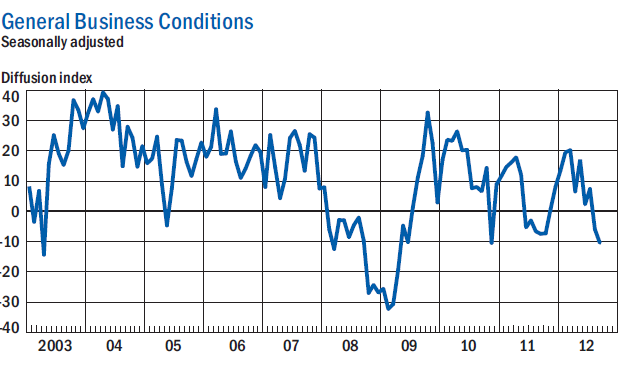
The Empire State Manufacturing Survey showed manufacturing in the New York region contracted more than expected. Just more evidence that the economy is losing steam going into the election. The diffusion index is now at the lows of late 2010. FWIW, I am hearing initial forecasts for 3Q GDP growth coming in around 1%. Meanwhile, several business owners testified last week that regulatory uncertainty is driving a lot of the inaction.

Paul Krugman has yet another editorial ridiculing anyone who disagrees with ZIRP and QE.  Nobody attacks a strawman with more savagery than Dr. Cowbell, who imagines he is debating with someone who honestly fears Zimbabwean style inflation (yes, he actually did say that).  Right now, commodities are soaring along with the stock market.  Wages are flat to falling.  So, a combination of flat wages and increased food and energy prices equals lower disposable income. I suspect a lot of middle class people would prefer not to have this “help.”  Or seniors, for that matter, who receive meager interest income from Treasuries and high quality corporate bonds.

Rick Santelli (kind of the anti-Krugman) raises some good points about why QE might not end up influencing mortgage rates to the consumer.  Why?  Because we are raising the guarantee fee on conforming mortgages, and the banks will respond to the GSE’s round of put-backs by increasing borrowing costs. His view on ZIRP – the government needs to borrow a lot of money and needs interest rates as low as possible. He also notes that a lot of the floor traders have become mortgage bankers.

Investors in foreclosed properties now have a new source of funds – banks! Waypoint Real Estate Group got $65 million from Citi to buy foreclosed properties. Citi is also working on a way to issue securities backed by rental income streams. This is very good news for the housing market.

Why Gene Weingarten is an A–hat

Yellojkt got something of a shout out in Gene Weingarten’s column this week in which he discusses his interactions with the commenterati. Here’s the relevant paragraph:

“The comparatively erudite Yellojkt, a frequent disparager of mine, periodically writes lengthy, joyful disquisitions on my abject failings as a professional, such as the blog item I am looking at from 2008, which goes on for pages and includes multiple links and is titled “Why Gene Weingarten Is an A–hat.” (Abstract: Because I suck.)”

The full column can be found here.

BB