Morning Report – Risk On 02/05/13

Vital Statistics:

  Last Change Percent
S&P Futures  1499.6 6.2 0.42%
Eurostoxx Index 2645.8 20.6 0.78%
Oil (WTI) 96.73 0.6 0.58%
LIBOR 0.296 0.000 0.00%
US Dollar Index (DXY) 79.63 0.075 0.09%
10 Year Govt Bond Yield 2.01% 0.06%  
RPX Composite Real Estate Index 193 -0.1  

Markets have a better tone this morning after yesterday’s sell-off.  Euro sovereign yields are down.  Bond yields are at the 2% level.

Stock index futures back up.  Dell doing a $23B LBO. Retail Investors Returning. Bonds can’t get out of their own way. Is the risk-on trade happening?  Feels like it. That said, the S&P 500 is nearing the top of its trading range since 2000. The 1970s bear market was a rangebound market where people would start to pile in at the top, only to have a crisis or inflation push the market back down.  The final cri de coeur was Business Week’s late 1979 piece The Death of Equities. That is what secular bear markets feel like when they end. The article even quotes a very happy diamond dealer in NY after ERISA changed the laws to let institutions buy hard assets, as if CALPERS was going to start burying gemstones in the back yard. 

Chart:  1970s Bear Market in Stocks.

The CoreLogic Home Price Index rose 8.3% in December, the biggest jump since May 2006. Excluding distressed sales, prices increased 7.5%.  They are forecasting a 7.9% YOY jump in January. The states with the biggest growth were AZ, NV, ID, CA, and HI.  The worst were DE, IL, NJ, and PA. It does feel like the secular bear in real estate is over. 

Listings of new homes has dropped to a 12-year low. For all of the fears of the shadow inventory, the problem seems to be a lack of merchandise. Many potential sellers are holding out for better prices, while professional investors are buying properties before they even hit the market.  Mark Zandi of Moody’s estimates that inventories might remain tight for a year or two. Sellers are worried that they may not be able to find a replacement home if they sell. This means the homebuilders are going to have a very good year.

Senate Democrats are trying to figure out a way to delay the sequestration cuts scheduled to take effect March 1. They are looking to replace the spending cuts with a surtax on oil companies and an end to the carried interest loophole. Meanwhile, House Republicans are considering a stopgap measure that would fund the government through Sep 30, which is $974 billion, well below the current level of $1.043T. Implicit in that measure is the assumption that the sequestration cuts happen. Republicans are resigned to having to accept the sequestration cuts and don’t have the appetite to try an negotiate a deal with the WH, which is going to delay releasing its budget until late March. While it has zero prospect of getting enacted as-is, it will be a clue as to whether the President is interested in some sort of long-term solution to the budget or is content to fiddle at the margins with what is currently out there.

Bites & Pieces: Slow Squid

Squid has a lot going for it. The species grows rapidly and so is considered sustainable. It’s high in protein and low in fat. Well, at least until you bread it, deep fry it, and serve it with marinara sauce. As bar food goes, it’s a favorite of mine. The Carlyle in Shirlington has a particularly good version. My mother always has it when visiting town. One of the most interesting squid dishes I had was at the Green Street Grill in Cambridge, MA. It was made Provencal style with garlic and tomatoes. It was an eye opener and one of my favorite ways to make squid.

I wanted to do something different with the squid I bought at my favorite waterfront fish monger on Friday (Captain White’s). Squid can be tricky to cook as if you cook it for more than a minute or two, you may as well serve up a plate of rubber bands. There are various strategies to tenderize it, but it comes down to a fast cook. Turns out that squid shares a characteristics with some of my favorite cuts of beef. You can cook it fast, but you can also cook it slow. In the case of beef, the collagen gradually breaks down and a tough cut of meat becomes melt in your mouth tender. That didn’t happen with the squid, but it was tender and the recipe is easy enough for a weeknight meal.

I slightly adapted a recipe originally published in Gourmet, which can be found on the Epicurious web site.. NPR also has a story on slow cooked squid with some recipes that I plan to investigate in the near future.

The dish has a flavor I’ve never gotten out of squid before. I love linguini with clams or mussels for the flavor one gets out of the shellfish, but don’t really care for the meat. We served the dish over black rice. It’d be good with linguini as well. I think that one could add fennel or another root vegetable to the dish.

I adapted the Epicurious recipe slightly. The original recipe calls for cooking just the garlic and parsley, then adding the squid. I decided to cook some chopped onions with the parsley and then add the garlic. I used a can of chopped tomatoes; they suggested using whole tomatoes and chopping them. The original recipe calls for adding ¾ of a cup of wine and ¼ cup of water after adding the squid and simmering for 10 minutes to reduce the liquid. Then, add the tomatoes and simmer on the stove top for 45 minutes, stirring occasionally. I wanted to make this a simple dish, so I added the wine and tomatoes together, brought it up to a simmer, and then braised the dish in the oven.

[Edit: I forgot that I added a teaspoon or two of capers to the dish as I thought they would fit and, well, I love capers.]

I had two half pound squid bodies rather than the pound and a half, but it was plenty for us. I cut them up into half inch squares, then rinsed, dried and coated them with olive oil. I thought that would give me more even cooking at the onset. They were about a quarter inch thick, so made good meaty bites. This would work well with smaller squid and I would encourage you to use the tentacles. Octopus might be good in this dish as well.

Ingredients

1 ½ pounds of squid, cleaned
1/4 cup minced onions or shallots
1 bunch of parsley, finely chopped
1 cloves of garlic, finely chopped
¼ teaspoon of red pepper flakes (optional or use to taste)
½ cup of dry white wine
28 oz. can of chopped tomatoes

Method

Cut the squid bodies into pieces or rings. Combine with tentacles if you have them. Rinse and dry, then toss with olive oil to coat.

Once the squid is ready, it’s a good time to turn on the oven. I set mine at 350 degrees, but would probably use a lower temperature (perhaps 300) the next time.

Reserve 2 tablespoon of chopped parsley for garnish (which I forgot to use).

Heat about 2 tablespoons of olive oil in a heavy pot or dutch oven. Add the chopped onion and parsley and stir for a minute. Add garlic and stir for another minute. Create a small open space, pour in a little olive oil, and add the red chile flakes. Mix everything together and add the squid. Cook for a minute or two and then add the wine and tomatoes. Bring to a simmer over medium heat and then throw into the oven, uncovered. Cook until the water evaporates, about 45 minutes to an hour.

Remove from the oven and serve over pasta or rice. Garnish with parsley.

BB

Morning Report – The Great Rotation? 02/04/13

Vital Statistics: 

  Last Change Percent
S&P Futures  1503.0 -3.7 -0.25%
Eurostoxx Index 2679.2 -30.9 -1.14%
Oil (WTI) 96.79 -1.0 -1.00%
LIBOR 0.296 0.000 0.00%
US Dollar Index (DXY) 79.45 0.325 0.41%
10 Year Govt Bond Yield 2.03% 0.01%  
RPX Composite Real Estate Index 193.1 0.0  

Markets are weaker on the back of big declines in the Italian and Spanish bourses. Euro sovereign yields are starting to tick back up. There doesn’t seem to be a story out there driving it. 

As the bond market has backed up, there is a lot of talk about whether this is the big rotation out of bonds and into stocks. Within the bond market, there is a rotation out of Treasuries and into high yield. Overall, the “risk on” trade seems to be gaining steam, which means we have seen the low point for mortgage rates. It also means that the private label market might come back.

Obama wants more revenue, specifically through reducing loopholes and deductions. I don’t know if this is posturing for the sequestration cuts or something else. Liberals are using the negative Q4 GDP report to argue that we can’t cut spending. That is simplistic – Q3 government spending was higher than normal due to the government’s “use it or lose it” budgeting. The government’s fiscal year ends in September, and there is always a push to spend your budget, even if you don’t really need it, to ensure your budget doesn’t get cut. Which means that Q4’s government spending was borrowed in Q3. Obama is being a little disingenuous when he says things like “The big problem was defense spending was cut 22 percent, the biggest drop in 40 years.” which implies we are already cutting to the bone. He is in favor of “smart spending reductions,” whatever that means, to bring down the deficit.  I suspect the only smart spending reductions he favors are the Orwellian-named “tax expenditures” and oil subsidies.  And don’t forget, the definition of what is considered a spending cut depends greatly on what the baseline is when you start counting. Many in Washington prefer to use the baseline from when spending was the highest (late 2010) as the baseline, project spending out 10 years from there, and count any difference between the old projection and the new projection as a “spending cut.”

The Straw Krugman

Dr. Cowbell (to steal just one of his nicknames) is both flattered and amused by how he has become the favorite boogeyman of the right:

Funny: Angry Bear finds some of the usual suspects explaining How to Debate Paul Krugman, and the answer appears to be this: invent a straw man who bears no resemblance at all to the economist/columnist of the same name, and ridicule that imaginary person.

I have to say, never in my wildest dreams did I imagine that I could play the role of History’s Greatest Monster to so many people. Thank you for the honor!

Aside from the silliness of the exercise, this little exchange is another illustration of a point I’ve noticed before: the way hard-right commentators assume that the other side must be their mirror image. They insist that no government intervention is ever justified; so liberals must support any and all government interventions. They want smaller government, as a principle; liberals must want bigger government, never mind what for. They believe that deficits and printing money are always evil; liberals must be for deficits and money-printing under all circumstances.

I’m sympathetic to this argument because I’ve seen it in action. It seems that expressing an opinion that the legitimate of role of government is slightly more than what Friedrich Hayek (or Ron Paul) would allow makes one an advocate of Politburo-style central planning.

The column Krugman links too has a deeper link to this item where Krugman’s Articles of Faith are enumerated. I’ve conveniently bolded the portions which do seem like legitimate strawman statements.

1) Recessions, depressions and crises are the result of the unhampered market. We actually do not have to investigate if markets were really free when recessions occurred or what really were the specific causes of whatever threw the economy off track. When there is a recession, depression or crisis, there must have been too much of an uncontrolled market.

2) The Great Depression was caused by uncontrolled markets.

3) Recessions, depressions and crises are practically the result of one problem: a lack of aggregate demand. People, for whatever reason (and who cares about the reason; let’s not get hung up on those details) don’t spend enough. If everybody were to spend more, people would sell more. Problem solved. It is the role of government to get people spending again. This is done by printing money and causing inflation so that people spend the money rather than save it. Or by the government running up deficits and spending it on behalf of the stupid savers.

4) The Great Depression was solved by the government spending lots of money and the central bank printing lots of money.

5) This explains ALL economic problems.

6) If there are recessions, depressions and crises, they can all be solved by printing money and by deficit spending.

7) If after many rounds of money printing and deficit spending, there is still a recession, then only one conclusion is permissible: There was obviously not enough money printing and deficit spending. We need more of it.

8) If after another round of money printing and deficit spending we still have a recession, then….well, do you not get it? We obviously have NOT PRINTED ENOUGH MONEY and we are NOT ACCUMULATING ENOUGH DEBT! And, by the way, remember 7) above.

Krugman is practicing Keynesianism as a religion. The 8 commandments above are not to be questioned. Whoever questions them is not worthy of debate.

Now, this attack is not completely unfair since Krugman is easily the most visible and vocal advocate of classical Keynesian stimulus. But also in the article is a video of noted libertarian Hans-Hermann Hoppe, a stereotypical Austrian Economist in both accent and philosophy, who says this is the way to engage Krugman:

Ask some questions almost like a child. Explain to me how increases in paper pieces can possibly make a society richer. If that were the case, explain to me why is there still poverty in the world? Isn’t every central bank in the world capable of printing as much paper as they want?

Now here is a debating style I have come to be familiar with recently. Just pepper someone with a litany of seemingly simple questions which belie the fundamental assumptions and premises beneath them.

If we were to pick a Most Ridiculed Pundit on ATiM, Krugman would probably be in the top three. And I am no fan of his tendency to insult the basic education of his opponents, particularly ones with credentials approaching his own. But to engage in my own logical fallacy of Arguing From Authority, they don’t give out Nobel Prizes for collecting box tops. Krugman is both fun to read and fun to ridicule but he rarely makes the arguments people claim he has made. Or when he has, he is far more likely to be right than the people just tearing him down on an ad hominem basis.

Morning Report – Jobs Day 02/01/13

Vital Statistics:

  Last Change Percent
S&P Futures  1501.6 8.3 0.56%
Eurostoxx Index 2707.2 4.2 0.16%
Oil (WTI) 97.39 -0.1 -0.10%
LIBOR 0.296 -0.003 -0.84%
US Dollar Index (DXY) 79.06 -0.144 -0.18%
10 Year Govt Bond Yield 1.99% 0.01%  
RPX Composite Real Estate Index 193.1 -0.2  

Futures are higher this morning after Jan payroll data.  157k jobs were added in January and the unemployment rate ticked up .1% to 7.9%.  Separately, there is a slew of economic data this morning. The University of Michigan consumer confidence rose to 73.8, construction spending rose .9% in Dec, and the ISM manufacturing survey rose to 53.1 from 50.7, a big upside surprise.  Both bonds and stock have found something to like in the data and are rallying.

The internals of the job report show that construction employment has been accelerating during what should be a seasonally slow period.  Weekly hours dropped. The labor force participation rate was unchanged at 63.6%. The BLS also made some revisions and adjustments to the historical numbers, which had the effect of increasing job creation during the past year and increasing the size of the labor force. It also means that some historical comparisons are not “apples to apples.” The market is focusing on the 7.9% unemployment number because that is what is driving the Fed at the moment. Overall, it was a mixed report, showing the labor market is improving, albeit slowly.

Chart:  US Unemployment Rate:

St Louis Fed President James Bullard says that unemployment in the “low 7s” could cause the Fed to end QE. 

Lender Processing Services has put out its January Mortgage Monitor. They show that foreclosure sales are at the lowest level since March of 2009, although starts are beginning to tick up again. Speaking of foreclosures, CoreLogic reported 56,000 foreclosures in November (a 3% YOY drop).  Pre-bubble run rates are closer to 21k.  Approximately 1.2 million homes were in the national foreclosure inventory at the end of 2012, which is a 20% decrease from the prior year. 

As home prices increase, more and more previously underwater homeowners are becoming eligible to refinance – LPS estimates the number could be 4 million.  Which means that in spite of rising interest rates, the refi boom may still have some legs.

Is cheap energy the answer to the problem of offshoring?  Nucor is building a new plant in Louisiana, after sending production to Trinidad.  The reason?  Cheap natural gas as a result of fracking.  Will it make much of a dent in unemployment?  Probably not, as it will only employ 150 people who will make on average $75k. Manufacturing is increasingly hiring highly paid skilled workers and not the unskilled. That said, the oil and gas industry does have a need for unskilled labor. 

Bill Gross says the rise in unemployment is giving the bond market a “period of rest”, meaning there is room for a bond market rally. He is recommending the 5 year and is avoiding duration as he believes that QE has made the bond market “bubbly.” It will be interesting to see what the bursting of that bubble will do to the economy. 

Morning Report – New Government Refi Program? 01/31/2013

Vital Statistics:

  Last Change Percent
S&P Futures  1494.0 -1.3 -0.09%
Eurostoxx Index 2710.9 -21.2 -0.78%
Oil (WTI) 97.69 -0.2 -0.26%
LIBOR 0.298 -0.001 -0.17%
US Dollar Index (DXY) 79.31 0.026 0.03%
10 Year Govt Bond Yield 1.97% -0.02%  
RPX Composite Real Estate Index 193.3 0.2  

Markets are down small as the earnings reports continue to stream in.  Economic bellwether UPS missed analyst estimates. Initial Jobless Claims came in at 368k.  Incomes and spending rose.  Bonds and MBS are continuing to rally after the FOMC statement yesterday.

The FOMC statement broke little new ground with the exception that they may have walked back their plan to end QE this year.  Recall from the minutes of the Dec meeting, the consensus seemed to be that purchases of Treasuries and MBS would end sometime in 2013, probably towards the end of the year. That was unexpected and caused a sell-off in bonds.  Yesterday, they said that if the outlook for the labor market does not improve substantially, they will continue to purchase Treasury and agency MBS.  That caused a rally in bonds yesterday.  Aside from that, the minutes contained nothing new.

As the sequestration approaches, defense contractors are relatively sanguine. Typical corporate optimism or do they know something the rest of us don’t?  Regarding the sequestration the latest amount for spending reduction is $85 billion.  The requested increase in spending from 2012 to 2013 is $74 billion.  So we are really talking about flat YOY spending (it really is a drop of $9 billion in the context of a $15.8 trillion economy).  The most likely outcome is that the sequester happens and no one notices.

Another underwater refi program is in the works, which would allow underwater borrowers in private label securitizations to refi into a government loan.  Another pilot program would have Treasury buy mortgages out of private label pools and mod the rates.  A backup plan would have Treasury cut the rates and pass on the difference between the old and new rate to the investor for 5 years.  If Washington comes up with a robust plan, the refi boom (which was thought to be over) could still have some legs.  

Opposition to Obamacare is coming from an unlikely source:  unions.

Break out the checkbooks

The FEC has updated the campaign contribution limits for the 2014 cycle.

FEC Increases Contribution Limits for 2014
By Kyle Trygstad Posted at 10:19 p.m. on Jan. 29

The Federal Election Commission increased the limits on contributions that individuals can give to candidates for federal office and national party committees in the 2014 election cycle.

Individual donors can now contribute up to $2,600 to a candidate in both the primary and general elections — $5,200 total — and $32,400 per calendar year to national party committees. The total amount of federal contributions that an individual can give during a two-year cycle also increased to $123,200, including $48,600 to candidates and $74,600 to parties and political action committees.

Those and other contribution limit figures are indexed for inflation as directed in the Bipartisan Campaign Reform Act of 2002, better known as McCain-Feingold, and generally increase with every election cycle.

The individual donation to candidates has gone up about $100 per election — from $2,100 in the 2006 cycle to $2,300 in 2008, $2,400 in 2010 and $2,500 in 2012. Individual donation limits to national party committees was $30,800 per calendar year in 2012 and $26,700 in 2006.

This cycle, the limit on national party contributions to Senate candidates went up to $45,400. They were limited to $43,100 in 2012 and $37,300 in 2006.

Morning Report – Negative Q4 GDP? 01/30/2013

Vital Statistics:

  Last Change Percent
S&P Futures  1502.2 -2.9 -0.19%
Eurostoxx Index 2741.1 -8.1 -0.30%
Oil (WTI) 97.63 0.1 0.06%
LIBOR 0.299 -0.002 -0.67%
US Dollar Index (DXY) 79.42 -0.142 -0.18%
10 Year Govt Bond Yield 1.99% 0.00%  
RPX Composite Real Estate Index 193.1 -0.3  


Markets are lower on a surprisingly weak 4Q GDP number, which showed the economy contracted by .1%.    The ADP employment change report showed the economy added 192k jobs in January.  Mortgage Applications fell 8% last week.  Later today, we will get the FOMC rate decision. The 10 year, which was above 2% earlier is back down below.  MBS are up small.

The Q4 GDP number was surprisingly weak (the Street was at + 1.1%) and will undoubtedly be revised upward as it does not jive with the other data points out there.  Certainly the earnings reports we are seeing out of Corporate America do not indicate a recession.  This is the “advance” report (the first of three) and is based on incomplete data.  The next estimate will be released at the end of Feb.  

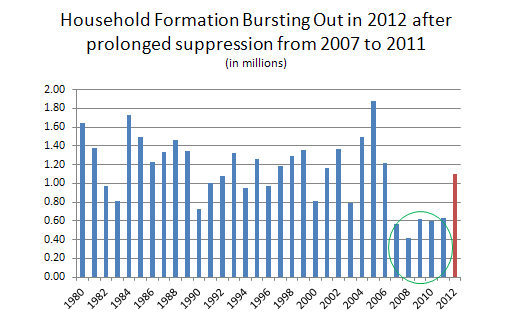
NAR has a good piece on the home ownership rate and household formation. The latest homeownership rate of 65.3% is the lowest since 1996.  Renters have been increasing.  They estimate that household formation broke out of its doldrums in 2012 and will be close to normalcy – around 1.1 million.  Note that this represents pent-up demand for housing as the Great Recession drove the low numbers, not demographics.  Of course some of these new households will go to rentals, but many will start purchasing starter homes, and they are the key to get transactions flowing again. This would also help ease the burden on the sandwich generation.

Chart:  Household Formation:

Looks like the sequester is going to happen, though the recent GDP report may give lawmakers a push to do something about it.  

When the FOMC statement is released, people will be focusing on the end of QE. Aside from the effect on interest rates, there is also the question about the size of the Fed’s balance sheet.  A recent paper projects the Fed’s balance sheet to start contracting in 2015, with a return to a more normal size in early 2018.  The Fed has been highly profitable during QE, since its own buying influences prices and makes its holdings of MBS and Treasuries more valuable. But what happens when they begin to sell?  The Fed may in fact lose money over the next few years, which will undoubtedly bring a political angle into the future role of the Fed.  Whoever succeeds Ben Bernake will, like Paul Volcker, preside over a Fed that will be unpopular, to say the least. 

Morning Report – The Secular Bear 01/29/13

Vital Statistics:

  Last Change Percent
S&P Futures  1492.9 -4.2 -0.28%
Eurostoxx Index 2736.0 -8.5 -0.31%
Oil (WTI) 96.55 0.1 0.11%
LIBOR 0.301 -0.001 -0.33%
US Dollar Index (DXY) 79.8 0.023 0.03%
10 Year Govt Bond Yield 1.96% -0.01%  
RPX Composite Real Estate Index 193.4 0.8  

Stock index futures are weaker as the Fed kicks off its January FOMC meeting. The markets will be parsing the press release looking for clues regarding the end of QE, specifically the timing and the economic variables that influence the decision. Today is a very heavy earnings day, with Danaher, Ford, EMC, International Paper, and Pfizer reporting. Bonds and MBS are up a tick or two.

The S&P Case-Schiller index of home values rose 5.5% YOY and .6% MOM in the month of November.   The hardest hit areas (Phoenix, Detroit, Las Vegas) showed the biggest YOY increases (Phoenix was up 23%!), while the New York declined 1.2% 

DR Horton reported a 39% increase in revenues and a 26% jump in homes closed from a year ago.  Orders were up 39% and backlog was up 62%. Like the other homebuilders, DHI is reporting general strength in their housing markets.  There was a shift towards larger houses as well, as the dollar increase in the value of homes built increased 60%, while the number of units increased 39%.  They are looking forward to the spring selling season with optimism.  The stock is up about 4% pre-open. 

Is the “risk on” trade we have been waiting for since 2007 finally on?  Trim Tabs is reporting that last month was a record month for inflows for stock mutual funds and ETFs – the last time we had inflows of this magnitude was the winter of 2000, right as the tech bubble was bursting.  Time to be cautious or time to break out the champagne?  Reason for optimism:  There are no, repeat no, signs of overheating in the economy.  If anything there is a tremendous amount of pent-up demand.  That is not recessionary, and should therefore be bullish for stocks.  Reason for pessimism:  Interest rates are going up. The great secular bull market in bonds that began with Paul Volcker’s tightening in 1981 is ending. The end of QE will mean long-term rates will rise, and short-term rates will soon follow. Also, we are in a secular bear market for stocks, and those rare animals typically last a lot longer than 12 years. 

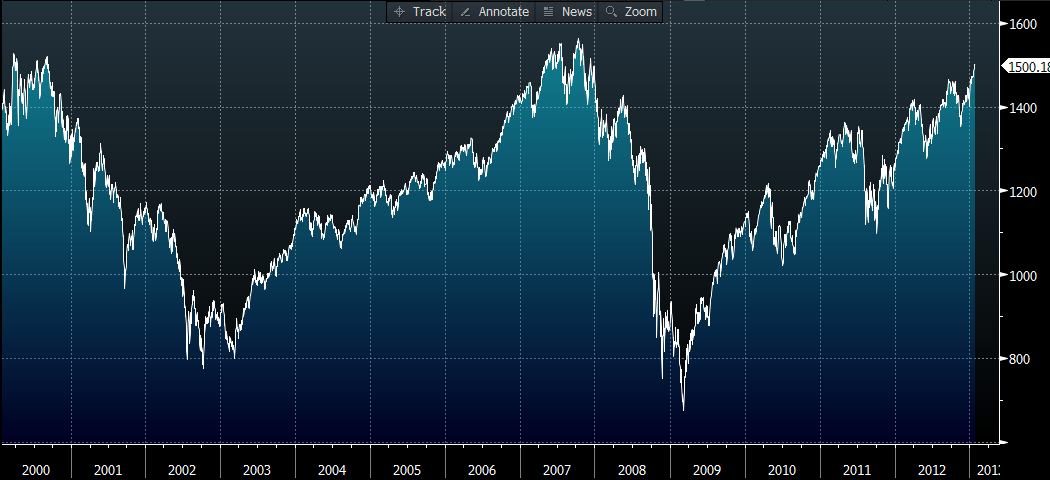
This secular bear market in stocks resembles the bear market of the 1970s. with stocks trading in a large range that oscillates over a period of years, while going nowhere.  To put the 1970s in perspective, the Dow Jones Industrial Average was at roughly the same place when I graduated from high school as it was when I was born.  

Chart:  Dow Jones Industrial Average 1965 – 1983: 

Compare to the S&P 500 since 2000: 


Similar oscillating pattern, with higher highs, and lower lows. If you believe in charts, they suggest a further run to eclipse the previous high and then a swoon lower. So, you might have another 8% – 10% left before the market heads back down again. 

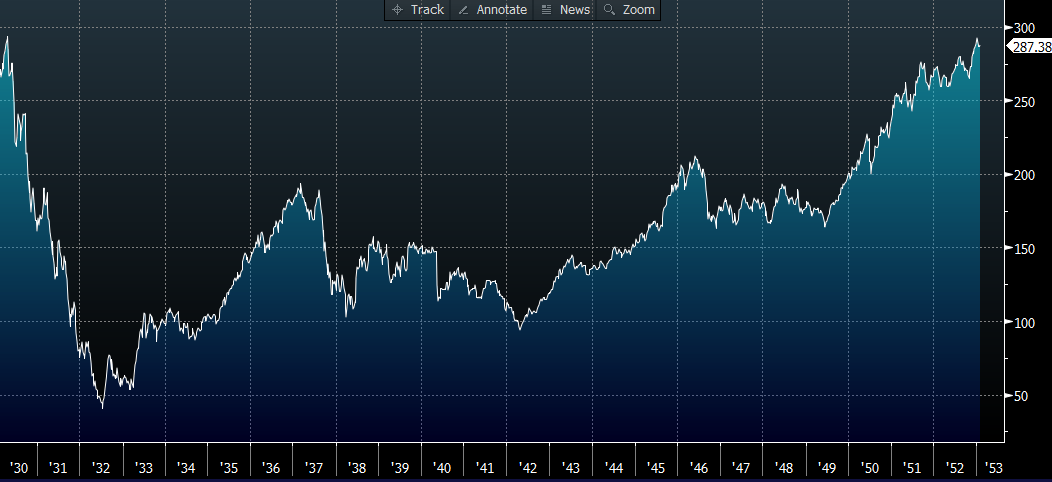
Of course we have one other secular bear market to look at:  the granddaddy of them all:

23 years of a secular bear – it took until 1953 to recover the losses from the 1929 crash.  Some stock market darlings – Radio Corporation of America (aka RCA) never regained its peak from the 1920s. The economic backdrop of deleveraging has a lot more in common with the Depression bear than the 1970s bear which was driven by commodity price shocks and inflation.

Of course as Wall Street loves to say, past performance is not indicative of future performance, and charts are just that – representations of history that may or may not be relevant. The market may not follow either pattern.  But, remember the great secular bull market in stocks from 1983 – 2000 was accompanied by a secular bull market in bonds that began at roughly the same time.  That will not be the case this time around. 

Morning Report – New Fannie Mae DIL program 01/28/13

Vital Statistics:


Last

Change

Percent

S&P Futures 

1497.4

1.7

0.11%

Eurostoxx Index

2747.9

3.7

0.13%

Oil (WTI)

96.17

0.3

0.30%

LIBOR

0.302

0.001

0.33%

US Dollar Index (DXY)

79.84

0.092

0.12%

10 Year Govt Bond Yield

1.96%

0.02%


RPX Composite Real Estate Index

192.6

0.0


Markets are slightly higher this morning after a strong earnings report from Caterpillar and strong durable goods numbers. Bonds continue their swoon, with the 10 year approaching 2%. Is the “risk on” trade we have been waiting for since 2008 finally at hand?  MBS are down as well.

Fannie Mae is offering deed-in-lieu options for underwater borrowers who are current on their mortgage and have experienced some sort of hardship like illness, job change, or other problems.  It effectively allows these homeowners to “toss the keys to the bank” and walk away from their underwater property with the underwater portion of their mortgage debt forgiven. The program does not address mortgages, so a second-lien holder could prevent a homeowner from walking away.

The Federal Appeals Court has rejected Obama’s recess appointments, specifically his appointments to the NLRB and the CFPB. Cordray’s appointment to head the CFPB was an interim appointment, and he will have to go through the process for his 5-year term.  Will it change anything for people in the industry?  Probably not.

Since we have kicked the debt ceiling can down the road for a few months, the next item is the sequestration – which is all of the automatic spending cuts that kick in.  Half will be in defense, and half will be in non-defense discretionary spending. Paul Ryan was on Meet the Press and said that he expects the sequestration cuts will happen.  Agencies are bracing for the cuts to happen as well.

Looks like the eminent domain idea is officially dead, at least in California.