Morning Report – watch the PIIGS 7/3/13

Vital Statistics:

  Last Change Percent
S&P Futures  1603.2 -4.0 -0.25%
Eurostoxx Index 2558.8 -44.4 -1.71%
Oil (WTI) 101.4 1.8 1.78%
LIBOR 0.274 0.001 0.37%
US Dollar Index (DXY) 83.39 -0.151 -0.18%
10 Year Govt Bond Yield 2.46% -0.01%  
Current Coupon Ginnie Mae TBA 102.5 0.1  
Current Coupon Fannie Mae TBA 101.4 0.0  
RPX Composite Real Estate Index 204.2 -0.3  
BankRate 30 Year Fixed Rate Mortgage 4.35    
Early close today for stocks (1:00 pm) and bonds (2:00 pm). 
 
Markets are down small after political issues in Europe are pushing PIIGS spreads out. The Portuguese 10 year yield is 117 basis points higher to 7.89% and Greece is out 58 bps. Want to know what can stop the bond market selloff in its tracks?  Risk off trade due to European sovereign bond problems
 
We have a slew of economic data this morning, and Friday’s jobs report looms large. Mortgage applications fell 12%. Purchases were down 3%, while refis dropped 16%. The ADP Employment Change report which foreshadows the private part of Friday’s jobs report came in better than expected at +188k. Initial Jobless Claims were 343k, better than expected. 
 
The Fed approved Basel III capital requirements yesterday. The Fed apparently relaxed some of the capital requirements for mortgages, but it appears this would only apply to community banks. I haven’t seen anything with regards to MSRs.

REPRINTED WITHOUT PERMISSION 7-2-13

Why They Fought
By DAVID BROOKS

Tuesday is the 150th anniversary of the second day of the Battle of Gettysburg. In his eloquent new account, “Gettysburg: the Last Invasion,” the historian Allen Guelzo describes the psychology of the fighters on that day.

A battlefield is “the lonesomest place which men share together,” a soldier once observed. At Gettysburg, the men were sometimes isolated within the rolling clouds of gun smoke and unnerved by what Guelzo calls “the weird harmonic ring of bullets striking fixed bayonets.” They were often terrified, of course, sometimes losing bladder and bowel control. (Aristophanes once called battle “the terrible one, the tough one, the one upon the legs.”)

But, as Guelzo notes, the Civil War was fought with “an amateurism of spirit and an innocence of intent, which would be touching if that same amateurism had not also contrived to make it so bloody.”

Discipline was loose. Civil War soldiers were not used to subordinating themselves within large organizations. One veteran observed that in battle “men standing in line got in paroxysms of laughter.” But many were motivated by the sense that they were living up to some high moral ideal. Words like “gallant,” “valor” and “chivalric” dot their descriptions of each other’s behavior. Upon being taken prisoner, one Union soldier shook his captors’ hands and congratulated them on the “most splendid charge of the war.”

Another officer remembered battle as a “supreme minute to you; you are in ecstasies.” A Union artillery officer confessed that throughout Gettysburg “somehow or other I felt a joyous exaltation, a perfect indifference to circumstances, through the whole of that three days’ fight, and I have seldom enjoyed three days more in my life.”

In our current era, as the saying goes, we take that which is lower to be more real. We generally believe that soldiers under the gritty harshness of war are not thinking about high ideals like gallantry. They are just trying to get through the day or protect their buddies. Since World War I, as Hemingway famously put it, abstract words like “honor” and “glory” and “courage” often seem obscene and pretentious. Studies of letters sent home by soldiers in World War II suggest that grand ideas were remote from their daily concerns.

But Civil War soldiers were different. In his 1997 book “For Cause and Comrades,” James M. McPherson looked at the private letters Civil War soldiers sent to their loved ones. As McPherson noted, they ring with “patriotism, ideology, concepts of duty, honor, manhood and community.”

The soldiers were intensely political. Newspapers were desperately sought after in camp. Between battles, several regiments held formal debates on subjects like the constitutional issues raised by the war. “Ideological motifs almost leap from many pages of these documents,” McPherson reports. “It is government against anarchy, law against disorder,” a Philadelphia printer wrote, explaining his desire to fight.

The letters were also explicitly moralistic. “The consciousness of duty was pervasive in Victorian America,” McPherson writes. The letters were studded with the language of personal honor, and, above all, a desire to sacrifice, as one soldier put it, “personal feelings and inclinations to … my duty in the hour of danger.”

One of the most famous letters was written not at Gettysburg but on July 14, 1861, on the eve of the First Battle of Bull Run. It was written by Sullivan Ballou, an officer from Rhode Island. Ballou had lost his own parents when he was young and, having known “the bitter fruit of orphanage myself,” he declared himself loath to die in battle and leave his small children fatherless.

“My love for you is deathless,” he wrote to his wife. “It seems to bind me to you with mighty cables that nothing but Omnipotence could break; yet my love of country comes over me like a strong wind and bears me irresistibly on with all these chains to the battlefield.”

It’s not just love of country that impels him, but a feeling of indebtedness to the past: “I know how strongly American Civilization now leans upon the triumph of the Government, and how great a debt we owe to those who went before us through the blood and suffering of the Revolution. And I am willing — perfectly willing — to lay down all my joys in this life, to help maintain this Government, and to pay that debt.”

These letter writers, and many of the men at Gettysburg, were not just different than most of us today because their language was more high flown and earnest. There was probably also a greater covenantal consciousness, a belief that they were born in a state of indebtedness to an ongoing project, and they would inevitably be called upon to pay these debts, to come square with the country, even at the cost of their lives.

Makes today’s special interest politics look kind of pathetic.

Morning Report – Highest home price appreciation since Feb 2006 7/2/13

Vital Statistics:

  Last Change Percent
S&P Futures  1606.5 -0.2 -0.01%
Eurostoxx Index 2597.2 -25.4 -0.97%
Oil (WTI) 98.8 0.8 0.83%
LIBOR 0.273 0.000 -0.07%
US Dollar Index (DXY) 83.42 0.368 0.44%
10 Year Govt Bond Yield 2.48% 0.00%  
Current Coupon Ginnie Mae TBA 102.8 0.1  
Current Coupon Fannie Mae TBA 101.5 -0.1  
RPX Composite Real Estate Index 204.5 -0.8  
BankRate 30 Year Fixed Rate Mortgage 4.34    


Markets are flattish on no real news. Later on today, we will get the ISM New York, Factory Orders, IBD / TIPP Economic Optimism and Vehicle Sales. None of these releases should be market moving. Bonds and MBS are flat.
 
The Fed votes on the Finalized Basel III rules today. For originators, the most important part of this will be the treatment of mortgage servicing rights. Basel III requires banks to over-reserve for MSRs once they reach a threshold point as a percent of capital. MSRs had been under pressure for quite some time in anticipation of the rule, but now that rates are rising, you are starting to see cheeky bids for newly-originated MSRs. For LO’s, the value of MSRs affects the value of SRPs which influences your ratesheet.
 
The CoreLogic Home Price index rose 12.2% in May, which was the highest price increase since Feb 2006. Excluding distressed sales, prices rose 11.6%. Home prices nationwide remain 20.4% below their peak which was set in April 2006. The Pending Home Price Index indicates that prices are expected to rise even more (13.2%) in June. These sales would have had contract signings before interest rates started backing up, so you can’t read too much into how higher rates are affecting home prices, but the pending home price index is encouraging. 
 
12 month home price appreciation:
  • Arizona – 16.9%
  • California – 20.2%
  • Connecticut – 3.8%
  • Florida – 11.1%
  • Nevada – 26%
  • New York – 9.8%
  • North Carolina – 5.6%
  • Tennessee – 5.3%
  • Texas – 8.5%
In anticipation of Friday’s jobs report, here is a cool little widget courtesy of the Federal Reserve Bank of Atlanta. The jobs calculator shows you how many jobs need to be created to get the unemployment rate down to a target rate. You can play with the labor force participation rate, population growth rate, etc. If you  take Ben Bernanke at his word that the Fed will end QE when unemployment hits 7%, you can use the calculator to figure out whether we are on pace or not.
 
Finally, I did an interview on Capital Markets Today where I discussed the recent rise in rates and its implications for housing and the economy. Check it out.


Latest interview on Blog Talk Radio. 7/1/13

I talk about the Fed, interest rates, and real estate.

http://www.blogtalkradio.com/capitalmarketstoday/2013/07/01/special-edition-market-turmoil-bond-market-interest-rates

Morning Report – Record outflows in bond funds 7/1/13

Vital Statistics:

Last Change Percent
S&P Futures 1607.5 8.2 0.51%
Eurostoxx Index 2618.1 15.5 0.60%
Oil (WTI) 97.87 1.3 1.36%
LIBOR 0.273 0.000 0.00%
US Dollar Index (DXY) 83.16 0.022 0.03%
10 Year Govt Bond Yield 2.53% 0.04%
Current Coupon Ginnie Mae TBA 102.3 -0.2
Current Coupon Fannie Mae TBA 101.3 -0.2
RPX Composite Real Estate Index 205.3 -0.2
BankRate 30 Year Fixed Rate Mortgage 4.39


Markets are higher on no real news. The Markit US Purchasing Managers Index came in a little lower than expected. Later this morning we will get construction spending and the ISM manufacturing. ISM could be market moving. Bonds and MBS are down.


This week is relatively data-light, with the 4th of July holiday in the middle. The highlight of the week will be the jobs report on Friday.


record $80 billion was pulled out of bond funds and bond ETF funds in the month of June, according to Trim Tabs. This record outflow is also based on people who follow the news closely. Q2 statements are coming out soon and a lot of people who don’t follow their investments closely may be in for a shock. Which means we could face another deluge of selling.


Delinquencies are falling again, with serious delinquencies dropping to 2.83% in the month of May, according to Fannie Mae’s monthly summary. Serious DQs were 3.57% a year ago. Separately, Citi paid just under $1 billion to settle buyback claims on mortgages originated from 2000 to 2012.


I will be on Capital Markets Today later this afternoon discussing the latest from the bond markets

A Blazing Hot Sunday in CA

Saturday it was 104 and today it’s supposed to be 106.  Friday we had to quit working out in the warehouse at about 1:00 pm and then went back out at about 6:00pm and worked until midnight while it was slightly cooler.   Yesterday we worked until about noon and then called it a day.  We were going to make a margarita and sit outside last evening but it was too damn hot for that even.  Today we’re taking the day off and swimming this morning and then either staying in and watching baseball or going to the movies.

*****************************************************************************

I love the picture with this story.

(Reuters) – More than 170 people were treated for heat-related ailments and some towns and cities took emergency steps to protect the homeless and elderly as the West sweltered on Saturday in dangerous near-record, triple-digit temperatures.

Extreme heat enveloped most of California and Nevada and parts of southern Arizona as a large high pressure system trapped hot air across the area, said National Weather Service meteorologist Todd Lericos.

More than 170 people were “treated for heat-related injuries” and 34 more were sent to local hospitals while attending an outdoor concert on Friday afternoon in Las Vegas, Nevada, where temperatures soared to 115 degrees Fahrenheit (46 C), said Erik Pappa, a spokesman for Clark County. On Saturday, highs are expected to reach 117 (47 C).

“It involves pretty much the entire West Coast at this point,” Lericos said, adding that the steamy conditions, which began in some pockets on Thursday afternoon, will likely continue throughout the weekend and linger into next week.

Temperatures were well into the triple-digits in most of the area, except in higher elevations.

In Death Valley, one of the hottest places on earth, temperatures could soar on Saturday to 128 F (53 C), close to the daily record set in 1994. 

******************************************************************************

There is a lot of pent up romance blooming in California.

In a surprise action, a federal appeals court cleared the way, bypassing a normal waiting period and lifting a hold on a trial judge’s order that declared Proposition 8 unconstitutional.

The news came in a single, legalistic sentence Friday afternoon from the U.S. 9th Circuit Court of Appeals.

“The stay in the above matter is dissolved immediately,” a three-judge panel wrote.

Gov. Jerry Brown told county clerks they could begin marrying same-sex couples immediately, launching plans for ceremonies up and down the state. The two same-sex couples who filed the federal lawsuit against Proposition 8 headed to the city halls in Los Angeles and San Francisco to tie the knot, ending their long fight to become legal spouses.

Of course in a state where the tension between the SSM sides is still alive and well, not everyone was pleased with the Court’s decision.

Supporters of Proposition 8 were furious that the 9th Circuit acted before the normal waiting period. ProtectMarriage, the sponsors of the ballot measure, has 25 days from the ruling to ask for reconsideration.

“It is part and parcel of the utter lawlessness in which this whole case has been prosecuted, said Chapman Law professor John Eastman, a supporter of Proposition 8. “Normally, courts let the parties kind of pursue their legal remedies before they issue a mandate.”

******************************************************************************

And many of us in CA, and elsewhere, realized Thursday that the SC decision could signal trouble to our system of ballot initiatives.  Be careful what you wish for I guess.

SACRAMENTO — Activists on both sides of the bitter fight over same-sex marriage managed to agree on one thing in the wake of Wednesday’s U.S. Supreme Court decision.

The justices, they said, set a worrisome precedent by giving elected officials undue power over ballot initiatives.

The court essentially voided Proposition 8, a measure placed on the state ballot by foes of gay marriage and passed by voters in 2008. The justices said supporters of the initiative had no standing to defend the measure after state leaders — who opposed the law — had refused to do so.

Their reasoning drew a testy dissent from Justice Anthony M. Kennedy, a Sacramento native, who wrote that the decision “disrespects and disparages” California’s political process — a staple of which is the ballot initiative.

The court, Kennedy wrote, did “not take into account the fundamental principles or the practical dynamics of the initiative system in California.”

Many in the state, regardless of their views on same-sex unions, shared Kennedy’s sentiment, fearing that elected officials now have permission to scuttle initiatives they dislike by simply deciding not to defend them in federal court.

“The initiative process, by its nature, is designed to bypass elected officials,” said Jon Coupal, president of the Howard Jarvis Taxpayers Assn., a group named for the man who transformed California government in 1978 with Proposition 13, a ballot initiative that reined in property taxes.

“Anything that vests power in those elected officials over the initiative process is a dangerous move,” Coupal said.

Even Lt. Gov. Gavin Newsom, an early supporter of same-sex marriage when he was San Francisco’s mayor and an opponent of Proposition 8, expressed such reservations.

*******************************************************************************

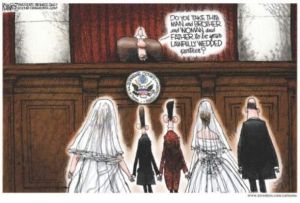
And just to confirm some of the hopefully irrational fears expressed out in America somewhere, here’s one from the SF Chronicle.
SC marriage

And don’t worry I won’t turn every Sunday into a CA day….I don’t want to make y’all too jealous because you don’t get to live here.

Morning Report – First Time Homebuyer Sighting. 6/28/13

Vital Statistics:

  Last Change Percent
S&P Futures  1603.2 -3.4 -0.21%
Eurostoxx Index 2596.7 -23.2 -0.88%
Oil (WTI) 97.22 0.2 0.18%
LIBOR 0.273 -0.001 -0.33%
US Dollar Index (DXY) 82.83 -0.075 -0.09%
10 Year Govt Bond Yield 2.52% 0.05%  
Current Coupon Ginnie Mae TBA 102.1 -0.5  
Current Coupon Fannie Mae TBA 101.1 -0.4  
RPX Composite Real Estate Index 205.5 -0.2  
BankRate 30 Year Fixed Rate Mortgage 4.38    


Markets are down slightly on no real news. The NAPM-Milwaukee report came in better than expected. Bonds and MBS are down.
 
Big drop in mortgage rates yesterday. Bonds were up a bit, but this was a big move. Sounds like the pandemonium in the TBA market since last week is taking a breather. You had a period where mortgage REITs and originators were getting in each other’s way trying to sell TBAs. Perhaps the Great Mortgage REIT Convexity Hedge / Deleveraging Trade is finished, at least for the moment. Ginnie I / II spreads and Fannie / Gold spreads will tell the tale.
 
KB Home reported earnings yesterday, and gave some background on where they see the housing sector. There were two big takeaways from the conference call.  First, the increase in interest rates is not negatively affecting demand; in fact it is creating a “sense of urgency” among buyers. This comports exactly with what Lennar said on their call earlier this week. Second (and this is big), the first time homebuyer is back. KB Home is one of the lower price points for the homebuilders and focuses on the first time and move up buyer. 60% of their business is the first time homebuyer. If this is in fact the case (and Lennar also observed the same thing) this is the last step needed for a full, robust housing recovery. 
 
Pending Home Sales increased 6.7% to a 6 year high, according to NAR. These are contract signings, not sales, so they reflect the increase in rates over the month of May. We are finally seeing robust growth in the West. The Northeast was flat, but grew 14% year-over-year. The West grew 16%, but was flat year-over-year. Next month’s number will be very interesting because it will include the “Bernanke Scare”, which is becoming the euphemism for last week’s FOMC statement that scared the beejeezus out of the bond market. 

Morning Report – Bill Gross’ investment outlook and why the CRA disparate impact analysis is all wet. 6/27/13

Vital Statistics:

  Last Change Percent
S&P Futures  1604.5 9.0 0.56%
Eurostoxx Index 2604.7 1.9 0.07%
Oil (WTI) 95.87 0.4 0.39%
LIBOR 0.274 -0.002 -0.58%
US Dollar Index (DXY) 82.85 -0.128 -0.15%
10 Year Govt Bond Yield 2.49% -0.05%  
Current Coupon Ginnie Mae TBA 101.7 0.3  
Current Coupon Fannie Mae TBA 101.1 0.4  
RPX Composite Real Estate Index 205.6 0.2  
BankRate 30 Year Fixed Rate Mortgage 4.57    


Markets are up this morning as personal income comes in a little better than expected, and personal spending comes in at expectations. Initial Jobless Claims came in at 346k, more or less in line with expectations. Bonds and MBS are up.
 
The Corker – Warner Bill to wind down the GSEs is out. The full text of the bill (all 154 pages of it) are here. Punch line: GSEs are wound down, their liabilities are transferred to the taxpayer, some private entity will bear the first 10% loss on new securitizations, and the Federal Mortgage Insurance Corporation (FMIC) will re-insure losses over 10%. 
 
Bill Gross’s latest investment outlook takes the view that the recent spike in rates was overdone.Yes, there was too much risk in the system (read leverage) and the Fed needed to act to squeeze some of that out. But, he believes that the 10 year yield is probably 30 basis points too high and belongs at 2.2%. Reasons: (a) the Fed’s economic forecasts are too optimistic (remember, we just revised Q1 GDP downward yesterday from 2.6% to 1.8% after coming in at .4% in Q4). (b), the Fed wants higher inflation – 1% is too low, and finally, he makes the point that the Fed Funds rate is going nowhere until 2015 at the earliest. This anchor of Fed funds should hold down Treasuries, in his view. Color me unconvinced with that final argument – the 10 year has yielded over 4% in the context of a 25 basis point Fed Funds rate. In fact, since we have been at ZIRP, the average 10 year yield has been 2.65%. From 2009 to 2011, it average 3.25%. So, I don’t see any reason why it can’t go back to those levels. 
 
Insurance companies are suing HUD over the “disparate impact” rule – which says if statistically your lending to “underserved” groups doesn’t comport with the national statistics, you are guilty of discrimination, no questions asked. Here is the complaint. Of course, these sorts or analyses use FICO as the only relevant variable, which is incorrect – the volatility of prices in the neighborhood matters too. As a lender, you are short a put (if the house drops in price, the borrower can toss you the keys and walk away, yet if the house increases in price, you get the cash flow stream). That put must be priced, and you can see that the volatility of the real estate indices in places like San Bernardino is much higher than places like Milwaukee WI. Which means loans in San Bernardino should have higher rates than loans in Milwaukee WI to take into account the price of that put. It isn’t discrimination, it is the proper pricing of risk. 

Morning Report – Purchase Apps up in spite of rate rise 6/26/13

Morning Report

  Last Change Percent
S&P Futures  1587.9 6.5 0.41%
Eurostoxx Index 2599.1 55.8 2.19%
Oil (WTI) 94.88 -0.4 -0.46%
LIBOR 0.276 -0.001 -0.18%
US Dollar Index (DXY) 82.73 0.144 0.17%
10 Year Govt Bond Yield 2.53% -0.08%  
Current Coupon Ginnie Mae TBA 101.2 0.7  
Current Coupon Fannie Mae TBA 100.7 0.7  
RPX Composite Real Estate Index 205.5 0.2  
BankRate 30 Year Fixed Rate Mortgage 4.58    


Green on the screen in spite of a nasty downward revision in Q1 GDP. Stock futures are holding in while bonds are taking off, with the 10 year yield down 7 basis points from an hour ago. MBS are on the move as well.
 
The first estimate of Q1 GDP released in late April had growth at +2.5%. That number was revised downward to 2.4% the following month. The third and final revision came in this morning: +1.8%. Hardly robust. It makes you wonder what Bernanke was looking at when he announced QE was coming to a close. 
 
In spite of the bloodbath in bonds last week, mortgage applications fell only 3%. The MBA purchase index was up 2%. Refis dropped 5.2%. There has been two theories out there about the increase in rates – either (a) the higher rates are going to put people off and they will withdraw from the market or (b) the higher rates are going to get people off the fence, because rates and prices are going up. So far, it looks like its the latter.
 
One other rate rise datapoint: yesterday: The Conference Board Consumer Confidence Index came in at 81.4, the highest since winter of 2008. Dig into the internals, and you will see the expectations index jumped considerably – this index takes into account a respondent’s view of their own personal financial situation, and shows that so far, the increase in rates has yet to be felt. Of course credit card rates are fixed to prime, which hasn’t moved quite yet, but the early data shows the economy is taking the hike in rates in stride.
 
Lennar, the big homebuilder who reported better than expected quarterly numbers yesterday, sounded extremely bullish on its conference call. First, they see no evidence that rates are affecting home purchases yet, which comports with what we saw out of the MBA purchase numbers above. Second, they are spotting…. wait for it…. the first time home buyer. Lennar’s average price point is $255k, which puts them squarely in the “first time homebuyer” category. They are noticing “household decoupling” which is a fancy way of saying recent grads are moving out of their parents’ basements. One other interesting tidbit – their price increases were pretty much eaten by increased costs. While lumber did rally hard late last year and into early this year, it has fallen precipitously. So what was the other increased cost? Labor. There is a shortage of skilled labor in many geographical areas. Does that make them bearish? Absolutely not – rising middle class wages is exactly what the economy needs. 
 
Finally, Census put out new home sales data yesterday. Sales of new single family homes came in at a seasonally adjusted rate of 476,000 in May, up 2.1% from last month and 29% from a year ago. The median sales price was $263,900, while the average sales price was $307,800. These are increases of 10% and 18% respectively, but it is not based on any sort of repeat-sales methodology so you can’t extrapolate existing home price appreciation from it. The difference between mean and median is the widest it has been, which implies most of the action is in the luxury end of the market. There are 161,000 houses for sale at the end of May, which represents 4.1 months’ supply at current sales volumes. As you can see from the chart below, we are still at very, very depressed levels. 

Morning Report – Comforting thoughts about the recent rate rise 6/25/13

Vital Statistics:


Last

Change

Percent

S&P Futures 

1576.3

10.1

0.64%

Eurostoxx Index

2546.0

34.2

1.36%

Oil (WTI)

95.53

0.3

0.37%

LIBOR

0.276

-0.001

-0.23%

US Dollar Index (DXY)

82.29

-0.137

-0.17%

10 Year Govt Bond Yield

2.51%

-0.02%


Current Coupon Ginnie Mae TBA

100.2

-0.5


Current Coupon Fannie Mae TBA

100.7

0.4


RPX Composite Real Estate Index

205.3

0.3


BankRate 30 Year Fixed Rate Mortgage

4.51


Green on the screen after the 10 year bond recouped all of its early losses and ended up positive on the day. The Chinese central bank agreed to keep money-market rates at a “reasonable” level. Durable Goods orders came in at 3.6%, above the 3% estimate. Ex transportation, they were up .7%, above the consensus estimate. April numbers were revised up. Bonds and MBS are up.

Homebuilder Lennar reported 2Q earnings per share of $.61, ahead of the $.33 estimate. The numbers included a tax benefit, but even without the one-time item, earnings still beat estimates by ten cents. Deliveries were up 39%, new orders were up 27% and backlog was up 55%. Stuart Miller, the CEO addressed the recent increase in rates directly: “Against the backdrop of recent investor concerns over recent mortgage rate increases, we believe our second quarter results together with real-time feedback from our field associates continue to point towards a solid housing recovery….Demand in all of our markets continues to outpace supply…affordability remains high and despite recent interest rate increases, we have seen very little impact on sales or pricing.” The stock is up 4.5% pre-open.

Senators Corker and Warner plan to introduce their bill today to euthanize Fan and Fred. They will be replaced by the Federal Mortgage Insurance Corporation which will act as a re-insurer and not a primary insurer. How this will actually play out is anyone’s guess – right now there are no mortgage insurance entities big enough to replace F&F. Perhaps the answer will be to over-collateralize MBS backed by QM mortgages by 10% and then apply the FMIC insurance. Obviously Dodd-Frank will have to weigh in on that one, and they are still figuring that part out. 

Lender Processing Services reported that April home prices were up 1.5% from March and 8.1% year-over-year. We are starting to see the Midwestern states start to show up in the top 10. California and Nevada are still #1 and #2 as usual. The LPS HPI is a little different than the other indices like Case-Shiller in that it applies a normalization process to REO and short sales in order to come up with a non-distressed index.

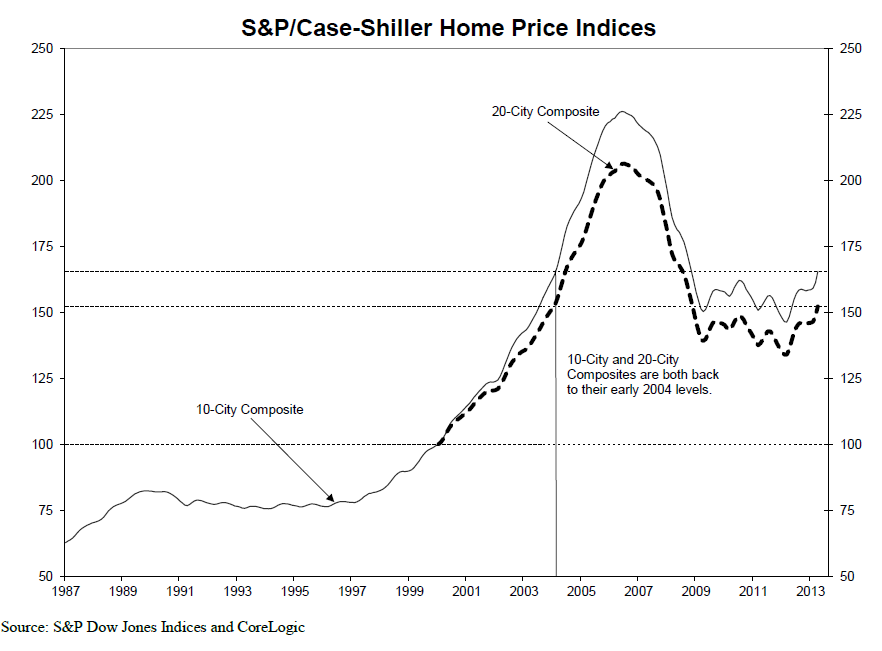
Case-Shiller reported home prices increased 1.72% month-over-month and 12.05% year-over year. This was the highest gain in the history of the Case-Shiller indices. David Blitzer of Case-Shiller addressed the recent increase in rates: “Last week’s comments from the Fed and the resulting sharp increase in Treasury yields sparked fears that rising mortgage rates will damage the housing rebound. Home buyers have survived rising mortgage rates in the past, often by shifting from fixed rate to adjustable rate loans. In the housing boom, bust, and recovery, banks’ credit quality standards were more important than the level of mortgage rates. The most recent Fed Senior Loan Officer Opinion Survey shows that some banks are easing credit restrictions. Given this, the recovery should continue.”

The FHFA Home price Index reported an increase of .7% month-over-month and 7.4% year-over year. Remember, each of these indices (LPS, Case-Shiller, and FHFA) have different methodologies and samples. FHFA looks only at properties with a conforming mortgage, which eliminates jumbos, distressed, cash-only, etc. This index is more of a “central tendency” index than Case-Shiller or LPS.

Image