Health Insurance Freedom

I posed a question up on Plum Line today and got some interesting responses. I think NoVA and jnc were active on the thread. We’ll make it a two parter. I thought Brent, Kevin or Mark might be interested.

1. Your employer pays for your family’s health insurance at a cost of $12,000 per year. Said employer offers to drop the coverage and increase your salary by the same amount. Under current law, you lose the tax benefit of deductibility, but gain the liberty to purchase whatever insurance you like. Is it worth the price?

2. Same as scenario #1, but assume that current law is changed to make health insurance deductible on Schedule A. That or make employer provided health insurance taxable.

—–

I was effectively asked the first question when negotiating terms for a possible new position. I responded that I would have to purchase health insurance of some kind as my better half is a freelancer. The offer included health insurance. I’d take it that way as I don’t care for the tax hit.

I’d say yes to Question #2 as I dislike the link between health insurance and employment. It’s a relic of wage and price controls from the 40s. The U.S. spends as many public dollars as most developed countries do and then kicks in a few more precent of GDP.

BB

Morning Report – Second Quarter GDP revised upward

Markets are lower this morning on tensions in Ukraine. Bonds and rallying as well. 


Some strong economic data this morning, with the second revision to 2Q GDP coming in at 4.2%. Consumption rose to 2.5% and the PCE price index (the Fed’s preferred inflation indicator) came in at 2.1%, with the core at the Fed’s target rate of 2%. 


Initial jobless Claims came in at 298,000, another strong number. The Bloomberg Consumer Comfort Index rose to a 5 week high. 


Pending Home Sales rose 3.3% in July, but are down 2.7% year-over-year.


The Ellie Mae Origination Insight Report is out. Refis dropped to 32% of all loans in July. FHA accounted for 20%, Conventional 64%, VA 11% and other 5%. The average FICO dropped to 727.


Fannie Mae has taken down their estimate for housing in 2015. They dropped their estimates for housing starts and new home sales by 17%. People hoping that 2015 is the breakout year in housing are going to be disappointed.


New rules on PMI could raise rates on average 15 basis points. 


The elderly are finding the amount they owe on their mortgages increasing. Not sure how much of this is due to reverse mortgages. The mortgage-burning party seems to be a thing of the past.


Consumers have confidence, but not the cash to do anything about it. This is why the consumer confidence numbers look good, but spending numbers are not. Asset prices can only do so much – the chief driver of spending is wages, not asset prices. In fact, home equity extraction during the bubble years masked the overall weakness in wage growth. 

Morning Report – Slow News Day 8/27/14

Stocks are higher this morning as the S&P 500 crossed the 2000 level yesterday. Bonds are following the rally in Europe. The German 10 year hit 90 basis points this morning.

Slow news day. Going to be a short missive because there isn’t much to talk about.

Mortgage Applications rose 2.8% last week. Purchases rose 2.6% while refis rose 2.8%. Refis were 55.7% of all mortgages originated.

As European economies continue to struggle, the speculation is that European Central Bank Head Mario Draghi will announce some sort of quantitative easing early in September. Blackrock was just appointed as the ECB consultant for the ABS purchase program, it looks like the ECB is serious about going down this route.

The 2008 meltdown was worse than the Great Depression, according to Ben Bernanke. “Of the 13 most important financial institutions in the United States, 12 were at risk of failure within the period of a week or two.”

Morning Report – Consumer Confidence at post-recession highs 8/26/14

Rallies in European stocks and bonds are dragging US stocks and bonds along for the ride. Remember the PIIGS? The US 10 year yields just a touch less than Italian sovereign debt and about 20 basis points more than Spanish sovereign debt. Let that sink in.

Durable goods orders were all over the map due to a big jump in aircraft orders. The headline number increased 22.6%, however the number most pros focus on – Capital Goods Orders Non-defense / ex-aircraft was down .5%, however June was revised up big, from 1.4% to 5.4%.

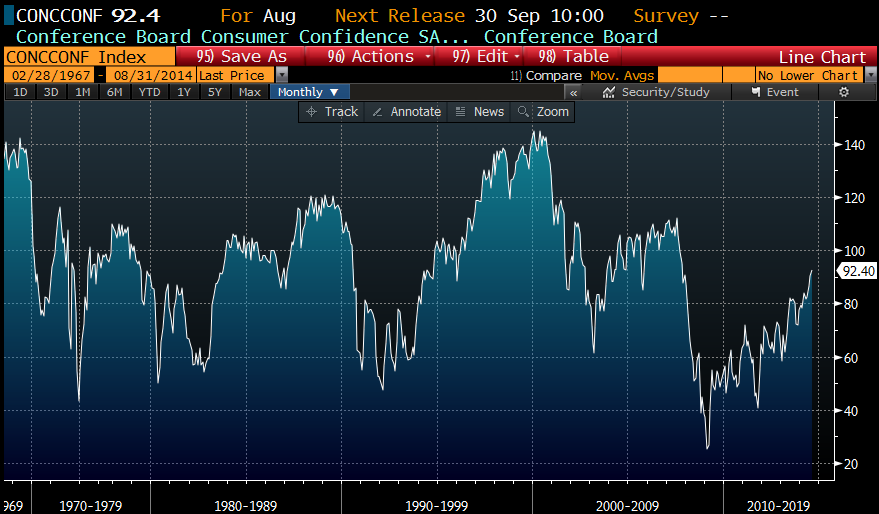
The Richmond Fed Manufacturing Index rose to 12 from 7. Consumer Confidence rose to 92.4 in August, from 90.3 the prior month. This is a post-recession high and we are approaching historical normalcy. Lets see if this translates into good personal spending numbers on Friday.

Consumer Confidence Bloomberg

It is official: Burger King is buying Tim Horton’s and plans to move its headquarters up north. Expect the usual kvetching about “corporate patriotism” out of the usual suspects. That said, Walgreens was jawboned into not moving their headquarters, but the stock was slammed on the decision. I am curious as to whether the left will go after the company by threatening a boycott or will go after Burger King Worldwide’s biggest shareholders – 3G and Pershing Square. That said, 3G is a Brazilian investment firm, and who knows if Ackman holds BKW in its onshore or offshore accounts. BKW could already be more or less foreign owned to begin with.

House prices are down month-over-month and year-over-year according to Case-Shiller. These are the seasonally-adjusted numbers – the non-seasonally adjusted numbers were still up .9% month over month.

Separately, home prices continue to rise, according to FHFA, with the index up .4% from May. Prices are up 5.1% year-over-year. The FHFA index is different than Case-Shiller in that it only looks at homes with a conforming mortgage, which means it excludes distressed and high end home. It is more of a central tendency index and tends to be less volatile than Case-Shiller.

Morning Report – Lots of data this week 8/25/14

Markets are higher this morning on no real news. Bonds and MBS are up small.

Lots of economic data this week: Tomorrow we get durable goods, the FHFA Home Price Index and Case-Shiller. Thursday, we get the second revision to second quarter GDP, and Friday we get Personal Income and Personal Spending.

On GDP, note that the Street is forecasting the advance estimate of +4.0% gets revised downward to +2.4%. If that ends up being the case, we will have had almost no GDP growth for the first half of 2014.

Why have the strategists gotten it so wrong with their bond market predictions? (Mea Culpa – include me in that camp). One explanation is that they are looking only at the US and ignoring the weakness emanating out of Europe. The second explanation is that inflation just cannot be found – the rally in the dollar has depressed commodity prices and there is little to no upward pressure on wages. This also might help explain why the Fed is considering hitting some bids with its paper once QE ends.

Another corporate inversion story: Burger King is apparently in talks to buy Canadian-based Tim Horton’s. Note Walgreen’s decided to scrap their plans for moving their headquarters and the stock got demolished.

The takeaway from Jackson Hole? Labor markets need to heal more before the economy can weather higher interest rates. Wage growth is flat right now. In order to get to the Fed’s 2% target on inflation, we would need to see wage growth of around 4%, because productivity-driven increases are non-inflationary. This just goes to show how far we have to go. That said, the economic staff at the Fed has taken down its estimate of the potential non-inflationary GDP growth, so there might not be as much slack as people think.

Think home flipping is dead? Think again.

Cinema

Rosanne and I try to take in a movie every Saturday night.  We don’t do pure adventure or pure chick flick together and we scour reviews for suitable dramas and comedies that leave chickflicks to her and my adult daughters and leave adventure, scifi, and mysteries to me and my male friends or me and my son.


Our last three weeks of flicks: Boyhood, A Most Wanted Man, and The Hundred Foot Journey.

The presence of Phillip Seymour Hoffmann in his last film aroused enough curiousity in Rosanne that she readily agreed to watch that spy movie.  Predictably, it was my hands down favorite of the three and her least favorite.  I had read the novel.  PSH was so good in the role that he changed my imaginary perception of the character for the better.  I wonder if LeCarre himself had that impression?

The other two movies were entertaining and by no means a waste of money.  Boyhood leaves you with enough to talk about over drinks afterward and the sense that the movie captured a slice of life very well, but it neither leaves a lasting impression nor requires revisiting.  However, because it was actually filmed over 12 years with the same actors naturally aging it will be a film school subject, I am sure.

The Hundred Foot Journey, like Chef, is at its heart a celebration of food.  A feel good movie, dressed up as a dramady, with terrific actors.  Chef, btw, was a feel good movie dressed up as a travelogue with good standup comics.

You may have noticed I am not, here, a harsh critic.  I could be.  I am capable of pointing out the flaws in three of the four movies I have mentioned so far, and if I did you would think I did not like them.  Let it be said that the best movies I ever saw were not coextensive with my favorite movies, and I am not writing here to prove my chops as a critic, if indeed I have any.

Finally, my first cousin’s daughter just starred in this Grade B horror flick.

http://www.rottentomatoes.com/m/come_back_to_me/

I am required to watch it, probably today.  Wish me luck.


Morning Report – How much slack is there really in the labor market? 8/22/14

Markets are lower this morning on no real news. Bonds and MBS are flat.

Dull Summer Friday with no economic news. Janet Yellen is scheduled to hold a press conference at 2:30 EST, so there is the possibility of something coming out that could move bonds.

The Washington Post has a breakdown on the Bank of America / DOJ settlement. Although the headline amount is $17 billion, it looks like they will actually pay closer to $12 billion. Of the homeowner relief, they may run out the clock on principal modifications and drag them out, as JP Morgan is doing.

Nonvoting St Louis Fed President James Bullard argues there is less slack in the labor market than the Fed’s statements imply. He argues that it is the unemployment rate and payroll growth that matters, and that the labor force participation rate doesn’t add much information and is outside the purview of monetary policy. He is probably correct in that regard – I don’t really see how 25 basis points one way or another on the Fed Funds rate is going to affect the long-term unemployed. That said, I don’t think they move meaningfully until we start seeing wage inflation. That doesn’t rule out a symbolic increase in the Fed Funds rate sometime next year. Separately, Charles Plosser thinks we should raise rates this year.

Morning Report – FOMC minutes data dump 8/21/14

Markets are higher after another sub 300k initial jobless claims number. Bonds and MBS are flat.

Existing home sales rose to a 5.15 million annual pace, according to NAR. Median Home Prices are up 4.9% to $222,900. Distressed sales made up 9% of all sales, the lowest percent since 2008. First time buyers inched up to 29%, and all-cash buyers ticked down to 29%. Days on Market increased to 48.

In other economic data, the Index of Leading Economic Indicators ticked up to .9% from an upward-revised .6% in June. The Philly Fed Manufacturing Index was strong at 28.

There was nothing earth-shattering in the FOMC minutes. One thing did jump out at me, and it was the fact that they lowered their estimate for the potential GDP growth rate. They revised their GDP forecast downward and also said that unemployment was closer to its natural rate. This effectively lowered the “speed limit” of the U.S. economy, and in a way, waves the white flag over the plight of the long-term unemployed. Of course there is probably not much monetary policy can do for the long-term unemployed in the first place, but that is a separate issue. I guess the Fed is seeing wage growth somewhere (not sure where, aside from skilled labor), and they think we are closer to seeing inflation flare up for the whole economy. The punch line is that, at the margin, rates may be going up sooner than anticipated.

Speaking of inflation, thanks to the recent rally in the US dollar, commodity prices are getting slammed. Oil is down 13% in the last two months, natural gas is down 20%, corn is down 17%, and bonds are rallying. Not seeing where the inflation is going to come from. Fun fact: Spanish 10 year bond yields are now lower than the US 10 year. Remember the PIIGS of the European Sovereign Debt Crisis? Their bond yields are generally in line with ours: Portugal is 3.26%, Italy is 2.59%, Ireland is 1.88%, Greece is 5.78% and Spain is 2.39%. Kind of amazing when you think about it. The point is that you can’t look at US rates in a vacuum – worldwide sovereign yields are rallying, and it is pulling US yields lower as well.

Bank of America settles with the DOJ for $17 billion. BOA’s purchase of Countrywide will probably go down in history as one of the most ill-advised mergers ever, along with Time Warner’s purchase of AOL, and Warren Buffet’s purchase Johns Manville’s asbestos liability stream. Separately, while the government dropped its criminal case against Angelo Mozillo, they are still going after him in a civil case.

Morning Report – Are We Japan? 8/20/14

Stocks are lower this morning on no real news. Bonds and MBS are flat.

Mortgage Applications rose 1.4% last week. Purchases fell .4%, while refis rose 2.7%. The 30 year fixed rate mortgage finally fell six basis points after stubbornly resisting the moves in the bond market.

Later on today, we will get the FOMC minutes. While there were no changes to the economic forecasts, the markets will be looking to see if the circle of hawks is growing.

Job growth is mainly at the low end of the pay scale. But the wage growth is mainly at the high end. The US labor market is incredibly bifurcated at the moment. This is certainly what keeps Janet Yellen up at night, although the bigger question is whether the Fed can really do anything about it.

BlackRock chief investment strategist Russ Koesterich is saying that bonds have it right, stocks have it wrong with respect to the view of the economy. The higher debt levels will act as a drag on growth for the next decade or two. In other words, we are Japan, and Reinhart / Rogoff are right. This is of course heresy to Dr. Cowbell, who believes the solution to the economic morass is to borrow more (since rates are so low) and to spend it on infrastructure. Japan did exactly what Krugman wanted, and took their debt to GDP ratio to 2.2x and has had little to no economic growth for a generation. As a point of reference, our debt to GDP ratio just over 106%, however the Fed owns about a quarter of that (through QE) so it is really debt we owe ourselves.

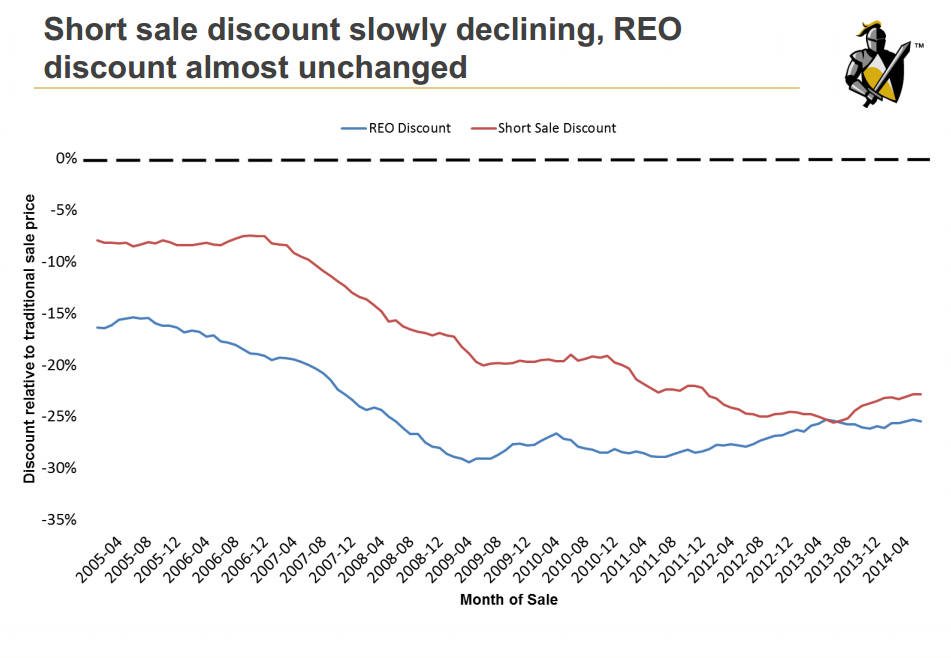
Foreclosure starts and Delinquencies ticked up in June, according to Black Knight Financial Services (formerly known as Lender Processing Services or LPS). DQs increased to 5.7% from 5.62% in May, while foreclosure starts ticked up to 88.3k vs 86.3k a month before. On a year over year basis, foreclosures starts are down 19%. Inventory continues to be concentrated in the judicial states of NY, NJ, and FL. Short sale discounts continue to narrow, while the REO discount is flat.

Non Delegation

Scott, QB, I, and probably JNC, are interested in the doctrine of non delegation.  QB directly referred to it in discussing the rise of the bureaucracy and I avoided it in that discussion because I had no idea where it stood after 78 years or so of disuse.  I did allude to “limits” of delegation, not specifically, but in general, that arise in federal cases.  So without doing any research of my own, one of JNC’s many cool links brought up a reference to this:

http://chicagounbound.uchicago.edu/cgi/viewcontent.cgi?article=1335&context=law_and_economics

I think it is very interesting.  Hope you read it too!