Morning Report – Housing affordability still above pre-bubble days 3/11/15

Stocks are bouncing back after yesterday’s sell-off. Bonds and MBS are down small.

Mortgage Applications fell 1.3% last week. Purchases were up 1.9% while refis fell 2.9%.

Attitudes about the US economy are finally turning around, according to the Fannie Mae National Housing Survey. More people think the economy is on the right track than the wrong track. Also interesting is that consumers sense that mortgages are becoming easier to get.

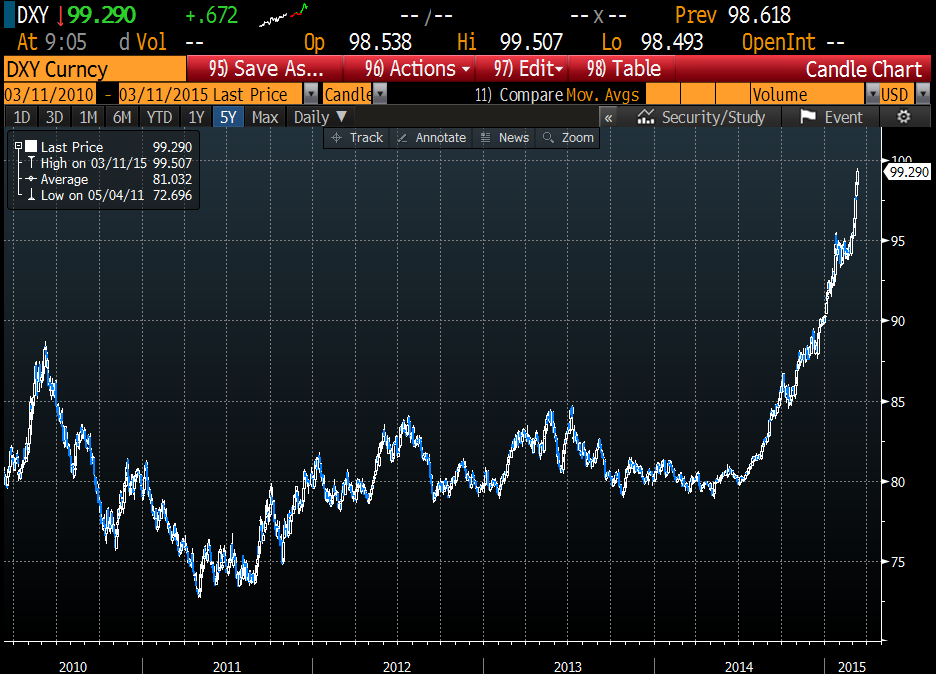
Inflation remains low, partly because the rally in the dollar is keeping a lid on import prices. Ever since the ECB began the march towards full QE, the dollar has been screaming. The dollar is approaching parity on the Euro – start thinking about that summer vacation in the South of France. Fun fact, when the euro was trading around 86 cents on the dollar, you could stay at the Ritz in Paris for roughly about the price of a good business hotel in Manhattan.
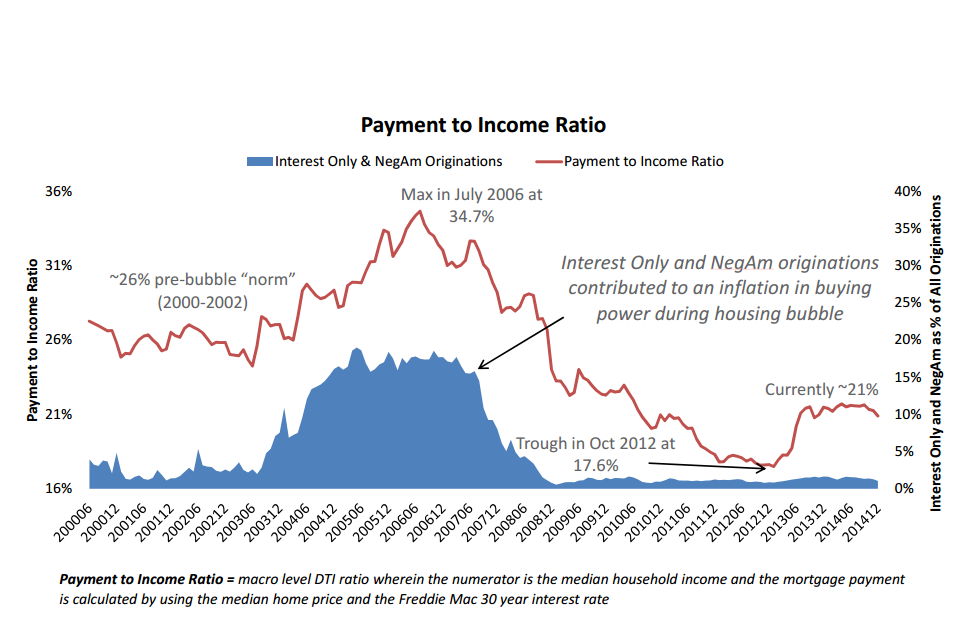
Housing affordability has decreased a bit since the trough of 2012, but still remains well above the pre-bubble years of 2000 – 2002, at least as measured by mortgage payment to income ratio. Pre-bubble, the DTI ratio for the median income and mortgage payment was about 26%. It rose to almost 35% during the bubble, fell to 17.6% in the trough, and is now around 21%. If you look at the chart below, you can see how much interest only and negative amortization loans factored into the bubble years. Pretty amazing to think that almost 1 in 5 mortgages was an IO / neg am during the go-go days of the bubble.
Interesting story about the mess that is Detroit. As downtown begins its gentrification / hipster renaissance, the rest of the city is struggling, and the biggest problem are these sales based on quitclaim deeds, which can leave the buyer with massive liabilities for back taxes.

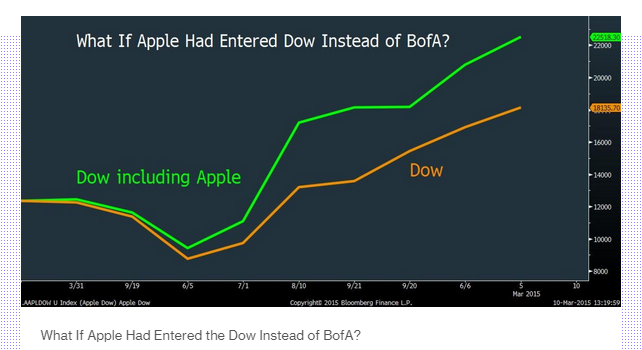
In February of 2008, Bank of America was added to the Dow Jones Industrial Average, just as the financial sector was beginning its swan dive. At that time, Apple was a $100 billion dollar company. What would have happened to the index if Apple was added instead of Bank of America?
Morning Report – More evidence of tightening in the labor market 3/10/15

Markets are lower this morning as commodities fall and the dollar climbs. Bonds and MBS are up as the German Bund hits new highs, with a yield of 26 basis points. German Bund yields are negative through 7 years, as the ECB buys the 5 year at a negative yield.

The continuing rally in European bonds will probably support the US 10 year as global bond managers unload Bunds to the ECB and buy Treasuries instead. The caveat is that inflation has to remain nowhere to be found in the US. Yesterday, Cleveland Fed President Loretta Mester sounded hawkish, saying that at 5.5% unemployment we are close to meeting the Fed’s full employment mandate. Of course this assumes that the current labor force participation rate of 62.8% is the new normal. Color me skeptical – I think a lot of these people who are out of the labor force want to work and will choose to if given the opportunity. This will keep a lid on wage growth.

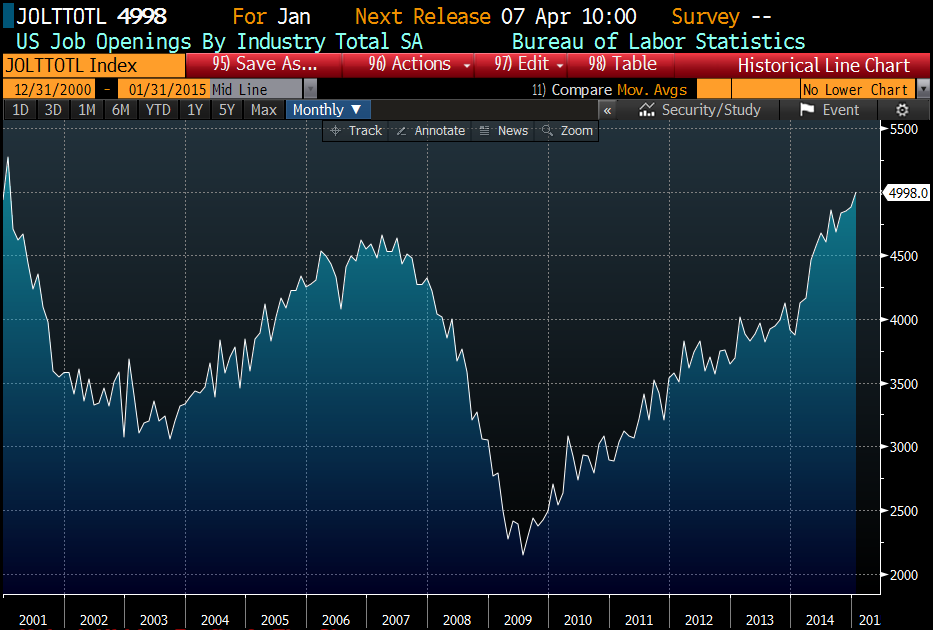
Job Openings remained around 5 million, according to the JOLTs job report. We are back to early 2001 levels. Hires decreased to 5 million and separations were unch’d at 4.8 million. The quit rate was unchanged at 2%.

Small business optimism rose a hair in February, according to the NFIB to 98 which has been the long-term average of the index, including the Great Recession. It is the third highest reading since 2007. We are seeing more evidence of labor shortages, however, with 53% of the respondents trying to hire, but 47% reported few or no qualified applicants. 29% of all owners reported job openings they cannot fill, which is the highest reading since early 2006. That said, sales fell, which could have been weather-related. 60% reported increased capital expenditures, which is the strongest reading since Oct 2007. Inflation remains nowhere to be found, and it looks like business owners are unable to raise prices.

CFPB Director Richard Cordray appeared before the House yesterday to discuss QM, payday lending, and overdraft protection. The discussion fell along usual partisan lines, with Democrats pushing for more consumer protection, and Republicans worried about limiting consumer choice.

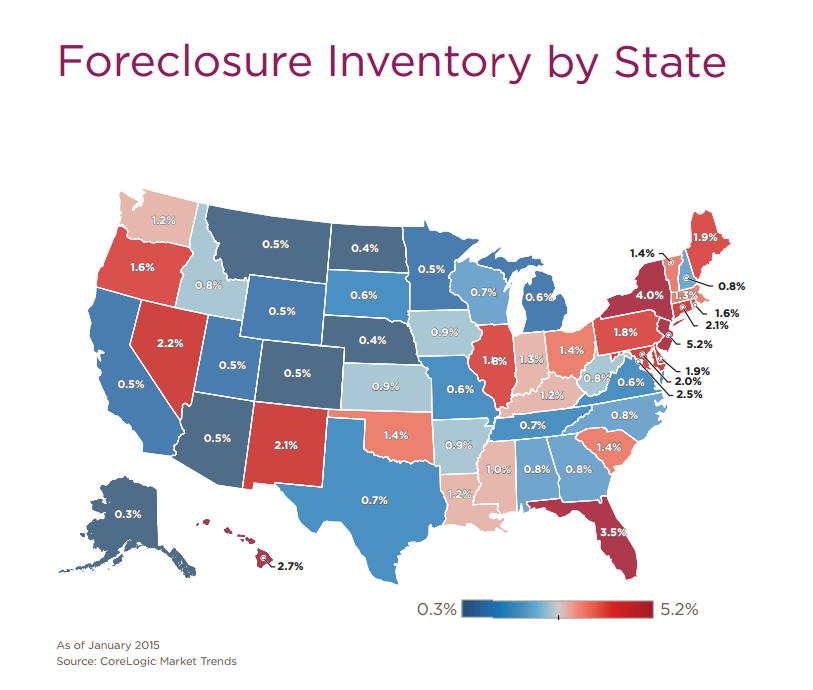
Foreclosures continue to fall, according to CoreLogic. They were down 14.7% month over month and 22% year over year. The seriously delinquent rate of 4% is the lowest since June of 2008. Foreclosure inventory is 549k, down 33% from a year ago.

Morning Report – Mortgage Credit is beginning to ease up 3/9/15

Stocks and bonds are higher this morning after Friday’s bloodbath.

Global bonds are rallying as the European Central Bank begins purchasing German and Italian government debt. Not sure what difference taking the Bund yield from 40 basis points to 30 basis points is going to make, but there you go. I wonder what economics students will think of this episode in 30 years. Grandpa, tell me again about the time when central banks were willing to buy their host country’s debt for dollars on the penny..

The week after the jobs report is typically very data-light, and this week is no different. The big events are retail sales on Thursday, and the JOLTS job openings on Tuesday. Which means bonds will probably be primarily influenced by events out of Europe.

The Bankrate 30 year mortgage rate didn’t move on Friday, but that is hard to believe given the big move up in rates. That said, mortgage rates have been lagging the moves in the bond markets.

Mortgage credit eased up in February, driven by jumbo and 97 LTV conventional. While we are at post-bust highs in credit availability, we are nowhere near where we were during the bubble, or even in the pre-bubble years.

How much do you need to make in the US to buy a house? Good question for the first time homebuyer. The answer is around 48k. Of course all real estate is local, and you need to make 142k to buy a home in San Francisco. Of course you could style in Cleveland on 142k, as you only need 32k to buy a home there.

Morning Report – Decent jobs report. Bonds get crushed. 3/6/15

Markets are lower this morning after a decent jobs report raised fears of a June rate hike. Bonds and MBS are down big.

  • Nonfarm payrolls + 295k (235k expected)
  • Unemployment rate 5.5%, down from 5.7% in Jan
  • Average hourly earnings + .1% MOM / +2.0% YOY
  • Labor force participation rate down to 62.8%.

The payroll number got the attention of the Street, however the drop in unemployment was due to a drop in the labor force. So far, we are not seeing job losses in the oil patch due to lower prices, however employment did fall due to the refinery strike going on. Average hourly earnings are still rising more or less at the rate of inflation, and came in at $24.78 an hour.

This jobs report is strong enough to make it more likely the Fed will start increasing rates in June, and people who were forecasting a 2016 rate hike are probably re-assessing that outlook. Hence the sharp sell-off in bonds.

End of an era: Apple is joining the Dow Jones Industrial average. Exiting is Ma Bell, who joined the index in 1939.

FHFA Chairman Mel Watt spoke at the Goldman Sachs Housing Finance Conference yesterday. Here are his prepared remarks. Main points, FHFA is going to sell non-performing loans to the public, progress continues on a single security for Fannie and Freddie loans. Eligibility for HARP will not be expanded.

Mark Cuban weighs in on technology companies and why he thinks there is a bubble that is worse than the 2000s.

Morning Report – Is China setting up for a 1929 moment? 3/5/15

Stocks are higher this morning after the ECB committed to buy 60 billion euros worth of bonds starting Monday. Bonds and MBS are up small.

Nonfarm productivity fell 2.2% in the fourth quarter, as output increased 2.6% and hours worked increased 4.9%. On a year-over-year basis, it fell .1%. Lower productivity means that wage inflation will become inflationary sooner than it otherwise would. Not sure what is driving the decline.

Unit labor costs rose 4.1%, which was a function of a 1.9% increase in compensation and a 2.2% decline in productivity. Unit Labor Costs are up 2.6% over the last year.

Initial Jobless Claims rose to 320k, and the Bloomberg Consumer Comfort Index rose to 43.5.

Is China setting up for a 1929 moment? Certainly the backdrop is there. This seems to be par for the course, as countries that go through a long secular growth spurt end up having bubbles. It happened to the US in 1929, it happened to Japan in 1989, and it has happened to China. Their government wants to deflate the bubble, as all governments who face this do, however that is easier said than done. The fallout will be felt in the luxury real estate markets in the US and Canada. Think the Bay Area, San Diego, Washington DC, NYC, Vancouver, Seattle. Do the Chinese banks puke Treasuries or do they buy them as a flight to safety? That is the most interesting question.

Morning Report – Obamacare goes before the Supreme Court 3/4/15

Markets are flattish on no real news. Bonds and MBS are up small.

The ADP Employment number came in at 212k, slightly lower than expectations. The Street is forecasting Friday’s payroll number to come in at 235k. The key number on Friday will be average hourly earnings, not payrolls.

Mortgage Applications rose .1% last week. Purchases were down .2%, while refis were up .5%. Refis as a percentage of applications dropped to 61.5%. A month ago, they were 71.5%.

Great interview with Stuart Miller, CEO of Lennar on CNBC. Key points: Spring Selling Season is just getting started, but initial indications look good, not seeing any sort of slowdown in the energy states, and a hike in interest rates will probably mean the economy (and wages) are improving, so it isn’t necessarily a negative for the builders.

Oral arguments over Obamacare will be heard at the Supreme Court today. At issue is what the term “established by the state” means. 33 states refused to set up exchanges for Obamacare health plans. Does this mean they are ineligible for Federal subsidies? Does “the state” = “the government” or does it mean a particular state?  The Administration is arguing that the intent was to provide subsidies to everyone, even if they didn’t set up an exchange. Others have pointed out emails showing it was meant to be a carrot to encourage states to establish exchanges, and regardless of intent, the law says what it says. If the SC rules for the plaintiffs, the issue gets punted back to Congress to fix, and since Republicans control the House and Senate, there will be a negotiation over the fix. If the SC rules for the Administration, then nothing changes. The decision is expected in June.

The CFPB is going after forced arbitration language in credit card loans, auto loans, etc. So other lenders are going to share in all the fun the mortgage industry has had over the past 5 years or so.

Morning Report – Household formation back to normalcy 3/3/15

Stocks are lower this morning on no major news. Bonds and MBS are down small.

January auto sales are generally coming in below estimates this morning, which has largely been attributed to the weather.

Bad weather in the Northeast didn’t stop the ISM New York survey from jumping to 63.1 from 44.5. This is the highest reading since September.

The IBD / TIPP Economic Optimism Survey rose to 49.1 from 47,5.

CitiGroup is selling its subprime lender OneMain Financial to Springleaf for $4.25 billion in cash. Springleaf is controlled by Fortress. The demolition of the House that Weill Built continues…

Lumber Liquidators fell 25% yesterday after a 60 Minutes report said that there were unsafe levels of formaldehyde (a carcinogen) in its Chinese-made flooring. The company disputes the report and made a filing with the SEC claiming that all of its flooring meets the safety standards set by US regulators. The company blames short sellers for feeding the report to 60 minutes. FWIW, the days to cover has jumped over the past month from about 8 to 14.5. While not quite Herbalife, this one could become a battleground stock.

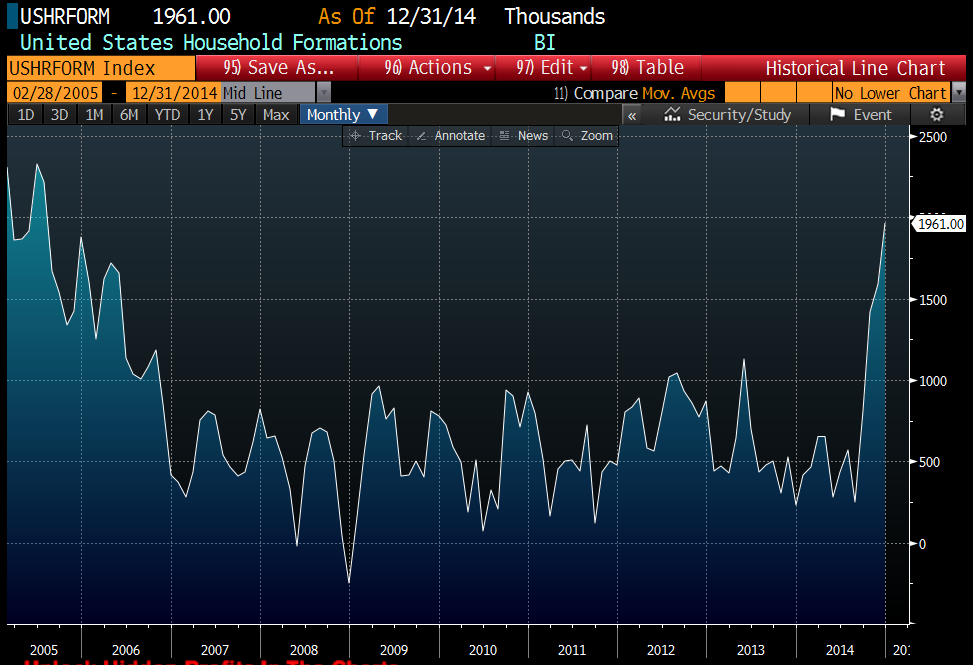
The absence of the first time homebuyer has been an issue for the real estate market, both in terms of transactions and new building. Housing formation has been depressed since 2006 as a combination of unaffordability during the bubble years and a tough job environment for new grads post-bubble has kept household formation low. Note the Millennial Generation is actually bigger than the Boomers – so this isn’t due to fertility rates 25 years ago. It appears that household formation has finally rebounded at long last. Granted, many of these new households will be renters, but it seems like we have at least made the leap back to normalcy (latest reading is just under 2 million) and we are out of this depressed range of 250k – 750k households forming a year. Now if we could only get housing starts back to a normal range of 1.5 million to 2 million, we would be in good shape economically.

Morning Report – The Great American Deleveraging Continues 3/2/15

Markets are flattish this morning on no major news. Bonds and MBS are down small.

Merger Monday is back with a couple of big deals in the tech space. NXP is buying Freescale Semi for 11.8 billion, and HP is buying Aruba Networks for $2.7 billion.

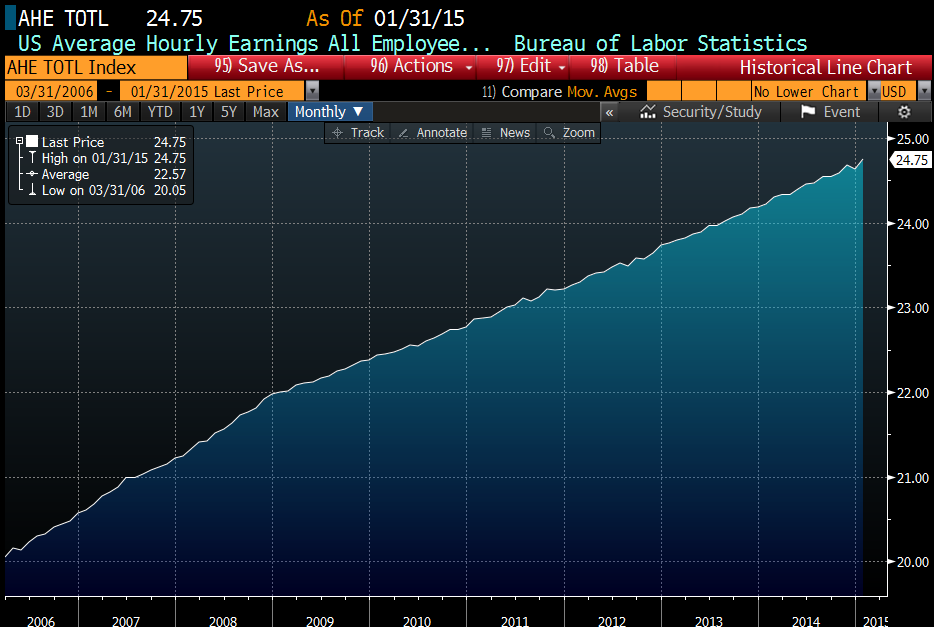
Lots of important economic data this week, but the jobs report on Friday will be the highlight of the week. Bond Markets will be focused on average hourly earnings. Below is a chart of average hourly earnings. Note the change in the slope of the line starting in 2009. That is a change from roughly 3.2% annual growth to 2% annual growth, which is more or less in line with inflation. Later on this week, we will get non-farm productivity, which is expected to fall, and unit labor costs which are expected to increase 3.3%.

Personal Income rose .3% in January, which was below expectations, but flat with December. Wages and salaries were up .6%, which was a big increase from the .1% reading in December. This tends to be a volatile component however, so don’t read too much into one data point. Disposable income rose .9%. The savings rate increased to 5.5% from 5% last month as well.  Personal spending fell .5%, however that was partially driven by lower energy prices. Stripping out food and energy, spending increased .1%, which is pretty much in line with what we have been seeing. The punch line: The Great American Deleveraging continues. As incomes increase, that money is used to pay down debt or is getting put in the bank. Investors hoping for another late 90s or mid aughts debt-driven consumption boom are probably going to be disappointed.

Construction Spending fell 1.1% in January, a disappointment. December was revised upward from .4% to .8%. Month to month numbers tend to be volatile. Where is the money going? Lodging, office and commercial space as well as manufacturing. Also public infrastructure spending with increases in transportation, and sewage. Where is it not going? Residential (still). Given the price increases and the current tight inventory, you should expect to see more homebuilding. If the personal income numbers continue to improve that will hopefully change.

Note that optimism about 2015 construction is the highest in 20 years, according to Wells Fargo. Nonresidential construction is the driver, not resi however. Still, that means we are finally seeing some capital expenditures which is encouraging.

The ISM Manufacturing PMI dropped in February to 52.9 from 53.5. The West Coast port slowdown is impacting exporters. The current level of 52.9 corresponds to a GDP growth rate of 3.1%.

Stanley Fischer is telling the markets not to get used to being spoon-fed by the FOMC. Once rates start increasing, the guidance will become more and more murky.

Warren Buffet’s annual letter to shareholders is out. There is nothing earth-shattering in the letter, except for the usual schedule of events for Buffetapalooza, where you can try to throw a newspaper more accurately than Warren. No mention if he is going to bust out the ukulele and jam with the Fruit of the Loom guys however.

Morning Report – Consumer Sentiment is at boom time levels. 2/27/15

Stocks are lower this morning after GDP came in a little better than expectations. Bonds and MBS are up small.

The second revision to fourth quarter GDP came in at 2.2%, a bit higher than the estimate of 2%, but a big drop from the Q3 reading of 5%. Personal consumption rose to 4.2%, a strong reading that bodes well for growth going forward. Government spending was down, driven by a 12.4% drop in defense spending. Business inventories were revised downward as well. Private capital expenditures slowed their rate of growth as well.

Pending Home Sales rose 1.7% in January, lower than expected, but better than the upward-revised 1.5% drop in December. They are up 6.5% year over year. Supply remains tight, however all-cash sales as a percent are dropping, which indicates the professionals may be exiting, leaving room for “real” home buyers to enter. The big question remains regarding inventory: will it simply jack up prices, or will it attract new building? The answer may be “both.”

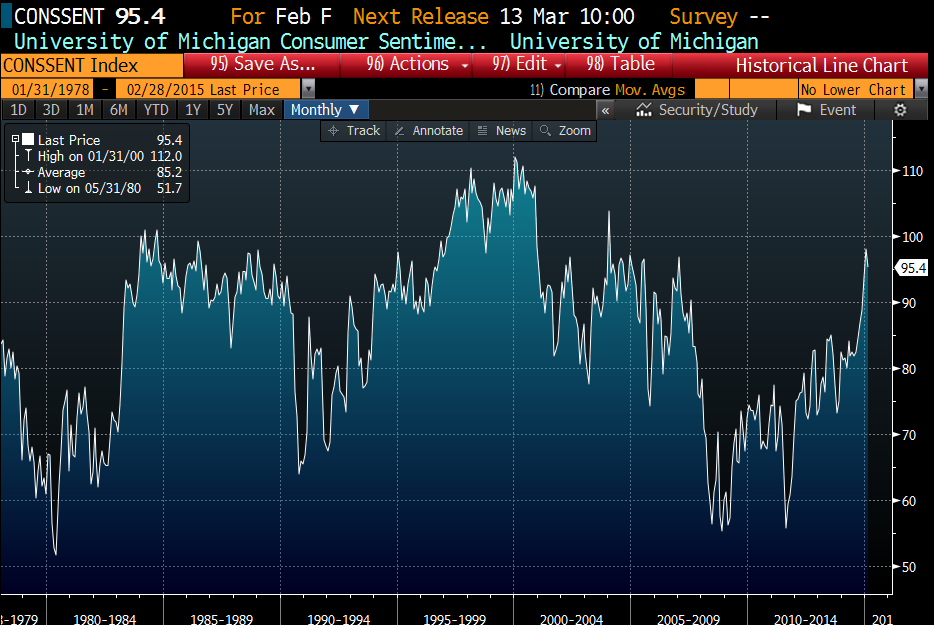
In other economic data, the ISM Milwaukee Index came in at 50.32, a disappointment, while the Chicago Purchasing Manager index fell sharply from 59.4 to 45.8. The University of Michigan Consumer Sentiment index rose to 95.4. These consumer confidence indices are driven by gasoline prices for the most part, but the numbers are encouraging nonetheless. We are back to boom-time levels. This is being confirmed by the strong personal consumption numbers this morning.

Why is Germany worried about government spending when it is getting paid to borrow? Switzerland, Sweden, and Denmark are imposing negative interest rates on bank deposits. Separately, are these ultra-low rates creating issues that will blow up later? We are in uncharted territory, and while everyone hopes that the world’s central banks can stimulate the global economy without causing another crisis, that is no sure bet. The stock market seems blithely oblivious to this possibility, however and that is another issue. I am wondering if this will all come to a head in time for the 2016 elections. Monetary policy acts with a lag, and if the Fed starts tightening in June, the effects will start kicking in by summer of 2016.

We are starting to see more evidence of improvement in the labor market with small business, which has been the engine of job creation historically. We are actually beginning to see the unwind of a strange dichotomy. The stock market had been flying over the past few years, yet things have been pretty gloomy for the economy overall. To the average American, it didn’t feel like the stock market was at record levels – it didn’t feel like 2005 or 1999. The reason for this was that the big S&P 500 names had lots of international exposure, which was driving earnings and the indices. Not only that, they could borrow at exceptionally low rates, while smaller business was subject to tighter credit. As Europe weakens and the US dollar increases, the international divisions are having a rougher go of it, while US domestic focused small business is benefiting from a turnaround in the US economy.

Morning Report – The McMansion is back 2/26/15

Markets are flat this morning on no real news. Global bonds continue to rally, but Treasuries are not really participating.
Inflation remains largely muted, with the Consumer Price Index falling .7% in January. Ex-food and energy, it rose .2, a little higher than expectations. On a year over year basis, inflation ex food and energy increased 1.6%.
Durable Goods orders rose 2.8% in January, rebounding smartly after a very weak December. Capital Goods (a proxy for business capital expenditures) rose .6%.
Initial Jobless Claims rose to 313k last week from 282k the week before. The Bloomberg Consumer Comfort Index fell from 44.6 to 42.7 last week.
Home Prices rose .8% in December, according to the FHFA. Home Prices are now about 4% from peak levels. The report has been expanded to include all sorts of additional data. The growth continues to be on the West Coast, while the Northeast lags.
Delinquencies and foreclosure rates dropped in Q4, according to the MBA. For the most part, we are back at pre-2007 (or pre-crisis) levels. Judicial states still have 3x the foreclosure rate as non-judicial states.
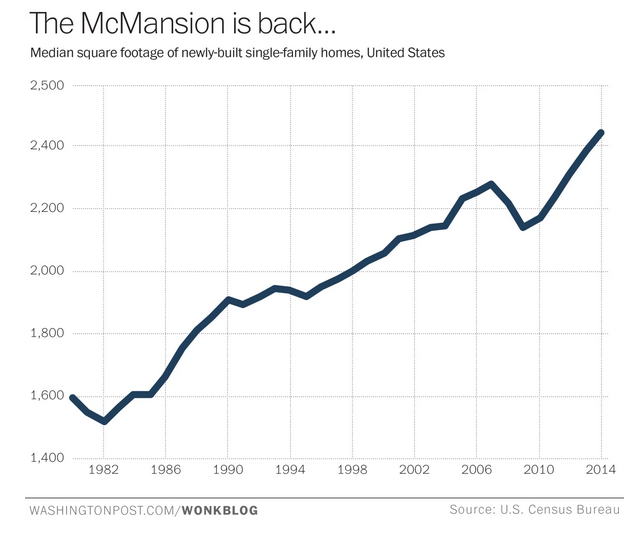
The McMansion is back. The median square footage of new homes topped 2,400 square feet last year. Builders are chasing the affluent because the first time homebuyer is still largely out of the market. That said, some builders, like D.R. Horton, are introducing new brands that are in the first time homebuyer price points.

How much slack is there really in the labor market? Are wages rising because of a shortage of labor in some areas? If so, then that means (a) the speed limit of the economy is lower, because more people working = higher output, and (b) the Fed will have to move earlier than they may want to in order to quell inflation. If these discouraged workers return to the labor force, downward pressure on wages will continue, however in the long run, output will be higher. This issue was discussed in the June 2014 FOMC minutes, but it hasn’t been brought up since.