

 Brent Nyitray
 Fairlington Blade
 Let the mutherfuker burn!
 jnc4p
jnc4p Kevin S. Willis
 Michigoose
 lmsinca
 markinaustin
 Arcanaut
 novahockey
 quarterback
 ScottC
 yellojkt
I’ve noted the first 3, so figured I should note the 4th. At this point this scene from The Office seems appropriate:
Filed under: This Day in History | 3 Comments »
I’ve noted the first 3, so figured I should note the 4th. At this point this scene from The Office seems appropriate:
Filed under: This Day in History | 3 Comments »
I was on the trading floor at Bear, Stearns in London. It was just after lunch. A headline went across Bloomberg saying a plane had hit one of the WTC towers. CNBC mentioned the story as well, but no one was thinking “terrorism.” I emailed one of my friends at Merrill Lynch (right across the street at the World Financial Center) and he wasn’t even aware of what happened. The European markets were down a bit on the day, but didn’t really react to the first hit.
After a few minutes, CNBC started showing live footage of the fire and then we saw plane 2 hit. Immediately, the world realized what had happened. The Euro markets were collapsing and I was inundated with sell orders. The news of the Pentagon hit came out. People on our floor started freaking out. We were in Canary Wharf (One Canada Square) in the tallest building in the UK. Planes routinely come close to the building as they approach City Airport. The head of Bear Stearns Europe came on the trading floor and told everyone if they were uncomfortable, to go home. No one knew if today was “fly a plane into financial headquarters day” Everyone bailed, and I was one of the last guys on the trading floor, trying to reconcile my book by hand and get flat before I left.
I looked up at CNBC before I left and saw the place I got married at a year earlier collapse on my birthday.
P.S. As I headed to the tube to go home, I passed the Slug and Lettuce (a pub) and found all of the “uncomfortable” Bear Stearns employees having a pint directly below the building they were so uncomfortable being in.
Filed under: This Day in History | 23 Comments »
Stocks are lower this morning as emerging markets fall. Bonds and MBS are flat. Overnight, China intervened in the f/x markets to support the yuan. China’s surprise devaluation in August was the catalyst for this whole sell-off.
Remember, when you read the words “Chinese supporting the yuan” think one thing: Treasury sales and increasing interest rate. The Chinese support the yuan by selling dollars, and the way they sell dollars is by selling Treasuries.
Brazil was downgraded to junk by S&P yesterday. This is part of the reason why emerging markets are heavy this morning. This move was expected eventually, however the speed in which it happened was surprising. Does this put a bid under Treasuries? Nope.
Import prices fell 1.8% in August and are down 11.4% year over year. A strong dollar is depressing commodity prices and making imports more cost competitive.
Initial Jobless Claims came in at 275k, a drop from 281k the week before. People who have jobs are generally keeping them.
The Bloomberg Consumer Comfort Index was flat at 41.4 last week. 2/3 have a negative view of the economy. while 55% have a positive view of their own personal financial situation.
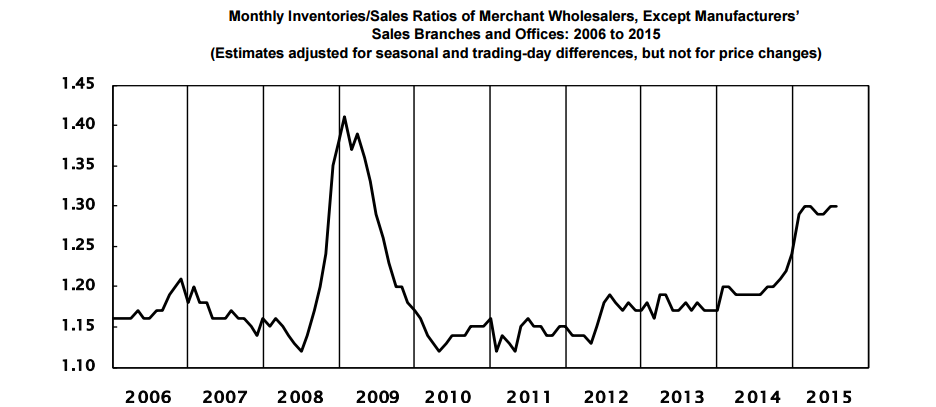
Wholesale inventories fell 0.1% in July, while wholesale sales fell 0.3%. The inventory to sales ratio, which can be considered a leading indicator for a recession is at 1.3x, an elevated reading. This would signal a recession is a possibility.
The current continuing resolution to keep the government open expires at the end of the month. Government shutdown talk will undoubtedly escalate as the two sides posture over funding Planned Parenthood.
To its proponents, Keynsianism cannot fail, it can only be failed. Dr. Cowbell is worried that Abenomics will fail in Japan. Of course Japan has followed the Keynsian playbook to the letter for 25 years and has had no growth and a debt to gdp ratio of 2.2x to show for it. Whenever you hear people saying: we need to spend big on infrastructure to put people to work and get the economy going again, remember they are basically putting the old New Deal / Japanese wine in a new bottle.
Filed under: Morning Report | 35 Comments »
Stocks are higher this morning on overseas strength in equity markets led by Japan. Bonds and MBS are down.
Mortgage Applications fell 6.2% last week, with purchases falling 0.9% and refis falling 9.9%.
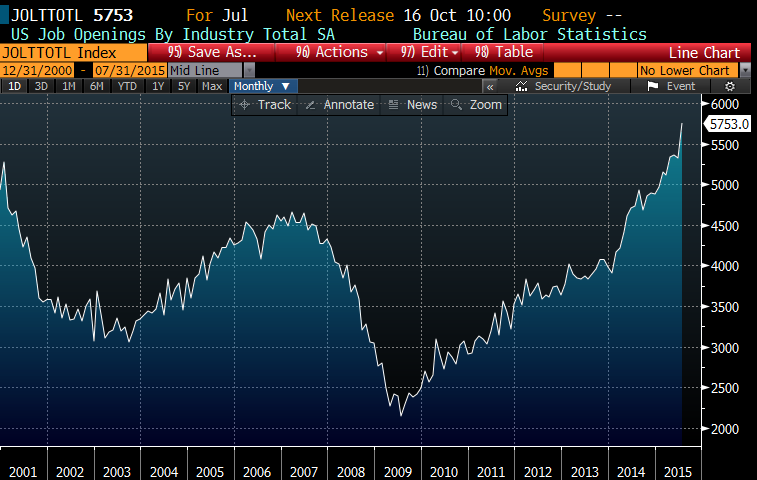
Job openings hit a record in July, with the JOLTS job openings hitting 5.7 million. Compare that number with the number of unemployed at 8 million. The quits rate (which is a measure of economic strength) has been unchanged for the past year however at between 2.7 million and 2.8 million. It seems surprising to see a labor force participation rate at 38 year lows, job openings at highs, an unemployment rate at boom time levels, and almost no real wage growth. It speaks to a mismatch between what business wants and who is available.
Chart: JOLTS job openings:
Citi is forecasting a better than 50% chance of a global recession in the next couple of years. This will be led by emerging markets and China. While that doesn’t necessarily mean the US will head into a recession, it does mean that there will be little to no upward pressure on interest rates. The biggest risk to the US is a sharp increase in the US dollar, which will hurt exporters. The policy response to a recession will be limited – monetary policy is already at pretty much full stimulus. Much more worrisome however, is the fact that protectionist policies are gaining in popularity.
Homebuilder Hovnanian reported earnings this morning. Deliveries fell 3.8% compared with last year. Gross margins were down as well. Contracts did expand however, to almost 20%. It seems like the builders in general had a bit of a lull in deliveries over the summer, but almost all reported bit increases in contracts and backlog. We are entering the slow season for the builders, which lasts about as long as football season. While I sometimes feel like Linus in the pumpkin patch, 2016 could be a big year for the builders. Would be nice to get housing starts back around historical levels of 1.5 million or so.
Larry Summers is out with another editorial which lays out the case for keeping rates at zero. His argument is that credit spreads have widened (which means the interest rate companies have to pay to borrow) has increased over the past month and that in of itself constitutes a tightening. David Stockman (Reagan’s budget director) was on Bloomberg Radio this morning excoriating the “clowns at the Fed” for not having raised rates already. His point is that the unemployment rate is in the middle of the range of what the Fed considers full employment. In fact, the 5.1% unemployment rate is in the bottom quintile of unemployment rates over the past 40 years.
Filed under: Morning Report | 46 Comments »
Stocks are higher this morning on overseas strength. Bonds and MBS are down.
The Labor Market Conditions Index rose 2.1% in August, better than the forecast. This is an index of various leading and lagging indicators.
The jobs report last week probably didn’t move the needle one way or the other with respect to the Fed’s decision next week. Yes, payrolls disappointed, but the 2 month revision was strong. The labor force participation rate remained mired at 38 year lows, however the unemployment rate ticked down and wage inflation ticked up ever so slightly. Note that August’s payroll miss seems to have a seasonal element to it and is usually revised upward.
The bond market seems to be ready for a rate hike. The Fed Funds futures are forecasting a very slow pace of tightening, the yield curve remains positively sloped, with the 10 year bond relatively heavy. Option volatility shows little sign of panic. The 10 year bond forward contracts indicate that even if the Fed hikes rates, the 10 year should maintain levels right around here.
The NFIB Small Business Optimism index edged up in August. Note that the survey was taken before the sell-off of the last few weeks. The labor data was decent – with businesses adding 0.13 workers, a historically strong number. Interestingly, 56% reported hiring or trying to hire, however 86% of those who are trying to hire are unable to find qualified candidates. (I wonder if “qualified” means someone with the wisdom of a 60 year old, the vision of a 50 year old, the efficiency of a 40 year old, the drive of a 30 year old and the paycheck of a 20 year old). Note that obama made an executive order over the weekend demanding that Federal contractors offer paid sick leave.
China has spent $260 billion trying to support its stock market. That is 2.4% of GDP. Note that stocks are not a major part of household assets, at around 2%. Real estate and bank deposits account for 70% and 24% of assets respectively. Interestingly the LTV of a typical Chinese home mortgage is about 17%. To put that in perspective, the US LTV is at 39%, and peaked at 57% in 2009.
Completed foreclosures dropped to 38,000 in July, according to CoreLogic. This is down 24% from last year, and 6% from June. Pre-financial crisis, 21,000 was a typical reading, so we have a way’s to go yet. Foreclosure filings have ticked up this year as the judicial states start to address their foreclosure inventory. The Northeast and Florida remain the states with the highest foreclosure inventory.
Filed under: Morning Report | 73 Comments »
Stocks are higher this morning after Chinese markets rallied to almost unchanged after an early swoon. Bonds and MBS are down.
Mortgage Applications rose 11.3% last week as purchases rose 4.1% and refis rose 16.8%. The 30 year fixed rate mortgage was steady at 4.08%. While the bond market has been pretty volatile, TBAs have been much more steady, tending to fade the moves of the bond market. This means you might see a big drop in the 10 year yield, hope to lock at a great rate, only to find that rates are lower, but not as much as the big move in Treasuries would suggest.
The ADP jobs report showed payrolls increasing by 190,000 jobs, which is less than forecast. July was revised lower as well. The Street is forecasting an increase of 218,000 in the official report on Friday.
After a couple big quarters, unit labor costs fell in the second quarter by 1.4%. This number tends to be volatile, as does productivity. The Fed pays close attention to these numbers.
The ISM New York Index fell pretty dramatically in August, from 68.8 to 51.1. The 68.8 reading was unusually good, while the 51.1 reading was unusually bad.
Factory orders rose 0.4% in July, lower than the 0.9% forecast. Ex-transportation, factory orders fell 0.6%.
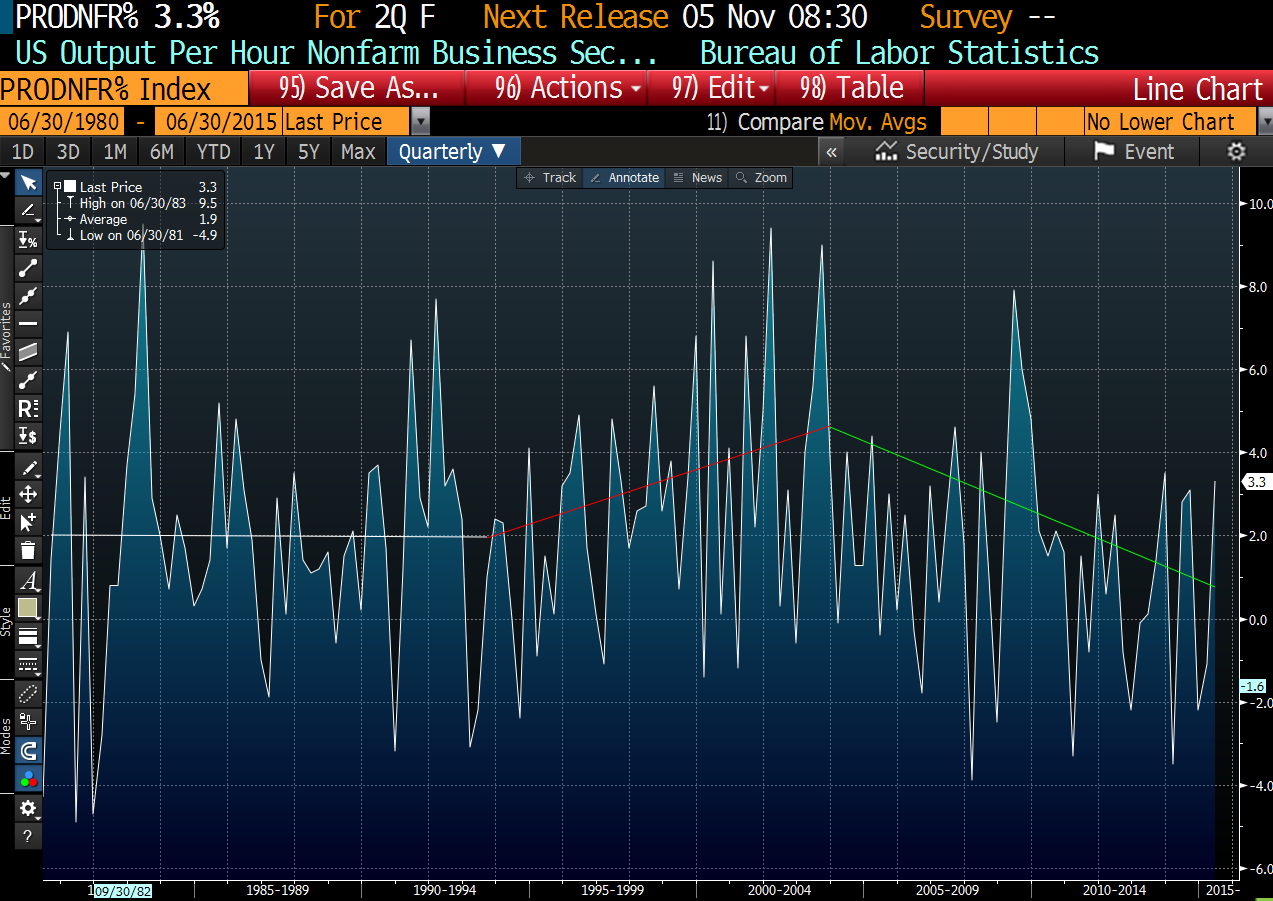
Productivity rebounded in the second quarter to an annualized rate of 3.3%. Overall, productivity growth has been in a downtrend for the past dozen years or so. This is one reason why wage inflation has been so hard to come by – productivity growth has been declining. Take a look at the chart below. You can see productivity flatlining around 2% in the 1980s, then a big acceleration in the 1990s as the personal computer goes from a glorified typewriter to an indispensible tool on everyone’s desk. That continues into the early 00s as the internet helps business become more productive. Finally, you see the decline as the PC and Internet phenomenons become played out. While the mainstream media mocked Jeb Bush for talking up the importance of productivity, he was right.
Is “quantitative tightening” the new buzzword? Not yet, but as central banks worldwide begin to let go of some of their reserves, it may become more common. For the past two decades, central banks (especially China) have been accumulating reserves as they manage their trade balances and their currencies. The net effect has been a bid under Treasuries and a release of money into the system. As China slows, this is reversing as they sell Treasuries to support their currency. When they sell Treasuries, they put pressure on US interest rates and the withdrawal of liquidity acts like a tightening. Punch line: this is the second-order effect of the global slowdown – you might see upward pressure on interest rates, a rising dollar, and a withdrawal of liquidity. This would compound the effect of any Fed tightening. Which means a bumpier road ahead as the Fed pursues normalization. This might explain why the Fed has chosen to not sell (and even to keep re-investing) its portfolio of Treasuries and MBS that it bought during QE.
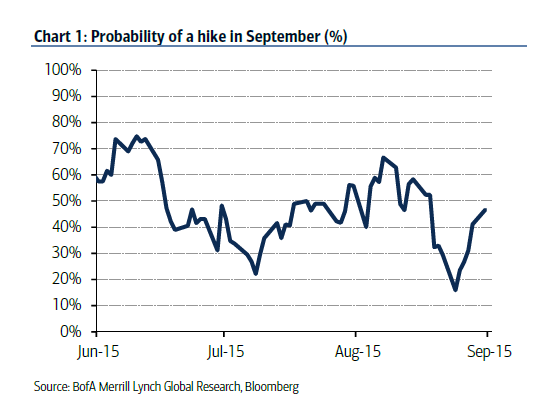
As world markets recover from last week’s bloodbath, the probability of as Sep rate hike is increasing.
Filed under: Morning Report | 118 Comments »
Stocks are lower this morning on global growth fears. Bonds and MBS are up.
IMF Managing Director Christine Lagarde said that global growth will likely remain weaker than the IMF was projecting two months ago. Chinese manufacturing fell to a 3 year low.
China continues to sell US Treasuries in order to support its currency. There has been a fear that China could take down the US by dumping Treasuries and pushing up interest rates here. In reality, the US has more leverage here. China’s economy is beginning to soften, and the last thing they would want to do is injure their biggest customer. Second, Japan would gladly take China’s supply of Treasuries. Third, the article mentions that China has no better alternatives than US Treasuries to stash a trillion dollars. Actually I think that is wrong. The proceeds will go to pay off domestic debt pledged against falling asset prices within China.
The ISM Manufacturing Survey fell to 51.5 in August, missing the Street expectation of 52.5. Prices paid fell from 44 to 39.
Economic Optimism took a big hit in August as well, as the index fell from 46.9 to 42, missing the Street expectation of 47.1 by a country mile.
Constructions spending rose 0.7% in July and June was revised upward from 0.1% to 0.7%.
Obama threw a bone to organized labor as his National Labor Relations Board ruled that companies that use contractors are considered joint employers. This makes parent companies liable for how their subcontractors treat their employees and also is intended to make it easier for unions to get a foothold in the big fast food chains. Who else has to worry about this? The homebuilding industry, which uses a lot of contract labor and has since the 1980s. “Are we concerned that this ruling might have some impact? I think we are alert to the ruling. We are aware that the Labor Department feels its mandate is broad, but we think that our business is highly differentiated from what’s being discussed in the current case or even extensions,” said Stuart Miller, CEO of Miami-based Lennar. Given how much homebuilding means to the overall economy, depressing the sector even further is not really what the economy needs at the moment. And the lack of housing supply leads to…
Higher prices and low affordability. The CoreLogic Home Price Index rose 1.7% in July, which is up 6.9% year over year. Prices remain 6.6% below their August 2006 peak.
Filed under: Morning Report | 39 Comments »
Stocks are lower this morning on overseas weakness. Bonds and MBS are up. Slow news day.
China has given up on using state funds to support its stock market. The government has spent about $200 billion trying to support the stock market.
The highlight of the week will be the jobs report on Friday. This will be the last jobs report ahead of the September FOMC meeting. After last week’s market sell-off, the Fed Fund futures contracts took their assessment of a Sep hike from around 50% to about 30%.
Aside from the jobs report, we have some important economic data this week with the ISM surveys and construction spending. That said, the jobs report will be the big event.
The ISM Milwaukee Index came in at 47.67, a bit lower than expectations.
The Chicago Purchasing Manager’s index was almost flat at 54.4.
Stanley Fischer made some hawkish comments in Jackson Hole on Friday, which is what stopped the rally in stocks.
I had a long interview with Louis Amaya on his Capital Markets Today show. You can access it here. I discuss the economy, real estate, the Fed and China. The interview starts at the 3 minute mark.
Filed under: Morning Report | 23 Comments »
Stocks are taking a breather after a big two-day rally. Bonds and MBS are up.
Personal Income rose 0.4% in July, in line with expectations. Personal Spending rose 0.3%. The Core PCE Index (The Fed’s preferred measure of inflation) rose at 1.2% YOY. Nice to see a little wage inflation. On the other hand, the low PCE inflation is going to worry the Fed.
Note that the National Labor Relations Board just issued a pro-union decision to make a company that hires a temporary agency for workers a joint employer. This will supposedly make it easier for workers to unionize and it makes the ultimate employer liable for what happens to temps. This was considered a big win for the unions. Does it ultimately result in higher wages, or simply more campaign cash for Democrats? I am betting on the latter.
St. Louis Fed Head James Bullard says that the recent volatility in the markets isn’t going to be much of a factor in the FOMC’s decision-making next month. The Fed Funds futures however discounted the probability of a Sep rate hike from about 50% to about 30%.
Pending Home Sales rose 0.5% in July. The real estate market is inching better, but tight supply and affordability issues are holding things back a little.
Consumer sentiment fell in August, according to the University of Michigan. The 91.9 reading came in below expectations.
Filed under: Morning Report | 16 Comments »
Markets are higher this morning as yesterday’s rally held and was followed throughout the world. Bonds and MBS are down.
Second quarter GDP was revised upward to 3.7%, a strong reading. Consumption rose 3.1%, and the core personal consumption expenditure inflation index rose 1.8%. After seeing these numbers, it is easy to see why the Fed was looking to hike rates in September. That was before the global financial market sell-off. The September jobs report next week will be huge.
Initial Jobless Claims fell slightly to 271k, as we sit at more or less record lows.
The Bloomberg Consumer Comfort Index rose to 42 from 41.1 last week. Roughly 1/3 feel positive about the economy, while 54% feel positive about their personal finances.
The sell-off in stocks has been dramatic – in fact the last time we saw this big of a downward move over several days was 1940. The more interesting market has been bonds, which have barely benefited from the big drop downward, and gave up all of those gains almost immediately. The US dollar has been getting whacked during this sell-off as well, which means foreign money is dumping Treasuries. It probably is the petro-economy states doing it, however I have been hearing rumblings of Chinese selling. Whether this is a new dynamic in the market or not remains to be seen, however the action in the 10-year feels like the path of least resistance is now down in price / up in yield.
The Washington Post has another article talking about how stocks are “rigged” based on trading on Monday. Yes, stocks were all over the place, however the structure of the market has fundamentally changed as a result of technology and regulation. There used to be professional market makers for NASDAQ stocks and the specialist on the floor of the NYSE that would be the buyer when everyone else is selling. On days like Monday, they would lose money, but make up for it in normal trading, by selling a stock 1/8 or 1/16 above where they were willing to buy it. Nowadays, with sub-penny spreads, the market maker will never make back losses on days like Monday, so they no longer do it. The only ones left are the high frequency traders, who may or may not be liquidity providers. Stocks aren’t “rigged” – investors are getting what they pay for.
Ray Dalio (of Bridgewater) explains why the Fed may hike rates a quarter of a point or so before launching QE4. His point is that there are two cycles to pay attention to: the first, which is the shorter term cyclical economy that lasts a decade or so versus the long-term cycle, which lasts closer to a century. He is making the argument that the Fed is probably going to do another big easing before the big tightening. This tightening might be 25 or 50 basis points, which he doesn’t consider a major tightening. The Fed is focused on the classic recession – expansion phase which began in 2005 and is more or less where we are today. Dalio believes we are at the end of a debt supercycle, and the last time we went through a debt supercycle deleveraging period was in the 1930s. And while US corporations (and households to a large extent) have gone through a major deleveraging, the rest of the world has not – especially China, which is just entering their deleveraging phase. Interestingly, these supercycles are not new – even the Bible refers to them as 50 year cycles followed by a massive forgiveness (called jubilees, even though they aren’t all that much fun).
Filed under: Morning Report | 92 Comments »
 All Things in Moderation