Morning Report: Mixed jobs report 3/4/16

Stocks are flattish after the jobs report. Bonds and MBS are down.

Jobs report data dump:

  • Nonfarm payrolls +242k
  • Unemployment rate 4.9%
  • Average hourly earnings -0.1%
  • Labor force participation rate 62.9%
  • Average weekly hours 34.4

Overall, an okay report: payrolls were better than expected, but hourly earnings disappoint. The increase in the labor force participation rate is a good thing to see. While it will depress wage growth at least initially, it will make for a stronger economy down the road. FWIW, there may be measurement issues regarding the wage measure that will supposedly be unwound in the next report.

Bonds sold off on the jobs report, with the 10 year and the 2 year bond yields up 3 basis points. I doubt this report will change any minds with regard to the March FOMC meeting, which most people seem to think will have no move in rates and hawkish language.

More evidence of wage inflation: Costco is upping the lower end of their wage scale from $11.50 to $13.00. They announced it on their earnings conference call last night. This will hit their earnings per share by about 1.3% over the next year. Competition for workers is becoming more intense as unemployment stays below 5%.

Texas Independence Day

In 1824, Stephen Austin drafted the Mexican Constitution, which framed the most liberal representative governmental system the world had known until then. Other Texans and Tejanos were instrumental in its passage. See:

http://www.tamu.edu/faculty/ccbn/dewitt/constit1824.htm
But the United States of Mexico was short lived as a democratic republic. Santa Ana seized dictatorial power by military coup in 1833 after he had been elected President. Soon Texas had no reason to stay in and every reason to get out of the Mexican Union.

The leading Tejano signatory to the 1824 Constitution was also a signatory to the 1836 Texas Declaration of Independence.

The Texas Declaration of Independence was produced, literally, overnight, from March 1 to March 2, 1836. Its urgency was paramount, because while it was being prepared, the Alamo in San Antonio was under seige by Santa Anna’s Army of Mexico.

As seen from the transcription below, the document parallels somewhat that of the United States, signed almost sixty years earlier. It contains statements on the function and responsibility of government, followed by a list of grievances. Finally, it concludes by declaring Texas a free and independent republic.

The full text follows:


When a government has ceased to protect the lives, liberty and property of the people, from whom its legitimate powers are derived, and for the advancement of whose happiness it was instituted, and so far from being a guarantee for the enjoyment of those inestimable and inalienable rights, becomes an instrument in the hands of evil rulers for their oppression.

When the Federal Republican Constitution of their country, which they have sworn to support, no longer has a substantial existence, and the whole nature of their government has been forcibly changed, without their consent, from a restricted federative republic, composed of sovereign states, to a consolidated central military despotism, in which every interest is disregarded but that of the army and the priesthood, both the eternal enemies of civil liberty, the everready minions of power, and the usual instruments of tyrants.

When, long after the spirit of the constitution has departed, moderation is at length so far lost by those in power, that even the semblance of freedom is removed, and the forms themselves of the constitution discontinued, and so far from their petitions and remonstrances being regarded, the agents who bear them are thrown into dungeons, and mercenary armies sent forth to force a new government upon them at the point of the bayonet.

When, in consequence of such acts of malfeasance and abdication on the part of the government, anarchy prevails, and civil society is dissolved into its original elements. In such a crisis, the first law of nature, the right of self-preservation, the inherent and inalienable rights of the people to appeal to first principles, and take their political affairs into their own hands in extreme cases, enjoins it as a right towards themselves, and a sacred obligation to their posterity, to abolish such government, and create another in its stead, calculated to rescue them from impending dangers, and to secure their future welfare and happiness.

Nations, as well as individuals, are amenable for their acts to the public opinion of mankind. A statement of a part of our grievances is therefore submitted to an impartial world, in justification of the hazardous but unavoidable step now taken, of severing our political connection with the Mexican people, and assuming an independent attitude among the nations of the earth.

The Mexican government, by its colonization laws, invited and induced the Anglo-American population of Texas to colonize its wilderness under the pledged faith of a written constitution, that they should continue to enjoy that constitutional liberty and republican government to which they had been habituated in the land of their birth, the United States of America.

In this expectation they have been cruelly disappointed, inasmuch as the Mexican nation has acquiesced in the late changes made in the government by General Antonio Lopez de Santa Anna, who having overturned the constitution of his country, now offers us the cruel alternative, either to abandon our homes, acquired by so many privations, or submit to the most intolerable of all tyranny, the combined despotism of the sword and the priesthood.

It has sacrificed our welfare to the state of Coahuila, by which our interests have been continually depressed through a jealous and partial course of legislation, carried on at a far distant seat of government, by a hostile majority, in an unknown tongue, and this too, notwithstanding we have petitioned in the humblest terms for the establishment of a separate state government, and have, in accordance with the provisions of the national constitution, presented to the general Congress a republican constitution, which was, without just cause, contemptuously rejected.

It incarcerated in a dungeon, for a long time, one of our citizens, for no other cause but a zealous endeavor to procure the acceptance of our constitution, and the establishment of a state government.

It has failed and refused to secure, on a firm basis, the right of trial by jury, that palladium of civil liberty, and only safe guarantee for the life, liberty, and property of the citizen.

It has failed to establish any public system of education, although possessed of almost boundless resources, (the public domain,) and although it is an axiom in political science, that unless a people are educated and enlightened, it is idle to expect the continuance of civil liberty, or the capacity for self government.

It has suffered the military commandants, stationed among us, to exercise arbitrary acts of oppression and tyrrany, thus trampling upon the most sacred rights of the citizens, and rendering the military superior to the civil power.

It has dissolved, by force of arms, the state Congress of Coahuila and Texas, and obliged our representatives to fly for their lives from the seat of government, thus depriving us of the fundamental political right of representation.

It has demanded the surrender of a number of our citizens, and ordered military detachments to seize and carry them into the Interior for trial, in contempt of the civil authorities, and in defiance of the laws and the constitution.

It has made piratical attacks upon our commerce, by commissioning foreign desperadoes, and authorizing them to seize our vessels, and convey the property of our citizens to far distant ports for confiscation.

It denies us the right of worshipping the Almighty according to the dictates of our own conscience, by the support of a national religion, calculated to promote the temporal interest of its human functionaries, rather than the glory of the true and living God.

It has demanded us to deliver up our arms, which are essential to our defence, the rightful property of freemen, and formidable only to tyrannical governments.

It has invaded our country both by sea and by land, with intent to lay waste our territory, and drive us from our homes; and has now a large mercenary army advancing, to carry on against us a war of extermination.

It has, through its emissaries, incited the merciless savage, with the tomahawk and scalping knife, to massacre the inhabitants of our defenseless frontiers.

It hath been, during the whole time of our connection with it, the contemptible sport and victim of successive military revolutions, and hath continually exhibited every characteristic of a weak, corrupt, and tyrranical government.

These, and other grievances, were patiently borne by the people of Texas, untill they reached that point at which forbearance ceases to be a virtue. We then took up arms in defence of the national constitution. We appealed to our Mexican brethren for assistance. Our appeal has been made in vain. Though months have elapsed, no sympathetic response has yet been heard from the Interior. We are, therefore, forced to the melancholy conclusion, that the Mexican people have acquiesced in the destruction of their liberty, and the substitution therfor of a military government; that they are unfit to be free, and incapable of self government.

The necessity of self-preservation, therefore, now decrees our eternal political separation.

We, therefore, the delegates with plenary powers of the people of Texas, in solemn convention assembled, appealing to a candid world for the necessities of our condition, do hereby resolve and declare, that our political connection with the Mexican nation has forever ended, and that the people of Texas do now constitute a free, Sovereign, and independent republic, and are fully invested with all the rights and attributes which properly belong to independent nations; and, conscious of the rectitude of our intentions, we fearlessly and confidently commit the issue to the decision of the Supreme arbiter of the destinies of nations.

Morning Report: Lots of economic data this morning 3/3/16

Stocks are slightly lower as a slew of economic data comes in this morning. Bonds and MBS are flattish.

Outplacement firm Challenger, Gray and Christmas reported that announced job cuts rose 21.8% in February to 61.6k. The energy sector accounted for 25k of the losses, followed by chemicals, computer, and industrial goods. The West and the Midwest bore the brunt of the cuts. Remember these are announced job cuts and often never actually happen. Overall, the employment picture is looking decent, however we’ll get a better look tomorrow.

Here is a table of the industries hit. Note that aside from energy, job cuts are pretty low. Note that these are not net numbers either – they don’t take into account any sort of hiring.

Initial Jobless Claims rose to 278k last week. Anything below 300k is a good number.

The ISM Non-manufacturing composite fell slightly to 53.4 in February from 53.5 in January. Business continues to be decent in the services sector.

Factory Orders fell 1.6% in January, while durable goods orders rose 4.7%. Capital Goods Orders rose 3.4%.

Why is wage growth so difficult to find? Productivity growth has been weak since peaking around 1999 – 2000. This was the tail end of the big boost from the Internet and the decade-long transformation of the PC into a tool on everyone’s desk. Last quarter it came in at -2.2%. Productivity has been negative for 3 out of the past 4 years, and that is not a recipe for wage inflation.

Unit Labor costs rose 3.3% in the fourth quarter, which drove the drop in productivity as output only increased 1%.

The Markit US Services PMI fell slightly in February to 49.7 while the composite PMI was flat at 50.

The Bloomberg Consumer Comfort Index fell to 43.6 from 44.2 last week. Falling perceptions of the economy drove the decline.

2012 Presidential Nominee Mitt Romney is going to try and push back the Trumpmentum with a speech tonight.

Nothing too earth-shattering in the Fed’s Beige Book which was released yesterday. Overall, manufacturing is flattish compared to last month, however labor markets improved overall, and “wage growth varied considerably, from flat to strong, across all districts.”

Morning Report: Global yields continue to fall 3/2/16

Stocks are lower this morning after yesterday’s strong rally. Bonds and MBS are down.

Mortgage Applications fell 4.8% last week as purchases fell 0.6% and refis fell 7.2%.

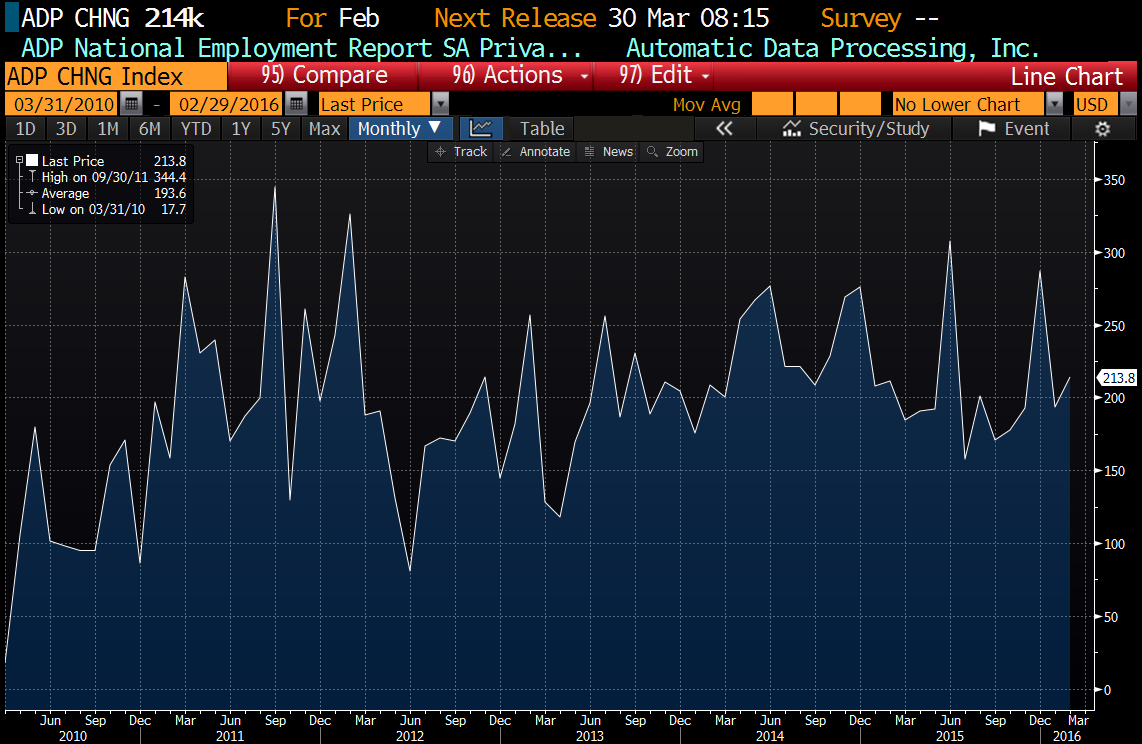
The ADP Employment change came in stronger than expected at 214k jobs. The Street is forecasting an increase of 195k payrolls for Friday’s jobs report. All of the activity was in the services sector, as the manufacturing sector lost about 9,000 jobs and the financial sector added only 8,000.

Chart: ADP jobs

The ISM New York Index fell slightly to 53.6

Donald Trump and Hillary Clinton were the big winners on Super Tuesday. You can probably stick a fork in Sanders at this point. For the GOP, the question is whether Donald Trump is a plurality winner or a majority winner. The establishment is hoping that once they coalesce around a single candidate, the numbers will swing to that candidate. If they go the brokered convention route, Trump will almost certainly run as an independent, which guarantees a Clinton landslide.

Yesterday was a bloodbath in Treasuries, with the 10 year yield increasing about 9 basis points to 1.82%. The 2 year yield increased 7 basis points. If we see strong wage growth on Friday’s jobs report, we could see further weakness in Treasuries.

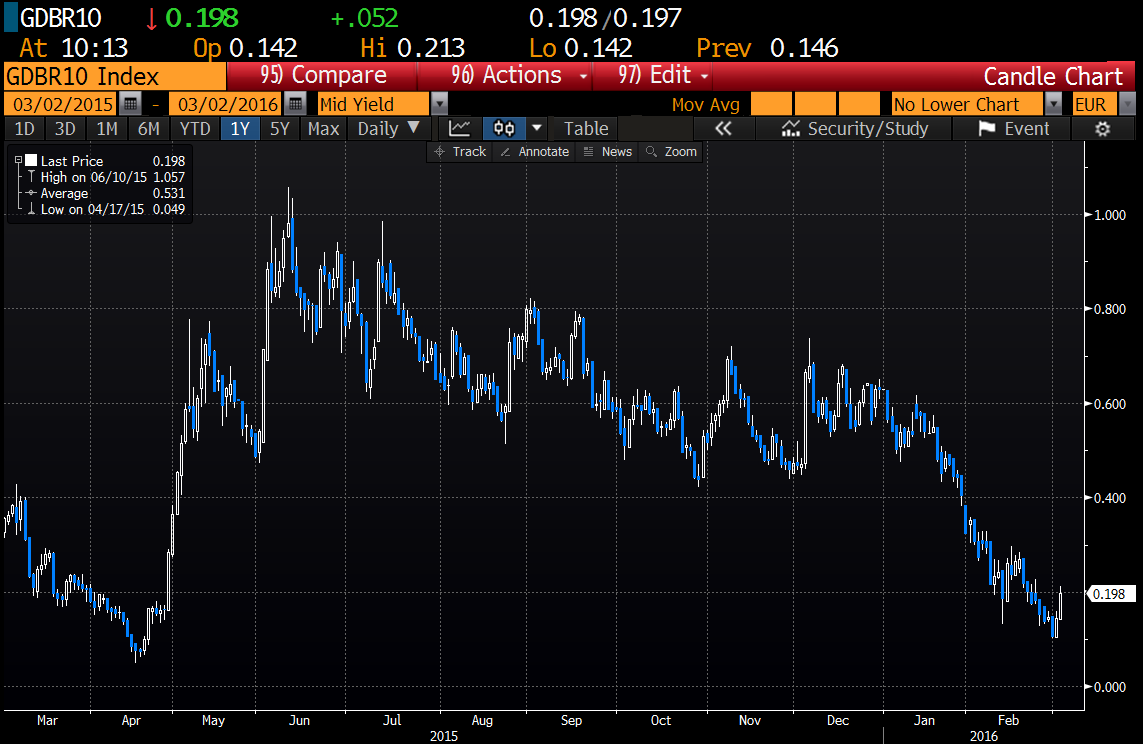
To put the current 1.85% 10 year yield in perspective: when the Fed hiked rates last December, the yield was 2.3%. That said, the fact that interest rates are falling globally will prevent Treasuries from falling too much. Note the German 10 year Bund is close to the sub 10 basis point lows of last spring, and currently yields 18 basis points. The Japanese Government 10 year bond yield is negative 5 basis points. Global investors look at Treasuries yielding more than Italian, Spanish, and Irish bonds and see relative attractiveness, especially since the US is about the only country not trying to devalue its currency. That should help keep a lid on rates.

Chart: German Bund Yield

The collapse in global bond yields is sending a signal that the Fed isn’t going to ignore – that deflation remains a threat. Janet Yellen has pledged to let the labor market “run hot” for a while and that means letting wage growth run. The big question is what happens to the labor force participation rate. If these workers come back, that will prevent too much wage inflation and will be ultimately better for the economy in the longer term. If they don’t, then look for wage inflation to begin and the Fed to move earlier.

Morning Report: Markets at odds with Fed forecasts 3/1/16

Green on the screen this morning as oil and emerging markets rally and the Chinese act to boost lending. Bondsd and MBS are flat.

The ISM manufacturing Index improved to 49.5 from 48.2 last month. Still below 50, which indicates a slowdown, but better than expected. The Markit US Manufacturing PMI came in at 51.3, better than expected.

Construction Spending rose 1.5% in January, much higher than the 0.3% forecast. Public construction drove the increase. Private residential construction was flat for the month.

The turmoil in the financial markets and the global economy have cooled the market’s forecast for further rate hikes. The Fed Funds futures contracts are now forecasting only a 10% chance of a rate hike at the upcoming March meeting and a coin toss for one by December. This is at odds with the last dot graph from the December FOMC meeting, where the median forecast was 1.25% by the end of 2016.

Vehicle sales are coming in strong this morning. Ford Feb sales were up 20%, while Fiat Chrysler sales were up 12% on strong Jeep sales. SUVs were the big gainer overall, as lower gasoline prices entice drivers to switch to bigger cars. Much of this growth is being fueled by cheap credit, however there is so much pent-up demand for new cars (the average age of a car in the US is 11.4 years) that this growth is probably sustainable for the near term and isn’t just a cheap credit story.

Today is Super Tuesday, where 12 states are holding primaries. So far, it looks like Hillary Clinton and Donald Trump will emerge as the winners.

Elmer Fudd warns of “distortions to savings and investment” due to negative interest rates. As the primary architect of the Great United States Housing Bubble, it would have been nice if he had worried about monetary policy-driven distortions to savings and investment say, 15 year ago.

Home prices continue to rise according to CoreLogic. Prices rose 1.3% MOM and are up 6.9% YOY. According to Corelogic, prices remain about 7% below their April 2006 peak. Overvalued markets include many in Texas, Washington DC, and Florida. You can see in the map below, which areas are cheap and expensive (green=cheap, red=expensive).

NAR is predicting existing home sales of 5.38 million in 2016, with average home price appreciation of 4% to 5%. It looks like the Northeast is finally starting to pick up a bit, with contracts up 11% in January.

Morning Report: Walter and Ocwen miss 2/29/16

Markets are higher this morning after the Chinese cut reserve requirements in an effort to stimulate their economy. Bonds and MBS are flattish.

The ISM Milwaukee Index improved to 55.2 from 50.4, while the Chicago Purchasing Manager index fell to 47.6 from 55.6.

Pending Home Sales fell 2.5% in January, according to NAR. A dearth of inventory continues to weigh on the market.

The corporate bond market is having difficulty digesting new issuance. Over the past 12 months, there have been 75 “no go” days, where the primary market was essentially shut. This is higher than the bad old days of 2008-2009. High Yield is even worse, with issuance down 75% year-over-year.

When the stock and bond markets disagree, go with what bonds say. Unsurprisingly, asset managers continue to rotate out of stocks and into bonds.

Warren says don’t worry, be happy. Also the annotated version of the annual letter.

What are the characteristics of houses that sell quickly? Spanish architecture and 1,500-2,000 square feet.

Originator and servicer Walter Investment reported lower than expected earnings this morning and the stock is down about 10%. for 2015, originations were up 36% and the servicing portfolio increased by 4%. In the fourth quarter, origination volume was up 8% YOY.

Walter wasn’t the only company to miss this morning: Ocwen also is down about 11% after missing its quarter. Delinquencies rose to 13.7% from 13.1%.

Texas Will Survive the Oil Glut, Thank You.

Screwing with Putin by killing the profits of the petro-state does not seriously threaten Texas, according to this Federal Reserve Report from the Dallas Branch.

http://www.dallasfed.org/research/heart/index.cfm

The vice president of the FRB-D  says that there are large “industry clusters” around the state where the economy is stable.

She says industries with high-paying jobs – like government, technology, construction, biomedical and defense – may not grow very quickly, but they don’t tend to lose jobs.

“(Researchers) look at the question of why cities tend to grow faster,” she says. “They tend to grow faster because firms tend to group into industries and specialize, so certain regions are specialized in certain industries. This increases productivity growth. It raises wages for workers and it has a lot of benefits on growth.

Orrenius says the report shows a surprising diversification in industry in places like San Antonio, one trend that mimics the nation as a whole.

“You really see some interesting insights,” she says. “We know that Houston is a huge center of the oil and gas industry in the nation, but then you see that Dallas, for example, has a very large concentration of professional and business services.”

The Report says that Austin bounced back from the Recession paced by its large and fast-growing high-tech sector.  Austin currently ranks first on The Kauffman Startup Index.

The Midland-Odessa Region will contract during the Glut, but that region has faced this before, many times, so it is “mature” in its handling of the situation.

Despite Houston’s huge petrochemical industry, diversification is pronounced. The Report says that “with five metropolitan areas of 1 million or more residents, Texas has more big cities per capita than the other large U.S. states with the exception of Florida and Ohio. Dallas–Fort Worth and Houston rank among the top five largest metropolitan areas in the U.S. in terms of both population and economic output. In fact, Texas is the only state to have two metros in the top five.”

Morning Report: Home Prices Continue to rise 2/25/16

Stocks are flat this morning on no real news. Bonds and MBS are up.

Initial Jobless Claims came in at 272k, an increase of 10k from last week.

Durable Goods orders rebounded smartly after a terrible December. They were up 4.9%, way better than the Street expectations.

Capital Goods orders rose 3.9% as well. Capital Goods orders are a proxy for business capital investment, so whatever turmoil is happening in the financial markets doesn’t seem to be affecting Main Street, at least not yet.

House prices rose 1.4% in the fourth quarter, according to the FHFA House Price Index. Home prices have now surpassed their bubble peaks and are making new highs. Note that this index is a sub-index of the real estate market – it only looks at homes with conforming mortgages, so it excludes all cash distressed sales and the jumbo market.

In other economic data, the Bloomberg Consumer Comfort Index fell slightly last week to 44.2. Consumer comfort is crawling back to the bubble days, but still is lower than the Big 90s when the stock market bubble was raging.

One thing that is apparent in this election cycle is that it is hip to bash big business. Why won’t they fight back and tell their side of it? In essence, they dismiss the current populism as so much heated campaign rhetoric and believe that when the election is over, it is back to business as usual. FWIW, they have scored some big victories with the Ex-Im bank and the TPP trade deal. Wall Street, for some inexplicable reason, continues to be content with being a punching bag.

Realtor.com lays out the 20 hottest real estate markets in February. Cliff Note version: mainly California. The Northeast is deader than Elvis.

The Atlanta Fed lowered their Q1 GDP estimate to 2.5% from 2.6%.

Morning Report: New Home Sales fall 2/24/16

Markets are getting pounded on the new worry du jour: Brexit. Bonds and MBS are rallying..

Brexit is the threat of the UK leaving the EU. It has implications mainly in the foreign exchange markets, but if the markets need something to worry about, well there you go.

Mortgage Applications fell 4.3% last week as purchases rose 2.2% and refis fell 7.7%. The spike in rates last week killed the refis.

New Home Sales continue to disappoint. Sales fell in January to 494k from 544k in December. For whatever reason, homebuilders continue to hold back production and rely in price hikes to move the top line.

Regardless, people are still optimistic about the housing sector going forward. Toll Brothers mentioned that a dearth of skilled labor is an issue. Interestingly, average selling prices on signed contracts are falling for them in some areas of the country (the Mid-Atlantic and the South) and are flat in the West. Their urban luxury apartment sector was where all the ASP growth was. Perhaps the builders have pushed price hikes about as far as they can and now buyers are beginning to balk.

Morning Report: Home Prices continue to rise 2/23/16

Stocks are lower this morning on fears of another yuan devaluation. Bonds and MBS are down.

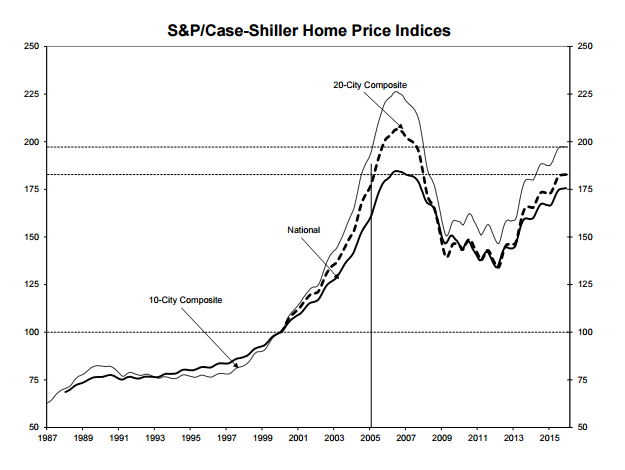
Home Prices continued to rally in December, according to the Case-Shiller Home Price Index. They were up 0.8% on a month-over-month basis and up 5.7% on a year-over-year basis. Prices remain about 11.5% below their July 2006 peak. Note the FHFA House Price index which we will get on Thursday is already at new highs.


Existing Home Sales were up 0.4% at 5.47 million units in January, according to the National Association of Realtors. On a year-over-year basis, they are up 11%, the biggest gain in 3 years. The median home price rose 8.2% year-over-year to $213,800 as supply constraints continue to drive up prices. Housing inventory is 1.82 million units, which represents a 4 month supply. A balanced market is more like 6 – 6.5 month’s worth. Ultimately, the big price increases are unhealthy because incomes have yet to really exhibit growth (although that may be changing). The median house price to median income ratio is roughly 3.8x, using the median income data from Sentier. 3.3 – 3.7x which is about normal.

Speaking of home supply, McMansion builder Toll Brothers reported earnings this morning. Revenues were driven again by an 11.7% increase in average selling prices and not by unit growth. Gross margins fell, which speaks to increasing costs. So far this February, deposits and contracts are flat with last year. The decline in stocks probably has a lot to do with it as the luxury buyer is going to be more sensitive to asset prices than the first time homebuyer.

Interesting to see this dynamic with the builders – a reluctance to build more units despite higher prices. Interestingly, CalAtlantic (the new name for Standard Pacific and Ryland after their merger) is bringing back the buydown loan.

In other economic news, consumer confidence slipped in in February, and the Richmond Fed Manufacturing Index both fell.

Blackrock is warning clients that the Fed is not likely to sit out the rest of 2016, the way the Fed Funds futures markets are predicting. Efficient market theorists might scoff at that notion, however the interest rate markets are so manipulated by central banks at the moment it makes sense to look at market signals with a jaundiced eye. What does that mean to mortgage types? Make hay now, because no one knows how long these low rates are going to stick around.

Speaking of credit markets, the new subprime – auto loans – are beginning to exhibit signs of trouble. Auto loans are being priced like mortgages, however a mortgage is secured by a generally appreciating asset, while an auto loan is secured by a depreciating asset. This is the result of financial repression, which is the act of pushing interest rates to the floor. Investors who have to earn a return (like pension funds and insurance companies) are forced to move further and further out on the risk curve to earn their required return. The actuarial tables really couldn’t care less that interest rates are zero.

Donald Trump looks to be cruising to a third consecutive victory in Nevada. The big question for the D is whether he is a plurality winner or a majority winner. Once the establishment coalesces around one candidate will he continue to lead? One other interesting tidbit: Democratic turnout for the primaries is pretty depressed. Republican turnout is huge. Kind of pokes a hole in the media’s attempt to create a Bernie Sanders movement, doesn’t it?