Posted on March 29, 2016 by Brent Nyitray
Markets are lower this morning on weaker commodity prices. Bonds and MBS are up small.
Pending Home Sales increased 3.5% MOM and are up 5.1% YOY. This is the best number in a year, and points to a strong Spring Selling Season. Lack of inventory remains a problem.
Inflation remains tough to find, but both BlackRock and PIMCO are calling for investors to add an inflation hedge, either by switching out of Treasuries into TIPS or by buying gold.
Barclay’s is calling the latest rally in commodity prices a dead cat bounce, and is calling for a steep decline as fast money exits en masse.
Home prices rose .52% month-over-month according to Case-Shiller. Prices are up 5.4% YOY. Portland, Seattle, and San Francisco reported the biggest gains. Again, tight inventory remains an issue, along with tight credit for the first time homebuyer.
Prices continue to defy gravity in New York City, however the demand for luxury condos is beginning to wane. 423 Park Avenue, now home of the tallest residential building in the Western Hemisphere, has 141 apartments for sale and luxury buyers are beginning to fade as foreign money is hesitant. Yet Manhattan is dotted with cranes, largely building high-end condos.
Homebuilder Lennar reported better than expected earnings this morning. EPS is the highest third quarter number since 2006. Average selling prices increased 12% to $365,000 while new orders increased 10% in units and 15% in dollar volume.
Filed under: Economy, Morning Report | 26 Comments »
Posted on March 24, 2016 by Brent Nyitray
Stocks are under pressure this morning as commodities drop. Bonds and MBS are up small.
Initial Jobless Claims rose to 265k last week while the Bloomberg Consumer Comfort Index ticked up to 44.6
Durable Goods Orders fell 1.8% last month, slightly better than expectations, but when you strip out transportation, the number was a huge miss. Capital Goods orders (a proxy for business capital expenditures) fell 1.8% missing by a country mile.
In other economic data, the Markit PMI numbers were barely expansionary and the Kansas City Fed improved slightly, but is still negative.
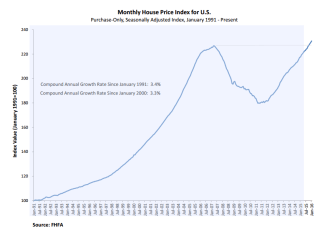
Mel Watt is going to have a decision on principal mods for conforming loans held by the government within the next 30 days. The left has been pushing FHFA to do this for years. Why the (expected) change? Probably the FHFA House Price index, which has now recouped all of its losses from the bubble years. HARP may go away as well – FHFA is toying with the idea of a high-LTV refi.
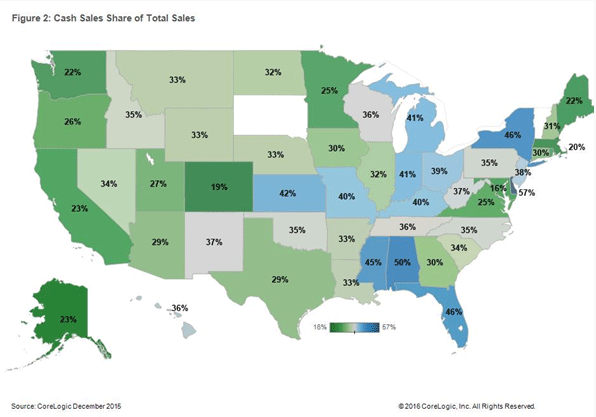
Cash sales are at their lowest level in 7 years, according to CoreLogic. In 2015, they accounted for 34% of all sales. The peak was January 2011 when they hit 47%. Pre-crisis, that number was in the high 20s. Unsurprisingly, the states with the highest foreclosure pipeline and the lousiest real estate markets have the highest cash sales percentages.

Mortgage lenders are on net still easing credit standards, however they are doing it at a slower pace, according to the latest Fannie Mae Mortgage Lender Sentiment Survey.Government loans actually were tightened.
Filed under: Economy, Morning Report | 23 Comments »
Posted on March 23, 2016 by Brent Nyitray
Markets are lower this morning on no real news. Bonds and MBS are up small.
Mortgage Applications fell 3.3% last week as purchases fell 1% and refis fell 4.9%. Despite an 11 basis point drop in the 10 year yield, mortgage rates barely budged, falling only 1 basis point.
New Home Sales ticked up slightly to an annualized pace of 512,000. The increase was driven entirely by building out West where there is an acute shortage of housing. Note that homebuilder KB Home reports after the close tonight. The median sales price increased 2.6% to $301,400.
Hawkish comments out of St Louis Fed President James Bullard: “You get another strong jobs report, it looks like labor markets are improving, you could probably make a case for moving in April,” Bullard, who votes on policy this year, said in a Bloomberg interview in New York Wednesday. “I think we are going to end up overshooting on inflation and the natural rate of unemployment.” Perhaps, but the doves are in control of the FOMC at the moment.
Bullard isn’t the only dissenter, however. Janet Yellen has a bit of a mini-revolt on her hands (as much as central bankers can “revolt” in the first place)
If negative interest rates in Europe and Japan don’t do the trick, then the next step is “helicopter money” which has always been a textbook-only idea but is gaining fans. The government would issue debt directly to the central bank, which would print the cash which the government would immediately spend, bypassing the banking system entirely. The theory is that if there is a liquidity trap (where banks just sit on Treasuries and won’t lend them out), this would inject the money directly in the economy. It would probably require legislation to change the way central banks are run in Europe (and certainly the US), and if there isn’t the political will to do massive Keynsian spending programs, then there won’t be the political will to do this. What are the risks to doing it? Who knows? Weimar Republic-esque inflation is one, but probably the biggest one would be a loss in confidence in central banks globally, which would probably mean a collapse of the banking system worldwide. Anyway, it is just a theory that is gaining some traction, but it probably remains in the textbooks.
And don’t forget – ZIRP and NIRP aren’t “free.” Insurers need to earn a certain rate of return on their money to fund future payouts, and the actuarial tables couldn’t care less than rates are 0%. The latest victim is the oldest insurance company in the world, Lloyds of London who reported a big drop in profits due to sub-par investment returns.
Filed under: Economy, Morning Report | 11 Comments »
Posted on March 22, 2016 by Brent Nyitray
Markets are weaker this morning after a terrorist attack in Brussels leaves 35 dead. Bonds and MBS are up.
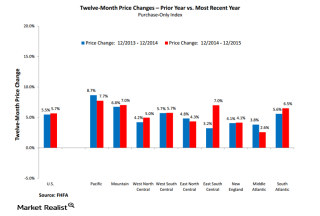
The FHFA House Price Index rose 0.5% last month. House prices have recouped all of their losses from the housing bust and are making new highs. Note the FHFA House Price Index is the only one showing the losses have been recouped – Case Shiller, and Core Logic have not.
You can also see the huge geographic disparity between the different regions in the US. The Northeast (which includes New England and the Middle Atlantic) are picking up the rear compared to the other parts of the country. As someone who grew up in the Rust Belt, I am beginning to notice similarities in the Northeast.
In other economic data, the Richmond Fed Manufacturing Index improved last month, and the Markit US Manufacturing PMI was flat.
We are well aware there is a problem with the first time homebuyer. They are saddled with large student loan debt, and are under-employed for the most part. The other big issue – low housing inventory is making the starter home unaffordable. When you look at the expensive areas, it gets ridiculous. The mortgage payment for a starter home in San Francisco (admittedly an extreme example) would run someone 110% of median income! I have said it before: the difference between 2% GDP growth and 3% GDP growth is housing. To address the dearth of inventory, we should have a run rate of 2 million starts a year. Yet we remain mired around 1.2 million. It obviously isn’t an oversupply issue – it is a credit issue. Yet the consensus seems to be that the financial sector remains “unregulated” and needs to be reined in. You would think politicians would like to see 3% economic growth but apparently they don’t. All obama seems to care about is racial bean-counting in the burbs..

Over half of US homes are now built in community associations. Issues over the creditor priority HOA claims over mortgages have been an issue in some states, apparently.
More evidence that the cheap labor arbitrage for China is about over.
Filed under: Economy, Morning Report | 12 Comments »
Posted on March 21, 2016 by Brent Nyitray
Markets are lower this morning on no real news. Bonds and MBS are down.
Existing home sales fell 7.1% in February to an annualized pace of 5.08 million. Bad weather in the Northeast and the Midwest may have played a part. Sales are up 2.2% on a year-over-year basis. Lack of inventory and affordability remain the biggest issues. The median home price increased 4.4% to $210,800, and total inventory is about 4.4 month’s worth. All cash transactions were 25% of sales and investor purchases ticked up to 19%. The share of first time homebuyers slipped to 30% as affordability problems and worries about the economy kept many younger buyers on the sidelines.
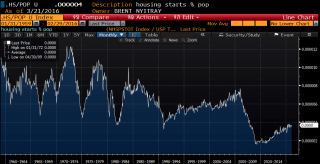
Given the tight inventory, why aren’t homebuilders aggressively adding supply? Finding affordable land plots and skilled labor appear to be the problem. It is amazing that 10 years after the housing bust, we are still 25% below the long-term average in housing starts. I adjusted housing starts by population, and the graph below gives you an ideal of how much we have underbuilt. We still just barely reached the low of the 81-82 recession, which was the nastiest since the Great Depression. What is going on? My guess is that the government is the problem, via zoning laws in some localities, and general Washingtonian regulatory funk tying up the credit markets. Correcting whatever problem is holding back housing is the difference between a tepid, meh economy of 2% growth, and a recovery where we see 3% growth and wage inflation. It would be nice if someone running for office noticed this and said something. Unfortunately, they only acceptable answer these days is that the financial sector isn’t regulated and needs to be sat on more.
Investor demand for paper isn’t necessarily the issue either, as right now anyone who can fog a mirror can get an auto loan. It is the same old story: new entrants come into the market, take risks that the established players won’t take, and a new market takes off. One thing that is different these days is technology. Lower credit borrowers will get a GPS installed on their car (no, not a nice navigation system, but a transmitter that tells the lender where the car is). Lenders also now have the ability to disable the car remotely.
Filed under: Economy, Morning Report | 13 Comments »
Posted on March 21, 2016 by novahockey
I spent the weekend in Nashville for a college guys weekend. I did not know that it is bachelorette party central. But that’s neither here nor there.
Couple of things I heard of interest.
My uber drivers was a Trump voter. He’s always voted Democratic before, including for Obama who he likes very much. on of my friends in involved in Ohio Democratic politics. He is very concerned about Trump. A contacts is a lawyer who works on Muslim immigration issues. So the younger guys who work for him (all Muslims) are all Trump supporters. WTF is that about: “He can’t deport us or stop us from coming, but he can be more fair on the Israel matter.”
So there you go.
Filed under: Economy | 37 Comments »
Posted on March 17, 2016 by Brent Nyitray
Markets are lower this morning after the Fed maintained interest rates yesterday. Bonds and MBS are up small.
Surprising that bonds aren’t rallying harder this morning as European rates are moving aggressively lower, with the German Bund yield down 8 basis points to 24 bp. The dollar is getting hit a bit, which might explain the lack of follow-through.
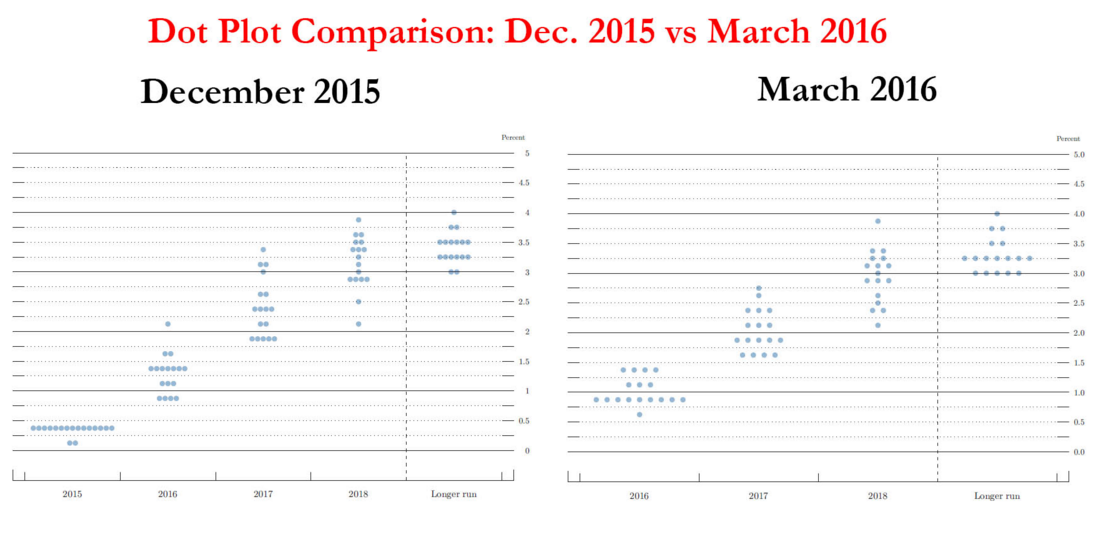
The Fed maintained interest rates and put out a relatively dovish statement. They took down their forecast for interest rates going out through 2018, which helped put a bid under bonds. In their updated economic forecasts, they took down their forecast for 2016 GDP to 2.2% from 2.4% and their estimate of 2016 inflation to 1.4% from 1.6%. They maintained their forecast for 4.7% unemployment. On the dot graph, the forecast looks for 2 more rate hikes this year, as opposed to their forecast of 4 in December.
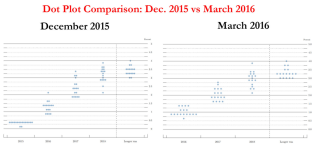
After the FOMC statement, stocks and bonds rallied, with the 10 year yield dropping about 4 basis points and the 2 year yield dropping 11.
Initial Jobless Claims rose to 265k last week, while the Philly Fed Index improved.
The Bloomberg Consumer Comfort Index edged up last week to 44.3 from 43.8.
The Index of Leading Economic Indicators improved 0.1% in February, while job openings increased to 5.54 million.
CFPB Chairman Richard Cordray appeared before the House Financial Services Committee this morning. He said the CFPB will take a “sensitive” approach to TRID enforcement, meaning that if you are making a good-faith effort to comply, they won’t hammer you.
Filed under: Economy, Morning Report | 41 Comments »
Posted on March 17, 2016 by novahockey

Rep. Connolly was on WTOP this morning saying that those responsible for the failures at Metro need to be held accountable. I started my day with a laugh and thought you might get chuckle out of that too.
For those unfamiliar, see NPR
Also, if you are visiting the DC area, do not use Metro. It is not safe. It will never be safe.
Filed under: Economy | 22 Comments »
Posted on March 16, 2016 by Brent Nyitray
Markets are lower this morning after inflation comes in a little hotter than expected. Bonds and MBS are down.
The consumer price index fell 0.2% month-over month, but the core index, which excludes food and energy, rose 0.3% and is up 2.3% year-over-year. This makes the FOMC statement (and the press conference that follows) more significant this afternoon. Remember, the decision will be out at 2:00 pm EST, so expect some volatility in bonds around that time.
Bonds sold off on the CPI number and the more dramatic move was in the 2-year, not the 10-year. The 2 year yield increased 3 basis points on the news to .99%. Movements in the 2-year signify the market’s expectations about what the Fed is up to. The 10 year is more driven by longer-range economic forecasts. The 10 year was up, sold off on the news and is now flat on the day.
Housing starts rose to an annualized pace of 1.178 million in February and January was revised upward to 1.12 million. Building Permits fell however to 1.17million from 1.2 million. The drop in permits was driven by multi-family construction as single-fam remains slow and steady.
Mortgage Applications fell 3.3% as purchases rose 0.3% and refis fell 5.6%. Refis now constitute 55% of the total number of loans, down about 9 percentage points over the last month.
The strong dollar is still making life tough for manufacturers. Industrial production fell 0.5% month-over-month, while manufacturing production rose 0.2%. Capacity Utilization fell to 76.7%.
Marco Rubio is out after losing his home state of Florida to Donald Trump. John Kasich won Ohio, which keeps him in the race and makes him the de facto “Establishment Candidate. Ted Cruz is still in and he is probably going to split the Trump vote, while Kasich solidifies the establishment vote. Policy-wise, Kasich and Hillary are almost identical. Trump is warning that there will be riots if he has the delegates (or is close) and loses a contested convention. The convention is 4 months away. A lot can happen.
On the Democratic side, Hillary did well, so we can stick a fork in the #FeelTheBern hashtag.
Filed under: Economy, Morning Report | 92 Comments »
Posted on March 15, 2016 by Brent Nyitray
Markets are lower this morning as the dollar rallies and commodities fall. Bonds and MBS are up.
The FOMC meeting begins today. The decision will come out at 2:00 pm EST tomorrow, along with the new economic and Fed Funds forecasts. Here is Tim Duy’s take on the state of play. His take: while you could make an argument to tighten, the Fed still considers the bigger risks to be to the downside. The doves are ascendant on the Board.
Retail Sales fell 0.1% in February, although declining gasoline prices had a lot to do with it. Ex-autos and gas, they were up 0.3%. The control group, which also strips out building products was flat. The downward revisions to January got everyone’s attention however as the initial 0.2% estimate was revised downward to -0.4%.
Inflation at the wholesale level remains well below the Fed’s target. The Producer Price Index fell 0.2% in February as well. Ex-food and energy, it was flat on a month-over-month basis and is up 1.2% YOY.
The Empire Manufacturing Index rebounded smartly to .62 after a heavily negative start to the year.
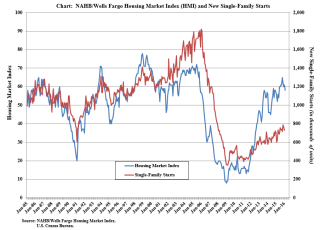
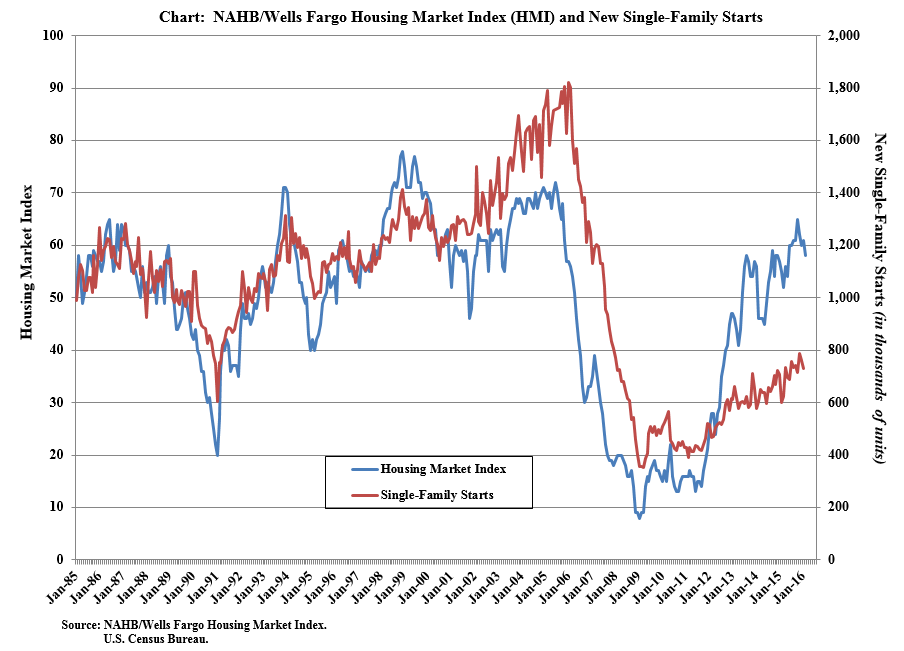
The NAHB Homebuilder Sentiment Index was unchanged at 58 in March. This is a 9 month low. A shortage of lots and labor continue to be the biggest headaches facing the sector. The builders have been able to drive the top line by raising prices, not by pushing volume. You can see below how the index has tracked versus housing starts. The divergence is as big as it has ever been.
Voters go to the polls in several states today, including Florida and Ohio, which are do-or-die races for Marco Rubio and John Kasich respectively. The Democratic side seems pretty much set at this point, unless Bernie Sanders pulls a free rabbit out of a hat.
Filed under: Economy, Morning Report | 20 Comments »


 Brent Nyitray
 Fairlington Blade
 Let the mutherfuker burn!
 jnc4p
jnc4p Kevin S. Willis
 Michigoose
 lmsinca
 markinaustin
 Arcanaut
 novahockey
 quarterback
 ScottC
 yellojkt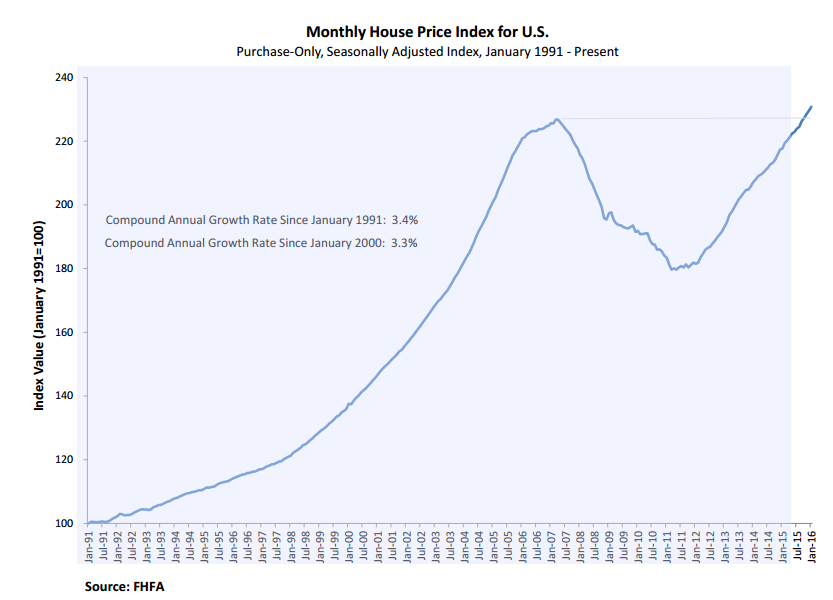


 All Things in Moderation