Morning Report: Housing starts disappoint 10/19/16

Vital Statistics:

Last Change
S&P Futures 2137.5 4.0
Eurostoxx Index 343.1 0.6
Oil (WTI) 51.1 0.8
US dollar index 88.0 0.0
10 Year Govt Bond Yield 1.76%
Current Coupon Fannie Mae TBA 103.3
Current Coupon Ginnie Mae TBA 104.2
30 Year Fixed Rate Mortgage 3.57

Stocks are up this morning as earnings reports continue to pile in. Bonds and MBS are flat.

Mortgage Applications rose 0.6% last week as purchases rose 3% and refis fell 1%.

Housing starts fell to a 1.05 million pace in September, driven by a big drop in multi-fam. Single fam was up around 8%. Building Permits rose to 1.23 million. Housing continues to be the biggest underperformer in the economy, but the subject hasn’t really come up in this election, for either side.

We have some Fed-speak today, with John Williams speaking at 8:45, Rob Kaplan at 1:30 and William Dudley tonight.

The final debate is tonight, and it looks like Hillary is pulling away from Trump at this point. The black swan event for the markets is a Democratic Party sweep, which will probably cause the stock market to spit up a hairball.

Lending standards in the jumbo space are loosening, even as the luxury end of the housing market underperforms. Loan Depot is now offering 40 year jumbo products that are interest-only for the first 10 years. Redwood is now offering a 90 LTV product that goes down to a 660 FICO.

The NAR is releasing its latest Profile of Home Buyers and Sellers. Here are the big changes over the past 35 years.

  • The first time homebuyer is a smaller percentage than it has been in the past.
  • The internet is not replacing the real estate agent
  • Houses have been getting bigger of the past 30 years, but have leveled out in recent years
  • Down payments have been going down
  • The home search process is taking longer than ever due to tight inventory

Zillow has their own report on trends in housing. Here is the executive summary (the report is very long and detailed):

“The home buying experience is both an intimidating financial transaction and an emotional milestone. Half of home buyers in the U.S. are under 36, meaning a new generation— Millennials—is shaping the future of real estate. Despite demographic reports about young adults’ urban lifestyles, Millennials share their parents’ aspirations for a single-family home, often in the suburbs.

The process of finding or selling a home is much more collaborative for Millennials than for older generations. They bring all available tools to the process, including their smartphones, social media and online networks. While older generations rely on real estate agents for information and expertise, Millennials expect real estate agents to become trusted advisers and strategic partners.

Millennial home buyers are also diverse. While only 9 percent of all homeowners are Hispanic, nearly 15 percent of the Millennials buying homes are Hispanic—reflecting the changing demographics of the American middle class.

Homeownership remains a vehicle for wealth in the U.S., but it can also be a financial burden, as families stretch their finances to afford the space they need, and large, dated homes owned by Baby Boomers and the Silent Generation demand maintenance and improvements.”

Morning Report: Inflation returns 10/18/16

Vital Statistics:

Last Change
S&P Futures 2137.5 15.0
Eurostoxx Index 342.3 5.0
Oil (WTI) 50.4 0.4
US dollar index 88.1 -0.2
10 Year Govt Bond Yield 1.78%
Current Coupon Fannie Mae TBA 103.3
Current Coupon Ginnie Mae TBA 104.2
30 Year Fixed Rate Mortgage 3.54

Stocks are higher this morning on no real news. Bonds and MBS are down.

It looks like the Fed has made some progress in getting inflation up to its goal of 2%. The Consumer Price Index came in at 0.3% MOM. Ex-food and energy it is up 2.2% on a YOY basis. The Fed doesn’t really look at CPI all that much – it prefers the Personal Consumption Expenditure Index – but it looks like we are moving further away from the deflation ledge that central bankers fear.

What drove the increase in the core index? Owner-equivalent rent, which is a proxy for real estate prices. It rose 0.4%, which is the highest reading since 2006.

What does increasing inflation mean for the mortgage business? Assuming higher inflation translates into wage inflation, you should see a pick-up in the purchase business as Millennials get jobs / raises. On the other hand, the refi business is going to take a hit.

One Texas builder is focusing on the entry-level homebuyer and using USDA loans to help make the sale. LGI Homes, based in Houston, is marketing to people in apartment complexes with flyers discussing the monthly payment they could have if they bought. These are largely properties in the exurbs around Dallas and Houston, where lower land acquisition costs translate into lower average selling prices. ASPs for LGI are below 200k, while ASPs for new homes in general is over $350k. LGI reports seeing the steadiest demand in entry-level.

Sentiment for the builders is high in general. The NAHB Housing Market Index fell 2 points in October, from its record in September.

High property taxes got you down? Here is something you can do about it.

Morning Report: Manufacturing disappoints 10/17/16

Vital Statistics:

Last Change
S&P Futures 2126.5 -0.5
Eurostoxx Index 338.0 -2.0
Oil (WTI) 40.4 0.0
US dollar index 88.3 -0.2
10 Year Govt Bond Yield 1.78%
Current Coupon Fannie Mae TBA 103.3
Current Coupon Ginnie Mae TBA 104.2
30 Year Fixed Rate Mortgage 3.58

Stocks are lower this morning on overseas weakness. Bonds and MBS are down.

Manufacturing in the US rose slightly in September, but came in lower than expected. August’s numbers were revised downward. Industrial Production rose 0.1%, while manufacturing production rose 0.2%. Capacity Utilization rose to 75.4%. The strength in the dollar is probably driving the weakness.

Manufacturing dropped in New York last month, according to the Empire State Manufacturing Index. The index fell for the third month in a row.

The black swan event for the financial markets? A democratic party sweep in November. If so, buy infrastructure stocks, sell pharma and financials.

Meanwhile, turnout is looking to be low this year as voters dislike both candidates and are tuning out all the rhetoric.

Elizabeth Warren fired a shot across the bow of the SS Hillary, directing her to demote SEC Chair Mary Jo White. Her sin? Not going along with the left who wants more disclosure of political activities and donations for corporations. Of course this has absolutely nothing to do with investor protection: it is more about using the regulatory power of the SEC to silence opinions that she doesn’t approve of (mainly businesses that donate to the Chamber of Commerce or other groups that argue for lighter regulation or lower taxes).

Morning Report: bank earnings 10/14/16

Vital Statistics:

Last Change
S&P Futures 2137.5 11.0
Eurostoxx Index 340.8 5.0
Oil (WTI) 50.7 0.3
US dollar index 88.3 0.2
10 Year Govt Bond Yield 1.78%
Current Coupon Fannie Mae TBA 103.3
Current Coupon Ginnie Mae TBA 104.2
30 Year Fixed Rate Mortgage 3.58

Stocks are higher this morning on good overseas economic data. Bonds and MBS are down.

Inflation at the producer level is picking up, according to the Producer Price Index, which rose 0.3%, higher than expected. The core index is up 1.5% YOY. Inflation remains under the Fed’s target, but we are seeing it creep up towards their preferred 2% range.

Retail sales increased 0.6% last month, in line with expectations. Retail Sales ex autos and gasoline rose 0.3%. Housing-related sales did particularly well, with furniture up 1% and building materials up 1.4%. I wouldn’t be surprised to see some strategists take up their Q3 GDP estimates on this number.

Consumer sentiment unexpectedly fell in early October, according to Reuters and the University of Michigan.

Business inventories rose 0.2%, a little higher than expected. This will have the effect of goosing Q3 GDP growth at the expense of Q4.

Wells Fargo reported earnings this morning. Origination was up 11% QOQ to $70 billion. Purchase activity accounted for 58% of originations. The stock is unchanged in early trading.

JP Morgan reported earnings this morning as well. Mortgage origination was up 8.4% QOQ to $27.1 billion. On an annualized basis, it is down 9.4%.

The typical homeowner’s perception of the value of their home is about 1.25% lower than where the appraised value has been coming in. Appraised values are up almost 8% YOY, which is a faster rate of appreciation than we have been seeing in the real estate indices like FHFA or Case-Shiller.

Morning Report: PIMCO is buying mortgages 11/13/16

Vital Statistics:

Last Change
S&P Futures 2116.0 -15.0
Eurostoxx Index 334.4 -4.0
Oil (WTI) 50.0 -0.1
US dollar index 88.4 0.1
10 Year Govt Bond Yield 1.75%
Current Coupon Fannie Mae TBA 103.3
Current Coupon Ginnie Mae TBA 104.2
30 Year Fixed Rate Mortgage 3.54

Stocks are lower this morning after weak Chinese data. Bonds and MBS are up.

The FOMC minutes showed that September was a close call with respect to raising rates, and definitely set up the markets for a December rate hike. The Fed noted that third quarter GDP was stronger than the first half of the year, and the labor market is strengthening. The consensus for a December tightening doesn’t necessarily indicate that there is the same consensus for further rate hikes. Interestingly, the Fed views consumer spending as”growing strongly” when the actual data does not suggest much strength at all. Bottom line, it looks like we are getting a rate hike in December, and the November meeting will be a non-event. The Fed Funds futures are assigning a 68% probability of a December hike of 25 basis points.

Initial Jobless Claims fell to 245k last week, which is the lowest since the early 70s.  Consumer comfort increased last week as well.

Import prices rose 0.1% MOM and are down 1.1% YOY. Export prices rose 0.3% MOM and are down 1.5% YOY. Strategists are warning that the rise in the dollar is going to hit corporate profits.

PIMCO is getting into a defensive posture, buying mortgage backed securities and inflation-linked securities. Mortgage backed securities now account for 55% of the Total Return portfolio from 49% in August. Why mortgages? Think about what will happen to long term bonds as the Fed hikes rates. If long term bonds don’t really move all that much (in other words, the yield curve flattens) the yield on mortgage backed securities will be much better than the yield on Treasuries. If the long end of the curve increases in line with the increase in the Fed funds rate, PIMCO is betting that the decrease in prepayment speeds will offset (at least partially) the interest rate effect. You can see over the past 5 tightening cycles, the yield curve has flattened.

John Stumpf is out at Wells. COO Tim Sloan, will take over. While the scandal was in the retail banking are and not the mortgage division, there probably will be fallout there too.

The Fed shrinks its balance sheet using this one weird trick..10/12/16

Vital Statistics:

Last Change
S&P Futures 2130.8 -4.0
Eurostoxx Index 339.6 -0.6
Oil (WTI) 50.8 0.0
US dollar index 88.4 0.1
10 Year Govt Bond Yield 1.79%
Current Coupon Fannie Mae TBA 103.3
Current Coupon Ginnie Mae TBA 104.2
30 Year Fixed Rate Mortgage 3.54

Stocks are down again after getting roughed up yesterday. Bonds and MBS are down as well.

Mortgage applications fell 6% last week as purchases fell 3% and refis fell 8%.

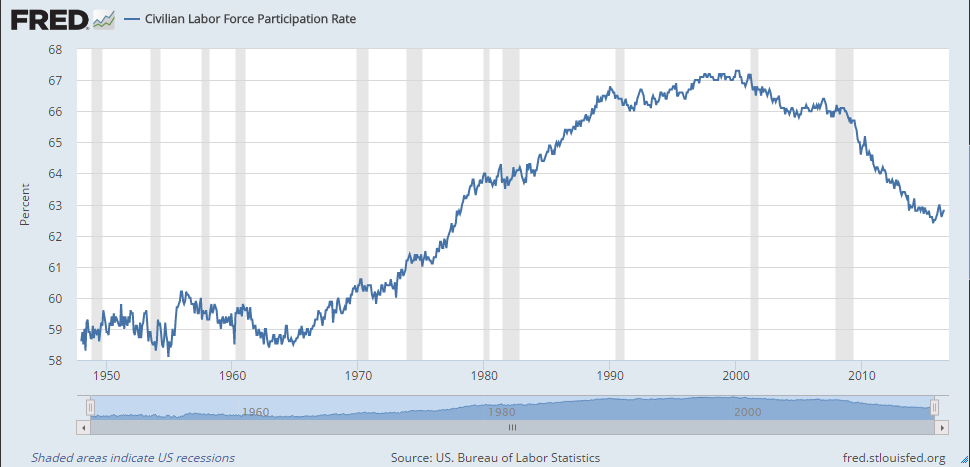
Job openings decreased by 400k to 5.4 million in August, according to the BLS. The quits rate (which is probably the best indicator for strength in the labor market) was steady at 2.1%. I wonder if we are seeing employers begin to hire the long-term unemployed, which would account for the drop in openings and the flat quits rate. The labor force participation rate is beginning to pick itself off the floor, as we saw in the latest jobs data.

We will get the FOMC minutes from the September meeting at 2:00 pm EST today. Be aware of possible market movement around then, especially if the minutes turn out to be a bit more dovish than expected. On Sunday, Fed Vice Chairman Stanley Fischer said that September’s decision to wait on hiking rates was a “close call.” The minutes will hopefully shed further light on that statement.

The biggest problem with QE is what to do with all of these assets that now sit on the Fed’s balance sheet. The Fed can’t sell the Treasuries it bought without withdrawing liquidity from the system. That would be contractionary, and the economy (or at least the financial system) might be too fragile to handle it. That would be the case even if the Fed just lets it run off by not re-investing maturing proceeds. There is now a school of thought that the Fed’s balance sheet should simply remain the size it is now, and we shouldn’t return to pre-bubble levels. The thinking is that governments should simply consolidate the Fed’s assets onto its own balance sheet. (called “permanent monetization”) Given that central banks are ultimately owned by the government, its Treasuries would effectively “cancel out” the debt issued by the government. This is why looking at the debt to GDP ratio is somewhat misleading: about a quarter of our debt is owned by the central bank. It is like taking out a loan and leaving the money in your savings account. In nominal terms, your debt is up, but your net worth is unchanged. One thing is for sure: none of this is in the econ textbooks. We are all making it up as we go along.

A Federal Appeals court ruled yesterday that the CFPB’s structure is unconstitutional. The director of the CFPB is appointed for a 5 year term, and can only be fired for cause by the President. The court found that this structure puts too much power in the hands of one person, and is more or less unaccountable. Rob Chrisman takes a look at what is going on.

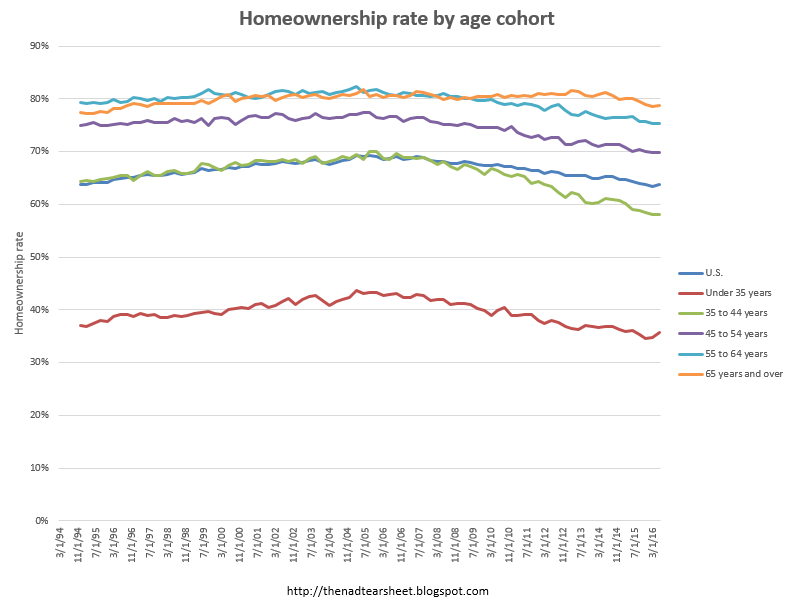
A study from the Urban Institute forecasts that the homeownership rate will continue to decline. The question ultimately rests on whether the Millennials are going to follow a different path than previous generations, or are they simply late bloomers who will eventually marry, have kids, and want a place in the suburbs. Note that the homeownership rate started going vertical in 1994, with the Clinton Administration’s policies to encourage homeownership, as a tool for social engineering. Post-crisis, the rates has returned to its previously undisturbed rate.

Morning Report: Optimism in short supply 10/11/16

Vital Statistics:

Last Change
S&P Futures 2152.8 -6.0
Eurostoxx Index 342.3 0.3
Oil (WTI) 51.0 -0.3
US dollar index 87.9 0.3
10 Year Govt Bond Yield 1.77%
Current Coupon Fannie Mae TBA 103.3
Current Coupon Ginnie Mae TBA 104.2
30 Year Fixed Rate Mortgage 3.54

Stocks are up small on no real news. Bonds and MBS are down.

Alcoa kicked off Q3 earnings season with a miss. Earnings season gets into full swing next week when all the big banks announce.

While bond yields rose pretty dramatically during September, there are still $10.7 trillion worth of negative bond yields worldwide. Half of it is from Japan. The German Bund is now trading at a yield of 6 basis points.  A years’ interest on a 1 million euro Bund would cover one night at the Bayerische Hof hotel in Munich. Happy Oktoberfest.

Small business optimism dipped in September, according to the NFIB. Sentiment came in at 94.1, well below the historical 98 average. The bright spot was an improvement in economic expectations (basically improving to neutrality) while job openings and inventories fell. Small business is also firmly in maintenance capital expenditure mode, choosing not to deploy capital for expansion. The election is probably having a negative effect on sentiment as well.

Meanwhile, the US economic confidence index continues to languish in negative territory. Historically, you would see a jump in confidence around election times, as candidates promise to make things better. Not this time around, however. This also makes the Fed’s job more perilous, as they don’t want to depress what little animal spirits are out there at the moment.

Tim Duy argues that Friday’s jobs report is bad news for Fed hawks who want a December tightening. He sees November as a long shot, and December as not a foregone conclusion. Lots of wonky labor economics, but he does give you a good idea on how the Fed thinks.

Goldman is out with a “be cautious” call for the rest of the year. A vulnerable European economy, combined with high US stock prices means the market could be looking at a 2% decline over the next couple of months.

Morning Report: RIP the mortgage interest deduction? 10/10/16

Vital Statistics:

Last Change
S&P Futures 2158.0 12.0
Eurostoxx Index 341.2 1.6
Oil (WTI) 50.6 0.8
US dollar index 87.6 -0.2
10 Year Govt Bond Yield 1.72%
Current Coupon Fannie Mae TBA 103.3
Current Coupon Ginnie Mae TBA 104.2
30 Year Fixed Rate Mortgage 3.54

Bonds are closed today, but overseas bond markets are weaker. Stocks are up.

No economic data today. The week after the jobs report is typically data light to begin with, and there really isn’t anything market-moving this week, except for may the PPI on Friday.

Dave Stevens of the MBA raised the issue of eliminating the mortgage interest deduction, albeit with the caveat that it be done in the context of tax reform, with lowering rates and eliminating deductions. He wasn’t advocating eliminating it in a vacuum.

If Donald Trump wins, tax reform is a definite possibility. If Hillary wins, will she be more like her husband, willing to deal with Republicans to get something done, or will she be more like Obama, where both sides had hardened positions? If you were going to eliminate the mortgage interest deduction, it will certainly make housing less affordable and would have a dampening effect on home price appreciation. That said, with rates as low as they are, interest payments as a percentage of your mortgage payment are at all-time lows. So if you wanted to eliminate it at the time when it causes the least amount of pain, now is the time to do it.

Republicans will never support eliminating deductions without cutting rates, and the historical bargain between right and left (Democrats trading increased taxes and spending for increased defense spending) might not work this time around. Believing in that trade was what got us the sequester, where Obama found his bluff called, as Republicans tolerated lower defense spending in exchange for lower discretionary spending. Given the general war fatigue of the American voter, Republicans are probably not going to be willing to trade increases in defense spending for more social spending, and certainly not for tax increases.

Punch line: the mortgage interest deduction probably isn’t going anywhere.

That said, the US subsidizes the residential real estate market six ways to Sunday, with the mortgage interest deduction, the 30 year fixed rate mortgage (try finding that anywhere else on the planet), taxpayer backing of almost all new origination, and the cornucopia of subsidies for affordable housing. Not to mention the central bank targeting of mortgage rates and real estate prices. And the powers that be still scratch their heads wondering why we had a real estate bubble…

Mortgage credit availability improved in September, according to the MBA.

Morning Report: Decent jobs report 10/7/16

Vital Statistics:

Last Change
S&P Futures 2156.0 -1.0
Eurostoxx Index 340.7 -2.0
Oil (WTI) 50.2 -0.3
US dollar index 87.7 0.0
10 Year Govt Bond Yield 1.76%
Current Coupon Fannie Mae TBA 103.3
Current Coupon Ginnie Mae TBA 104.2
30 Year Fixed Rate Mortgage 3.54


Stocks are flat this morning after an ok jobs report. Bonds and MBS are down.
Jobs report data dump:
  • Nonfarm payrolls increased by 156,000 (August revised upward)
  • Unemployment rate 5%
  • Labor Force Participation Rate 62.9%
  • Average weekly earnings up 0.2% (2.6% annually)
  • Average weekly hours 34.4
Overall, a decent report, but nothing to write home about. The best news in the report was the increase in the participation rate as the labor force increased by about 440k while the number of employed increased by about 350k. The labor force participation rate looks like it may have bottomed, at least for now.

Global sovereign debt continues its sell-off, with the German Bund venturing back into positive yield territory. Overnight we had a flash crash in the British pound, which fell 6%. For currency traders, a 6% move is gargantuan.
We will have a lot of Fed-speak today, with Stanley Fischer at 10:30, Loretta Mester at 12:45, Esther George at 3:00 pm and Lael Brainard at 4:00.
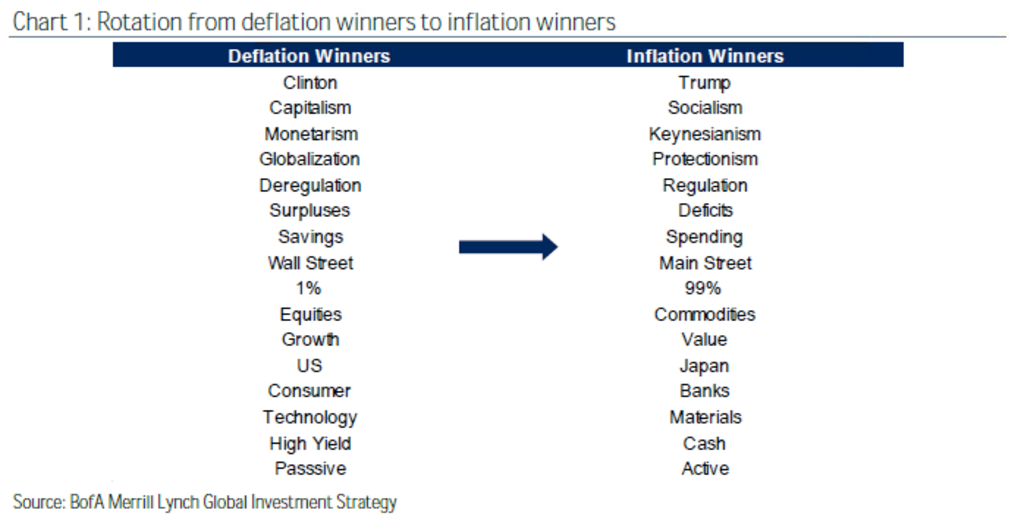
Bank of America is out with a report saying that the new populism and push-back against globalization represents a possible sea-change in asset pricing. The big picture is that we are moving from a “deflation” asset pricing environment to an inflation asset pricing environment. Corporate profitability will suffer as wages increase, regulation increases, and people push back against using globalization as a means of cost-cutting. Government attempts to goose the economy will transition from monetary stimulus to fiscal stimulus. Overall, bad for bonds, but probably good for real estate.

Assuming Hillary wins, she may face the same nemesis her husband did early in his first term: bond market vigilantes. Every time Bill Clinton talked about stimulating the economy, bonds would sell off, which would offset any potential stimulative effect. Bob Woodward said that Bill Clinton’s reaction to this dynamic as :”You mean to tell me that the success of my program and my reelection hinges on the Federal Reserve and a bunch of f*****g bond traders?” Clinton political adviser James Carville said at the time that “I used to think that if there was reincarnation, I wanted to come back as the president or the pope or as a .400 baseball hitter. But now I would like to come back as the bond market. You can intimidate everybody.”
Regardless of what this does to the refi market, it should positively affect the purchase market. Currently, the homeownership percentage for the Millennials is about 34%. That number should increase to above 40% as the Millennial age cohort hits homebuying age. The homeownership rate for the 35-45 age cohort has historically been 60%+. So there is a lot of pent-up demand for homes, which should keep the purchase business humming for many years to come.

Morning Report: Bond yields rising on central bank comments 10/5/16

Vital Statistics:

Last Change
S&P Futures 2148.0 3.0
Eurostoxx Index 343.7 -2.0
Oil (WTI) 49.6 0.9
US dollar index 87.0 0.0
10 Year Govt Bond Yield 1.68%
Current Coupon Fannie Mae TBA 103.3
Current Coupon Ginnie Mae TBA 104.2
30 Year Fixed Rate Mortgage 3.48

Stocks are higher this morning on no real news. Bonds and MBS are flat

Bonds sold off yesterday as Chicago Fed President Charles Evans said he expected a rate hike at the December FOMC meeting. Global bonds are also selling off after the ECB discussed tapering its bond purchase program in a move similar to what the Fed did. The German Bund is at -4 basis points after closing last week at -15.

We will have some Fed-speak today, with Neel Kashkari speaking at 9:30 and Jeffrey Lacker speaking at 1:00 pm.

Regardless of who wins in November, there will probably be some changes at the Fed. Donald Trump will probably pursue more wall street types (like Neel Kashkari) while Hillary will focus on diversity. There has been speculation that Janet Yellen would resign if Trump wins, but that looks like a long shot and would weaken the non-political perception of the Fed.

Bill Gross takes aim at central banks worldwide in his latest investment outlook.While central bankers are on a mission to reflate economies via low and negative interest rates, they are undermining the process via which capital gets allocated. Pension funds and insurance companies have to buy overvalued paper simply because there are no alternatives. Ultimately the financial markets exist to allocate capital to new businesses and projects based on risk and reward. Interest rates act as critical inputs into the risk and reward calculation. Central bank activity is distorting the signal that interest rates ordinarily provide, and the longer they do it, the more likely we will increase the misallocation of resources (generally known as bubbles) which will hinder the economy going forward. Exhibit (a) is Japan.

Despite the sell-off in the bond market, mortgage rates seem to be holding steady. This is par for the course, as mortgage rate movements typically lag bond market movements.

Speaking of mortgages, mortgage applications rose 2.9% last week as purchases fell 0.1% and refis increased 5%.

The ADP employment report came in weaker than expected, with 154k jobs added in September, which was less than the 170k forecast. The Street is looking for 168k jobs in Friday’s report. The big number will be wage growth.