Quantum Future – copied right, 2017

Personal note – the story I “copied right” below is of special interest to me. Some years ago, at dinner with my friend Fred Moore, now a retired sub-atomic physics specialist and professor at UT, he described to me a lab experiment his team had successfully completed whereby a signal was sent instantaneously using the property of quanta that they are “paired”; thus it was a signal that need not be encrypted to be unintelligible in transit because no actual particle carried the signal from point A to point B – it just appeared by pairing. This was mind boggling to me then, and Fred went on to explain that their work was turned over to the feds, DARPA, I think, for investigation for military/security use. Buried in this article is the news that China is using that very technological breakthrough in a satellite that can receive and transmit these “global, unhackable” signals. In a sea of otherwise good news, I hope to God DARPA or NASA have done this too.

Quantum leaps
The strangeness of the quantum realm opens up exciting new technological possibilities
The Economist Mar 11th 2017

A BATHING cap that can watch individual neurons, allowing others to monitor the wearer’s mind. A sensor that can spot hidden nuclear submarines. A computer that can discover new drugs, revolutionise securities trading and design new materials. A global network of communication links whose security is underwritten by unbreakable physical laws. Such—and more—is the promise of quantum.


All this potential arises from improvements in scientists’ ability to trap, poke and prod single atoms and wispy particles of light called photons. Today’s computer chips get cheaper and faster as their features get smaller, but quantum mechanics says that at tiny enough scales, particles sail through solids, short-circuiting the chip’s innards. Quantum technologies come at the problem from the other direction. Rather than scale devices down, quantum technologies employ the unusual behaviours of single atoms and particles and scale them up. Like computerisation before it, this unlocks a world of possibilities, with applications in nearly every existing industry—and the potential to spark entirely new ones.


Quantum mechanics—a theory of the behaviour at the atomic level put together in the early 20th century—has a well-earned reputation for weirdness. That is because the world as humanity sees it is not, in fact, how the world works. Quantum mechanics replaced wholesale the centuries-old notion of a clockwork, deterministic universe with a reality that deals in probabilities rather than certainties—one where the very act of measurement affects what is measured.


Along with that upheaval came a few truly mind-bending implications, such as the fact that particles are fundamentally neither here nor there but, until pinned down, both here and there at the same time: they are in a “superposition” of here-there-ness. The theory also suggested that particles can be spookily linked: do something to one and the change is felt instantaneously by the other, even across vast reaches of space. This “entanglement” confounded even the theory’s originators.


It is exactly these effects that show such promise now: the techniques that were refined in a bid to learn more about the quantum world are now being harnessed to put it to good use. Gizmos that exploit superposition and entanglement can vastly outperform existing ones—and accomplish things once thought to be impossible.


Improving atomic clocks by incorporating entanglement, for example, makes them more accurate than those used today in satellite positioning. That could improve navigational precision by orders of magnitude, which would make self-driving cars safer and more reliable. And because the strength of the local gravitational field affects the flow of time (according to general relativity, another immensely successful but counter-intuitive theory), such clocks would also be able to measure tiny variations in gravity. That could be used to spot underground pipes without having to dig up the road, or track submarines far below the waves.


Other aspects of quantum theory permit messaging without worries about eavesdroppers. Signals encoded using either superposed or entangled particles cannot be intercepted, duplicated and passed on. That has obvious appeal to companies and governments the world over. China has already launched a satellite that can receive and reroute such signals; a global, unhackable network could eventually follow.

 
The advantageous interplay between odd quantum effects reaches its zenith in quantum computers. Rather than the 0s and 1s of standard computing, a quantum computer’s bits are in superpositions of both, and each “qubit” is entangled with every other. Using algorithms that recast problems in quantum-amenable forms, such computers will be able to chomp their way through calculations that would take today’s best supercomputers millennia. Even as high-security quantum networks are being developed, a countervailing worry is that quantum computers will eventually render obsolete today’s cryptographic techniques, which are based on hard mathematical problems.


Long before that happens, however, smaller quantum computers will make other contributions in industries from energy and logistics to drug design and finance. Even simple quantum computers should be able to tackle classes of problems that choke conventional machines, such as optimising trading strategies or plucking promising drug candidates from scientific literature. Google said last week that such machines are only five years from commercial exploitability. This week IBM, which already runs a publicly accessible, rudimentary quantum computer, announced expansion plans. As our Technology Quarterly in this issue explains, big tech firms and startups alike are developing software to exploit these devices’ curious abilities. A new ecosystem of middlemen is emerging to match new hardware to industries that might benefit.


The solace of quantum


This landscape has much in common with the state of the internet in the early 1990s: a largely laboratory-based affair that had occupied scientists for decades, but in which industry was starting to see broader potential. Blue-chip firms are buying into it, or developing their own research efforts.


Startups are multiplying. Governments are investing “strategically”, having paid for the underlying research for many years—a reminder that there are some goods, such as blue-sky scientific work, that markets cannot be relied upon to provide.


Fortunately for quantum technologists, the remaining challenges are mostly engineering ones, rather than scientific. And today’s quantum-enhanced gizmos are just the beginning. What is most exciting about quantum technology is its as yet untapped potential. Experts at the frontier of any transformative technology have a spotty record of foreseeing many of the uses it will find; Thomas Edison thought his phonograph’s strength would lie in elocution lessons. For much of the 20th century “quantum” has, in the popular consciousness, simply signified “weird”. In the 21st, it will come to mean “better”.

Morning Report: Small Business Optimism rises 3/14/17

Vital Statistics:

Last Change
S&P Futures 2372.0 1.0
Eurostoxx Index 374.3 1.1
Oil (WTI) 48.3 -0.2
US dollar index 91.7
10 Year Govt Bond Yield 2.60%
Current Coupon Fannie Mae TBA 101.03
Current Coupon Ginnie Mae TBA 102.5
30 Year Fixed Rate Mortgage 4.21

Stocks are flat this morning on no real news. Bonds and MBS are flat as well.

Should be a quiet day in the markets as the FOMC meeting begins and most of the Northeast gets buried with snow.

Inflation remains tame at the wholesale level, as the producer price index rose at 0.3% MOM and 2.2% YOY. Ex food and energy, the index rose 0.3% and 1.5%. The core index was up 0.3% and 1.8% MOM / YOY respectively.

Small Business optimism slipped in February, but remains close to 43 year highs, according to the NFIB. Optimism on the regulatory front, along with the potential for tax reform drove the increase. The job openings component of the index hit levels not seen since 2000, and a tight labor market is squeezing margins for business owners who don’t yet have to confidence to pass on those increased costs to customers. Small businesses continue to report higher sales, and we are beginning to see businesses invest in plant and equipment, something that has been dormant since 2007.

CoreLogic takes a look at the foreclosure crisis 10 years on. A total of 7.8 million homes were lost to foreclosure, and at the peak of the crisis, there was 1.5 million foreclosed homes in inventory.

The Congressional Budget Office scored the GOP’s healthcare plan yesterday. It basically is as expected: cheaper and covers less people. A few GOP defections in the Senate will kill it.

Morning Report: Fed will almost assuredly hike this week 3/13/17

Vital Statistics:

Last Change
S&P Futures 2372.0 1.0
Eurostoxx Index 374.3 1.1
Oil (WTI) 48.3 -0.2
US dollar index 91.7  
10 Year Govt Bond Yield 2.59%
Current Coupon Fannie Mae TBA 101.03
Current Coupon Ginnie Mae TBA 102.5
30 Year Fixed Rate Mortgage 4.21

Stocks are flat this morning on no real news. Bonds and MBS are up.

We will be getting a lot of important economic data this week, with housing starts, inflation, and retail sales. That said, the biggest event this week will be the FOMC meeting on Tuesday and Wednesday. A major snowstorm is expected to hit the East Coast on Tuesday, so that could affect things, especially if the government tells all non-essential government employees to stay home on Tuesday. DC is expected to get 6 – 10 inches, while the Northeast could get up to 2 feet.

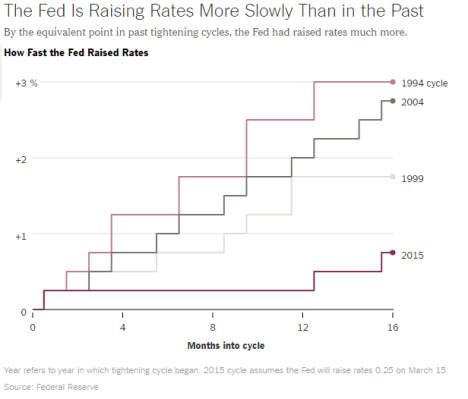
The era of easy money is supposedly over at the Fed, although even if the Fed hikes 3x this year, monetary policy will still be extraordinarily accommodative. With its giant balance sheet and still negative short term rates, it will take a long time to get to neutrality. Not only that, the Fed is going much slower than it has in the past. You can compare the different cycles in the chart below. Another big break from the past was communication: Over the past month, Fed governors have been singing from the same sheet of music and preparing the markets for hikes. This time around, the markets believe the Fed will actually hike rates; in 2016 the markets called the Fed’s bluff.

tightening cycles 2

FWIW, Goldman is saying it will be a close call between 4 hikes this year and 3 hikes plus a balance sheet adjustment. The Fed Funds futures are now 90% on a hike this week. The big question is how much of this is the Fed getting ahead of expected expansionary fiscal policies which may or may not happen.

Here is a good cheat sheet of how various asset classes have performed during Fed tightening cycles. Cash outperforms bonds, but stocks outperform both. Who says you can’t fight the Fed?

hiking cycles

Morning Report: Decent jobs report 3/10/17

Vital Statistics:

Last Change
S&P Futures 2378.0 11.8
Eurostoxx Index 374.8 1.9
Oil (WTI) 49.9 0.6
US dollar index 91.9  
10 Year Govt Bond Yield 2.60%
Current Coupon Fannie Mae TBA 101.438
Current Coupon Ginnie Mae TBA 102.784
30 Year Fixed Rate Mortgage 4.21

Stocks are higher this morning after a strong jobs report. Bonds and MBS are up small.

Jobs report data dump:

  • Payrolls up 235k vs 200k expected
  • unemployment rate 4.7%
  • labor force participation rate 63%
  • average hourly earnings up 0.2% MOM, up 2.8% YOY

Overall a decent report. Didn’t match the ADP number on payrolls, but ADP generally correlates with the revised BLS report, not the first one. Looks like the Fed is going to hike next week. Note another big increase in construction employment, to 58k, which is the highest since 2007. Bonds had already sold off on the strong ADP number, so they are recouping some of those losses today.

Donald Trump met with community bankers yesterday and promised to ease the regulatory burden the state has imposed on them. There has generally been bipartisan agreement that the regulatory burden on small banks has been too heavy, and that it is inhibiting credit to small business.

Goldman is out with a call this morning forecasting that the Fed will hike 3x this year: March, June, and September. They expect the Fed to end their reinvestment of maturing assets in the fourth quarter this year. The end of reinvestment shouldn’t have a major effect on mortgage rates, since spreads were largely insensitive to QE in the first place.

The Fed funds futures are now forecasting a 50% chance of a June rate hike, up from about 20% a couple weeks ago.

Household net worth increased to record levels in the fourth quarter, according to the Federal Reserve. The ratio of net worth to disposable income hit 6.5x, which matches bubble-era highs.

Morning Report: Home equity rises 3/9/17

Vital Statistics:

Last Change
S&P Futures 2363.0 -1.0
Eurostoxx Index 372.1 -0.5
Oil (WTI) 49.6 -0.7
US dollar index 92.0  
10 Year Govt Bond Yield 2.58%
Current Coupon Fannie Mae TBA 101.438
Current Coupon Ginnie Mae TBA 102.784
30 Year Fixed Rate Mortgage 4.19

Stocks are lower this morning as oil continues to fall. Bonds and MBS are down small.

Initial Jobless Claims ticked up to 243k last week. The 4 week moving average is 237k. Consumer Comfort improved.

There were 37,000 announced job cuts in February, according to outplacement firm Challenger, Gray and Christmas. This is a decline of 19% from January and a decrease of 40% from February last year. The job cuts are dominated by the retail sector as department stores had a lousy holiday season. In fact, the job cuts in retail are almost 6x the next biggest sector (energy). Of course some of this is seasonal, but there continue to be problems with the shopping mall sector or retail. The financial sector also reported about 3,300 job cuts as higher interest rates hurt some in the mortgage space and automation / falling fees reduce headcount in banking and asset management. On the other side of the coin, companies announced they were hiring over 162k – and 100k of them were by Amazon.com. It seems strange to think that for every job lost in bricks and mortar retail, 3 were created for online shopping, but there you go.

Import prices rose 0.2% in February and are up 4.6% YOY, however when you strip out petroleum, they fell 0.1% and are up 0.5% YOY. While the Fed is concerned about potential inflation, we have yet to see any hard evidence of it yet.

Rising home prices helped reduce negative equity by over $2 billion in the fourth quarter, according to CoreLogic. About 3.2 million homes (or 6.2%) have negative equity. A total of 7.7 million have under 20% equity. These loans become refi candidates as home price rise. Cashout refis driven by increasing home prices will undoubtedly become a larger component of the refi universe as rates continue to rise.

Under Donald Trump’s proposed budget HUD will get about 14% less than last year. It looks like most of the cuts will fall on community devlopment block grants and public housing maintenance. It doesn’t appear (at least initially) that the mortgage side of things is affected at all.

Morning Report: Strong ADP jobs report 3/8/17

Vital Statistics:

Last Change
S&P Futures 2368.3 1.8
Eurostoxx Index 372.8 0.6
Oil (WTI) 52.5 -0.6
US dollar index 92.0  
10 Year Govt Bond Yield 2.57%
Current Coupon Fannie Mae TBA 101.438
Current Coupon Ginnie Mae TBA 102.784
30 Year Fixed Rate Mortgage 4.19

Stocks are higher after a strong ADP jobs report. Bonds and MBS are down.

The private sector added 298,000 jobs in February, according to the ADP jobs report. This reading was the highest in 3 years and beat the consensus number by 115,000 jobs. January was revised upward as well. Construction employment increased by 60,000, which bodes well for home construction, although a mild winter probably affected that number.  Friday’s payroll number is forecast to be 195,000. The report sent the 10 year and the 2 year bond yield up 3 basis points.

Mortgage applications rose 3.3% last week as purchases rose 2% and refis rose 5%. Refis as a percent of total production increase marginally after hitting a 9 year low last week at 45.4%. The average mortgage rate increased by 6  basis points last week.

Productivity increased at a 1.3% annual pace in the fourth quarter as output rose 2.4% and hours worked increases 1%. Unit Labor costs increased 1.7%. Productivity was marginally below expectations, while unit labor costs were above. Productivity (or lack thereof) has been a consistent issue over the past 10 years. Productivity ultimately is what drives increases in standards of living.

Given the strong economic data, the Fed has been jawboning the markets, sending Fed Funds forecasts higher. The move over the past 3 weeks in the Fed Funds futures contracts was the result of a number of speeches designed to wake up the markets. “We didn’t clearly see how the balance of risks was shifting, so they have to slap our faces, and say, ‘Look, you are missing the point’,” said Tim Duy, an economics professor at the University of Oregon. You can see the huge change in sentiment in the chart below, which calculates the implied probability of a March hike:

Despite the chance of 2-3 hikes this year, the Fed isn’t really moving to a contractionary monetary policy regime. On a scale of 1 to 10, we are going from 9 to maybe 8.5. We aren’t even remotely near a normal level in the Fed Funds rate, which is still negative by about 100 basis points (the effective FF rate is trading at 67 basis points and the inflation rate is around 1.7% or so, so the real rate is about -1%).

Janet Yellen’s Fed is almost the mirror image of Alan Greenspan’s Fed in that Yellen communicates to the markets what the Fed is thinking, while Greenspan stayed as opaque as possible. Note that the last 3 times the Fed went into a tightening cycle, they blew up the mortgage backed securities markets (1994) the stock market bubble (1999) and the residential real estate bubble (2006). You could argue that we currently have a bubble in global sovereign debt in that bond prices are assuming that inflation has been vanquished and is never, ever, ever coming back.

Republicans released their repeal and replace of Obamacare, and for the most part it is pretty similar to Obamacare. There are some small changes, but it more or less keeps the same structure. Direct subsidies are being replaced by refundable tax credits, while the Medicaid expansion gets block granted to the states. The Cadillac Tax gets pushed out to 2025, and pricing becomes more of a function of age than income. Conservative Republicans are against it, as well as pretty much every Democrat.

When dealing with corporations, there is a public Trump (the tweeter) and the private Trump. Since taking office, he has hit pharma companies on drug prices, automakers on outsourcing, and even retailers. Behind closed doors he is more accommodating. This explains why business confidence has been increasing despite these public statements.

Despite the strong data, the Atlanta Fed revised its forecast for Q1 GDP to an increase of only 1.3%.

Morning Report: Obamacare lite 3/7/17

Vital Statistics:

Last Change
S&P Futures 2372.0 -3.5
Eurostoxx Index 372.8 -0.5
Oil (WTI) 53.6 0.4
US dollar index 91.7  
10 Year Govt Bond Yield 2.50%
Current Coupon Fannie Mae TBA 101.86
Current Coupon Ginnie Mae TBA 103.19
30 Year Fixed Rate Mortgage 4.19

Stocks are lower this morning on no real news. Bonds and MBS are flattish.

Home prices rose 0.7% MOM and are up 6.9% YOY, according to CoreLogic. Including distressed sales, home prices are about 4% below their April 2006 peak. Other indices like the FHFA House Price Index have already surpassed their old bubble peaks. Of course they haven’t really surpassed the bubble peaks on an inflation-adjusted basis – over the past 11 years, inflation has increased prices 20%. Currently, we have pockets of overvaluation in Florida, the Pacific NW, Texas, and parts of the Northeast.

Rising prices are helping homebuyer sentiment. The latest Fannie Mae Home Purchase sentiment index rose 5.6 percentage points to 88.3, a new record. Note that the index only started in 2010, so it has a limited history. The employment-related questions showed big improvements. People are not worried about losing their jobs, and a net 19% of respondents reported increased income over the past year.

Redfin has some advice for Ben Carson regarding affordable housing policy. Punch line: increase subsidies, and try and coax local governments to change their zoning laws using carrots of infrastructure investment.

Meanwhile, construction executives are the most optimistic they have been in years. Of course some of that optimism is predicated on a big infrastructure plan out of DC, which may or may not happen.

The Republican replacement for Obamacare is out. The major changes include an elimination of the individual mandate, and block-granting Medicaid to the states. The Cadillac tax gets deferred until 2025 as well. The popular parts of Obamacare (allowing kids to stay on their parents’ plan until their mid twenties and the the pre-existing condition coverage mandate) remain in place.

Morning Report: Markets still ignoring DC show 3/6/17

Vital Statistics:

Last Change
S&P Futures 2373.8 -7.5
Eurostoxx Index 373.6 -1.6
Oil (WTI) 53.2 -0.1
US dollar index 91.5  
10 Year Govt Bond Yield 2.48%
Current Coupon Fannie Mae TBA 101.86
Current Coupon Ginnie Mae TBA 103.19
30 Year Fixed Rate Mortgage 4.19

Stocks are lower this morning on overseas weakness. Bonds and MBS are flat.

Fed Funds futures are now fully pricing in a 25 basis point hike at next week’s FOMC meeting. Now that we are in the quiet period, the only market-moving data should be late this week when we get productivity and the jobs report.

Consumer spending has almost fully recovered from the Great Recession, with the February number coming in at $101, the strongest February since 2008.

Factory orders increased 1.2% in January. Consensus was for a 1.1% increase.

Over the weekend, the war between Democrats and Trump intensified, with Democrats calling for Attorney General Jeff Sessions to resign and Trump accusing the Obama administration of tapping the phones of Trump Tower. So far, markets are basically ignoring all of this as a sideshow. IMO, markets are sanguine about this simply because the deepening partisanship makes gridlock even more likely, and therefore a lot of the uncertainty is taken off the table. When and if that ever changes, the canary in the coal mine should be the dollar.

Prepay speeds dropped by 30% in January, according to the Black Knight Financial Services Mortgage Monitor. Delinquencies declined by 4% versus December and are down 17% YOY. That said, foreclosure starts increased largely due to seasonal effects. Note the decline in prepayments was not uniform across the credit spectrum: 720+ FICO prepays declined by 32%, while sub 620 FICO prepays fell by 10%. Even with rates up here, it still makes sense for some borrowers to do cash-out refis in order to consolidate higher interest rate debt like credit cards.

What should you do if you are upside down on your home? Zillow has you covered.

Morning Report: Stocks and bonds telling a different story?3/3/17

Vital Statistics:

Last Change
S&P Futures 2379.0 -3.0
Eurostoxx Index 374.5 -1.1
Oil (WTI) 52.8 0.2
US dollar index 91.8
10 Year Govt Bond Yield 2.49%
Current Coupon Fannie Mae TBA 101.72
Current Coupon Ginnie Mae TBA 103.15
30 Year Fixed Rate Mortgage 4.09

Stocks are still taking a breather after a nice run. Bonds and MBS are down.

The focus today will be all of the Fed-speak, with Janet Yellen and Stanley Fischer speaking around lunchtime. The Fed enters their quiet period ahead of the March FOMC meeting tomorrow. The markets have gone from pricing a March hike as a 30% chance to an almost certainty over the past several weeks.

The ISM Non-Manufacturing index improved in January, as business activity and new orders (especially exports) led the charge. Employment ticked up slightly. The reading of 57.6 was the highest since October 2015.

Ben Carson was confirmed as the new HUD Secretary yesterday on a 58-41 vote. HUD probably won’t have a lot to do with GSE reform, as that is largely a Treasury function. Ben Carson is a neurosurgeon by trade, and his public record on housing was limited to an editorial criticizing Obama’s enforcement of the Fair Housing Act. During his hearing, however he praised the Fair Housing Act as an important piece of legislation. The safety of public housing is a priority for him, and he plans to increase HUD’s efforts to eliminate lead paint, mold, etc from public housing. He wants to continue to advance HUD’s mission of financing low income / credit / first time homebuyers while introducing private capital and protecting taxpayers.

Snap priced its IPO yesterday, where it had a 44% gain on the first day of trading. Many IPOs lately have not seen a big pop on day 1, so this is a bit of an anomaly. The lack of big gains from IPOs represents the drop in commission revenue and the balance of power between issuers and the buy side (a big jump in price on the first day means that the IPO was underpriced and the issuer is leaving money on the table). In the past, the banks were more worried about keeping the big mutual funds happy since they were a steady source of commission revenue, while issuers would typically do a deal and then go away for a while. Nowadays, commissions are basically nothing, so banks are more concerned with keeping issuers happy than they are with keeping, say Fidelity happy. When I started in the business, commissions were 5 cents a share, and bid-ask spreads were an eighth. Today, commissions are less than half a penny a share and bid-ask spreads are 1/10 of a cent on big liquid stocks.

As a general rule, when the stock price is telling you one thing and the bonds are telling you another, go with what the bonds are telling you. We are seeing a bit of that right now with stocks and bonds – as stocks are off to the races on the reflation trade, bonds have been in a range post-election. Bonds are saying either (a) fiscal stimulus is not going to happen or (b) fiscal stimulus isn’t going to work. That is certainly a fair take, and I do think rates have gotten a bit ahead of themselves. On the other hand, interest rates have been so heavily manipulated by central banks over the past decade, that the signal-to-noise ratio is lower than normal. Ultimately this is a criticism of monetary policy has gotten short shrift in the public debate: that interest rates are an important signal that the economy uses to allocate capital. When central banks manipulate rates to help goose the economy, those signals are distorted, and the typical effect is a bubble. Keynes and Hayek explain it to you here.

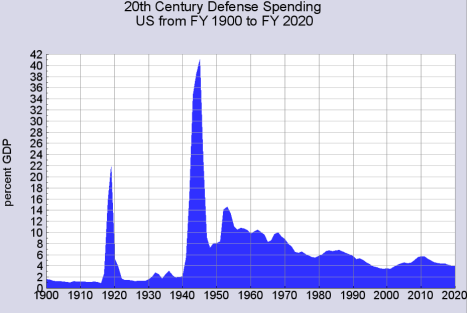
One of Donald Trump’s plans is to increase defense spending. The proposed increase is anywhere from $20 billion to $54 billion, from the current $582 billion level (or 3.1% of GDP). Here is a chart of defense spending over the past century as a percent of GDP in order to put current levels into perspective:

defense-spending

Solid tips for doing your taxes this year.

Morning Report: Initial Jobless Claims at 44 year low 3/2/17

Vital Statistics:

Last Change
S&P Futures 2394.0 0.5
Eurostoxx Index 375.9 0.2
Oil (WTI) 53.0 -0.9
US dollar index 91.9  
10 Year Govt Bond Yield 2.47%
Current Coupon Fannie Mae TBA 101.88
Current Coupon Ginnie Mae TBA 103.28
30 Year Fixed Rate Mortgage 4.09

Stocks are flat this morning on no real news. Bonds and MBS are down small after Fed dove Lael Brainard suggested rates should rise soon.

The Fed funds futures are now assigning a 90% probability of a rate hike at the next FOMC meeting. It was only 30% or so just a few weeks ago.

Fed watcher Tim Duy has a good piece on the Fed’s balancing act and how it relates to November. He was in the “two hikes with an option for a third” camp and thinks the Fed will stand pat in March. He raises a good point on the December dot plot that freaked out bond investors: the most hawkish members that contributed to that plot are non-voters.

Initial Jobless Claims fell to 223k last week, which was the lowest level in 44 years. When you correct for population growth, we are in uncharted territory.

Snapchat priced their IPO at $17 a share yesterday. The company sports a modest 21.4x sales multiple.

Consumer Comfort improved last week, and is at the highest since early 2007.

Donald Trump seems to be settling in on picking Kevin Hassett from the American Enterprise Institute to lead his Council of Economic Advisors. Hassett is known for supporting a “New Deal” style program where the government provides jobs to the long term unemployed. His rationale is that the government gets some value in return, it makes the LT unemployed more attractive to private sector companies, and it probably reduces crime.

While robotics have been displacing manual labor jobs for quite some time, artificial intelligence is replacing white collar jobs as well. In fact, the two professions that have been most insulated from the globalization wrecking ball (law and medicine) are ripe for machine learning and AI. Much of what I used to do as a trader 15 years ago is now completely done by algorithms. This is probably the single biggest reason why wage growth is so hard to find – the competitor to human labor only gets cheaper and better.

As we approach tax season, it pays to look at some of the tax benefits of buying. In 2016, however several tax benefits expired, including the deduction for mortgage insurance, the tax free treatment for forgiven mortgage debt, and the tax break for “green” energy home improvements. The new administration and Congress are looking to simplify the tax code, which means ending some of the social engineering pieces like the green energy home improvements mentioned above. The gist is that tax rates will be lowered, however deductions will be eliminated, and the standard deduction will increase. The mortgage interest deduction, and the deduction for state and local taxes will have the biggest effects.