Morning Report: Bank earnings pour in 7/13/18

Vital Statistics:

Last Change
S&P futures 2797 -1
Eurostoxx index 385.18 0.81
Oil (WTI) 70.6 0.27
10 Year Government Bond Yield 2.84%
30 Year fixed rate mortgage 4.53%

Markets are flat as bank earnings come in. Bonds and MBS are up small. Slow news day.

The US government held a reasonably strong auction yesterday, where primary dealers took down their smallest positions ever. Meanwhile, speculative shorts in Treasuries (one of the biggest trades on the Street) are struggling as rates stay stubbornly low. Some continue to warn that the flattening yield curve is really telling us that a recession is around the corner.

The prepared remarks for Jerome Powell’s semiannual report to Congress should be out today. Probably won’t be market-moving, but you never know.

Import prices fell 0.4% in June as petroleum and food prices fell. For the year, they are up 4.3% however.

Consumer sentiment fell according to the University of Michigan / Reuters survey. The current conditions index drove the fall, which is usually a function of gas prices. Trade fears also weighed on sentiment.

Wells Fargo reported earnings this morning. Earnings were down due to a tax charge. Stripping out the tax charge, they were flat. They had a tough quarter for mortgages like everyone else. Origination for the quarter was $50 billion, which is up seasonally from Q1, but down 11% YOY. The current pipeline of $24 billion is down 26% YOY. Margins were 77 basis points, which is down 17 from the prior quarter and down 47 bps from a year ago. The stock is down 3% pre-open.

JP Morgan had a similar story to Wells. They originated $23.7 billion in mortgages during Q2, which was higher seasonally and down about 10% from a year ago. Mortgage banking revenue (which includes servicing) was down 6% YOY. Margin compression again was the story, especially in correspondent lending. They marked up the MSR book. JPM is flat pre-open.

A bunch of other banks reported this morning and the whole sector is getting hit, with the XLF down about a percent and a half.

Federal Reserve Chairman Jerome Powell made positive comments about the economy, although he is concerned about trade and the effects of a long trade war with China. He is concerned about rising trade tensions, although he notes that Trump’s goal is to get others to lower their tariffs. If he succeeds in that, then the trade tension would be a good thing, not a bad thing. It is important to remember that China’s biggest weapon against the US is not imposing tariffs on US goods – it is ignoring US intellectual property laws. Those sorts of things will not really show up in the balance of trade numbers, but will have huge effects on IP firms, particularly media and software.

Morning Report: The Fed is looking for new recessionary indicators 7/12/18

Vital Statistics:

Last Change
S&P futures 2790 16
Eurostoxx index 384.01 2.61
Oil (WTI) 70.92 0.54
10 Year Government Bond Yield 2.86%
30 Year fixed rate mortgage 4.53%

Stocks are higher after China made some conciliatory comments regarding the trade situation. Bonds and MBS are flat.

Inflation at the consumer level remains under control, with the consumer price index rising 0.2% MOM / 2.9% YOY. Ex-food and energy it rose 0.2% / 2.3%. These numbers were more or less in line with Street expectations. Energy, especially petroleum drove the increase in the index. Housing also pushed up the index, while autos and utilities exerted downward pressure.

Initial Jobless Claims fell to 214,000 last week, which is at levels we haven’t seen since the early 1970s (when we had a draft).

Loan performance continues to improve, according to CoreLogic. The 30+ DQ rate fell from 4.8% to 4.2% in April. DQ rates are near historic lows, except for FL, TX, and LA which are still dealing with the fallout from Hurricane Harvey. The national foreclosure rate fell by 10 basis points to 0.6%. Home price appreciation of 7% is helping matters. In fact, home equity is increasing rapidly, but HELOC are not.

As the 2s-10s spread decreases, many in the financial press are worrying whether the slope of the yield curve is signalling a recession. We already have some strategists calling for the yield curve to invert sometime in 2019. An inverted yield curve (where short term rates are higher than long term rates) has historically been a strong recessionary signal. As a general rule, the yield curve flattens during tightening cycles. In fact, it did invert in the late 90s (before the stock market bubble burst) and during the real estate bubble (before the Great Recession).

Recent Fed research indicates the 2s-10s spread may not be the best signal of an upcoming recession. It suggests the spread between the 3 month T bills and 18 month Treasuries could be more predictive. Another signal is the Eurodollar futures market. The idea is that the Fed would use these indicators as a yellow signal and stop tightening before they risk a recession.

To me at least, the last two recessions had very little to do with the Fed. We had a stock market bubble, and we had a residential real estate bubble. To say the Fed caused those recessions implies that these bubbles would have kept on going had the Fed just stayed away (or stopped tightening sooner). That is a big assumption – all bubbles eventually come to an end, and when they do you have a recession. The tightening may have been the catalyst to initiate the recession, that is a question of “when,” not “if.” We were going to have a recession given we had a bubble in place already. And the Fed might have been guilty of causing the bubble in the first place, but that is a separate question.

Of course, all bets are off when it comes to this yield curve versus the past. The size of the Fed’s balance sheet relative to the economy is vastly different this time around. Pre-Great Recession, the Fed had about $800 billion worth of assets. Now it is about $4.4 trillion. To draw comparisons, you would have to estimate where the 10 year would have been without Operation Twist, QE1, QE2, and QE3. Punch line, the yield curve may in fact invert if the Fed continues to tighten and inflation remains under control. The signal-to-noise ratio of the yield curve is extremely low, so take it with a grain of salt.

Morning Report: Quits rate jumps in May 7/11/18

Vital Statistics:

Last Change
S&P futures 2781 -11
Eurostoxx index 382.05 -4.2
Oil (WTI) 73.29 -0.82
10 Year Government Bond Yield 2.85%
30 Year fixed rate mortgage 4.53%

Stocks are lower this morning after Trump threatened tariffs on $200 billion worth of Chinese goods. Bonds and MBS are flat.

China has vowed to retaliate if the Trump Administration follows through on its threat to impose 10% tariffs on about $200 billion worth of Chinese goods. Since China imports far less than $200 billion from the US, they may have to come up with other measures to retaliate – anything from denying visas to limiting tourism and increasing regulatory measures. Strategists are beginning to warn that the trade war could derail the recovery.

Inflation at the wholesale level increased in June, according to the PPI. The headline number rose 0.3% MOM / 3.4% YOY. Ex food and energy, it was up 0.3% / 2.8% and ex food energy and trade services 0.3% / 2.7%. Services and motor vehicles drove the increase.

Donald Trump nominated Brett Kavanaugh to the Supreme Court yesterday. He is generally a regulatory skeptic, and has ruled against overreach in the past. He has already weighed in on the CFPB, which he believes is unconstitutional. From CFPB vs PHH, writing for the majority: “The CFPB’s concentration of enormous executive power in a single, unaccountable, unchecked Director not only departs from settled historical practice, but also poses a far greater risk of arbitrary decision-making and abuse of power, and a far greater threat to individual liberty, than does a multi-member independent agency. The overarching constitutional concern with independent agencies is that the agencies are unchecked by the president, the official who is accountable to the people and who is responsible under Article II for the exercise of executive power.” That said, Kennedy was already considered a vote against the CFPB, so the nomination won’t move the needle there.

Kavanaugh has also ruled against the EPA, which generally ignored the “cost” side of the “cost / benefit” analysis of regulations during the Obama Administration. Overall the regulatory environment for the financial industry could get a little easier with Kavanaugh on the Court.

Speaking of the CFPB, Brian Johnson has been tapped to be the #2 of the agency. He replaces Leandra English, who resigned last week.

Small business optimism remains elevated despite trade concerns, according to the NFIB Small Business Optimism Survey.  Employment continues to grow, with 1 in 5 firms adding employees in June on net. Sales are up overall, but margins appear to be facing pressure from higher labor and input prices. Credit needs are being fully met.

Job openings fell to 6.6 million in May, which was just off the record high of 6.8 million set in April. Hires were strong at 5.8 million, led by health care and social assistance. The big number was the quits rate, which is one of the best leading indicators of wage inflation. It rose to 2.4%.

The big question remains: how much slack is there really in the labor market? Most of the official numbers imply there is none. Yet, there is only modest wage inflation. I suspect the employment-population ratio tells the real story, and that number has yet to really recover from the Great Recession. Demographics are part of the story, but as people work longer, the assumption of 65 = retirement might have to change. I suspect many of those who are retired would gladly take a job if offered.

For the construction sector, the number of unfilled jobs hit a record high. That sector has been facing labor constraints for quite some time, and this partially explains why housing starts have been so far below what is needed to meet demand.

Mortgage Applications increased 2.5% last week as purchases rose 7% and refis fell 4%. Last week included the 4th of July, so there are all sorts of adjustments baked into that number. Refis fell under 35%, the lowest number since August 2008. ARMS decreased to 6.3%. Overall rates fell about 3-4 basis points last week.

Meanwhile, the MBA’s mortgage credit availability index improved last month as increases in conventional and jumbo availability offset a contraction in government.

Nominee Kavanaugh

From Jonathan Adler at Volokh:


Judge Kavanaugh has served on the D.C. Circuit for twelve years. This court is often referred to as the “second-highest” court in the land because it hears the lion’s share of legal challenges to major federal regulations. Administrative law is a heavy part of the court’s docket, and forms a large part of Judge Kavanaugh’s record. In his time on the D.C. Circuit, Judge Kavanaugh has written over 200 opinions, over 100 of which concern administrative law.

Prior to serving on the D.C. Circuit, Judge Kavanaugh was a partner at Kirkland & Ellis, worked in the Bush White House, and for Independent Counsel Kenneth Starr. He clerked for Anthony Kennedy, as well as for two circuit court judges. There is no question about his qualifications for this nomination.

Attention will now turn to Judge Kavanaugh’s judicial opinions and other writings. Aaron Nielson has a summary of Judge Kavanaugh’s concurrences and dissents at the Notice & Comment blog. Going beyond Kavanaugh’s opinions, here are some other writings. Here’s a lecture Judge Kavanaugh gave at CWRU on the D.C. Circuit at the Case Western Reserve University School of Law. A published version of the lecture is here. Here is Minnesota Law Review article on the separation powers and here is Harvard Law Review piece on statutory interpretation.

Here are some additional thoughts on the Kavanaugh nomination:

  • Judge Kavanaugh is widely respected on the Supreme Court. Many of his clerks go on to clerk at One First Street. More importantly, his opinions attract notice from the justices. Several of his dissents have been vindicated by subsequent Supreme Court decisions. His dissents showed the way for the Court in Michigan v. EPA (White Stallion Energy Center v. EPA concerning mercury emissions), UARG v. EPA (CRR v. EPA concerning GHG emissions), Free Enterprise Fund v. PCAOB (concerning separation of powers), and D.C. v. Wesby (concerning qualified immunity). And even when certiorari was granted, Judge Kavanaugh’s dissents have been noted in subsequent Supreme Court cases (as in Lexmark International v. Static Control Components which favorably cited Kavanaugh’s dissent in Grocery Manufacturers Association v. EPA). This suggests other justices will take the new junior justice’s opinions quite seriously, especially on administrative law.
  • Judge Kavanaugh takes administrative law very seriously, and he makes agencies do their homework. As much as any other judge on the D.C. Circuit, he makes sure that agencies act within the scope of the authority they have been delegated by Congress, that they follow the procedures required by the APA, and that the adequately justify their decisions. This has often led to decisions invalidating agency action — both in challenges brought by supporters and opponents of regulation — but Judge Kavanaugh is not an anti-regulatory zealot. Where agencies play by the rules, he has upheld their actions against legal challenge, even where the actions in question may seem unreasonable or unfair (as when he rejected challenges to surface coal mining regulations).
  • Judge Kavanaugh shares the Chief Justice’s belief that there is a “major questions” exception to Chevron deference. In the challenge to the FCC’s “net neutrality” rule, Judge Kavanaugh echoed the Chief Justice’s admonition that courts should not lightly presume that Congress has delegated agencies broad regulatory authority if Congress never actually said so in the underlying statutory provisions.
  • Judge Kavanaugh takes separation of powers seriously, as can be seen in his dissenting opinions arguing that the structure of the Public Company Accounting Oversight Board (PCAOB) and the Consumer Financial Protection Bureau (CFPB) are unconstitutional. The former of these opinions was subsequently vindicated by the Supreme Court.
  • Like his former boss, Justice Kennedy, Judge Kavanaugh has a broad understanding of the freedom of speech protected by the First Amendment, including commercial speech. This is most noticeable from his separate opinion concurring in the judgment in American Meat Institute v. USDA. In this opinion, he showed a sophisticated understanding of how to reconcile various cases concerning commercial speech regulation and compelled commercial speech (an understanding better than that of the court’s majority, as I noted here).
  • Judge Kavanaugh’s views of executive power may depart from those of Justice Kennedy. Whereas Justice Kennedy voted with the Court’s liberals in support of habeas petitions filed by enemy combatants in the Boumediene case, Judge Kavanaugh has interpreted this precedent quite narrowly, and may be unlikely to follow his former justice’s lead. On the other hand, Justice Kennedy was himself highly supportive of executive power in many national security and foreign affairs cases, voting in support of Presidential power in cases such as Hamdi v. Rumsfeld, Trump v. Hawaii, and Zivotofsky v. Kerry.
  • Judge Kavanaugh will be criticized for prior statements he has made about Presidential immunity. In the Minnesota Law Review article linked above, he suggested that a sitting President should not be subject to litigation or criminal investigation. Note, however, that this was his opinion in 2009. More importantly, he did not suggest Clinton v. Jones was wrongly decided and said explicitly that any such insulation from litigation or investigation would have to be enacted by Congress, and could not be imposed by the Courts. Many early news reports on the nomination obscure or fail to mention this fact.
  • Judge Kavanaugh’s extensive record has created an extensive paper trail. There will be lots of documents for the Senate Judiciary Committee to review — and it’s certain that Senate Democrats will seek to slow things down on that basis. On the other hand, insofar as Senate Democrats have already announced their opposition to the nomination — some even before the nomination was announced — it’s not clear why they would need more time to review the record. After all, they don’t need more time to review materials if they’ve already made up their minds.

======================================================================

I think this is a fair assessment of his writings and decisions and different from the spin the media has put on it from their various political as opposed to judicial or legal analyses.  I did read a [basically non-political] opinion of his that I found to be totally off the point of the case, and that would be the basis of my questioning of him.  There was no reason for a guy as smart as he is to miss the point of the whole litigation.  Maybe his clerk wrote his opinion, but I would want to make sure I knew he wasn’t throwing in a spanner for some personal reason.  If y’all are interested I will dig up the case.

And no, my questioning him on his politics would be limited or non-existent.  If he satisfied me on how he freaking missed the point on a simple case I would vote for him.


Morning Report: 75% of the US Treasury market is underwater 7/9/18

Vital Statistics:

Last Change
S&P futures 2773.25 10.1
Eurostoxx index 383.72 1.4
Oil (WTI) 74.01 0.21
10 Year Government Bond Yield 2.86%
30 Year fixed rate mortgage 4.50%

Stocks are higher this morning as trade war fears recede. Bonds and MBS are down.

Earnings season begins this week, with a bunch of the big banks reporting on Friday.

The biggest econ data will be the PPI and CPI on Wednesday and Thursday. For the most part it should be a quiet week.

Leandra English has resigned from the CFPB. She was the Deputy Director for Richard Cordray, and believed she should have been given the job instead of Mick Mulvaney. She sued in Court and lost. Now that Kathy Kraninger has been nominated, she is gone.

Donald Trump will announce his SCOTUS pick at 9:00 pm tonight. The favorites are Brett Kavanaugh and Thomas Hardiman.

Interesting stat: 75% of the US Treasury market trades under par. This is the highest percent ever recorded (we started measuring this in the 80s). In the past, it generally peaked around 50%, which happened at the end of Fed tightening cycles and was usually a buying opportunity. I would note that these were in the context of a secular bull market in bonds. In secular bull markets, you buy the dip. We are now in a secular bear market in bonds and that changes the dynamic.

The REO-to-Rental Trade was a big winner over the past several years. Hedge funds and pension funds bought foreclosed properties for pennies on the dollar, fixed them up and rented them out, earning high single digit returns. As home prices rise, you would think these people will start ringing the register. Turns out they are doubling down. Professional investors are buying up homes in urban areas with good schools. This is making things even tougher for the first time homebuyer who is struggling to find a starter homes. That said, it isn’t a ridiculous number – last year major investors bought 29,000 homes, which is a drop in the bucket compared to total existing home sales of 5.45 million.

Morning Report: Goldilocks jobs report and the FOMC minutes 7/6/18

Vital Statistics:

Last Change
S&P futures 2740 2
Eurostoxx index 381.23 -0.36
Oil (WTI) 42.31 -0.63
10 Year Government Bond Yield 2.82%
30 Year fixed rate mortgage 4.52%

Stocks are flattish this morning as a good jobs report offsets the new tariffs that went into effect this morning. Bonds and MBS are up.

Jobs report data dump:

  • Payrolls up 213,000 (street was looking for 190,000)
  • Unemployment rate 4% (.2% increase, street was looking for 3.8%)
  • Labor force participation rate 62.9% (.2% increase)
  • Average hourly earnings +.2% MOM / 2.7% YOY (in line with expectations)

Overall, a good report – strength in payrolls, and an increase in the labor force participation rate. The labor force increased by 600k, where the number of unemployed increased 500k and the number of employed increased 100k. Of those 500k added to the ranks of the unemployed, 200k were re-entrants to the labor force. The achilles heel (at least as far as those looking for wage growth) has been the reservoir of the long-term unemployed. This will help ease some of the labor shortage, which has been a constraint on growth. It will also raise the non-inflationary growth rate for the economy overall, which is kind of like a speed limit. For the Fed, this is a bit of a Goldilocks report – it gives them the breathing room to lift rates gradually which limits the risk of a recession.

The FOMC minutes didn’t really reveal much new information. Most pointed to the strong labor market and cited several statistics (JOLTS, unemployment rate, regional Fed surveys) to point to a tight labor market. “Several” members (i.e. a minority) thought that there was still some slack in the market as the long term unemployed are re-entering the labor market. Note this morning’s jobs report bears that out. The members also discussed the slope of the yield curve, and whether the flattening was telling them anything. Interestingly, only “some” participants thought that the Fed’s asset purchase program (i.e. QE) was affecting the shape of the yield curve, and therefore distorting the information sent from it. Kind of begs the question – if QE didn’t affect the shape of the yield curve, then what was the point? Or even more importantly, why do they still have $4.5 trillion worth of bonds on the balance sheet?

The Fed also thought about the possibility of a trade war and how that would end up slowing down the economy. They also thought that they might have to raise the Fed funds rate further than they had anticipated earlier: “With regard to the medium-term outlook for monetary policy, participants generally judged that, with the economy already very strong and inflation expected to run at 2 percent on a sustained basis over the medium term, it would likely be appropriate to continue gradually raising the target range for the federal funds rate to a setting that was at or somewhat above their estimates of its longer run level by 2019 or 2020.”

The Fed Funds futures turned slightly more hawkish on the minutes, with the probability of a Sep hike increasing from 75% to 80% and the chance of a Sep and Dec hike hitting 53%.

In other economic news, the trade deficit fell to the lowest level in 18 months. Not sure how much of that is due to tariffs already in place.

Tariffs (especially lumber) are wreaking havoc on the entry-level new housing market. Builders generally have to purchase things like land and materials up front before they build and get paid for the construction. When materials prices are artificially supported by tariffs, that increases their risks, and makes them pull back.

Morning Report: Gen X hit hardest by Great Recession 7/5/18

Vital Statistics:

Last Change
S&P futures 2733 19.7
Eurostoxx index 382.97 2.89
Oil (WTI) 74.32 0.2
10 Year Government Bond Yield 2.85%
30 Year fixed rate mortgage 4.54%

Stocks are higher this morning on rumors that the Trump Administration is dialing back its plans for tariffs on European autos. Bonds and MBS are flat.

The minutes from the June FOMC meeting are coming out at 2:00 pm today. Be careful locking around then since they could be market-moving.

The service economy continues to plow ahead, according to the ISM Non-Manufacturing Survey. Higher input prices, tariffs, and labor shortages are the biggest worries. Trucking shortgages are increasing prices, and that has the potential to push up inflation since it touches just about every business, at least indirectly.

The economy added 177,000 jobs last month according to the ADP Survey. This was a touch below street estimates. Note that ADP numbers have generally been higher than the government’s for the past several months. The Street is looking for 191,000 jobs in tomorrow’s payroll report. While the payroll number will be important, for the bond market, it will all come down to the average hourly earnings number.

Initial Jobless Claims ticked up to 231,000 last week. Separately, outplacement firm Challenger, Gray and Christmas noted there were 37,000 announced job cuts in May.

Tariffs on about $34 billion worth of Chinese exports are set to go into effect tomorrow. Beijing has announced it will retaliate with more tariffs the “instant it goes into effect.” Trade fears have been weighing on the stock market, and we are seeing some effects in commodity prices. Today’s minutes will probably discuss the issue at length. On one hand, this trade war is pushing up commodity prices, which is inflationary and should encourage the Fed to lean hawkish, at least at the margin. On the other hand, trade wars are an economic drag, which should encourage more dovishness. The Fed generally considers commodity inflation to be transitory, so on net trade wars should encourage dovishness, at least at the margin.

Oil prices have been a problem for while now, as WTI crude now trades close to $75 a barrel. Oil prices have been rising due to Venezuela issues and pressure on Europe to not buy Iranian oil. Trump tweeted that OPEC should increase production, which caused Saudi Arabia to announce it would increase output and Iran to announce that his pressure on them have added about $10 to the price of oil in the first place.  At the end of the day however these issues affect North Sea Brent prices, which really only matter to East Coast refineries. The rest of the country uses US domestic oil. Higher gas prices do make consumers surly and the Administration wants to see them down ahead of midterms this fall.

Here are the hottest real estate markets in June, according to Realtor.com. Note it isn’t the names you would think.

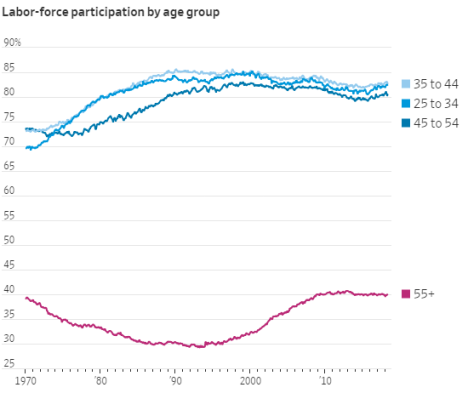
Interesting chart in today’s Journal about which breaks down the labor force participation rate by age cohort. The press keeps harping on the job market for entry level workers (essentially the Millennial Generation) however if you look at the labor force participation rate for that cohort, it is lower than the year 2000, but not by much. Nor is the problem the 55+ cohort (baby boomers). They are close to all-time highs. It is Gen X that is the issue – their cohort peaked around 83% in 2000 and now is closer to 80%. It is this generation that was hit hardest by the Great Recession (nailed right during the peak earnings years) and has yet to recover.

labor force participation rate by age cohort

Morning Report: Manufacturing strong 7/3/18

Vital Statistics:

Last Change
S&P futures 2737 10
Eurostoxx index 380.51 3.77
Oil (WTI) 75 1.06
10 Year Government Bond Yield 2.87%
30 Year fixed rate mortgage 4.52%

Stocks are up this morning as emerging markets rally overnight. Bonds and MBS are flat.\

Today should be quiet as markets close early ahead of the 4th of July holiday.

Manufacturing continued to plow ahead in June, according to the ISM PMI Index. The responses from the survey participants show that the trade war is having some impact. One food and beverage company mentioned that they were shifting some production to Canada in order to escape Chinese retaliatory tariffs on US products. Inflationary pressures are present in higher commodity prices, and we are seeing secondary pressure from transportation (higher oil prices and driver shortages are pushing up prices here). Pretty much every commodity is seeing price increases, and there are material shortages in aluminum, steel, and electronic components. Overall, this is a strong manufacturing reading, which is usually associated with 5.2% GDP growth. Of course, manufacturing isn’t the driver of the economy it used to be, but it is still a strong reading.

The Fed is going to pay close attention to this report, particularly the part about labor shortages. From their standpoint, inflationary pressures from commodity price inflation are generally considered transitory and therefore temporary. An old saw in the commodity markets is that the cure for high prices is high prices. The potential dampening effect from trade battles will also concern them. IMO, until you start seeing wage inflation pick up in a meaningful way the Fed will consider this a push. Note we will get some insight into this on Thursday when the minutes from the June meeting are released.

The Fed funds futures are still handicapping a 76% chance of a 25 bp hike in September and a 45% chance of one in December as well.

Construction spending rose 0.4% in May, and is up 4.5% on an annualized basis. Residential construction was up 0.8% MOM and 6.6% YOY, as an increase in private resi construction was offset by a drop in public housing spending. Manufacturing construction took a step back, which will be something to watch (could just be noise, but could be trade-related). Meanwhile retail (specifically mall-related construction) is in the doldrums as vacancy rates soar.

Home price appreciation accelerated in May, according to the CoreLogic Home Price index. Prices rose 1.1% MOM and are up 7.1% YOY. The housing shortage is well-documented, and the problem is most acute at the entry-level. Higher rates and low inventory is also preventing some people from moving. CoreLogic estimates that 50% of the mortgage market has a rate of 3.75% or lower. According to CoreLogic’s model which compares home price appreciation to income appreciation, we are seeing large pockets of overvaluation, particularly in Florida, the West Coast, the sand states, and parts of the Eastern Seaboard. The Midwest remains cheap.

Trump is reportedly mulling whether to pick a new Chief of Staff. One of the potential candidates is current CFPB Chairman Mick Mulvaney. Mulvaney is currently doing double duty as OMB and CFPB head, so a change for him would be unlikely, but the possibility is still there. Here are the implications of a change and who might replace him.

Labor shortages continue to be an issue in the Midwest. Companies are now less squeamish about hiring ex-cons. In Elkhart, (where the labor market is so tight it sports a 2% unemployment rate and even the KFC is offering sign-on bonuses), companies are hiring convicted felons (except sex offenders) and are waiving drug tests. It is a back-to-the future scenario, where the labor market is suddenly transported back to 1955.

An Interesting Amicus Brief

Were states correct when they forced electors to vote according to the popular vote in those states?  Here are the arguments for elector discretion.


Presidential electors can vote with discretion

Morning Report: New downpayment assistance programs 6/29/18

Vital Statistics:

Last Change
S&P futures 2728.75 9.5
Eurostoxx index 379.91 3.04
Oil (WTI) 73.39 -0.06
10 Year Government Bond Yield 2.84%
30 Year fixed rate mortgage 4.52%

Stocks are higher this morning on end-of-quarter window dressing. Bonds and MBS are flat.

Personal incomes rose 0.4% in May while personal spending rose 0.2%. Incomes were in line with estimates, while spending was lower. The June FOMC statement said that consumer spending was accelerating – no evidence of that in this report. Services spending drove the decline, and we could be seeing evidence that higher gasoline prices is affecting discretionary expenditures. Inflation was in line with expectations at the MOM level, and a hair above expectations on an annual basis. The core PCE index ex-food and energy came in at 2%, which is right where the Fed wants it. April’s income and spending numbers were revised downward. Don’t be surprised if strategists take down some of their Q2 GDP forecasts on these numbers.

The Chicago PMI improved to 64 from 62, which is a 5 month high. New Orders and order backlog drove the increase. We are seeing some signs of inflation brewing, with extended lead times, and a 7 year high on the prices paid index. Businesses were asked about how trade was affecting their operations. About 25% said they were having a significant impact, 40% said there was a minimal impact, and the rest were either unsure or insulated from trade issues.

KB Home reported strong numbers, with a 170 basis point increase in gross margins, 10% revenue growth, and a 50% increase in operating income. ASPs were up 4% to 401,800, and order growth was 3%. Backlog was the second highest on record. The stock is up 7% pre-open.

Interesting theory about the lack of construction workers: opiods. Between users and those that have been convicted of crimes related to usage, many workers are shut out of the work force. 80% of homebuilders report shortages in subcontractors.

The Senate will hold hearings on July 12 and 19th for Kathy Kraninger’s nomination to run the CFPB. The conventional wisdom is that she is not intended to be confirmed, but is to be an excuse to keep Mick Mulvaney in charge of the agency.

Deutsche Bank failed its stress test, while State Street, Goldman and Morgan Stanley got dinged.

Many Millennials are struggling to get a down payment for a home, and now some companies are working to help them get it. One company will supply up to a $50,000 downpayment if the borrower rents out a room on Air B&B and shares the income with the company. These loans are appealing to borrowers who might qualify for a FHA or 3% down Fannie loan but don’t want to pay the MI and other costs. While there are fears that we are bringing back the bad old days of the real estate bubble, here is the MBA’s mortgage credit availability index. We are a long way away from the days of the pick-a-pay mortgage.