Morning Report: Ginnie Mae is increasing scrutiny of non-bank lenders

Vital Statistics:


Last Change
S&P futures 2642 0
Eurostoxx index 357.3 2.93
Oil (WTI) 52.35 0.36
10 year government bond yield 2.73%
30 year fixed rate mortgage 4.62%


Stocks are flat as we begin the FOMC meeting. Bonds and MBS are up small.


Despite the end of the shutdown, we will have to wait for economic data. Two big reports this week – GDP and personal incomes – have been delayed.


Economic activity picked up in December, according to the Chicago Fed National Activity Index. Production-related indicators and employment drove the increase. Note that the CFNAI is a meta-index of a number of announced economic indices, and the government shutdown has decreased the amount of data going into the index. We’ll see the same effect next month as well, so the index won’t be as accurate as it usually is. Regardless, the CFNAI is an amalgamation of previously released data, so it doesn’t move markets.


Ex-Fed Head Narayana Kochlerakota thinks the Fed should consider easing at the next meeting. His argument is that the Fed has been falling short in maintaining inflation at its 2% target and that notwithstanding the latest unemployment data we are still not at full employment. He is looking at the percentage of prime age people (age 25-54) who are currently employed. We are just south of 80%, and were closer to 82% during the late 90s. Given that the number of prime age people in the US is roughly 100MM, then we have about 2 million more jobs to create in order to get to back to where we want to be. Interestingly, he not only advocates maintaining the current balance sheet, he thinks it should increase about 4% a year to grow in lockstep with the economy.
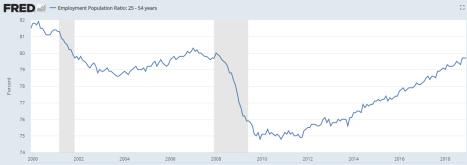
 

employment population ratio


Guess what has been one of the best performing assets so far this year (almost tripled in under a month). If you guessed the GSEs, you would be correct. The market is betting that shareholders won’t get wiped out when / if housing reform happens this year. Check out this chart of Fannie Mae:


fnma chart


Ginnie Mae is stepping up oversight of its partners, particularly non-bank lenders, telling some that they must improve some financial metrics before they will be granted more commitment authority, which is the ability to securitize FHA and VA loans. The government is concerned that non-bank lenders have replaced a lot of the traditional banks in servicing government loans. Indeed, they have – nonbanks now service 61% of government loans, up from 34% at the end of 2014. FHA was largely a backwater of the mortgage market pre-crisis, however post crisis, it has picked up the load that subprime left. Servicers for government loans have a lot more liquidity demands than servicers for GSE loans – and in a downturn the advances liability could take out undercapitalized mortgage bankers. VA lenders can face what is called no-bid risk, which can be a disaster for many servicers without a line of credit to cover advances and loan buyouts.

Morning Report: Is tapering behind the sell-off?

Vital Statistics:


Last Change
S&P futures 2651 -12
Eurostoxx index 356.08 -1.82
Oil (WTI) 52.76 -0.93
10 year government bond yield 2.76%
30 year fixed rate mortgage 4.62%


Stocks are lower this morning on no real news. Bonds and MBS are down.


We have a temporary reprieve of the government shutdown, with agencies to -re-open until Feb 15. This will allow Congress more time to work on some sort of deal on border security. Trump is willing to shut down the government again, or use emergency powers to secure funding. Note that Trump said over the weekend he is skeptical that Congress will come up with anything he would be willing to sign.


With the government shutdown over, we should start getting economic data again. We will have a big week for data, with GDP on Wednesday and the jobs report on Friday. Not sure what is going to happen with the missed data from the shutdown.


The FOMC meets Tuesday and Wednesday, however no change in the Fed Funds rate is expected. Jerome Powell will hold a press conference after the meeting, which is unusual for January meeting. The Fed Funds futures are pricing in only a 1% chance of a hike, so the press conference will be about something else – probably balance sheet runoff and the idea that the Fed’s balance sheet will probably end up closer to current levels than it will be to pre-crisis levels.


Note there has been some criticism that the Fed’s balance sheet reduction is behind the sell-off in the market. They believe that the Fed’s reduction in Treasury purchases, combined with higher borrowing amounts is causing rates to rise and that is spooking investors. The idea is that government borrowing is crowding out other investments by soaking up all of that excess liquidity in the market. The Fed isn’t buying that argument: “It’s hard to fathom the [Fed] balance sheet is having some dramatic effect,” Minneapolis Fed President Neel Kashkari said in a Jan. 17 interview. FWIW, if Fed buying was the catalyst for the sell-off, we should be seeing a steepening of the yield curve (in other words higher long term rates). In fact, we are seeing the opposite. IMO, the biggest reason for the sell off has been the re-introduction of money market instruments to the investment menu. For the past 10 years, they have paid nothing and therefore money market investors have been forced to invest in stocks and longer term bonds. Now that short term rates are rising again that money is returning to its natural home, which means some selling in the stock and bond markets as the trade is unwound.


D.R. Horton reported fourth quarter net income increased 52% YOY, although that was partially driven by a tax charge in Q4 last year. Orders were up 3% in units and flat on a dollar basis. Donald Horton, Chairman of the Board said: “Sales prices for both new and existing homes have increased across most of our markets over the past several years, which coupled with rising interest rates has impacted affordability and resulted in some moderation of demand for homes, particularly at higher price points. However, we continue to see good demand and a limited supply of homes at affordable prices across our markets, and economic fundamentals and financing availability remain solid. We are pleased with our product offerings and positioning for the upcoming spring selling season, and we will adjust to future changes in market conditions as necessary.”

Morning Report: Initial Jobless Claims break 200,000

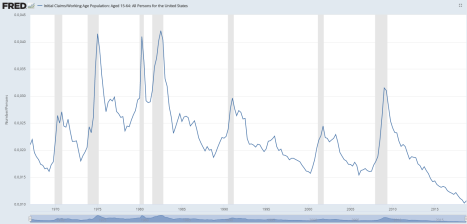
Initial Jobless Claims broke 200k, falling to 199k last week. This is the lowest level since the 1960s. For all of those fretting over a possible economic slowdown, we aren’t seeing any evidence of that in the initial jobless claims numbers. These numbers are impressive enough in of themselves, however if you correct for population growth, we are in pretty much uncharted territory.


initial jobless claims divided by population


The Index of Leading Economic Indicators fell 0.1% in December, according to the Conference Board. This follows a 0.2% increase in November. “The US LEI declined slightly in December and the recent moderation in the LEI suggests that the US economic
growth rate may slow down this year,” said Ataman Ozyildirim, Director of Economic Research at The Conference Board. “While the effects of the government shutdown are not yet reflected here, the LEI suggests that the economy could decelerate towards 2 percent growth by the end of 2019.”


Adjustable rate mortgage are making a comeback, at least according to the latest Ellie Mae Origination Insight Report. ARMs accounted for 9.2% of all originations in December, up from 8.8% in November. Purchases accounted for 71% of all originations, and other indicators like FICO, DTIs, and cycle times were largely unchanged.


Dueling bills to re-open government failed in the Senate yesterday. Talks have resumed between the parties to find a compromise everyone can live with.


The Fed is contemplating an earlier end to the tapering process than the market has been anticipating. The Fed’s balance sheet pre-crisis was about $800 billion. It peaked around $4.5 trillion and has fallen to something like $4.1 trillion since they began letting some of the portfolio run off (i.e letting bonds mature and not re-investing the proceeds). The market thought the Fed would likely return to pre-crisis levels, however the consensus is that probably won’t happen as it could create issues with banking reserves. What does that mean for the mortgage industry? At least for the moment it means that there will be more incremental demand for TBAs from the Fed, which will mean lower rates, at least at the margin.


Housing reform may be a front-burner issue again, as lawmakers pledge to do something with Fan and Fred.

Morning Report: Dueling bills to end the shutdown

Vital Statistics:


Last Change
S&P futures 2643.25 4.75
Eurostoxx index 356.16 1.08
Oil (WTI) 52.37 -0.25
10 year government bond yield 2.73%
30 year fixed rate mortgage 4.62%


Stocks are higher this morning on no real news. Bonds and MBS are flat.


Dueling bills to end the shutdown will be voted on in the Senate today, with neither one having much chance of passing. The point of holding these votes is to hopefully create some avenue for compromise. Separately, Trump will postpone the State of the Union address until after the shutdown is over.


The government estimates that first quarter GDP could be flat if the government shutdown lasts for the whole quarter. There is always some seasonal noise that depresses Q1 GDP relative to the rest of the year, and the added effects of the shutdown would exacerbate that.


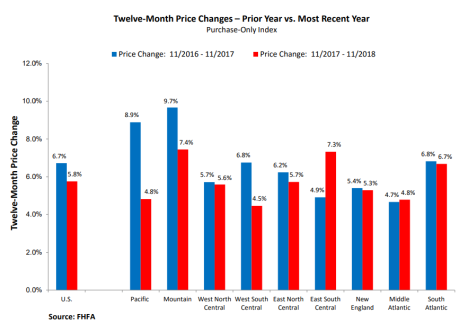
House prices rose 0.4% in November, according to the FHFA House Price Index. On a YOY basis, they were up 5.8%. Take a look at the chart below – you can see how much the hot markets out West have cooled down.  That said, the FHFA index is holding up better than indices like CoreLogic or Case-Shiller. This is because the index focuses on conforming loans only, which makes it a starter-home heavy index and that is where the demand is.


fhfa regional


There has been another major leak of financial data, this time affecting mortgage and loan data from Citi, HSBC, Wells, Capital One, and HUD. The data contained names, social security numbers, and bank account numbers. Much of the data was quite old, dating back to the bubble years.


Morning Report: Existing home sales fall

Vital Statistics:


Last Change
S&P futures 2641 9.75
Eurostoxx index 356.16 1.08
Oil (WTI) 52.77 -1.03
10 year government bond yield 2.76%
30 year fixed rate mortgage 4.48%


Stocks are higher this morning as earnings reports continue to come in. Bonds and MBS are flat.


Mortgage applications fell 2.7% last week as purchases fell 2% and refis fell 5%. This was a bit of a give-back after a torrid start to the year. Rates were more or less unchanged, and the unadjusted purchase index was close to a 9 year high. Still, it is encouraging to see activity picking up ahead of the Spring Selling Season, which is just around the corner.


Existing Home Sales fell 6.4% in December according to NAR. The seasonally adjusted annual number comes out to 5 million, which is down 10% YOY. The median house price rose 3% to $253,600 and inventory fell to 1.55 million units, down from 1.74 million in November. At current rates, it represents a 3.6 month supply, which is an increase from 3.2 month’s worth in November. Days on market increased to 46 days, up from 42 in November and 40 a year ago. While the 30 year fixed rate mortgage fell from 4.87% in November to 4.64% in December, these sales would represent transactions done under a higher interest rate regime – the drop in rates will probably be reflected in January data. There is still quite the mismatch between what is available for sale – largely luxury properties – and what is needed, which is entry-level housing. The first time homebuyer still represents about 32% of all sales – historically that number has been closer to 40%. The Northeast and the Midwest experienced the biggest drops in sales.


The Senate will vote on a plan to open government – wall funding in exchange for temporary protection for Dreamers. The Democrats have declared this a non-starter, but we’ll see how close this comes to passing. The Democrats have their own bill in the Senate which doesn’t include wall funding and is also unlikely to pass. The big question concerns what Trump will actually sign.


Non-traditional mortgages are making a comeback, after a long slumber. Originations for these types of products – bank statement loans and the like – increased 24% in 2018, however their share of the total mortgage market is still extremely small, around 3%. Investor demand for these products is picking up as well – securitizations quadrupled last year to $12 billion. While these loans are a far cry from the neg-am NINJA loans of the bubble years, regulators and affordable housing advocates are fretting over these loans.


New home sales fell 16% in 4 of the largest markets to close out the year, according to Redfin. Higher mortgage rates and tax issues are depressing sales in some of the pricier markets. Look for homebuilders to face a squeeze as well as rising input prices and slower price growth depress margins. Builders may have to concentrate on building lots of lower-priced entry level units, which is exactly where the demand is.


new home sales redfin

Morning Report: Consumer sentiment declines

Vital Statistics:


Last Change
S&P futures 2653.73 -17.75
Eurostoxx index 355.2 -1.16
Oil (WTI) 52.83 -0.97
10 year government bond yield 2.76%
30 year fixed rate mortgage 4.48%


Stocks are down this morning on overseas weakness. Bonds and MBS are up.


Today begins the World Economic Forum in Davos. For the most part, it is basically an event where CNBC interviews hedge fund managers and government officials in the snow, however there is always the chance that someone could say something market moving.


Dave Stevens (formerly head of the MBA) outlines some of the effects of the shutdown on the mortgage business. For most lenders, the shutdown is a non-issue. 4506-Ts, social security, and flood insurance is not impacted. Lenders located in areas where there are a high quantity of government workers are unable to get VOEs for furloughed workers. This is beginning to impact closings – while the GSEs will permit loans to close without a VVOE from the government, these loans are ineligible for sale until this is done. While this won’t impact lenders with a balance sheet (i.e. banks), most independent mortgage originators won’t be able to hold a funded loan and wait out the shutdown.


Industrial Production rose 0.3% in December, while manufacturing production rose 1.1%. Capacity Utilization ticked up to 78.7%. Motor vehicles and construction products drove the increase.


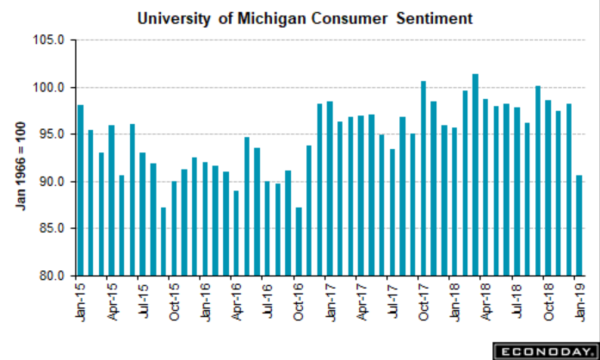
Consumer sentiment plunged in early January according to the University of Michigan consumer sentiment survey. Whether this is shutdown driven or not is anyone’s guess, but it does add fuel to the argument that the Fed went too far in 2018. The big change – future expectations.


consumer sentiment


China’s growth has slowed to the lowest levels in almost 3 decades – falling to 6.4% in the fourth quarter. The government does have some levers to push, however the bigger concern is their real estate bubble, which is vulnerable. Consumer spending is also decelerating as well, albeit from a torrid pace. The biggest effect on the US would be to hold a lid on interest rate increases and to slow down global growth. The effect of a Chinese recession will probably have the same sort of effect that Japan had in 1990 – depressing global growth, lowering import prices and allowing countries to grow without goods and services inflation.


The FHFA is not going to defend the constitutionality of its structure. The Fifth Circuit ruled in July that the FHFA is unconstitutional in that it has too much power and violates the separation of powers. The previous head of FHFA – Mel Watt – planned to appeal the decision, however the Trump Administration agrees with the ruling and will not contest it. The decision from the Fifth also ruled that the government’s current net worth sweep (in other words, all profits from the GSEs go straight to Treasury) is Constitutional. So, basically the net effect would maintain the current structure, but also allow the President to fire the head of the FHFA at will.


Note that Mark Calabria (the Trump nominee to run FHFA) is not a huge fan of securitization in general and all of the general subsidies the government puts in the US residential real estate market.

Morning Report: Trade Detente?

Vital Statistics:


Last Change
S&P futures 2646.5 11.25
Eurostoxx index 355.63 4.9
Oil (WTI) 52.63 0.58
10 year government bond yield 2.77%
30 year fixed rate mortgage 4.48%


Stocks are up this morning on overseas strength. Bonds and MBS are down.


Stocks got a lift yesterday around 2:30 when the Wall Street Journal reported that the US was considering lifting tariffs on China in order to secure a trade deal. Stocks shot up on the news while the 10 year bond yield rose to 2.75%. We didn’t see much movement in MBS (FWIW, I don’t think I saw any reprices), but the weakness in bonds is continuing this morning. The Trump Administration did say that nothing has been decided and nothing is imminent. Treasury Secretary Steve Mnuchin is in favor of trade detente, while U.S. Trade Representative Robert Lighthizer is more hawkish.


Initial Jobless Claims fell to 213,000 last week as expected seasonal layoffs failed to materialize.


The new FHFA Director Mark Calabria has more of a libertarian bent than his predecessor, Mel Watt. For instance, he is skeptical of the whole originate to securitize model, which introduces more risk into the system in his view. He also doesn’t support the subsidies that make things like the 30 year fixed rate mortgage possible. For those that don’t know, the US residential real estate financing system is unique, with all sorts of subsidies to borrowers. 30 year fixed rate mortgages are unheard of overseas, with most mortgages being adjustable rate. Second, overseas banks “eat their own cooking” – in other words, they hold and service the loans they make. That is generally not the case in the US – most loans are securitized and sold to pension funds, sovereign wealth funds, etc. In other words, the borrower bears the interest rate risk and the bank bears the credit risk. In the US, the investor bears the interest rate risk while the taxpayer bears the credit risk.


Calabria comes in when the government / GSE system is pretty much the only game in town. Even Obama’s FHFA wanted to see the private sector take on a bigger role in mortgage finance, however the simple fact is that it hasn’t really stepped up yet. There are many reasons for this that I discussed here that are independent of policy levers. Given that reality, the chance that anything changes much in the mortgage space is pretty remote.


Morning Report: Luxury home prices falling

Vital Statistics:


Last Change
S&P futures 2605 -8
Eurostoxx index 349.68 -0.7
Oil (WTI) 51.56 -0.75
10 year government bond yield 2.72%
30 year fixed rate mortgage 4.48%


Stocks are lower this morning on no real news. Bonds and MBS are flat.


The NAHB Housing Market Index rebounded slightly in January, but it is still way lower than the index peak in December 2017. The recent drop in rates is helping, but affordability issues and input costs are still dogging the homebuilding industry. Lennar and KB Home still reported decent numbers, and we have yet to see builders having to offer large incentives to move inventory. The supply / demand imbalance is still solidly in favor of the builders, but affordability issues are contributing to a decline in foot traffic.


CoreLogic estimates that refinances will account for only 25% of all mortgage origination in 2019, the lowest in 25 years. Rate / Term refis will become even less important, as prepayment burnout has taken hold at these levels. The opportunities will be largest in cash-out, where homeowners can refinance high interest rate credit card debt, and in product swapping, where FHA borrowers with sufficient home equity will be able to refinance into a product with no MI.


refi share


The Fed’s Beige Book noted that growth is slowing, but is still decent. The language in the report changed from growth being “solid” or “strong” “moderate to modest.” Many companies noted that input prices are rising, but they are unable to pass those increases on to customers. While residential real estate is rising in price, commercial and industrial real estate is not.


More problems for real estate prices at the high end. Greenwich CT prices continue to fall, which is about luxury real estate prices as much as it is about the changing nature of the financial industry. Note however that prices have fallen 7.3% in San Jose. Apple is reducing hiring due to weaker than expected iPhone sales, and the fizz is pretty much out of the social media craze.

Morning Report: Bank earnings coming in

Vital Statistics:


Last Change
S&P futures 2609 2
Eurostoxx index 347.72 0.2
Oil (WTI) 51.15 0.64
10 year government bond yield 2.74%
30 year fixed rate mortgage 4.44%


Stocks are flattish as bank earnings continue to come in. Bonds and MBS are down.


Inflation at the wholesale level declined 0.2% MOM and rose 2.5% YOY. Ex-food and energy, it rose 0.1% MOM and 2.3% YOY. Rising food prices more than offset declines in energy. More and more strategists are thinking the Fed will stand pat: “We expect the Fed to sit tight until June, and odds are rising that it could be an even longer pause given the absence of an acceleration in inflation, past tightening in financial market conditions, slowing in the global economy and uncertainty surrounding geopolitical events,” said Ryan Sweet, a senior economist at Moody’s Analytics in West Chester, Pennsylvania.


Mortgage applications jumped 13.5% last week as rates fell to the lowest levels in 9 months. Purchases rose 9% while refis rose 19%.


Last week United Wholesale announced that they were removing most LLPAs from their loans in order to guarantee the best rate. Yesterday cross state rival Quicken announced they would cut pricing as well to compete. We have a wholesale price war in Amityville.


Wells Fargo announced earnings that disappointed the street as revenues declined. Mortgage banking volumes were down 28% on a YOY basis. Despite a flattening yield curve, net interest margins were flat with Q3 at 2.94%.


JP Morgan reported a sequential drop in revenues as well, however earnings were up smartly. There is some tax cut noise in the numbers however. The mortgage business had a rough go of it as originations fell 30% to $17.4 billion.


Fitch sees a stable mortgage market in 2019, after a 9% decline in 2018. Good news: delinquencies and arrears continue to fall. Bad news: lack of affordability will depress origination.


Kansas City Fed Head Esther George thinks now would be a good time to pause in the normalization process. FWIW, she doesn’t think we are quite at “neutral” yet but we are close. Note that she is on the hawkish end of the spectrum.

Partial Shutdown – “unintended” security consequence (from WaPo)

Dozens of government websites have been rendered insecure or inactive.

Some NASA, Justice Department and other government agency websites were insecure or not working as of today because important security certificates had expired, according to a report from Internet security company Netcraft. With so many federal employees out, the agencies probably do not have the IT resources to renew the certificate.

Check out the link.