Morning Report: More on Friday’s jobs report

Vital Statistics:


Last Change
S&P futures 2756 0.4
Eurostoxx index 371.87 1.24
Oil (WTI) 56.47 0.4
10 year government bond yield 2.65%
30 year fixed rate mortgage 4.32%


Stocks are flattish on no real news. Bonds and MBS are flat.


The upcoming week has a lot of economic data, however most of it is not housing related, and probably won’t be market-moving either. The biggest housing-related number will be new home sales and construction spending. We will also get inflation data and industrial production.


Friday’s payroll number was a definite downward surprise, and the question is whether this indicates a slowing labor market? Extremely low job prints happen occasionally we had sub-20k months in Sep 2017 and May 2016. Both prints ended up being a blip, and there is a good chance this gets revised upward in next month’s number. The number to take away from the jobs report is the increase in average hourly earnings. Average hourly earnings are a notoriously non-volatile series, and this one keeps inexorably increasing by larger and larger amounts.


average hourly earnings


Just because the US economy is doing relatively well, that doesn’t mean things are rosy overseas. China has had some bad days in the stock market, and the cracks are starting to appear in the economy. In Europe, the German Bund yield (The European benchmark) is about to go negative. Growth estimates have been slashed from 1.7% to 1.1%. So there is a bit of a global slowdown, and it means that we will probably take some shrapnel in the form of lower rates.


CFPB Chair Kathy Kraninger appeared before the House Financial Services Committee last week, and the commentary broke down along partisan lines. Democrats, pining for the Cordray days, had a laundry list of complaints, ranging from a de-emphasis on payday lenders to kvetching about changes in internal reporting lines. Republicans generally supported her and the agency’s end of regulation by enforcement. Kraninger reaffirmed the Agency’s commitment to chasing bad financial actors.

Morning Report: Surprising payroll number

Vital Statistics:


Last Change
S&P futures 2729.75 -20
Eurostoxx index 370.51 -3.3
Oil (WTI) 55.07 -1.53
10 year government bond yield 2.63%
30 year fixed rate mortgage 4.35%


Stocks are lower this morning after Chinese stocks fell 4.4% overnight. Bonds and MBS are up.


Jobs report data dump:

  • Payrolls up 20,000 (huge miss – Street was looking for 180k)
  • Unemployment rate 3.8%
  • Labor force participation rate 63.2%
  • Employment-Population Ratio 60.7%
  • Average hourly earnings up 3.4%

Surprisingly poor payroll number, and a bit of a suprise given the ADP number and all of the other numbers, which indicate strength. I suspect this will get revised upward next month. The average hourly earnings number is the highest in a decade, and probably is a better indicator of the health of the labor market than the payroll number. Still, the first indication of a labor slowdown will be a drop in hiring, so it bears watching.


Housing starts rose 1.23 million in January, which was a touch higher than the Street estimate. Building Permits rose 1.35 million, slightly above the 1.29 million estimate. January housing numbers are typically the nadir of the seasonal slowdown, so it is hard to read too much into them.


Labor productivity rose 1.9% in the fourth quarter as output increased 3.1% and hours worked increased 1.2%. Productivity is what allows non-inflationary growth and is the biggest input into higher standards of living. Unit Labor costs rose 2%.


Initial Jobless Claims fell to 223,000.


House Democrats have introduced legislation to prevent any sort of reform of the CFPB. Their big objection is the fact that Mick Mulvaney ended regulation by enforcement action, which was the practice of promulgating intentionally vague rules and then fining companies for violating them without saying what the rules exactly are. Since the government has unlimited resources and most companies don’t, they choose just to pay whatever the agency asks. Mulvaney also required the agency’s lawyers to conduct cost-benefit analyses for proposed regulations, which they also dislike. The bill has zero Republican sponsors, will go nowhere in the Senate, and is really nothing more than a messaging exercise.


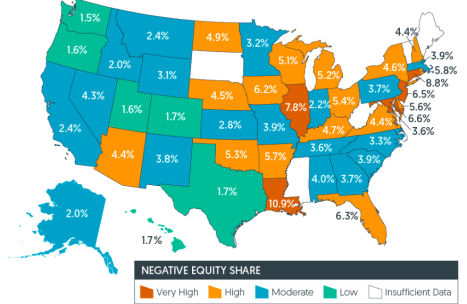
Rising home prices means rising home equity. In the fourth quarter, homeowners saw their equity increase by 8.1%, or $678 billion, according to CoreLogic. The number of homes with negative equity rose to 2.2 million units, however the amount of the negative equity also fell. Louisiana, Connecticut, and Illinois have the highest percentage of homes with negative equity, while Washington, Oregon, and Utah have the smallest.


negative equity

Morning Report: New home sales jump in February

Vital Statistics:


Last Change
S&P futures 2786.75 -4
Eurostoxx index 376.51 0.03
Oil (WTI) 56.07 0.4
10 year government bond yield 2.70%
30 year fixed rate mortgage 4.43%


Stocks are lower this morning on no real news. Bonds and MBS are up.


The economy added 183,000 jobs in February, according to the ADP Employment Survey. The Street is looking for about 180,000 additions in Friday’s employment situation report, so the ADP numbers seem to be in line.


Mortgage applications decreased 2.5% last week as purchases fell by 2.6% and refis fell 2%. The typical mortgage rate rose by 2 basis point to 4.67%.


The ISM non-manufacturing index expanded in February, which means that the services sector is picking up momentum.  The biggest issues seem to be potential trade issues, labor shortages and trucking costs.


New Home Sales rose by 621,000 in December. This is up 3.7% from the downward-revised November number, but down 1.5% from a year ago. For the full year, 622,000 homes were sold, which is slightly higher than the 613,000 sold in 2017. The median price was $318,000, while the average price was $377,000. The median sales price has been declining over the past year after peaking in November 2017 at $343,400. This demonstrates the shift from luxury to entry-level home construction to meet demand. This is a reversal of the early years of the crisis, when the luxury end of the market was the only part that was working.


Note that new home sales are about where they were during the 60s – 80s. Pretty amazing when you take into account that the US population has increased by close to 60% since 1970.


new home sales


Here is a copy of the letter that NAR, MBA, and a host of other housing advocates sent to Joseph Otting, Acting Director of the FHFA regarding GSE reform. It urges FHFA to go slow, work to maintain the 30 year fixed rate mortgage, and allow the GSE’s to act as a counter-cyclical buffer.


The Fed is catching up to the markets. Boston Fed President Eric Rosengren said it could be “several meetings” before the Fed gets enough clarity on the economy to make a move in interest rates. In many ways, he is acknowledging what the Fed Funds futures have been saying for a while now – that the Fed is going to wait and see how the 2018 hikes affect the economy before making any further moves. Since monetary policy generally acts with a 9 – 15 month lag, it means that the economy still hasn’t factored in the Sep and Dec hikes from last year.

Morning Report: Atlanta Fed is predicting 0.3% growth in Q1

Vital Statistics:


Last Change
S&P futures 2793.25 3.2
Eurostoxx index 374.38 -0.84
Oil (WTI) 56.73 0.14
10 year government bond yield 2.74%
30 year fixed rate mortgage 4.43%


Stocks are up on trade hopes. Bonds and MBS are flat.


Construction spending fell 0.6% in December, but was up 1.2% on a year-over-year basis. While the government shutdown may have had an effect on public construction spending, private construction spending was down the same amount. Housing continues to punch under its weight class, falling 1.4% MOM and 1.5% YOY. Public housing construction was even worse, falling 5% MOM and 20% YOY.


Now that more people are shopping for real estate online at sites like Zillow, Redfin and Realtor.com, the photos you use to show your property take on greater importance. Certainly it pays to have someone who knows what they are doing to photograph your home to put it in the best light, as opposed to simply posting photos from your phone. Now, with photo editing software getting cheaper and cheaper, more people are using edited photos to show their place. Some of this is innocuous: like photoshopping out your personal stuff in the kitchen and some of it is not: adding a pool or removing a wall. Given that 20% of homes are bought sight unseen, this is no longer a trivial, theoretical issue. It takes on even more importance given the move towards computer-generated appraisals.


Mortgage rates tend to vary across states. For example, the cheapest state to borrow in is California, where the average rate is 4.74%. The most expensive is NY, where the average rate is 4.96%. The US average is 4.84%. You would think that judicial versus non-judicial foreclosure laws would explain the difference (you can live in your foreclosed house for years in NY), but maybe there is more going on here. Guess what the second-lowest rate state is: New Jersey, which has a pretty similar foreclosure legal structure.


Yesterday I mentioned that strategists and the Atlanta Fed are extremely bearish on Q1 GDP growth, figuring that it will come in under 1%. A couple of points: First, Q1 GDP has been weak for the past several years. It might be a measurement issue or something spurious, but that is one reason economists might be cheating down the number a tad. Second, if Q1 GDP comes in around 1%, you can probably forget about any rate hikes this year. For what its worth, the Fed Funds futures are predicting a 94% chance of no hikes this year and a 6% chance of 1 hike.


HUD Secretary Ben Carson plans to leave the Administration at the end of Trump’s term, where he will return to the private sector.

Morning Report: Homeownership rate increases in Q4

Vital Statistics:


Last Change
S&P futures 2814 6.75
Eurostoxx index 376.36 1.22
Oil (WTI) 56.49 0.7
10 year government bond yield 2.74%
30 year fixed rate mortgage 4.44%


Stocks are higher this morning on real news. Bonds and MBS are down.


The big data this week will be the jobs report on Friday. Jerome Powell said in his Humphrey-Hawkins testimony that he would like to see further wage increases, which should calm the bond markets if the average hourly earnings number comes in a bit hotter than expected. Other than that, we will get new home sales and the ISM data.


The homeownership rate ticked up to 64.8% in the fourth quarter, according to the census bureau. This is up from 64.4% in the third quarter and 64.2% a year ago. The homeownership rate has been slowly ticking back up after bottoming at 62.9% in 2016. Note that we are nowhere near the highs of around 69.2% during the bubble years. Bumping up that number by lending to Millennial borrowers is going to drive the mortgage business going forward, and will have to replace the rate / term refi business that drove earnings for years.


homeownership rate


28 organizations, including the MBA, NAR and a whole host of affordable housing advocates sent a letter to Acting FHFA Director Otting counseling him to go slow in GSE reform.  “A well-functioning housing finance system should provide consistent, affordable credit to borrowers across the nation and through all parts of the credit cycle without putting taxpayers at risk of a bailout,” the letter states. “We urge policymakers to take these principles into account to ensure that access and affordability are preserved under the current, and any future, housing regime.” FHFA had indicated it was willing to make some reforms without Congress, which prompted the letter. Any true GSE reform will require legislation.


Despite a strong Q4 GDP print of 2.6%, first quarter estimates are in the 0% to 1% range. Does the economy “feel” like it rapidly decelerated in the past couple of months? Some of the numbers suggest it – as in personal income and consumption.  I don’t sense it, but that’s what the pros are saying. As a general rule, people’s subjective assessment of the economy is often influenced by their personal partisan values. When Democrats are in charge, Republicans tend to feel the economy is worse off than it really is, and the same goes in reverse. During the Obama years, the professional economists (including the Fed) were consistently high on their GDP estimates. Now, during the Trump years, professional economists seem to be undershooting the numbers – i.e. actual growth numbers out of the BEA are much higher than forecast. I doubt there is any tampering going on, but it is something to keep in mind, especially when locking around big economic events.

Morning Report: 2018 GDP highest in 12 years

Vital Statistics:


Last Change
S&P futures 2788 -6.75
Eurostoxx index 371.36 -1.22
Oil (WTI) 56.82 -0.13
10 year government bond yield 2.67%
30 year fixed rate mortgage 4.34%


Stocks are lower this morning on no real news. Bonds and MBS are down.


Fourth quarter GDP came in at 2.6%, a deceleration from the third quarter reading of 3.4%, but much higher than many in the political economic punditry were predicting. Consumer spending rose 2.8%, while inflation rose 1.6%. Inflation fell from 1.8% in the third quarter. For 2019, GDP came in at 2.9%, the highest reading since 2006.


Initial Jobless Claims rose to 225,000 continuing a string of extremely low readings.


One of the most politically explosive issues these days concerns wage growth – why it seems to be so low and what can be done about it. Many will misinterpret cherry-picked numbers to make the claim that wages have not increased for 40 years, which is preposterous. That said, wage growth has been running in the high 2s, and with inflation around 2%, that equates to under 1% real wage growth. Modest, but certainly not what you would expect, especially this far into a recovery, especially with unemployment running below 4%. If the numbers don’t appear to comport with common sense, often times there is an issue with the numbers.  That seems to be the case here. It turns out that wage growth is quite a bit higher, and it is due to the measurement problems inherent in the Bureau of Labor Statistic’s calculations. The BLS basically adds up wages paid and divides it by hours worked. If higher paid older workers are exiting, and younger lower paid workers are entering it will depress the averages, and it won’t accurately measure the growth that someone who has stayed in the labor force for the entire year has seen. Take a look at the chart below, where the Fed imputed average wage growth from census data as opposed to the BLS. Wage inflation jumps from 3% to 5%, which makes a lot more sense given the current economic numbers.


average hourly earnings vs census


Toll Brothers reported an increase in pretax earnings and sales for the first quarter of 2019. Orders declined in a big way however, falling 24% in units and 31% in dollars, driven primarily by weakness in California. Home price appreciation has been moderating in the hotter markets, and it is especially pronounced in the luxury segment, where Toll resides. The cancellation rate jumped to 9.6% from 5.3% a year ago. Tax reform limited the mortgage interest deduction, and the luxury segment is most prominent in high tax states, so those two effects are squeezing demand.


Realtor.com predicts this year’s Spring Selling Season could be the weakest in years despite rising inventory. While lower rates have improved conditions compared to late 2018, we are still weaker than early 2018.

Morning Report: No revelations in Humphrey-Hawkins testimony

Vital Statistics:


Last Change
S&P futures 2785.75 -5
Eurostoxx index 372.14 -1.55
Oil (WTI) 56.64 1.06
10 year government bond yield 2.63%
30 year fixed rate mortgage 4.34%


Stocks are lower this morning on no real news. Bonds and MBS are up.


Jerome Powell’s Humphrey-Hawkins testimony didn’t really reveal much in the way of new information. Here are his prepared remarks.  The Fed will be patient as it evaluates incoming data: “With our policy rate in the range of neutral, with muted inflation pressures and with some of the downside risks we’ve talked about, this is a good time to be patient and watch and wait and see how the situation evolves.” He didn’t volunteer too much information regarding balance sheet runoff other than to say the Fed is evaluating the timing. For the most part, the bond market didn’t really react much to the testimony other than to rally somewhat on his view that he doesn’t see much in the way of wage-push inflation. The message to the bond market: don’t freak out if you start seeing wage growth with a 3 handle.


Home prices rose 1.1% in the fourth quarter, according to the FHFA House Price Index. December was up 0.3% from November. The hot markets of 2017, especially the West Coast markets, have cooled substantially and are now experiencing appreciation more in line with the rest of the country. This chart probably understates the deceleration in the hotter markets, as the index only looks at loans with a conforming mortgage, which means it is only measuring the lower price points, which is where the strength lies. The jumbo market has been struggling.


FHFA regional


Mortgage Applications increased 5.3% last week as purchases rose 6% and refis rose 5%. Mortgage rates were little changed last week, but as we anticipated, homebuyers are responding favorably to this more stable rate environment,” said Mike Fratantoni, MBA Senior Vice President and Chief Economist. “Purchase applications for both conventional and government loans rose last week, with the government gain led by a 14 percent increase in applications for VA purchase loans.”


A Senate Panel voted to advance Mark Calabria to a full vote on the Senate floor. The vote was 13-12, straight along party lines. The industry applauded the appointment.


Both Zillow and Redfin have models to value homes – which one is more accurate? It turns out that if you look at listed homes, Redfin is the winner, with an error rate of 1.8%. However, for homes off the market, it rises to 6%. Zillow, who doesn’t break out on the market / off the market for its error estimates comes in around 4%. FWIW, appraisers consider an error range of 4% about accurate. Note though that these are median error rates. In newer subdivisions, where square footage and lot sizes are similar, the estimates will be pretty predictive of final sales prices. As the properties become more diverse the error ranges increase. Note that in MSAs like Chicago, the median error is 4%, but over 40% of all home sales are not within 5% of the final sales price.

Morning Report: Housing starts disappoint

Vital Statistics:


Last Change
S&P futures 2791.5 -5
Eurostoxx index 371.78 -0.4
Oil (WTI) 55.5 0.03
10 year government bond yield 2.66%
30 year fixed rate mortgage 4.35%


Stocks are lower this morning on overseas tensions between India and Pakistan. Bonds and MBS are flat.


Jerome Powell heads to Capitol Hill today for his first day of Humphrey-Hawkins testimony. While this events are ostensibly to allow Congress to question the Fed about monetary policy, they are really nothing more than a posturing exercise for politicians to hop on their respective ideological hobby-horses. Expect Democrats to focus like a laser on income inequality, too big to fail banks, and fair lending. Expect Republicans to focus on inflation worries, banking regulation, and the return of the bond vigilantes. The markets will be listening for information on balance sheet reduction and further hikes this year. This probably won’t be market-moving.


Housing starts fell to a seasonally-adjusted annual rate of 1.08 million, a double-digit percentage drop on both a month-over-month and annual basis. As a general rule, winter housing starts numbers can be volatile due to the weather, however this is simply an awful number. The street was looking for 1.25 million, which is still a depressed number. Remember, between 1959 and 2002, we averaged 1.5 million housing starts a year. The last time we saw that sort of building was 2006.


housing starts


The Home Despot reported fourth quarter earnings this morning, and forecasted weaker-than-expected comparable sales. Part of this is a technical aspect of their accounting conventions, but it does speak to weakness in home improvement spending.


Economic activity slowed in January, according to the Chicago Fed National Activity Index. Production-related indicators drove the decline. How much of this was temporary due to tariff issues / government shutdown remain to be seen. Employment remained positive.


More sellers are cutting prices this winter in order to move their homes, according to Redfin. 21% of home sellers are reporting a price decrease, which is a post-crisis high. “Many sellers listed their homes late last year just as rising prices and mortgage rates were starting to price out their core pool of potential buyers,” said Las Vegas Redfin agent Jennifer Brockman. “Meanwhile, some buyers are starting to think that waiting to purchase a home could pay off, especially as listing inventory continues to rise. In this new market reality, buyers may have negotiating power now that they won’t have in the spring and summer.”


redfin price drop

Morning Report: Trade fears ease

Vital Statistics:


Last Change
S&P futures 2803 12.3
Eurostoxx index 371.62 0.39
Oil (WTI) 56.98 -0.31
10 year government bond yield 2.67%
30 year fixed rate mortgage 4.43%


Stocks are higher this morning on overseas strength. Bonds and MBS are flat.


The upcoming week should be relatively uneventful. Fed Head Jerome Powell heads to Capitol Hill for his Humphrey-Hawkins testimony, where Democrats will try and get him to say that income inequality is the number one problem in the economy, while Republicans will try and get him to say that raising taxes and regulation is bad for the economy. We will also get GDP on Thursday. It looks like the jobs report won’t be out this week.


Trump is considering an extension of the March 1 deadline for a trade agreement with China. On March 1, tariffs were set to increase on a number of number of Chinese goods. While this doesn’t take the trade threat off the table with respect to the markets, it does help calm things down. Note that the news was treated with gusto overseas – the Shangai Composite was up 5.6%.


Existing home sales fell 1.2% in January according to NAR. On an annual basis, they are down 8.5%. The seasonally-adjusted annual rate of 4.94 million is the lowest since November 2015. The median existing sales price rose only 2.8% to 247,800, which is much lower than we have been seeing in the home price indices like CoreLogic, Case-Shiller or FHFA. While home price appreciation is definitely slowing, this number probably speaks more to type of home being sold – more sales at the lower price points. Inventory is rising – hitting 1.59 million units. however that represents only a 3.9 month supply at current sales levels, which is well below what is considered a balanced market of 6 – 6.5 months.


December durable goods orders rose 1.2%, while November was revised upward to 1%. This report contains only December data, as Census catches up after the January government shutdown. New orders for non-defense capital goods (a good proxy for business capital expenditures) increased 3.7%.  In other economic data, initial jobless claims fell to 216k, while the index of leading economic indicators fell to -0.1%. The Philly Fed manufacturing index fell as well. In response to recent data, the Atlanta Fed GDP tracking model has taken down its Q4 estimate to 1.4%


TIAA bank is getting out of the retail bricks and mortar business and is selling their retail mortgage ops to US Bank to focus 100% on consumer direct and correspondent.


M&T Bank just bought a $13 billion MSR portfolio. This is a surprising move given that the capital treatment for MSRs (how much regulatory capital they are required to set aside) is more than the value of the MSRs themselves. Of course regulatory capital issues don’t necessarily determine investment decisions by themselves, but this is an interesting move.

Morning Report: Homebuilder sentiment improves

Vital Statistics:


Last Change
S&P futures 2783.25 -3
Eurostoxx index 370.68 -0.04
Oil (WTI) 56.9 0.81
10 year government bond yield 2.67%
30 year fixed rate mortgage 4.43%


Stocks are flattish on no major news. Bonds and MBS are flat as well.


Homebuilder sentiment improved markedly in February according to the NAHB / Wells Fargo Homebuilder Sentiment Index. Expectations for future sales drove the increase. The index touched a 3 year low in late 2018, so things are still disappointing compared to 2016-2017, but well above historical numbers. Challenges remain for the building industry however. “The five-point jump on the six-month sales expectation for the HMI is due to mortgage interest rates dropping from about 5% in November to 4.4% this week,” Dietz continued. “However, affordability remains a critical issue. Rising costs stemming from excessive regulations, a dearth of buildable lots, a persistent labor shortage and tariffs on lumber and other key building materials continue to make it increasingly difficult to produce housing at affordable price points.”


The FOMC minutes didn’t really contain much in the way of new information. They see the balance sheet reduction ending sooner than anticipated, which means the Fed will no longer have a $800 billion balance sheet like it had pre-crisis – it will now probably be in the $3 – $4 trillion range. Second, there is uncertainty whether there will be more hikes in 2019. The Fed Funds futures have been predicting no further hikes this year for several months now, so perhaps this is simply the members catching up with what the markets are saying. Note Cleveland Fed President Loretta Mester thinks we may need to still hike rates this year and end tapering.


MBA mortgage applications increased 3.6% from the previous week as refis increased 6% and purchases increased 2%.  Rates actually increased by 8 basis points to 4.56%. While refi activity has been increasing from the dismal levels at the end of 2018, they are still well below historically anemic. A combination of prepayment burnout and rising rates are driving the decrease. Going forward, home price appreciation, not interest rates will be the impetus for refinance activity as cash-outs will inevitably rise to pay off credit card debt and FHA borrowers with sufficient equity will want to refinance into conventional loans with no MI.


Chart: MBA Refinance index 1998 = Present

MBA refinance index


Move over Rocket Mortgage, here comes mello smartloan, which is loanDepot’s new 100% digital mortgage loan experience. They claim this loan can reduce time to close by 75%.