Morning Report: 30 year bond yield near record lows

Vital Statistics:


Last Change
S&P futures 2871 -14.5
Oil (WTI) 54.49 -0.44
10 year government bond yield 1.69%
30 year fixed rate mortgage 3.85%


Stocks are lower this morning after the Argentinian markets blew up overnight and the Hong Kong airport remains occupied by protesters. Bonds and MBS reversed their rally and are down after the Trump Administration announced they would delay the tariff increases on Chinese goods until mid-December. They were scheduled to take effect September 1.


The German Bund yield has hit a record low at negative 61 basis points. While the 10 year bond yield is still some 30 basis points from a record, the 30 year bond is getting close at a yield of 2.13%. Note that with the 10 year yield of 1.63% is lower than the dividend yield of the S&P 500.


30 year bond yield


Some economic data this morning: the consumer price index rose 0.2% MOM / 1.8% YOY, which was a touch higher than the Street forecast. Ex-food and energy, it rose 0.3% / 2.2%. The CPI remains pretty much where the Fed wants it, and is not going to be the driver of Fed policy, at least in the near term. Like it or not, the Fed is watching the markets and following them even if the signal-to-noise ratio is heavily distorted.


Small Business Optimism continued to increase as the index improved in July. Despite all of the handwringing in the business press over growth small business continues to grow and invest. Biggest headwind? Labor. The top concern of business was finding quality labor at 26%, which is a record. 57% reported capital expenditures, which means they have enough confidence to invest in infrastructure to grow their businesses. Only 3% of businesses reported not having their credit needs met, which is close to historical lows and kind of begs the question of what the Fed hopes to accomplish with lowering rates.


Mortgage delinquency rates continued to fall, hitting 20 year lows for most of the country. 30 day DQs fell to 3.6% and the foreclosure rate fell to 0.4%. The only areas with elevated DQ rates are in the Midwest and Southeast and are the result of flooding.


delinquencies


Fitch is out saying that GSE reform will probably not result in near-term downgrades.

Morning Report: Trump talks down the dollar

Vital Statistics:


Last Change
S&P futures 2905 -14.5
Oil (WTI) 54.68 0.64
10 year government bond yield 1.69%
30 year fixed rate mortgage 3.86%


Stocks are lower after a bunch of non-US political headlines over the weekend. Bonds and MBS are up.


Overseas, currencies and bond yields are focusing on elections in Italy and Argentina, as well as protests in Hong Kong. Protestors shut down the Hong Kong airport over the weekend.


The week ahead will have a few important data points, but nothing likely to be market-moving. We will get inflation at the consumer level tomorrow, retail sales / productivity / industrial production on Thursday, and housing starts on Friday. There doesn’t appear to be any Fed-speak this week, so things should be quiet absent overseas political developments. Congress is on vacation until Labor Day, so things should be quiet in DC as well.


Building materials prices rose 0.7% (NSA) in July, but are down overall year-over-year. Despite tariffs, softwood lumber prices are down 20% over the past year, while other products like gypsum are down less. Roofing materials (tar / asphalt) were flattish-to-down as well. Rising home costs are due more to labor, land, and regulatory costs than they are due to sticks and bricks.


After rising for a decade, average new home sizes are falling as builders pivot away from luxury buyers to first time homebuyers. In 2018, the average size of a single family dwelling was 2,588 square feet, down from 2,631 the year before. Builders had largely decided to relegate the first time homebuyer to the resale market and focused on McMansions and luxury urban apartments during the immediate aftermath of the housing crash. Townhomes are also increasing in popularity, with 69,000 sales last year, the most since 2007. This is the sector growing the fastest.


Prepay speeds were released on Friday, and we saw some eye-popping CPRs on the government side: 2018 FHA had a CPR of 30.7%, while VA was almost 50%. People who loaded up the boat on MSRs in 2017 and 2018 have been killed.


The Fed is looking at the idea of a countercyclical capital buffer as a way to mitigate the credit cycle. The idea would be to have the banks hold more capital (i.e. lend less) when the economy shows signs of overheating and then allow them to hold less (i.e. lend more) when the economy goes into a down cycle. This would only apply to the Citis and JP Morgans of the world – banks with more than 250 billion in assets. “The idea of putting it in place so you can cut it, that’s something some other jurisdictions have done, and it’s worth considering,” Fed Chairman Jerome Powell said at a late July press conference. It is an interesting idea, although reserves are typically sovereign debt, and this sounds a bit like adding buying pressure to a market that certainly does not need it.


Trump tweeted about the dollar, arguing that it should be weaker. Note this is a yuge departure from the strong dollar policy that every other president has supported. “As your President, one would think that I would be thrilled with our very strong dollar,” he tweeted. “I am not! The Fed’s high interest rate level, in comparison to other countries, is keeping the dollar high, making it more difficult for our great manufacturers like Caterpillar, Boeing, John Deere, our car companies, & others, to compete on a level playing field. With substantial Fed Cuts (there is no inflation) and no quantitative tightening, the dollar will make it possible for our companies to win against any competition. We have the greatest companies in the world, there is nobody even close, but unfortunately the same cannot be said about our Federal Reserve. They have called it wrong at every step of the way, and we are still winning. Can you imagine what would happen if they actually called it right?”


The strength in the dollar is more due to the relative strength of the US economy versus its trading partners, along with various carry trades. A carry trade is where you borrow money in a low yielding currency like the Japanese yen and invest the proceeds in a high-yielding government bond like the US Treasury. The net effect of a strong dollar is to make our exports more expensive to foreign buyers, make imports cheaper for US consumers and to lower interest rates in the US. The problem is that the ones who benefits from a weaker dollar (exporters) are loud and visible, while the beneficiaries (everyone else) aren’t even aware they are benefiting from it. Note that as the US has pivoted from a manufacturing-based economy to a service / IP based economy, the currency has a smaller and smaller impact on things.


Chart US dollar index (1989 – Present):


dollar

Morning Report: Inflation comes in lower than expected

Vital Statistics:


Last Change
S&P futures 2025 -14.5
Oil (WTI) 53.14 0.64
10 year government bond yield 1.70%
30 year fixed rate mortgage 3.83%


Slow news day.


Stocks are lower this morning as we round out a volatile week. Bonds and MBS are up with global sovereign yields lower across the board. The Japanese Government Bond is flirting with a record low yield at -22 basis points. Japan has about $12 trillion in government debt outstanding, which isn’t chump change – it is about 75% of the Treasuries held by the public.


Chaos in the Italian government pushed their yields up 26 basis points, and they now yield more than US Treasuries. Also, China reported a year on year decline in producer prices, as the country is in a bind between slowing growth and a real estate bubble.


Inflation at the wholesale level came in lower than expected, with the producer price index up 0.2% MOM / 1.7% YOY. Ex-food and energy, it fell 0.1% MOM and was up 2.1% YOY. Now that the Fed is in easing mode, the inflation numbers will fade in importance.

Morning Report: Reprieve from volatility

Vital Statistics:


Last Change
S&P futures 2891 10.5
Oil (WTI) 52.40 1.34
10 year government bond yield 1.75%
30 year fixed rate mortgage 3.83%


Markets are stronger this morning after China fixed the yuan stronger than expected. Bonds and MBS are down.


Mortgage credit availability decreased in July, according to the MBA’s Mortgage Credit Availability Index. Conventional credit increased by 0.1%, while government credit decreased. Credit increased primarily in the jumbo space. The drop in government credit availability was seen primarily in the high balance and streamline buckets.


Foreclosures filings are down 18% in the first six months of the year, according to ATTOM. Most MSAs fell, and it looks like any increases were concentrated in Florida. 177k properties entered the foreclosures process in the first 6 months of the year, down from 1.07 million in the first 6 months of 2009, which was the peak.


One strategist is out with a call for a “Lehman-like” sell off in the stock market, beginning as early as this month. Note this is a call based on market technicals, not fundamentals, which means it is looking at sentiment indicators and volatility. Note that the crash of 1987 happened in a similar environment, with trade and currency tensions between the US and Japan. Note another technical analyst is out with a call saying the US 10 year yield will eclipse the prior low of 1.36%. It is important to keep in mind that the US economy is not driving the action right now, nor is trade. This is being driven by overseas bond markets, and the actions of foreign central banks. The Fed is following the markets, not driving them.


Initial Jobless Claims fell to 209k last week, while consumer credit fell in June.


Morning Report: Surprise refi boom

Vital Statistics:


Last Change
S&P futures 2850 -24.5
Oil (WTI) 52.746 -.94
10 year government bond yield 1.63%
30 year fixed rate mortgage 3.86%


Stocks are lower this morning on continued trade fears. Bonds and MBS are up.


New Zealand cut its short term interest rate more than expected, which sent sovereign yields lower overnight. The German Bund is approaching negative 60 basis points, and UK Gilts just dropped below a 50 basis point yield. All of this pushed US Treasury yields down to 1.62% overnight and we are now sitting at 1.63%. 2s-10s are at 10 basis points, and the September Fed Funds futures are now pricing in a 100% chance of a cut, with a 1/3 chance of 50 bps and a 2/3 chance of 25 bps.


fed funds futures


Mortgage rates have been falling along with the drop in yields, but they have been lagging the move. We are seeing compression high up in the rate stack, which means that the higher note rates are not improving by much. Why is that? Prepayment fears. Given the drop in rates, it is a risky bet to pay 105 for for a Fannie 4.5% coupon bond when the 2.5% are trading at par.  Those 4.5% MBS might prepay so quickly you won’t make up for that extra premium you paid. Hedging issues are also coming into play here, as MBS investors generally abhor rate volatility and we have been getting a lot of it. Bottom line, this is good news for mortgage bankers, but prepare to be disappointed when you run new scenarios. Rates are better, but not by as much as you would expect.


Mortgage applications increased 5.3% last week as purchases decreased 2% and refis increased 12%. On a YOY basis, refis are up 116%. Take a look at the chart of the MBA refi index below. Houston, we have a refi boom. Now if we could only do something about housing starts….


refi index


Lost in the noise about interest rates was another strong job openings report. The JOLTs job openings came in better than expected at 7.35 million and the prior month was revised upward to 7.38 million. The quits rate was flat at 2.3%.

Morning Report: Trump labels China a currency manipulator

Vital Statistics:


Last Change
S&P futures 2853 24.5
Oil (WTI) 54.76 -.04
10 year government bond yield 1.75%
30 year fixed rate mortgage 3.92%


Stocks are higher after China stopped the devaluation of the yuan and fixed it at a higher than expected rate. Bonds and MBS are flat.


Treasury officially called China a “currency manipulator” yesterday for the first time since 1994. This is a specific term used when the country in question intervenes in the currency markets and has a large trade surpluses. That said, it is also largely symbolic in that it doesn’t have any real consequences. It brings the IMF into the loop and that is about it. In essence it is a political move.


The 10 year bond was up something like 24 ticks yesterday, but we did not see much movement in MBS, particularly up in the rate stack. If you were looking for big improvements in the 4%+ note rate range, you were disappointed. As a general rule, MBS will lag the moves in Treasuries, especially large ones. If the 10 year seems to find a level around these prices, then eventually mortgage rates will follow. But it generally seems like mortgage rates take a “wait and see” posture after big moves. If we get some sort of trade detente with China, it is likely we will give back a big chunk of this rally and mortgages seem to be wary of this.


Home prices rose 0.4% MOM and 3.4% YOY according to CoreLogic. This is despite lower rates from a year ago. Prices are rising at the lower price points and languishing at the higher price points. That said, incomes are rising and that should push prices higher, especially combined with lower rates.


Grandpa, tell me again about when people paid to lend money? We know all about negative yields in the sovereign debt markets, with investors paying over 50 basis points per year for the privilege of lending to the German government. We have seen some corporate bonds trade at negative yields, so why not mortgages, too? Jyske Bank in Denmark is offering 10 year mortgage bonds with a negative coupon. Nordea Bank may be following suit as well, by offering 30 year mortgage bonds with negative coupons. Denmark’s government bond yields -50 basis points already, and some banks in Denmark are offering 30 year mortgages with rates as low as 50 basis points. Home prices are up 24% over the past 2 years in Denmark.


You have to wonder what the Fed is thinking here – no matter what they do, it seems long term rates globally are being drawn into a vortex of negative rates. Mohammed-El Arian talked about this at the MBA secondary conference in May – the 10 year yield is going to be pulled down by global rates no matter what the Fed does. The US has to feel like the Rodney Dangerfield of government bonds: of the major players, only Greece, Russia, Mexico, Brazil, Indonesia, China, and India have higher yields.


The service economy cooled in July, according to the ISM non-manufacturing PMI. It fell from 55.1 to 53.7, which means the sector grew, just at a slower rate than June. That said, this is the lowest reading since August of 2016, which is a concern. The report usually has some anecdotes and I thought this was interesting: “Tariffs continue to push costs higher, and customers are looking for more discounts due to mortgage-rate fluctuations.” (Construction). We have a housing shortage and builders are experiencing softening prices?


Black Knight Financial Services said that July home affordability is at an 18 month high. Falling interest rates have translated into a 15% increase in buying power. The share of median income needed to make principal and interest payments on the average home fell from 23.3% to 21.3% in November 2018. In the early 80s, when mortgage rates were double digit, this percentage was closer to 40%.

Morning Report: 10 year bond yield hits a 3 year low

Vital Statistics:


Last Change
S&P futures 2886 -44.5
Oil (WTI) 54.43 -.84
10 year government bond yield 1.77%
30 year fixed rate mortgage 3.91%


Stocks are lower this morning on more trade war fears. Bonds and MBS are up.


Bond yields worldwide are down this morning, and many traders are watching the yuan / dollar exchange rate. Weakening the yuan is one of the arrows in China’s quiver to combat tariffs. A weaker yuan will make Chinese imports cheaper, which can offset the effect of tariffs. Globally, we see the German Bund with a negative 50 basis point handle, and the Japanese government bond pushing negative 20 basis points. If this continues, I think we are looking at another 25 basis point cut in September.


Trump tweeted about the yuan exchange rate this morning and called it “currency manipulation.” This is not an idle term – Treasury Secretary Steve Mnuchin has resisted calling China a currency manipulator, because it is a weighty accusation. Trump also asked if the Fed was “listening.” The Fed is not in the currency business – that is Treasury’s job – but he is putting additional pressure on the Fed to cut rates. If there is a silver lining in all this, it is that it means lower rates and that is good for the mortgage market. It also looks like some of the more expensive real estate markets on the West Coast are re-thinking their zoning laws, which could add some much-needed supply.


The week after the jobs report is invariably data-light, and this week is no exception. The biggest reports will be job openings on Tuesday and producer prices on Friday. Since we are no longer in a tightening cycle, the inflation data will not be a market mover. Note that the disappointing construction spending number is pulling down Q3 GDP estimates to the 1.6% – 1.9% range.


Morning Report: Trump trade tweet sends bond yields lower

Vital Statistics:


Last Change
S&P futures 2941 -11.5
Oil (WTI) 55.51 1.04
10 year government bond yield 1.90%
30 year fixed rate mortgage 3.96%


Stocks are lower after yesterday’s Trump Trade Tweet. Bonds and MBS are up.


Donald Trump sent bonds higher yesterday afternoon with this tweet saying that trade talks had broken down between the US and China, and he was therefore imposing an additional 10% tariff on $300 billion in goods from China. This sent stocks reeling, and the 10 year bond yield down about 10 basis points. MBS were slow to react, however we did have some reprices late in the day. If you look at the box scores above, you’ll see we finally have a 3 handle on the 30 year fixed rate mortgage. Commodities were also slammed, with oil down 8%.


The escalation in the tariff wars caused some strategists to bump up their probabilities of a September rate cut. Goldman’s Jan Hatzius sees a 70% chance of 25bps, 10% of 50, and 20% of no change at the FOMC meeting next month. This was mirrored in the Fed funds futures market, however the 50 basis point cut looks unlikely. They Sep futures are pricing in an 85% chance of another 25 bps. They were pricing in a 56% chance of a rate cut before the tweet came out.


Some of the rally in bonds yesterday was almost certainly due to convexity-related buying, which means hedge adjustment activity. This sort of buying is invariably violent and temporary, which means mortgage backed securities will probably lag the move for a day or two. That said, the path of least resistance for rates remains down, especially since overseas bond yields followed along. The German Bund now yields negative 48 basis points. In fact, their longest term bond – 29 years – is now negative. Think of it: tying your money up for 29 years to get…. absolutely nothing. This is the fixed-income equivalent of buying Salon.com stock at 1000x pageviews in 1999.


bund


Jobs report data dump:

  • Nonfarm payrolls up 164k (in line with expectations)
  • Unemployment rate 3.%
  • Average hourly earnings up 0.3% MOM / 3.2% YOY (better than expectations)
  • Labor force participation rate 63%
  • Employment / population ratio 60.7%

Overall a good report, and now stock bullish given the Fed’s new posture. Wage growth is picking up and average hourly earnings keep trending upward despite PCE inflation that is stuck in the high teens.


average hourly earnings

Morning Report: The Fed cuts rates

Vital Statistics:


Last Change
S&P futures 2983 0.5
Oil (WTI) 57.51 -1.04
10 year government bond yield 2.00%
30 year fixed rate mortgage 4.07%


Stocks are flat after the Fed cut interest rates 25 basis points. Bonds and MBS are up.


The Fed cut the Fed Funds rate by 25 basis points yesterday, which was in line with what the markets were expecting. Bonds sold off (rates higher) initially but eventually worked their way back to unchanged on the day and rates are lower this morning. The volatility in bonds did widen MBS spreads a little, which means that mortgage rates didn’t necessarily follow the 10 year yield lower.


The markets seemed to take the fact that Esther George and Eric Rosengren dissented in stride. Both voted against cutting rates. Jerome Powell’s press conference was a bit surreal given that his body language gave the impression he didn’t actually believe his “insurance cut for maintaining the recovery” narrative very much. If you watch the press conference, you’ll see him struggle with a question from Bloomberg’s Michael McKee regarding how cutting interest rates in an economy awash in capital will have any effect. Powell mentioned slowdowns in Europe and China several times, and that probably gave away the game.  This was a rate cut in response to global weakness, certainly not US economic numbers nor Trump’s jawboning. Since using monetary policy as a tool to help foreign economies is not in the Fed’s job description, he can’t come right out and say it.


You can’t help the feeling that global central banks have engineered a sovereign debt bubble globally and now have no idea what to do about it. Their exit strategy is to create inflation, which would send money out of bonds, but cutting rates is causing bonds to get more expensive, exacerbating the bubble. The result has been a situation that makes zero economic sense: why would anyone pay to lend money, let alone to a government with a debt to GDP ratio of 240% (Japan)? I guess it is one of those things that people will eventually wake up to en masse. In other words, “it won’t matter until it matters, and then it will be the only thing that matters.” But the #1 rule of bubbles is that they go on longer and go further than anyone expects.


The Fed funds futures moved marginally in response to the rate cut. The markets are now pricing in about an 85% chance of one more cut this year, and are handicapping a better than 50% chance of a cut in September.


fed funds futures


The Wall Street Journal is reporting that the FHA is going to announce a move to lower the limit for cash out refinances to 80 LTV from 85 LTV.  “The risk at 85% is more than what we think is appropriate to bear and more than what we think we should expose taxpayers to,” said Keith Becker, the FHA’s chief risk officer. This change will bring FHA loans in line with Fannie and Freddie which cap cash outs at 80%.


In another change, a HUD proposal has been circulated that would reverse an Obama-era standard for fair lending – the disparate impact standard – and replace it with a 5-step framework to demonstrate that discrimination occurred. In other words, it will put the burden of proof back on the regulator to prove the lender intended to discriminate. I don’t have the actual proposal, so there isn’t much to go on quite yet.


In other economic news today, initial jobless claims came in at 215k, construction spending fell 1.3% and the ISM Manufacturing index slipped to 51.2.


Morning Report: Fed Day

Vital Statistics:


Last Change
S&P futures 3017 5.5
Oil (WTI) 58.51 0.54
10 year government bond yield 2.05%
30 year fixed rate mortgage 4.07%


Stocks are higher this morning after good numbers from Apple. Bonds and MBS are flat.


The FOMC announcement is scheduled for 2:00 pm EST. A Bloomberg piece from Ex NY Fed President William Dudley was making the rounds yesterday, which poured cold water on the idea that the Fed is entering a new easing cycle.

“All told, the case for lowering rates is less compelling now than it was when the Federal Open Market Committee last met in June. This doesn’t necessarily mean that an interest-rate decrease this week would be a mistake. But it does mean that market participants — who are expecting a series of cuts over the next year or so — might be in for an unpleasant surprise, because the Fed’s future moves will be more dependent on incoming economic data than they think. There’s a good chance that, after this week’s meeting, the central bank will be “one and done.”

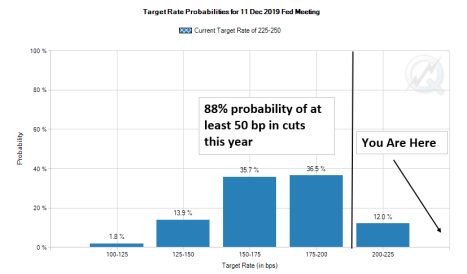
If Dudley is right, and Powell’s subsequent press conference confirms this, then the Fed Funds futures market is way over its skis with respect to further rate cuts this year. The December Fed Funds futures are handicapping a 88% chance of at least 50 basis points in rate cuts this year. If the Fed disappoints, that doesn’t necessarily mean that long-term rates would increase, since the US 10 year is highly influenced by overseas bond markets. But further rate cuts are already baked in the cake, and the market will be vulnerable to a statement and / or press conference that is insufficiently dovish. Not only that, don’t be surprised if one or two members dissent (in favor of no rate cut). Might want to think about locking before the 2:00 pm release.


fed funds futures


Mortgage Applications fell 1.4% last week as purchases decreased 3% and refis were down 0.1%. Purchase activity is up 6% from a year ago, however it has been stalling out. Refinance applications for conventional mortgages were up 1.1%, however a 3% drop in government (primarily VA) offset the gain. Conventional 30 year mortgage rates were unchanged at 4.04%.


The economy added 156,000 jobs in July, according to the ADP Employment Report. IT and mining fell, while most other buckets increased. The Street is looking for 164,000 nonfarm payrolls this Friday.


The employment cost index rose 0.6% in the second quarter. On a YOY basis, they rose 2.7% as wages and salaries rose 2.9% and benefit costs rose 2.3%.