Morning Report: Some forecasts for 2020

Vital Statistics:


Last Change
S&P futures 3116 -1.25
Oil (WTI) 57.29 -0.24
10 year government bond yield 1.82%
30 year fixed rate mortgage 4.00%


Stocks are flattish this morning as violence continues in Hong Kong. Bonds and MBS are flat as well.


Optimism for a trade deal with China waxes and wanes, and we had some conflicting reports this weekend. CNBC said that the government was disappointed in Trump’s reluctance to roll back tariffs, while the Chinese state media company said Beijing and Washington had constructive talks over the weekend.


The upcoming week has some real-estate related data with housing starts and existing home sales, but nothing much market moving. We will get the FOMC minutes on Wednesday, but the sense in the market is that the Fed is on hold for a while, and probably through the election.


The Fed said the US financial system “appears resilient” in its semiannual report on financial stability. “The current combination of very low credit spreads and high levels of indebtedness among risky nonfinancial corporates, including through leveraged loans, merits heightened vigilance,” Fed Governor Lael Brainard said in a prepared statement. “Over the medium term, the low-for-long environment and the associated incentives to reach for yield and take on additional debt could increase financial vulnerabilities.” They were also critical of cryptocurrencies, warning they could destabilize the system if implemented without regulation and oversight. Wasn’t the whole point of cryptocurrencies to have a medium of exchange that is beyond the reach of governments?


Predictions for 2020:  Rates will remain low, with Fannie Mae predicting the 30 year fixed rate mortgage will end up in a tight range around 3.5% – 3.6%. Home price appreciation will re-accelerate, with home prices rising 5.6% next year versus 3.5% this year. Inventory will remain tight, however especially at the lower price points. “While historically low rates increase buying power and make it more likely for potential buyers to attain their homeownership dream, they also increase the risk of a long-run housing supply shortage, which we predict will continue through 2020 and possibly intensify,” Kushi says. “As first-time buyers lock-in these historically amazing rates and existing owners refinance—in droves in recent months, everyone will stay put and not sell. Where’s the incentive?”

Posting This Because I Thought no one Would See It – Quoting Somin

Volokh Conspiracy readers may be interested to see videos of two panels I participated in at this year’s recently concluded Federalist Society National Lawyers Convention: “The Wisdom and Legality of Sanctuary Cities” and “Originalism and Constitutional Property Rights.”

In the sanctuary cities panel, I crossed swords with former Attorney General Jeff Sessions, among others, and explained why the Trump administration’s attacks on sanctuary cities violate constitutional limits on federal power, and have—fortunately—led to a long series of defeats in court, at the hands of both liberal and conservative judges. I also described why sanctuary jurisdictions have good policy and moral reasons for refusing to cooperate with some aspects of federal immigration enforcement, including the fact that involving local police in immigration enforcement undercuts ordinary law enforcement. Sanctuary jurisdictions are also justified in rejecting cooperation with federal deportation efforts, given the horrific abuses in its immigration detention facilities, and the government’s history of wrongfully detaining and deporting even US citizens.

At the property rights panel, I discussed and debated the original meaning of constitutional protections for property rights with distinguished takings scholars Tom Merrill (Columbia), Richard Lazarus (Harvard), and my George Mason University colleague Eric Claeys.  I argued that the original meaning of the Takings Clause requires judicial enforcement of tight limits on government power to take property for “public use,” a concept which should be given a narrow construction encompassing only publicly owned projects, while excluding most condemnations that transfer property to private parties. My talk was in large part based on my book The Grasping Hand: Kelo v. City of New London and the Limits of Eminent Domain.

On the property rights panel, I advocated what might be seen as a right-wing position (defending strong constitutional protection for property rights). On the sanctuary cities panel, I defended what is usually considered a  “left-wing” perspective on sanctuary cities. But, despite the seeming contradiction, I think there is actually an underlying coherence between the two positions: both advocate strong judicial enforcement of constitutional limits on government power, and both protect poor and vulnerable populations against the sometimes overwhelming power of the state.

Of course this year’s Federalist Society Convention will probably be best remembered for Attorney General William Barr’s seriously flawed speech extolling an extraordinarily broad theory of executive power. Among other things, he ignores the many ways in which executive power has grown far beyond the Founders’ design and argues for near-total judicial (and often also congressional) deference to the president on anything involving “foreign relations” and “exigent circumstances.” This is a misreading of the Constitution, and such deference has historically led to grave abuses of power. If time permits, I may have more to say on Barr’s speech later.

Morning Report: Retail Sales strong

Vital Statistics:


Last Change
S&P futures 3105 8.25
Oil (WTI) 56.59 -0.14
10 year government bond yield 1.84%
30 year fixed rate mortgage 4.00%


Stocks are up this morning on optimism for a trade deal. Bonds and MBS are flat.


Retail Sales increased 0.3% MOM and 3.1% YOY. in October. The control group, which strips out the volatile auto, gas, and building materials sectors) increased 0.3%. Apparel and big-ticket items like furniture and appliances were weak, however. Regardless, it is looking like this year’s holiday shopping season will be strong.


Dallas Fed President Robert Kaplan doesn’t see a recession in 2020 as strong consumer spending and a robust labor market provide a strong foundation to keep the economy going. Numerous Fed speakers – Powell, Williams, Kaplan, Clarida – have all expressed comfort with the current level of interest rates. As a general rule, the central bank is loath to do anything during an election year for fear of appearing political and wanting to help one candidate or another. This is especially true when one of the candidates is trying to influence Fed policy publicly. This means we probably won’t see any further action out of the FOMC until 2021. Long-term rates (and mortgage rates) will therefore be more influenced by overseas rates and any sort of inflation surprises in the US. FWIW, I think the Fed is exactly where they want to be, with a positively sloped yield curve, decent growth and tame inflation.


Mortgage delinquencies fell to a 25 year low, according to the MBA. The rate for 1 – 4 unit DQs fell to 3.97% in the third quarter, which was down 59 bps from the second quarter and 50 bps from a year ago. “Mortgage delinquencies decreased in the third quarter across all loan types – conventional, VA, and in particular, FHA,” said Marina Walsh, MBA’s Vice President of Industry Analysis. “The FHA delinquency rate dropped 100 basis points, as weather-related disruptions from the spring waned. The labor market remains healthy and economic growth has been stronger than anticipated. These two factors have contributed to the lowest level of overall delinquencies in almost 25 years.”


Morning Report: Fannie / Freddie sale by 2022?

Vital Statistics:


Last Change
S&P futures 3088 -6.25
Oil (WTI) 57.59 0.44
10 year government bond yield 1.83%
30 year fixed rate mortgage 4.00%


Stocks are lower this morning on weak overseas economic data. Bonds and MBS are up.


Initial Jobless Claims rose to 225k last week. We are still at extremely low levels historically. Jerome Powell will be testifying today at 10:00 am. Nothing earth-shattering came out of his testimony yesterday, although he pushed back on Trump’s suggestion that the Fed should cut rates below zero.


Inflation at the wholesale level came in a little hotter than expected, with the Producer Price Index rising 0.4%% MOM and 1.1% YOY. Ex-food and energy, it rose 0.3% MOM and 1.6% YOY. These readings are still well below what the Fed would like to see, which is inflation at 2%.


Mark Calabria said that Fannie and Fred could be ready to exit government conservatorship by 2022. “If all goes well, 2021, 2022 we will see very large public offerings from these companies,” Calabria said at an event sponsored by the American Association of Residential Mortgage Regulators and the Conference of State Bank Supervisors. “The consent decree will be able to give that window where they can go to market, do an offering and still operate under a way where we’ve got some prudential safeguards.” Fannie and Fred stock fell on the news. Fannie’s stock has been a trader’s dream, with plenty of volatility to play with.


FNMA chart

Morning Report: Jerome Powell to testify at 11:00 am today

Vital Statistics:


Last Change
S&P futures 3082 -9.25
Oil (WTI) 56.59 -0.24
10 year government bond yield 1.88%
30 year fixed rate mortgage 4.03%


Stocks are lower this morning after overseas weakness due to the protests in Hong Kong. Bonds and MBS are up.


Jerome Powell will testify in front of Congress at 11:00 am today. It probably won’t be market-moving, but you never know. With the Fed in a holding pattern and the 2020 election coming up, the central bank will probably fade into the background.


Inflation at the consumer level increased 0.4% MOM in October and 1.8% YOY, driven by increasing housing and medical costs. The core number (ex-food and energy) was up 0.2% MOM and 2.3% YOY. We will get wholesale inflation numbers tomorrow.


Mortgage applications increased 10% last week as purchases rose 5% and refis increased 13%. “Mortgage applications increased to their highest level in over a month, as both purchase and refinance activity rose despite another climb in mortgage rates,” said MBA Associate Vice President of Economic and Industry Forecasting Joel Kan. “Positive data on consumer sentiment and growing optimism surrounding the U.S. and China trade dispute, were behind last week’s rise in the 30-year fixed mortgage rate to 4.03 percent. Refinance applications jumped 13 percent to the highest level in five weeks, as conventional, FHA and VA refinances all posted weekly gains. With rates still in the 4 percent range, we continue to expect to see moderate growth in refinance activity in the final weeks of 2020.”


Bidding wars for real estate have hit a 10 year low, driven by flattening prices on the Left Coast. Nationally, the percentage of houses with bidding wars fell to 10.1%, a drop from 38% a year ago. This was almost certainly driven by home price appreciation failing to keep up with wage inflation, along with rising interest rates. San Francisco was probably affected by a disappointing IPO market. The supply / demand imbalance is still there however, so if interest rates remain at these levels, we could see bidding wars return when the spring selling season hits.


Google is getting into the banking business by offering checking accounts. As if Google doesn’t already know enough about us…

Morning Report: Trump talks trade at noon today

Vital Statistics:


Last Change
S&P futures 3087 -0.25
Oil (WTI) 57.09 -0.04
10 year government bond yield 1.94%
30 year fixed rate mortgage 4.02%


Stocks are flat this morning on no real news. Bonds and MBS are up small.


Donald Trump will speak at the Economics Club today around noon and markets will be listening for any sort of information on trade with China. This will probably be something that affects stocks more than bonds, but just be aware.


Small business optimism remained strong in October, according to the NFIB Small Business Optimism Index. Job creation, inventory investment and capital spending drove the increase. While we are seeing increases in labor compensation, prices paid are still flattish so we aren’t seeing inflation. “Labor shortages are impacting investment adversely – a new truck, or tractor, or crane is of no value if operators cannot be hired to operate them,” said NFIB Chief Economist William Dunkelberg. “The economy will likely remain steady at its current level of activity for the next 12 months as Congress will be focused on other matters, and an election cycle will limit action. Any significant change in trade issues will impact financial markets more than the real economy during this period. Adjustments to a new set of ‘prices,’ such as tariffs, will take time.”


Homebuilder D.R. Horton reported better than expected earnings this morning, sending the shares up 3% pre-open. Forward guidance for 2020 was also above expectations. The homebuilders have been on a tear this year, as interest rates have fallen. The homebuilder ETF (XHB) is up something like 50% YTD.


Mortgage credit availability increased in October, according to the MBA. “Mortgage credit availability increased in October, driven mainly by an increase in conventional loan programs, including more for borrowers with lower credit scores, as well as for investors and second home loans,” said Joel Kan, MBA Associate Vice President of Economic and Industry Forecasting. “Credit supply for government mortgages continued to lag, declining for the sixth straight month. Meanwhile, the jumbo credit index increased 3 percent to another survey-high, as that segment of the market stays resilient despite signs of a slowing economy.”


CBS is out with a piece claiming that climate change will eliminate the 30 year fixed rate mortgage. The fear is that flood insurance could get too expensive and wildfires will make certain areas uninsurable / uninhabitable. How that translates into the end of the 30 year fixed rate mortgage is anyone’s guess, since the piece fails to show its work. FWIW, this article is just clickbait. The 30 year mortgage is going nowhere, and climate change isn’t going to destroy the financial system. The Union of Concerned Scientists frets about the “short sighted” market, but a typical mortgage lasts about 7-10 years, so something that might happen in 30-50 years is going to be off the radar, by definition.

Morning Report: NAR predicts 750,000 new homes in 2020

Vital Statistics:


Last Change
S&P futures 3078 -12.25
Oil (WTI) 56.72 -0.54
10 year government bond yield 1.95%
30 year fixed rate mortgage 4.04%


Stocks are lower this morning on overseas weakness. The bond market is closed for Veteran’s Day.


The upcoming week doesn’t have much in the way of data, with the exception of CPI and PPI. Given that the Fed is in a holding patters, these numbers shouldn’t have much of an effect on the bond market unless they are way out of line with expectations. Donald Trump will speak to the NY Economic Club on Tuesday, and investors will be looking for information regarding progress on trade with China. Jerome Powell will speak to Congress on Wednesday and Thursday. And while it will probably not be market-moving, the House will televise impeachment hearings on Wednesday and Friday. So far the markets have ignored the whole kerfuffle.  Unless the Democrats drop something earth-shattering it probably will remain a sideshow. Given the silo-ization of information sources, it will probably turn out that only the converted will be watching the sermon. The consensus seems to be that the House will impeach and the Senate will not convict, with the voting falling strictly down party lines.


NAR is predicting that new home sales will jump 11% in 2020 to 750,000 units, the highest since 2007. Existing home sales should increase to 5.56 million units. Median existing home prices are expected to rise in the low 4% range, while new home prices should fall as builders focus on starter homes. While 750,000 may be a large number compared to recent history, it is only at historical averages, which doesn’t really take into account the increasing population.


new home sales


Consumer credit growth decelerated in September, according to the Fed. Credit card debt fell, although non-revolving debt credit flows dropped as well. The Fed’s Senior Loan Officer Opinion Survey noted that lenders may be tightening standards, which explains the drop in credit card debt.  Note the collateralized loan obligations have been hit recently, which is a potential warning on credit.


The early estimates for Q4 GDP are rolling in, and they range anywhere from 0.7% to 2.1%. The Fed estimates are on the low side (surprising since they just cut rates 3 times) and Goldman is out with the 2.1% call. Q4 GDP is going to be all about consumer spending, and so far the consumer confidence numbers are holding up well.


Morning Report: Yesterday’s bond market sell-off

Vital Statistics:


Last Change
S&P futures 3082 -2.25
Oil (WTI) 56.27 -0.94
10 year government bond yield 1.95%
30 year fixed rate mortgage 4.04%


Stocks are flattish this morning on no real news. Bonds and MBS are down.


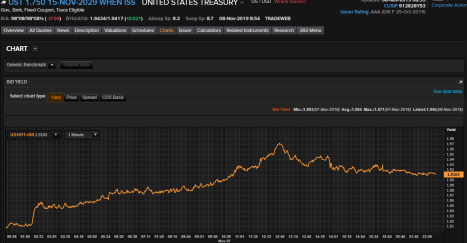
There was no catalyst I can see for why bond yields rose so dramatically yesterday. There wasn’t any economic data (initial jobless claims aren’t market movers) and there was no Fed testimony or anything. The 10 year bond yield rose from 1.81% to 1.97% intraday in what was a complete wash-out for the bond market. If anything, it felt like a major asset allocation trade was happening, where investors sell bonds and buy stocks. Many funds will use a strategy comparing the earnings yield or dividend yield on the S&P 500 versus the yield on government bonds. That said, this was a global phenomenon, as the German Bund and UK bond yields have also been heading lower. It is almost as if we went from fretting about a recession to fretting about inflation. Maybe the China deal caused it, and maybe it was exacerbated by convexity selling, but there really isn’t a good explanation out there of what was going on. You can see the dramatic move intraday yesterday. Note that the move started late in Asian trading before the European markets opened and carried on throughout the day.


11-7 bond chart


JP Morgan just did a credit risk transfer deal on portfolio of jumbo mortgages. In these sorts of deals, investors get a above market interest rate in exchange for bearing first losses on the portfolio. It works essentially like an insurance policy. This means two things: first, banks may be the first step in taking some of the burden off Fannie and Fred, and second we may see better jumbo pricing as a result.


Zillow says that its house-flipping business will generate as much as $1.25 billion in revenues. The company reported a loss last night that beat expectations, and the stock was sent up 9% after hours.

Morning Report: Risk on feel as the US and China strike a trade deal

Vital Statistics:


Last Change
S&P futures 3088 12.25
Oil (WTI) 57.27 0.94
10 year government bond yield 1.88%
30 year fixed rate mortgage 3.97%


Stocks are higher this morning after the US and China agree to remove tariffs. China also made some high profile arrests to stem the tide of fentanyl coming into the US. The fentanyl issue was a key part of the US’s issues with China. Bonds and MBS are down on the “risk-on” trade.


After a dismal start to the year, the luxury end of the market (homes over $1.5 million) rebounded in the third quarter as rates fell. Prices rose 0.3% on average, but they had been falling since 2018. Manhattan was hit particularly hard on the new mansion tax. Florida was the beneficiary as prices rose over 100% in West Palm and some of the other nearby areas. Previously hot markets like San Diego also remained in the losing category. “Because recession fears peaked over the summer, I expected luxury home prices and sales to dip. But it appears that nerves alone weren’t enough to scare off wealthy homebuyers,” said Redfin chief economist Daryl Fairweather. “The U.S. economy grew faster than expected in the third quarter, partly as a result of healthy consumer spending. Those results, along with flat luxury home prices and rising sales, go to show that Americans are basing their spending habits on their own personal financial situation rather than concerns about global economic tensions. For many, that means strong incomes and good employment prospects.”


Fannie Mae is out with their housing forecasts for 2020. They anticipate the 30 year fixed rate mortgage will continue to fall, hitting 3.5% by the end of 2020, and home prices will rise about 4%. Interestingly, they do not anticipate any sort of pickup in housing starts – in fact they anticipate they will be flat with 2019. Despite the drop in rates, they anticipate origination volumes will fall to 1.86 trillion from 2.04 trillion as the refinance share of the market falls from 37% to 31%.


New York Fed President John Williams said that the FOMC sees no reason to cut interest rates further: “The three rate cuts we did were very effective at managing the risks” slowing global growth and trade uncertainty present to the U.S. economy, New York Fed President John Williams said at a Wall Street Journal event in New York. Chicago Fed President Charles Evans echoed the same sentiment.


Finally, we know that gathering strength in the US economy is helping push rates higher. It is important to note that rising rates is not simply a US phenomenon. US Treasuries don’t trade in a vacuum – they are always going to be subject to moves in overseas rates. For now, the key overseas interest rate to watch is the yield on the German Bund, which has increased by 45 basis points since early September. The Bund still has a negative yield, but it is now -27 basis points after bottoming at -72 basis points 2 months ago.


bund

Morning Report: Brookings frets about the non-bank sector

Vital Statistics:


Last Change
S&P futures 3074 4.25
Oil (WTI) 56.97 -0.24
10 year government bond yield 1.83%
30 year fixed rate mortgage 3.97%


Stocks are higher this morning on no real news. Bonds and MBS are up.


Mortgage Applications fell 0.1% last week as purchases decreased 3% and refis increased 2%. “U.S. Treasury yields once again exhibited some intraweek volatility before declining sharply toward the end of the week,” said Joel Kan, MBA Associate Vice President of Economic and Industry Forecasting. “As a result, mortgage rates decreased, with the 30-year fixed rate falling below 4 percent again. In response to the lower rates, refinance applications climbed 2 percent, as homeowners with larger loan balances helped to keep the average refinance loan size elevated. Purchase applications fell slightly last week but remained almost 7 percent higher than a year ago.”


Job openings ticked down in September, according to the JOLTS survey. The quits rate fell to 2.3%, although it was lowest (1.7%) in the Northeast. The rest of the country was in the mid-2s. The Fed keeps a close eye on the quits rate as often presages an increase in wage growth. Construction job openings remain elevated, as does the quits rate for the sector.


construction labor market


The ISM non-manufacturing survey came in much better than expectations. Business is “brisk” and a shortgage of workers remains one of the biggest headaches. Whatever late-summer fears about an impending recession or business slowdown appear to have abated.


Productivity fell in the third quarter, according to BLS, as output increased 2.1% and hours worked increased 2.4%. Unit labor costs rose 3.3%, reflecting a 3.6% increase in compensation and the 0.3% drop in productivity. Manufacturing has been a weak spot, as decreasing demand has lowered output.


PennyMac has filed an antitrust lawsuit against Black Knight alleging that “Black Knight uses its market-dominating LoanSphere® MSP mortgage loan servicing system to engage in unfair business tactics that both entrap its licensees and create barriers to entry that stifle competition.” Basically Pennymac developed their own servicing infrastructure and Black Knight is suing them. Separately, Black Knight reported better than expected earnings this morning.


The government is getting worried about shadow banks (read independent mortgage bankers) and their market share in the mortgage origination business. Independent mortgage banks were the subject of a Brookings paper which points out they are vulnerable to financial shocks given that they rely on short-term funding in the money markets to fund their business. Note this isn’t only an origination issue – it is a servicing issue and the revolves around advances. For FHA and VA servicing these advances can spin out of control. This is probably what is behind the government’s recent moves to curb the use of the False Claims Act, which basically drove the big banks out of the FHA /  VA business. Nonbanks currently originate 90% of all GNMA loans.


nonbank share