This should be a comment, not a post

Apologies for making this a full blown post. I wanted to comment on shrink’s “Peace be upon you” post, but my iPad will not allow me to post comments for some reason. Anyway…

For the record, and for those of you who might be wondering just what it is shrink (or “-“, as he is now apparently known) is talking about, this thread and this comment in particular is what apparently “wrecks it for everybody” and “drives away the people worth having” (ie shrink himself, or Teilhard de Chardin as he was called before he became “-“).

I leave it to you to decide just what or who “the problem” really is.

Peace Be Upon You

The problem is: people who need to get after other people, one way or another. They wreck it for everybody. The people they run off are easy to run off and those are almost always the people worth having.

The solution, a zebra, someone with a whistle? Well, someone needs to make people who enjoy attacking other people go away. It seems like the hardest task to me. Or is it?
You can always tell if someone is trying to lay bait for an attack, they set up some specious premise, or at least, illogical. Knock that chip off my shoulder, I dare you! If the conversation doesn’t go their way, they come back harder and eventually get personal. That is an easy pattern to recognize.
It can’t be a love fest, there has to be disagreement or there is no point. But the rules have to be strict. It is possible to have ongoing, long term, civil disagreements, that is the organizing principle.

MedPAC Tease

I’ve been promising lmsinca a post on MedPAC for quite some time. They’re meeting again next week and will have a session (benefit redesign) that I think will be of more interest. So I’m going to combine the two meetings into one post.

Until then, a little nugget:

Just like the rest of the program, a small percentage of Part D (the drug benefit) beneficiaries account for the majority of program spending. For Part D, 8 percent account for 40 percent of total spending and 20 percent of the total prescriptions. In 2009, on average the “high-cost” beneficiary filled 111 prescriptions over the year. Each prescription cost an average cost of $110. The lower-cost beneficiaries, by comparison, filled 41 prescriptions at a cost of $42 each during the same time period. “High cost” tended to use more brand-name drugs (as opposed to generics).

It’s the same story over and over. There’s a small percentage of beneficiaries who are the cost drivers. Until we figure out how to control costs in this area the rest is rearranging the deck chairs.

Also, Medicare is estimated to reach six percent of GDP by 2040, and the Hospital Insurance Trust Fund will be unable to pay full benefits after 2024. That’s 13 years from now. The growth in expenses means that a beneficiary’s average out-of-pocket costs will increase faster than Social Security benefits.

Update: Slight edit to answer lms’ clarifying question.

Update II: A lot of criticism regarding Part D is directed at the non-interference clause, which prohibits the government from direct negotiation. Repealing this would have a negligible effect, according to CBO. Part of the reason is that it would not be a true negotiation, because the biggest tool the government could use, a restrictive formulary, is left off the table because it’s a political nonstarter. Also, before the MMA was enacted various prescription drug bills were kicking around congress for many years. The vast majority of them — republican and democratic — included this provision. As it stands, drug manufacturer negotiate with the prescription drug plans, who have every incentive to get a good deal. But again, they’re hamstrung by the requirement to have very inclusive formularies. In some class of drugs they’re required by law to include the vast majority of the available prescriptions — in every therapeutic category its at least 2 drugs.

Regarding re-importation, the law gives HHS the authority to do it, provided that the department can certify it can be done safely. FDA is worried about counterfeit drugs, tampered drugs, etc. There’s also the R&D argument. Haven’t spent too much time on this issue, but the NIH looked at it a few years back. Personally, I think it’s a band-aid approach to more systemic problems in the overall health care system.

Friday Light (An Open Thread)

I don’t know how many of you have been following the “Occupy Wall Street” protests but I thought this was a decent historical perspective of the movement. There’s a great tradition of populist anger against the economic elite. The protesters don’t seem to have any real leadership or defined goals, they appear to want it that way, but they are reflecting similar complaints going all the way back to the Shay and Whiskey Rebellions.

It is my possibly vain hope that reading up on such historical matters might inspire efforts like Occupy Wall Street to greater cogency and a deeper, more solid foundation in longstanding (if embattled and problematic) American values than they now seem to possess. You don’t have to look as late as the 19th-century Populists and the 1930′s labor movement, for example, to find an American left deeply immersed in both economic issues and an ambitious vision of a better country. Those things were present at the creation.

Occupy Wall Street probably doesn’t, when you shake it down, want to secede from the union like the whiskey rebels — happily enough. But those rebels didn’t start out by wanting to secede, either; they’d fought in the awful front lines of the Revolution in hopes that those sacrifices might lead to something for them and their families; it didn’t. Occupy Wall Street does seem to want to secede, somehow, from the hopeless-feeling regurgitation, through the two political parties, of elite finance theories and policies that never seem sincerely dedicated to any fundamental improvement of opportunity for what they call, not wrongly, “the 99%.”
But a lot of efforts to state a goal for the protest itself devolve in sloganeering about the economic situation and self-admiring paeans to the virtues of protesting. Wouldn’t galvanizing this stuff require… leadership? Our founding democratic-finance activists weren’t such communitarians that they refused to have leaders and set achievable goals. They were used to being rank-and-file — even though as miltiamen, they elected their leaders.

And they knew where they’d succeeded and failed. This thing in Zuccotti Park is open-ended. It has no declared closing date. How can it ever declare victory, get the hell out, build its organization, and come back to fight another day? (lms)


Here’s a story that people have been waiting for:

SANAA, Yemen (AP) — Anwar al-Awlaki, a U.S.-born Islamic militant cleric who became a prominent figure in al-Qaida’s most active branch, using his fluent English and Internet savvy to draw recruits to carry out attacks in the United States, was killed Friday in the mountains of Yemen, American and Yemeni officials said. (lms)


From the department of who didn’t see this coming:

Most Bank of America customers will soon see a new charge on their statements — $5 for any month in which they use a BofA debit card to make a purchase.

Consumers should prepare for more such charges, analysts say, as big banks strive to recover revenue they have lost to financial reforms adopted in the aftermatch of the economic meltdown.

The new Bank of America fee will be phased in early next year, said Anne Pace, a spokeswoman for BofA, the nation’s largest retail bank.


Customers will still be able to use their cards at the bank’s automated teller machines without being charged, the bank said Thursday.

They also can make debit purchases free if they have a mortgage from Bank of America or if they have a total of $20,000 on deposit at Bank of America and in certain Merrill Lynch accounts (you may recall that Bank of America’s corporate parent bought Merrill Lynch as the financial crisis set in).

The bank, like others, has been testing ways to recover debit-card revenue that is going away because of new regulations.

Banks previously had charged merchants 44 cents on average every time they accepted a debit card for a purchase. Under new regulations that take effect Saturday, banks with more than $10 billion in assets will be able to charge merchants only 21 cents to 24 cents per transaction.

Bank of America and other big banks have said they will compensate by charging customers. “The economics of offering debit cards have changed,” Pace said in interview. (lms)
****
Texas was a “weak Governor” state until the decade of Perry. Perry has assiduously turned perhaps thousands of appointments into crony opportunities, shaping the bureaucracy in a way no other governor ever tried to do on a grand scale. This is not insidious in itself, but there are so many instances of barely qualified “friends” replacing experienced technocrats that it hurts Texas, while it benefits Perry. Today’s big story in Austin involves the biggest money bureaucracy in state government – the Texas Department of Transportation, or “TXDOT”. Big $$ for crony

From the story:enempany lobbyist and former top aide to Gov. Rick Perry was chosen Thursday 


An energy company lobbyist and former top aide to Gov. Rick Perry was chosen Thursday to lead the 12,000-employee Texas Department of Transportation and will be paid at least $100,000 more annually than the career engineer he succeeds. lpartment of Transportation and will be paid at least -…$1more annually than the career engineer he succeeds.
The former

Amadeo Saenz, 55
Salary: $192,000
Experience: Engineer. Worked for 33 years for TxDOT.
The current
Phil Wilson, 43
Salary:$292,500+
Experience: Lobbyist, executive for Luminant Energy. Texas secretary of state for one year. Aide for 15 years: U.S. Sen. Phil Gramm, Gov. Rick Perry.

Note from me: This new salary is the max allowed for a state employee, but they are going to try to gain an exemption to pay Wilson even more.

— MarkInAustin

Bits & Pieces (Thursday Evening Open Mic)

If you’ve never seen the Star Wars Gangsta Rap, you should.

Because it’s fun, and fun is good. Speaking of fun, you should also watch Muppet Bohemian Rhapsody, if you haven’t. Of course, it helps if you’re familiar with Queen’s original. It’s really well done.

Some other stuff might go here. Like this! Chastity Bono appearing on the Sonny & Cher show around age 3.


You’ve got to love that set. Okay. That’s it unless something else occurs to me. — KW


Unresolved Issues

Michi linked a piece last night as a counter argument to Melissa Harris-Perry’s claim that President Obama is the victim of a double standard and that white liberals may be abandoning him because we have set a higher standard for a black president. A few of us discussed this on Tuesday night and came to the conclusion that her claim was a stretch at best. Here’s David Sirota with more analysis.

By seeing this record and then explaining away declining liberal support for President Obama as a product of bigotry, Harris-Perry exhibits the ultimate form of both denialism and elitism. It assumes voters (and readers of the Nation) are all lockstep partisans who don’t — and shouldn’t — care about actual issues, public policies and governmental actions, and that they should instead just line up with their party’s leaders without question. It further assumes — without any factual evidence — that if and when voters don’t follow this partisan script, it means that some deeper psychological factor like racism (rather than, say, rational, considered analysis of public policy) is the primary motivating factor in their behavior.

Betraying the arrogant elitism at the heart of such an argument, Harris-Perry declares that the “legislative record for [Obama’s] first two years outpaces Clinton’s first two years” — a line that suggests that Obama is automatically more deserving of liberal support than Clinton. Yet, in making this part of the basis of her “electoral racism” allegations, she implies that liberal voters are so ignorant that they automatically believe sheer numbers of bills passed trumps what’s actually in the bills. She hopes — or, perhaps, believes — that nobody remembers that many of those bills (the Patriot Act extension, the extension of the Bush tax cuts, the bank bailouts, the no-public-option health insurance giveaway legislation, to name a few) were initiatives that many liberals opposed.


Here’s another follow up to an issue we discussed yesterday. The USPS Office of the Inspector General has released its “management advisory” report on the funding of the postal service’s pension obligation. I’m fairly certain there’s a political football counterpoint to all of this but I thought this was a fairly straight forward stating of the relevant facts. Please correct me if you find something contrary.

In July 1971, when the Post Office Department became the Postal Service, employees that belonged to the federal pension fund began contributing to the Postal Service’s portion of the pension fund. These retirement costs were divided according to the number of years employees had belonged to each fund. However, the federal pension fund paid for retirements was based on 1971 salaries, not final salaries as administered by the Office of Personnel Management (OPM).

OPM has explained that these mischarges were in response to what they believed to be the will of Congress expressed in 1974 legislation. However, the 1974 language was repealed by Congress in 2003. Congress directed OPM to use its authority to oversee the reforms using accepted “dynamic assumptions” that include pay increases and inflation. OPM switched to dynamic funding for the Postal Service portion, but did not for their share. The Postal Service paid the $75 billion difference.

In 2004, the Postal Service appealed the OPM’s methodology for pension fund allocation and the appeal was denied by the OPM. The denial relied on 1974 legislation that made the Postal Service responsible for the pension costs related to salary increases. However, the 1974 language was repealed by Congress.

In addition, the OPM directed the Postal Service to use 100 percent pre-funding for both pension and health care retirement funds. In contrast the OPM has pension funding levels of 41 percent for federal employees and 24 percent for the military. The OPM’s own retiree health care prefunding for federal employees is 0 percent. The Standard & Poor’s 500 companies’ pension funding is 80 percent.

Correcting either the $75 billion overcharge or reducing the 100 percent target prefunding level to 80 percent would result in the ability of the Postal Service to pay off the Treasury debt associated with paying the $75 billion overcharge.


Admin Note: I think it’s important that as many of us as possible, work schedules allowing, try to contribute new posts and find ways to add to our contributors list. I don’t believe new posts necessarily need to be long-winded each and every time, although I like those, it can be something short and sweet that will spark a discussion.

lmsinca

Hump Day Open Thread

As today is my husbands 63 and 5 months birthday celebration we’re taking the day off, JK. We’re always looking for an excuse for a holiday.

A few links to keep us going.

I found this headline from the NY Times amusing.

Europe Nears Agreement on Bailout Fund That May Be Inadequate

By the time the entire process is finished, about mid-October if all goes well, Europe’s leaders will have a newly expanded European Financial Stability Facility that most analysts say will be, at $600 billion, grossly inadequate to extinguish the crisis, since it lacks the means to cope with the larger economies of Italy and Spain.
It seems another example of too little, too late on the part of the leaders of the 17-nation euro zone. But it is also another example of sharply differing analyses of the core problem of the euro, making a solution hard to reach.


And from the Left Coast Desk
Gov. Chris Christie was here at the Reagan Library. I guess he’s still not running.

The video, on the Politico website, represented his “answers back to back to back together on the question of running for the presidency,” he told hundreds of Republicans gathered at the Ronald Reagan Presidential Library in Simi Valley — several of whom asked him to run.

Among the responses on the video: “I’m 100% certain I’m not going to run,” “I don’t want to run” and “I don’t feel ready in my heart to be president.”


And my favorite DFH David Dayen points to this. Apparently the USPS is required to pre-fund future retiree benefits of postal workers who aren’t even born yet.


The USPS economic crisis is the result of a provision of the Postal Accountability and Enhancement Act of 2006 that requires the Postal Service to pre-fund the health care benefits of future retirees—a burden no other government agency or private company bears.


The legislation requires the USPS to fund a 75-year liability over a 10-year period, and that requirement costs the USPS more than $5.5 billion per year. Guffey also pointed out that “the federal government is holding billions of dollars in postal overpayments to its pension accounts.” 


All of the USPS losses over the past four years come from this mandate. You cannot find another organization in the world, AFAIK, that pre-funds 75 years of benefits over a 10-year period. And it’s not just the overpayments, it’s the opportunity costs of having to hold that much reserve capital that cannot be used when times are tough, or to invest in more attractive services. This results from a 2006 law that was one of the last time bombs of the Denny Hastert-Bill Frist Congress. That needs to change.

— LM


Apropos of nothing: Using a 3D Printer to print food. That’s cool, but I saw a talk (I think it was a TED talk) where the guy talked about using the same sort of technology in laser printers to print nutritious wafers. Couldn’t find that, but that also sounded exciting. Not quite to the point of having Star Trek food replicators. But close. — KW

Illinois likely to appeal dismissal of charges against man facing 75 years for “eavesdropping” by recording a public official. – NoVA. They want to throw him in jail essentially for life.

Flat tax vs. fair tax

This topic came up in a bit of back and forth recently, so I thought I’d hold forth and dodge a few soft tomatoes. Sauce!

There seem to be two sharp divisions between conservatives and liberals on taxation. The first of these is what kind of taxes people should pay. I have heard the refrain from conservative economists that taxes such as capital gains and estate taxes are the worst and consumption taxes are the best. I’m sure it’s pure coincidence that the wealthy pay the former taxes whereas lower wage earners are hit more heavily by the latter. I see this division as a philosophical one. I support taxing capital gains as ordinary income with indexing for inflation. Or perhaps a rate lowered by the inflation rate.

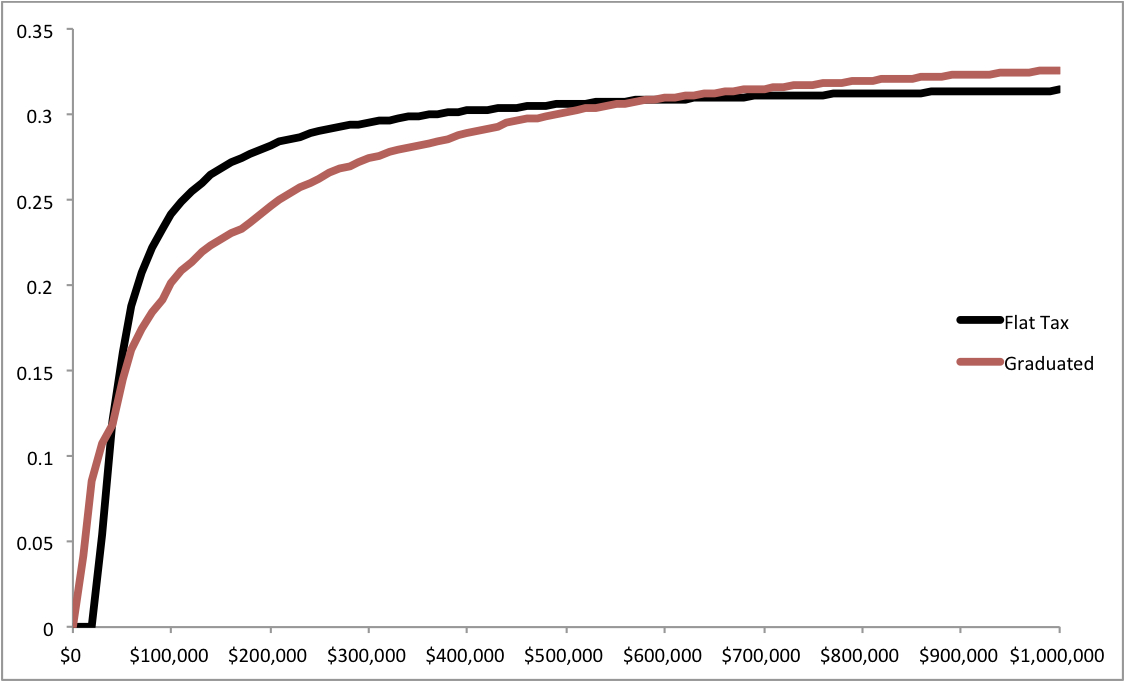
The flat tax vs. graduated rates is more interesting to me. As it has been proposed, the flat income tax is reasonably progressive due to the large personal exemption that is attached to it. But how do they compare? I took as a proposition to compare the current tax rates with a hypothetical flat tax. I put in a significant exemption for the flat tax and required it to raise roughly the same revenue as the current system. I even went to the census to get the income distribution. It’s a little tricky as 26% of households earn $100k or more and that wasn’t broken out. I assumed a gradually falling fraction from $100K upwards (using a Lorentzian distribution). It misses those earning $1M+, but I’ve heard enough times that this is a small fraction of the total. Anyway, this is a thought experiment, so my theoretical America has an income cap of $1M.

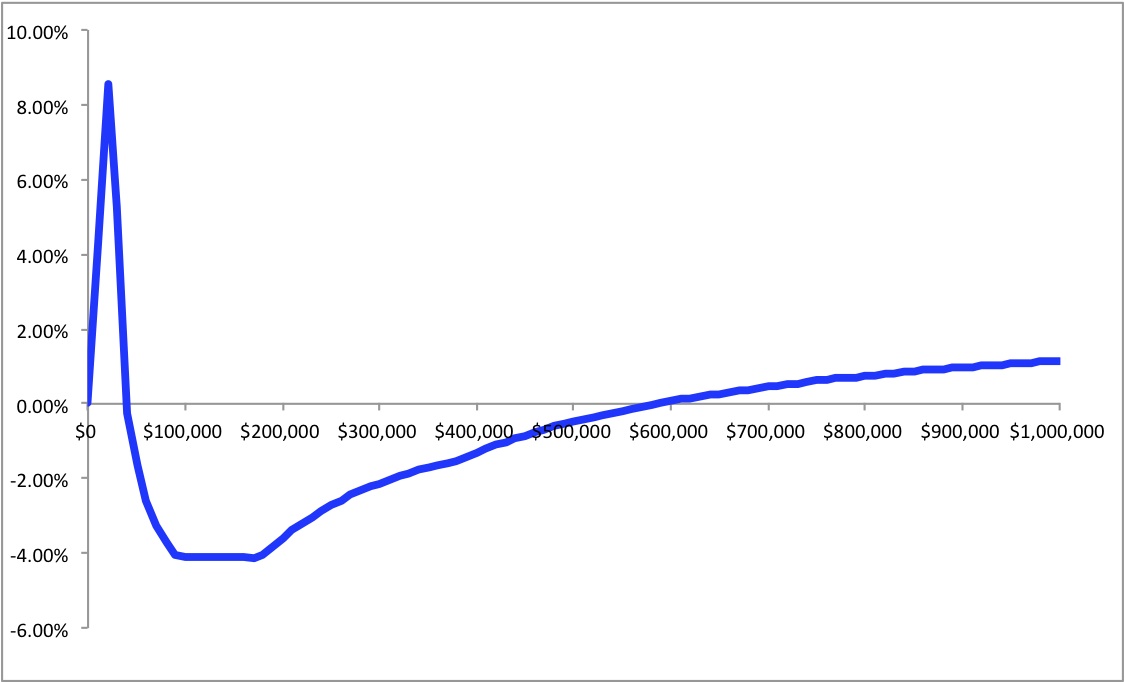
The requirements on my flat tax are that it has a $25K personal exemption and must raise the same amount as the current system. Turns out that you need a 32% rate. Here’s the plot of the two rates compared and the difference.

My flat tax is a little more progressive for incomes under $40K, though neither system generates much income from that portion of the electorate. The real story is that the upper middle class, roughly the 50% to 90% percentile, will see a rise in their effective rates of a few percent and those in the top 10% pay somewhat reduced rates. Now, there’s lots missing. Households have more than one person and there’s plenty of exemptions. So, this should really be a case of the taxation for net income after deductions, but I don’t have the demographics on that one.
Both sides are proposing a progressive system, so what’s the point? The main effect of a flat tax reform will be to redistribute the tax burden more evenly across the top half of the income spectrum. True, a flat tax is simpler to administrate, but so would a graduated system with several brackets. One can look that information up in a table anyway.
BB

Is This Premise Valid?

This article is making the rounds in the rightwing blogosphere. Short version, “White liberals are abandoning Obama because of racism.”

This speaks more about the victim politics of the author than of reality.

What do those on the left think?

http://www.thenation.com/article/163544/black-president-double-standard-why-white-liberals-are-abandoning-obama

–Troll

Tuesday Open Thread

It looks like some of the big money boys aren’t all that happy with the current GOP field. They’re still urging Gov. Christie to enter the race.

Several dozen potential Christie backers attended a meeting in July convened by Mr. Langone to introduce the governor to top-shelf Republican donors, many of them on the sidelines so far in the 2012 campaign. Others saw him in action in June, when Mr. Christie quietly flew to Colorado to speak at a private retreat hosted by Mr. Koch and his brother, Charles, another prominent Republican donor.

And while Mr. Christie has so far resisted their entreaties, he is facing a renewed effort in recent days following stumbles by Gov. Rick Perry of Texas, whose debate performances and stances on Social Security, immigration and other issues have left many major donors looking again for someone they think can take on Mr. Obama next year.


I’m going to put this in as a link because I still haven’t quite figured out how to put up a video. This guy talks about the looming market crash and Greek default on the BBC.

This is not an entertaining Rick Santelli-style rant, it’s a cool assessment of how the Euromarket crisis is likely to end, which he thinks is very badly. The flummoxed reaction of the BBC host suggests that the trader, Alessio Rastani, was a booking mistake.


And it looks like we dodged the shutdown bullet again.

UPDATE No. 3: Looks like we can all rest easy — at least for the next six weeks.

Senate leaders announced a short-term deal Monday evening that appears likely to avert the partial government shutdown that was set to begin this weekend. The emergency funding in the deal is in line with what the House has already approved, Politico reports.

The reason that Republicans and Democrats were able to compromise is because the major sticking point — whether to offset an increase in emergency funding in fiscal 2011 with cuts elsewhere — is more or less moot now that FEMA has said it will likely have enough cash on hand to continue to hand out relief money through Friday, when the government’s fiscal year ends.